
Interview copilots are advanced AI-powered assistants who help interviewers in real time by automating note-taking, proposing follow-up questions, and offering structured feedback tools. They are rapidly becoming crucial to modern hiring teams.
It's evident that this isn't simply another passing HR tech trend. Platforms like Index.dev are paving the way for faster, more consistent, and less biased hiring judgments.
This is a significant boost for IT hiring managers who must manage many interviews each week. An AI interview copilot allows you to focus on the discussion rather than the paperwork, while assuring consistency in evaluation across all candidates.
In this article, we'll discuss what interview copilots are, how they vary from candidate-facing AI tools, and why they're important for technical recruiting. We'll also discuss the benefits, use cases, and how to select the best solution, whether standalone or integrated into your hiring stack.
Make faster, fairer hiring decisions with Index.dev’s vetted global developers, matched in 48 hours, risk-free.
What Is an Interview Copilot?
An interview copilot is an artificial intelligence-powered assistant meant to aid hiring managers in conducting more productive, efficient, and fair interviews. Unlike AI tools that applicants use to prepare for or "cheat" interviews, a copilot works on the interviewer's end, improving the quality and consistency of the evaluation process.
This is how it works. During a live interview, whether virtual or in person, an AI interview assistant operates discreetly in the background. It automatically takes notes, records crucial conversation topics, and generates intelligent follow-up questions based on candidate replies. This means you may participate completely in the conversation without fear of losing important facts.
Many advanced AI interview software platforms also provide interview scorecards, standardized evaluation templates, and real-time reminders to help eliminate bias and ensure adherence to the rubric. Some even anonymize input so that teams may make more inclusive, data-driven recruiting decisions.
The advent of interview intelligence systems, such as Metaview and FinalRound AI, has demonstrated that this is no longer a "nice-to-have." It's the new standard for companies looking to speed recruiting and improve applicant experience.
Simply said, interview copilots serve as your second brain during interviews, silently organizing findings, suggesting better questions, and ensuring that your team analyzes each candidate fairly and precisely.
Why Interview Copilots Are Gaining Momentum
As the hiring environment evolves to virtual-first operations, interview copilots have emerged as critical tools for contemporary teams. According to a 2023 SHRM analysis, more than 70% of interviews are already performed remotely, and this figure is expected to rise further in dispersed and hybrid teams.
Traditional interviewing techniques are ineffective in this virtual environment. Interviewers struggle to take comprehensive notes while keeping the talk flowing. Feedback is unreliable, prejudice frequently enters into evaluations, and busy teams postpone decisions owing to inadequate documentation.
This is where AI interview assistants are gaining traction. They serve as interview copilots, taking notes automatically, generating real-time follow-up questions, and arranging applicant evaluations to fit with role-specific scorecards. Their objective is not to replace interviewers, but rather to improve interview intelligence by providing consistent, accurate, and actionable observations.
The category's growth is supported by considerable market interest. Y Combinator, Sequoia Capital, and Accel have all supported interview intelligence startups, indicating both traction and trust in their long-term usefulness. According to TechCrunch's coverage of Metaview's $7 million Series A, demand for tools that "bring science to interviewing" is growing throughout the enterprise.
In addition, there is an increasing emphasis on prejudice reduction and diversity, and inclusion in employment. Copilot solutions help protect applicant identities, standardize interview flows, and provide fair experiences regardless of who conducts the interview.
As Hannah West, VP of Talent for a hypergrowth SaaS firm, puts it:
"With interview copilots, we've finally replaced opinion with structured evaluation, and it's made us faster, fairer, and more confident in every hire."
In short, interview copilots are no longer considered "nice-to-have" equipment. They're becoming the new standard for any organization looking to make better, quicker, and more equitable recruiting decisions, without burning out their interviewers.
Learn the best practices for vetting software developers, including technical skills, soft skills, culture fit, and more.
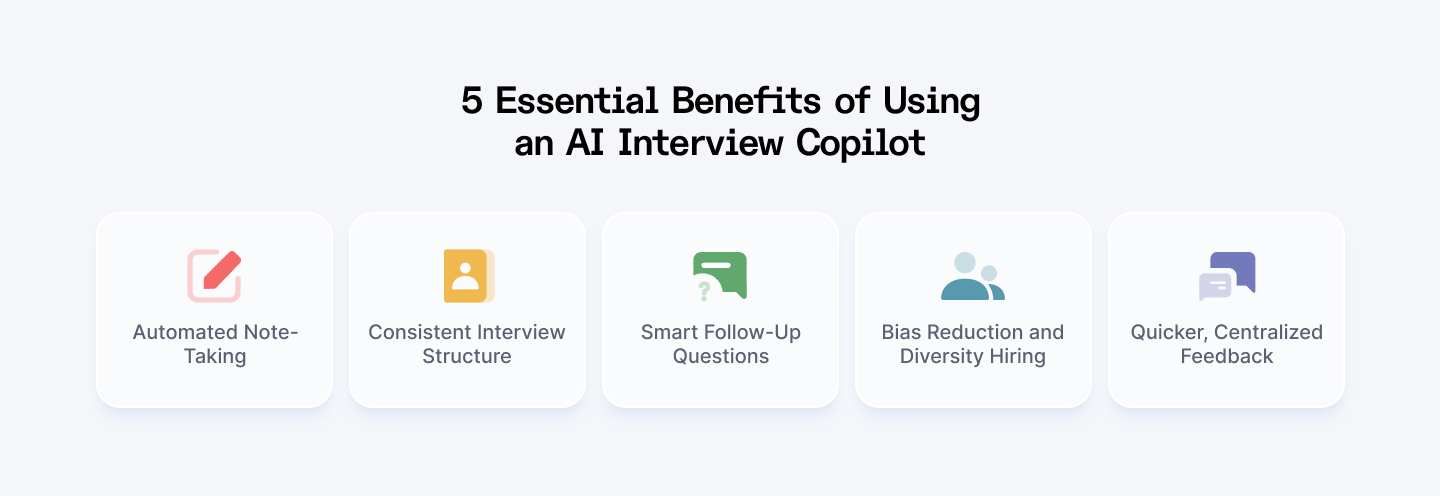
5 Essential Benefits of Using an AI Interview Copilot
Implementing an AI interview copilot may significantly enhance how recruiting managers conduct, analyze, and debrief interviews. These solutions go beyond automation; they improve interview intelligence and let your team focus on what's most important: finding the perfect candidate. Here are five important benefits of incorporating an AI interview helper into your employment process.
1. Automated Note-Taking
Manual note-taking may distract interviewers from engaging in productive conversations. An interview copilot overcomes this by automatically recording key points during the call.
- Avoid context switching:
- With AI collecting everything from applicant replies to interviewer impressions, managers can remain present and engaged.
- With AI collecting everything from applicant replies to interviewer impressions, managers can remain present and engaged.
- Create real-time summaries:
- Most copilot platforms offer rapid recaps that highlight essential abilities, value alignment, and potential red flags.
- Most copilot platforms offer rapid recaps that highlight essential abilities, value alignment, and potential red flags.
- Improve post-interview recall:
- No need to go through scrawled notes, structured interview summaries are preserved and available for review and team discussions.
- No need to go through scrawled notes, structured interview summaries are preserved and available for review and team discussions.
2. Consistent Interview Structure
Inconsistency is a major impediment to fair and successful hiring. An AI interview program guarantees that all interviewers follow a consistent procedure.
- Reduce interviewer variability:
- Copilots encourage interviewers to ask the same key questions to all candidates, reducing subjective ratings.
- Copilots encourage interviewers to ask the same key questions to all candidates, reducing subjective ratings.
- Stick to scorecards and rubrics:
- These solutions frequently interface directly with your ATS or HRIS and employ role-specific evaluation templates.
- These solutions frequently interface directly with your ATS or HRIS and employ role-specific evaluation templates.
- Improve applicant fairness:
- Regardless of who conducts the interview, everyone has an equal playing field, which increases trust and candidate experience.
- Regardless of who conducts the interview, everyone has an equal playing field, which increases trust and candidate experience.
3. Smart Follow-Up Questions
An interview copilot does more than simply listen; it thinks alongside you.
- Prompts for real-time responses:
- For example, if a candidate discusses creating a GraphQL API, the copilot can say, “Ask how they handled versioning.”
- For example, if a candidate discusses creating a GraphQL API, the copilot can say, “Ask how they handled versioning.”
- Ensures digging into skills/claims:
- These nudges decrease superficial interviews and promote deeper insights into candidate capabilities, which is especially important in technical professions.
- These nudges decrease superficial interviews and promote deeper insights into candidate capabilities, which is especially important in technical professions.
4. Bias Reduction and Diversity Hiring
Bias is typically unintentional, but its influence may be significant. AI copilots add structure and anonymity to the process in order to reduce it.
- Redact name/college during evaluation:
- Some platforms use anonymization to enhance skill-based assessments.
- Some platforms use anonymization to enhance skill-based assessments.
- Behavioral analysis without surface-level judgment:
- Instead of depending on intuition, copilots prioritize real reactions and alignment with work criteria.
- Instead of depending on intuition, copilots prioritize real reactions and alignment with work criteria.
- Backed by research:
- A Harvard Business Review article discovered that structured interviews minimize prejudice and enhance predicted hiring accuracy by up to 25%.
- A Harvard Business Review article discovered that structured interviews minimize prejudice and enhance predicted hiring accuracy by up to 25%.
5. Quicker, Centralized Feedback
Interview feedback frequently vanishes within hours. An AI interview assistant reduces delays and centralizes everything.
- Feedback collected before it fades:
- Copilots record interviewer impressions during or soon after the call, when the conversation is still fresh.
- Copilots record interviewer impressions during or soon after the call, when the conversation is still fresh.
- Makes debriefs data-driven:
- Having summaries, scorecards, and sentiment monitoring all in one location allows recruiting managers to make faster, more informed judgments.
- Having summaries, scorecards, and sentiment monitoring all in one location allows recruiting managers to make faster, more informed judgments.
Use Case: From Chaos to Clarity
Company: ScaleForge
Industry: Mid-sized SaaS platform for developer productivity.
Team: Five interviewers from Engineering and Product.
The Problem
Before using an AI interview copilot, ScaleForge's employment process was chaotic. Interviewers used unsynchronized loops, took scattered notes, and frequently omitted to provide timely feedback. As a result, recruiting managers had to deal with delayed choices, dropped candidates, and contradicting judgments.
The Solution
ScaleForge implemented an AI interview assistant into their ATS workflow. The copilot technology enabled interviewers to follow a consistent pattern with minimal effort.
This is how it worked:
- AI-generated question prompts guaranteed that all candidates were assessed on the same core abilities.
- Automated note-taking produced thorough summaries, freeing interviewers from multitasking.
- Post-interview analytics identified reaction patterns and highlighted hire/no-hire trends using scorecards and sentiment analysis.
The outcome
In only one quarter, the outcomes were transformative:
- 3x quicker decision-making: Candidates went from initial interview to offer in an average of 5 days.
- Time-to-hire decreased by 7 days, increasing the close rate for top candidates.
- Interviewer satisfaction increased by 40%, according to internal team polls.
This use case demonstrates how a well-integrated AI interview software can transform a fragmented process into a high-efficiency, data-driven system, all without replacing human intuition.
How Interview Intelligence Fits in the Bigger Picture
Interview intelligence is a growing subject that incorporates data science with the art of interviewing. At its heart, it refers to the systematic collection, analysis, and use of interview data, which includes discussion transcripts, feedback ratings, question types, and candidate sentiment.
AI interview copilots are critical to developing this intelligence layer. They create a searchable, auditable dataset by automating note capture, standardizing evaluations, and generating structured insights, which traditional interviews cannot produce. This data may be studied over time to improve hiring tactics, uncover interviewer biases, and forecast high-performance signals more accurately.
This intelligence layer works easily with the rest of the HR tech stack, syncing with ATS systems like Greenhouse or Lever, relying on sourcing tools like HireEZ, and feeding into talent evaluation platforms like Codility or HackerRank.
According to HireVue, interview intelligence helps teams:
- Maintain uniform quality among interviewees.
- Improve forecasts regarding future performance.
- Create auditable and compliant hiring records.
- Reduce time to decision without losing rigor.
For tech-forward companies, the transition to AI-powered interview intelligence is about more than simply efficiency; it's about boosting recruiting accuracy, transparency, and strategic alignment across the board.
Standalone Tools vs. Integrated Solutions: What to Choose?
As AI interview copilots gain popularity, recruiting teams must determine whether to utilize a separate interview helper tool or one that is directly incorporated into their applicant tracking system (ATS).
How do the two compare?
Feature | Standalone Copilot Tools | Integrated ATS Copilot |
| Setup Time | Medium – requires integration | Instant (if using the same vendor) |
| Learning Curve | Medium – a new platform to learn | Low – part of the existing workflow |
| Workflow Disruption | Medium – toggling between tools | Minimal – native to hiring stack |
| Centralized Data | No – separate storage | Yes – unified interview intelligence |
| Cost Efficiency | Often, a separate license | Usually bundled with ATS |
Integrated AI interview software, such as Copilot, incorporated directly into platforms like Ashby or Greenhouse, centralizes and searches all interview data. There is no need to switch between tabs or manually sync records, resulting in fewer compliance concerns and a smoother user experience.
Furthermore, integrated copilots benefit from tighter security and compliance controls since they follow your current ATS's authentication and data governance policies—an important factor for business teams concerned with GDPR, SOC 2, or HIPAA compliance.
If speed, simplicity, and security are important, an interview copilot connected with your ATS is a better long-term option.
How to Integrate an AI Interview Copilot into Your Team
Introducing an AI interview copilot into your employment process does not need to be disruptive. When implemented effectively, it may speed up uptake and improve interviewer performance from the start.
1. Start Small: Pilot One Hiring Loop
Choose one role—say, a backend engineer—and do a 2-3 week pilot with 2-3 interviewers. Limit the scope to allow for the speedy evaluation of impact.
2. Train Interviewers to Emphasize Value, Not Just Features
Many tools fail because teams view them as "another tool." Instead, think of the copilot as a personal assistant who reduces note-taking and simplifies decision-making. Tools like Ashby Copilot even provide in-product walkthroughs and statistics to illustrate value from the start.
3. Customize Prompts by Role
When suggestions are tailored to each job family—coding assignments for engineers, case studies for project managers, and portfolio evaluations for designers—an AI interview assistant becomes even more effective.
4. Get Feedback and Iterate
After each cycle, survey your team. Has the copilot improved their focus? Did the summaries fit their impressions? Use this input to improve question banks and debrief forms.
5. Include Copilots in Interviewer Enablement Programs
Integrate your copilot into interviewer training and onboarding. Make it a basic component of how interviews are conducted, not merely a "nice-to-have."
Run an A/B test between copilot-supported and non-supported loops to compare time-to-decision, feedback quality, and candidate NPS. Use this data to justify a larger deployment and tool ROI.
The Future of Interviewing: AI-Powered and Insight-Driven
The future of recruiting is not only digital, but also fundamentally intelligent. According to Gartner research, by 2026, AI will be used in 75% of interviews. Interview copilots are already paving the path for a more systematic, equitable, and data-driven recruiting process.
Next-Generation AI Interview Copilots will not just transcribe and summarize. They will judge tone, delivery, and confidence in real time, assisting hiring managers in identifying behavioral indications that go beyond what is spoken. This progression will include emotion-aware AI, which can identify hesitancy, enthusiasm, or nervousness to better assess candidate suitability.
Voice and video analysis will also gain popularity, bringing a multimodal dimension to interview intelligence. When combined with standardized scorecards and previous hiring data, interviews will become significantly more predictive and objective.
Furthermore, the impact of copilots extends beyond external recruiting. Rich, searchable interview histories will aid internal mobility, succession planning, and employee redeployment by enabling HR teams to identify latent potential within the organization.
For forward-thinking teams, now is the moment to see AI as a strategic hiring partner rather than merely a productivity boost.
Discover 11 mistakes companies often make when hiring remote developers and learn how to avoid them to build the best team.
Final Thoughts
AI interview copilots are more than simply tools; they are force multipliers for modern recruiting. They automate note-taking, decrease unconscious bias, expedite decision-making, and ensure consistent evaluations. What was the result? Higher-quality hiring is made more quickly and fairly.
Forward-thinking businesses are already incorporating interview analytics into the heart of their hiring processes, increasing transparency, minimizing guessing, and harmonizing interviewers across functions.
Do not treat copilots as "just another tool." Consider them your real-time productivity companion, enhancing your decision-making without replacing human judgment.
Start acquiring interview intelligence now!
Contact us to learn how our integrated copilot will improve your hiring process, seamlessly, safely, and at scale.


