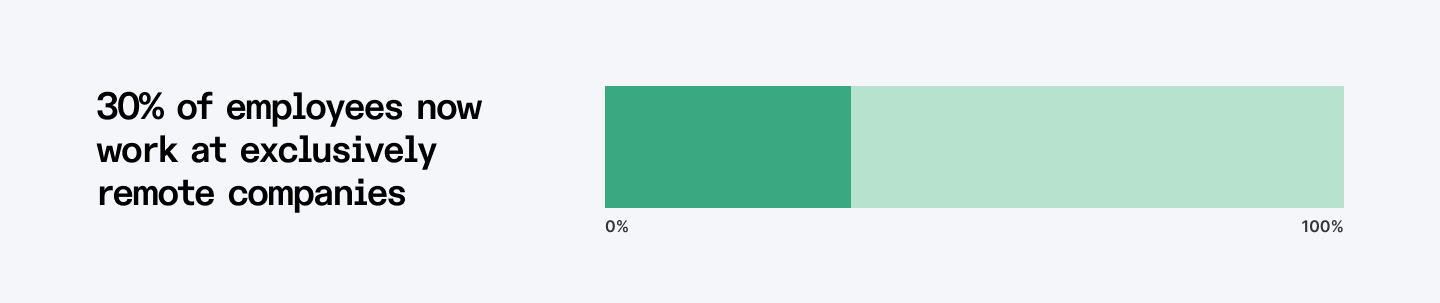
Remote hiring is everywhere. Recent studies found that 3 in 10 workers are employed by remote-first companies. Globally, the IT industry has the highest number of remote workers, with 67.8% of all remote employees. Other remote hiring trends show that this number will only grow.
However, with all that remarkable possibilities that remote hiring offers, it can also bring obstacles you must be aware of. Narrowing down the right engineering talent from a pool of applicants is a challenging task. You need someone who is technically skilled, culturally fit, a good communicator, and able to perform well remotely—managing their time, prioritizing tasks, and aligning with your business's time zones.
Whether you're looking to tap into global talent pools to hire contractors or assemble a full team, this guide will help you understand what to avoid when hiring remote developers and teams.
Quickly hire top remote developers with Index.dev. Access 16,000+ vetted candidates and start interviewing within 48 hours!
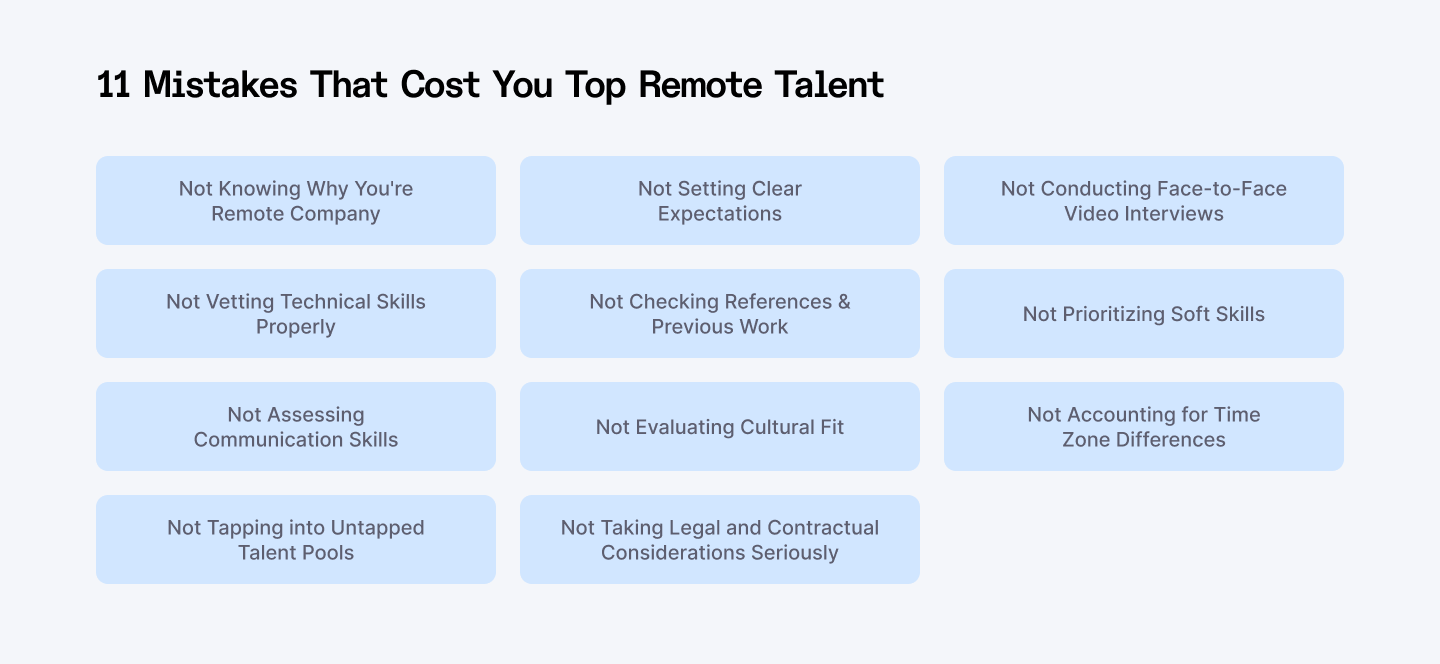
1. Not Knowing Why You're Remote Company
When hiring remote developers worldwide, businesses face three major challenges:
- Time zones: Hiring globally means your team may operate across multiple time zones. Are you prepared to manage this? If not, you may need to set a core time zone that works best for the business or ask employees to stick to it or cover at least 4 hours of overlap for better collaboration.
- Collaboration: With a globally distributed team, how will your staff collaborate effectively? What communication, productivity, and project management tools will they use daily? Which software will improve their workflow?
- Isolation: Being a remote company means trusting employees to know where they work best and supporting their productivity. How will you ensure that remote employees still feel connected and valued? What strategies will you use to build trust among team members who may never meet in person?
Prior to addressing these challenges, it's essential to understand why you want to operate as a remote company and what will guide you in embracing this way of working. Transitioning to virtual work requires replacing decades of in-person practices.
This involves:
- Relying heavily on thorough documentation
- Training employees on effective use of collaborative tools
- Setting clearer agendas to reduce unnecessary meetings
- Building a strong culture that fosters trust
Are you ready to embrace this ‘better way of working’?
Explore More: IT Staff Augmentation in Eastern Europe: A Complete Guide
2. Not Setting Clear Expectations
Not setting clear expectations about what ‘good remote work’ looks like right from the start can create misunderstandings, which result in a bad hire and negative experience. To avoid unqualified candidates, craft a detailed job description that clearly emphasises working hours, compensations and other important expectations upfront. Here is a template you can use:
- Decide whether you are remote-first or remote-friendly.
- What are your logistic requirements?
- What level of remote experience is needed?
- Are you looking for professionals in a specific region or time zone?
- Your role requires a hybrid schedule or is fully remote.
- Flexibility of working hours versus a strict 9-to-5 mandate.
- What project management tools are essential for the role?
- What KPIs are measured in the role?
3. Not Conducting Face-to-Face Video Interviews
Video interviews are largely replacing in-person interviews. They allow you to humanize the remote interview process and, also, assess candidates’ body language. Body language can sometimes provide as much insights about candidates as their words, and face-to-face interviews make it easier to spot them. You see exactly what makes the candidate’s eyes light up and get a feel for their interpersonal skills. You can learn more about the candidate’s passions, goals, and things that motivate them at work.
Conducting video interviews also allows you to make more informed decisions whether they are the right fit technically and culturally. To do this you can use video conference tools like Google Meet or Zoom, as they are easy to set up. You will also be able to record video calls so you can have a more in-depth look at candidates.
4. Not Vetting Technical Skills Properly
Labor costs account for more than 60% of corporate expenses and software developers are often the biggest operating expense. To separate truly qualified engineers and avoid the high cost of a mis-hire, vetting technical skills properly is crucial. Here are the key considerations you should prioritize:
- Hard Skills: Look for candidates with solid technical skills and hands-on experience in relevant programming languages, frameworks, and technologies. Depending on your project requirements, assess their proficiency in JavaScript, Python, Java, or C++. Evaluate their grasp of popular frameworks like React, Django, or Vue. Familiarity with Git and platforms like GitHub is a must. Validate their knowledge of database management systems such as SQL, MongoDB, or PostgreSQL.
- Work Experience: Experience is invaluable. Look at what they have already built: code snippets, GitHub repositories, StackOverflow activity, and past projects. Assess their expertise through coding challenges like debugging exercises, algorithm optimization, feature development, and system design. Consider candidates who have previously worked in remote or distributed teams.
- Open Source Projects: Participation in open-source projects demonstrates their passion, collaboration skills, and ability to work in diverse teams. Evaluate whether the candidate actively shares industry insights through blogs or contributes to open-source projects. This demonstrates their passion for what they do, collaboration skills, and ability to work in diverse teams.
- Problem-solving: A big amount of developer time is spent on spotting problems, correcting bugs, and building resilient infrastructures. Assess their ability to overcome a complex challenge in building software, managing high-pressure tasks in their previous roles, or troubleshooting a software error independently.
Read More: How to Vet Software Developers
5. Not Checking References and Previous Work
Current statistics show that 20% of employers do not check references. Among the 80% who do, the majority report changing their mind about hiring the candidate.
Resumes and even successful interviews may not provide a complete picture of a candidate.
Checking references and previous work experience is your window into the candidate’s work ethic and ability to collaborate in a remote environment. This also helps:
- Validate the technical skills and expertise discussed during the interviews.
- Gain insights into the candidate’s work ethic, consistency, reliability, punctuality, integrity, and respect for deadlines.
- Assess their collaboration style, willingness to compromise, adaptability in team dynamics, respect for diverse perspectives, and conflict resolution skills.
Also diligently review their previous works and see if they align with the complexity and scope of your project requirements. Evaluating their portfolios, code snippets, Github repositories, and open source contributions is a tactic that might help you examine their coding style, how they approach documentation, how consistent they are in their coding practices, the complexity of projects they can handle and their problem-solving skills.
6. Not Prioritizing Soft Skills
Let’s say you’re hiring a full-stack developer remotely to help your startup build a real-time chat app and have two candidates to choose from:
- John is super talented, but has low self-discipline, interpersonal skills, and emotional intelligence. He also is lacking empathy and accountability or responsibility for action.
- Joe, who isn’t quite as talented as John, but is a more organized person that communicates clearly, listens actively, and adapts quickly to changing situations. He also has a positive attitude towards work and is open to feedback.
For a remote company like you, choosing Joe will be a better decision for long-term success. It is better to have a more adept communicator with an upbeat personality than a super talented engineer with limited communication skills.
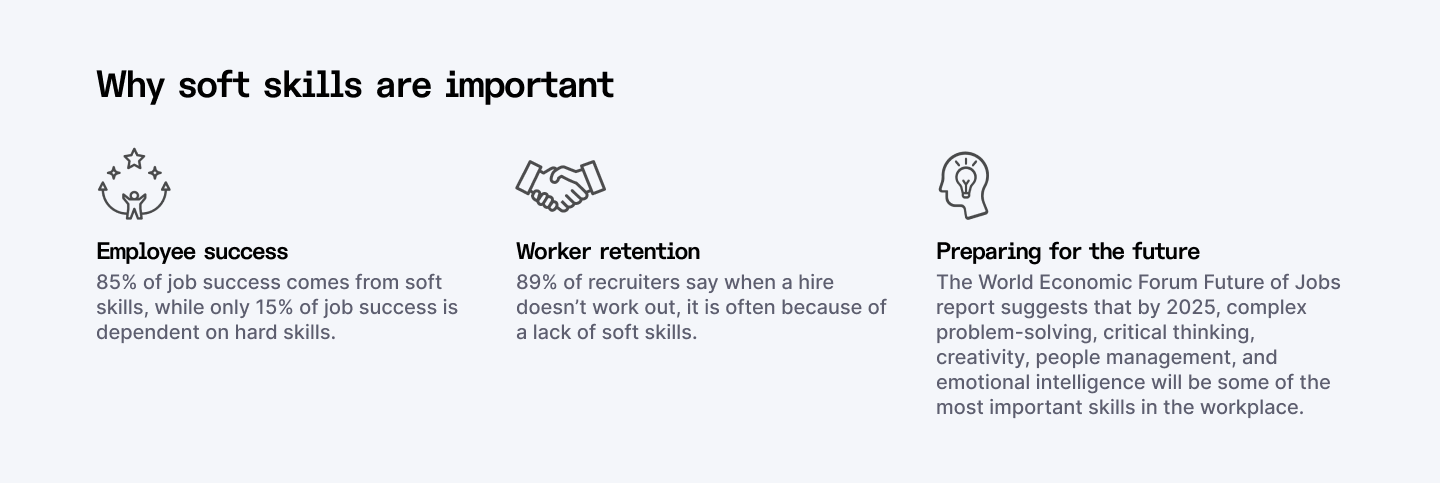
A candidate’s soft skills contribute to team cohesion. So, evaluating them is just as important as assessing technical proficiency. Here are the top soft skills you should evaluate:
- Communication: How do they handle conflicts? How do they communicate with team members across time zones? How do they explain complex technical concepts to someone with non-technical backgrounds?
- Problem-solving: How do they approach debugging when dealing with complex issues? How do they prioritize tasks when encountering two development issues?
- Creative Thinking: How open are they to brainstorming a new product or feature? How do they provide creative solutions to a difficult technical problem?
- Team player: How do they contribute and collaborate in a remote team environment? How do they address challenges while working with teams from different cultural backgrounds? What are their biggest obstacles to effective team cohesion in the development process?
Read More: Effective Ways to Assess Developer's Problem-Solving Skills in Tech Hiring
7. Not Assessing Communication Skills
A recent study shows that 86% of employees and executives cite ineffective collaboration and communication as the primary cause for workplace failures. Remote collaboration heavily relies on effective communication, which is why I consider this topic deserves its own in-depth discussion.
Assessing a candidate's communication skills involves ensuring they are fluent in your organization's preferred language(s) and capable of using remote tools to communicate, interact, and collaborate effectively with teammates. You can evaluate their communication abilities through:
- Assessing the clarity and coherence of their emails and messages
- Conducting video interviews to gauge their speaking, listening, and comprehension skills
- Using tools like Slack, Zoom, Google Meet, or project management software to analyze their ability to collaborate
- Providing real-world scenarios related to remote work during interviews to assess their remote performance, ability to handle time zone differences and strategies for staying connected and productive.
8. Not Evaluating Cultural Fit
Not everyone is able to perform at 100% while working remotely. Yes, you might enjoy it, but there are plenty of developers out there who find it difficult to build a working routine that works for them or crave for human interaction, thinking that virtual meetings are literally ‘just not the same’ as face to face conversations.
So, evaluating a candidate's cultural fit—ensuring their values, work ethic, and collaborative spirit align with your company—is crucial, especially in a remote setting where team bonding occurs virtually.
To make it happen, ensure the candidates know exactly what remote work means and ask questions that revolve around common problems your company faces with distributed teams. How do they handle challenges in a remote team environment? Are they flexible enough to different work cultures? Do their career goals align with the remote opportunities your company provides? These are just a few of the interview tactics that might help you find out more about the candidates’ past experience working autonomously, remotely.
Additionally, give the candidates you evaluate culture fit assessments to complete. This way you will double check whether their values, beliefs, behaviours, and personality align with the core values and culture of your organization.
9. Not Accounting for Time Zone Differences
Working globally often means working with employees in different locations which may not always be in the same time zones. Ignoring time zone differences is crucial hiring mistakes as it can lead to miscommunication, project delays, and team frustration.
When hiring developers for remote work, ensure they are conforming to your company’s home time zone and provide at least a 4-hour overlap. At the same time, you must be aware and respect their time schedule. Here’s a few tips on how you can effectively manage those time zone disparities:
- Schedule meetings, updates, and collaborative sessions which align with everyone’s agreed time zones.
- Identify overlapping hours where all team members can be online simultaneously.
- Communicate the expected response time for emails and messages.
- Respect the rest hours of team members by avoiding urgent requests or meetings.
- Implement a shared calendar highlighting the working hours of each team member, for better scheduling.
- Use a time converter to find the best common hours for members.
- Use asynchronous communication tools, project management platforms, and documentation systems to ensure constant workflow.
Even when working remotely, it's best to work with someone in the same time zone as you.
10. Not Tapping into Untapped Talent Pools
Untapped markets exist in different locations, online platforms, and among different demographics. If you want to build a business with the best talent you can find out there, you should look for talent in less crowded places. Remote work gives you the freedom to erase geographic borders and places like Eastern Europe, Balkans, Latin America, Caucasus, or the Middle East can be good starting points to expand your search. This will enable you to:
- Find the best talent for the job, not just the one in your proximity
- Increase the diversity of your hires
- Hire the right people within budget and halve your development costs
- Fill hard-to-hire roles faster
- Lower competition for high-performing talent
Read More: 15 Less-known Benefits of Hiring Contractors Globally
11. Not Taking Legal and Contractual Considerations Seriously
Hiring someone from another country means you must follow that country’s labor laws. For example, employees in Germany may have different rules for overtime, minimum wage, and paid time off than employees in the U.S. Ignoring these differences or failing to comply with local laws can lead to serious problems for your business.
Penalties for violating labor laws vary by country and severity but can include large fines, damage to your reputation, and even restrictions on operating in that region. This makes legal compliance a top priority when hiring globally.
Here’s how to address this challenge:
- Clearly define the project scope, including deliverables, timelines, and milestones.
- Include confidentiality clauses to protect sensitive company information.
- Outline payment terms, such as rates, invoicing schedules, and accepted payment methods.
- Specify conditions for contract termination for both parties.
- Understand labor laws in both your country and the remote worker’s location.
- Ensure compliance with tax regulations and employment standards.
- Identify whether the worker is classified as a freelancer, contractor, or full-time employee under local laws.
- If you’re hiring remote developers as employees, make sure your payroll process can produce clear, itemized pay statements each pay period using an online pay stub generator can help standardize that documentation.
- Work with legal experts who specialize in international contracts to protect your business.
Taking these steps will help you avoid legal pitfalls and build a strong, compliant working relationship.
Conclusion
Building a global team comes with many benefits — and is a great way to expand your team.
But hiring remote developers can be tricky. By following the right steps you will be able to easily narrow down candidates, make the hiring process less daunting, and hire talented people that can serve your business better from anywhere.
It’s important not to rush the hiring process as it might result in mismatched skills, cultural misfit, high talent turnover, decreased productivity, and lower team morale.
If you’re interested in hiring remote developers and need help finding the right-fit candidates both technically and culturally, access Index.dev talent network for vetted, interview-ready candidates. Hire the best one in just 48 hours!