AI is transforming the way businesses find and hire top people. AI-powered recruitment systems may speed up and improve the hiring process by utilizing machine learning algorithms and advanced data analytics for applicant sourcing, screening, and selection.
Despite these technical breakthroughs, one important issue remains unresolved: price transparency. Many organizations, particularly small and medium-sized enterprises, struggle to determine how much they should spend on AI recruiting services.
Traditional recruitment agency prices are frequently unclear, whilst developing AI solutions come with a diverse range of pricing schemes that might be confusing or deceptive.
For HR professionals, recruiting managers, and budget-conscious decision-makers, the lack of transparency makes it impossible to efficiently plan recruitment budgets or assess the genuine value of a service.
This article attempts to demystify AI recruitment price models, break down expenses clearly, and assist organizations in making informed decisions.
See exactly what AI recruiting should cost in 2025. Hire top developers fast with Index.dev and make every hire count.
1. Traditional Recruiting Agency Fees
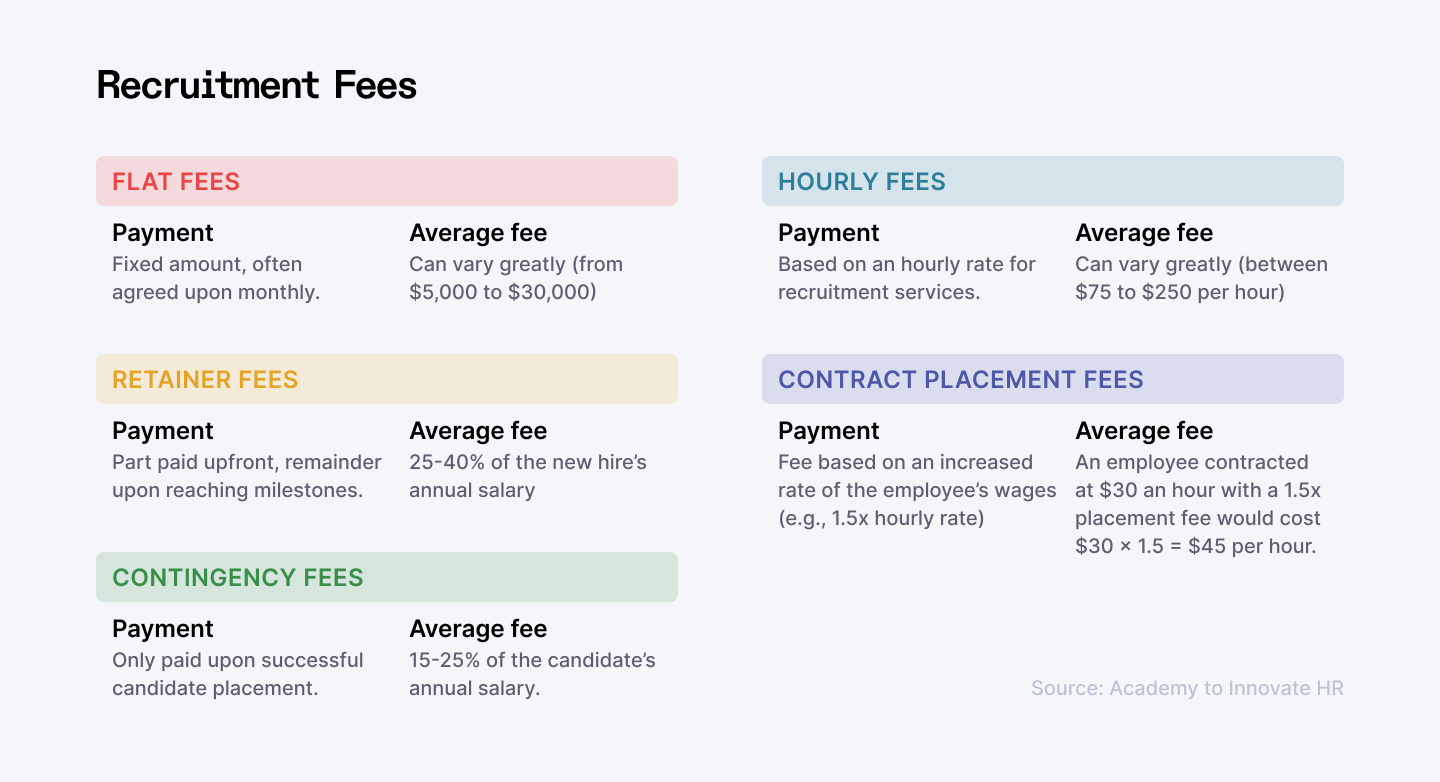
Traditional hiring companies have long been the go-to answer for organizations looking to fill unfilled jobs, particularly at the mid to senior levels. Typically, these companies charge between 15% and 25% of the candidate's first-year compensation.
For example, if an organization hires an employee with an annual salary of $75,000, the agency charge will fall between $11,250 and $18,750. This technique is commonly known as a contingency-based method, in which the recruiter gets compensated only if a successful placement is accomplished.
While this structure provides a simple approach to acquiring talent, it has substantial limitations. First, the high cost might be a strain, especially for medium-sized businesses with limited finances.
Second, because agencies are paid only after placement, there may be a haste to fill posts without proper vetting, raising the possibility of mishires. Third, the whole process lacks transparency since many agencies do not reveal the breakdown of their service prices, making it impossible for businesses to determine the exact value of the service given.
Despite these limitations, traditional recruitment remains popular, particularly for difficult-to-fill or executive-level roles, where the personal network of experienced recruiters is extremely valuable.
2. AI-Powered Recruiting Platforms
AI-powered recruiting platforms are challenging traditional hiring methods by automating and improving key stages of the recruitment process.
These platforms use machine learning algorithms to scan resumes, score prospects based on fit, and even anticipate cultural alignment, making the hiring process quicker, more efficient, and data-driven. Companies should expect two primary pricing models.
Platforms such as Recruitee use the subscription-based approach, which costs a set monthly price of about $249. This approach provides predictable pricing and limitless consumption, making it appropriate for businesses with frequent recruiting requirements.
In contrast, the performance-based model charges fees only upon successful placement, often at 10-15% of standard agency rates. This lowers the initial costs and aligns the recruiter's incentives with the client's performance.
The advantages of AI-powered systems extend beyond cost reductions. They speed up applicant finding and deliver data-driven insights to improve recruiting quality and decision-making. However, organizations must carefully evaluate the platform's capabilities and pricing structure to verify that it is compatible with their hiring strategy.
Explore AI recruiting tools that strengthen and scale talent sourcing.
3. Contingency Search
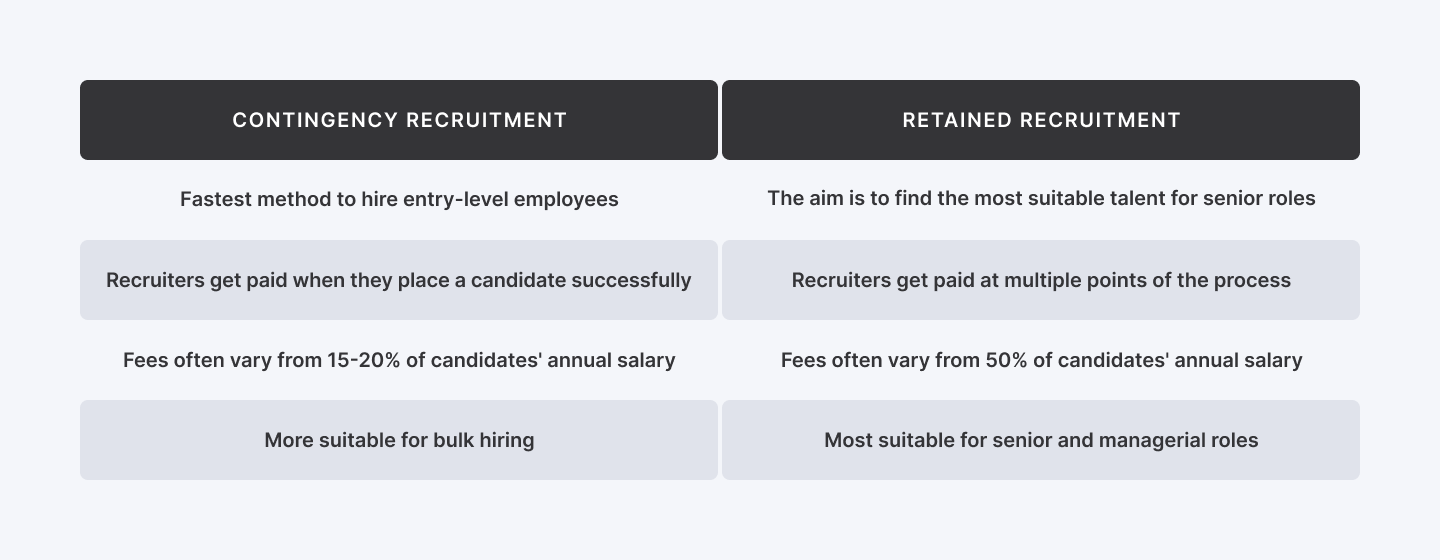
Contingency search is still a popular recruiting approach, especially for organizations looking to save upfront expenses. Recruiters are only paid when a successful placement is completed under this arrangement, making it appealing to organizations with limited resources or unpredictable employment requirements. The normal price structure is a percentage of the candidate's first-year pay, which can range from 15% to 25% but is generally less than the cost of retained searches.
The primary benefit of contingency search is that corporations avoid paying upfront costs, which considerably decreases financial risk. Recruiters are encouraged to fill vacancies quickly since their remuneration is solely based on successful recruitment. This makes it a versatile choice for positions that are not urgent or highly specialized.
However, there are significant tradeoffs. Because the recruiter is solely compensated for success, there may be less dedication to rigorous prospect vetting, resulting in potentially inferior candidate quality. The method may also be less planned, prioritizing quantity above quality. To avoid mis-hires, businesses should carefully consider the recruiter's reputation and historical success before implementing this technique.
4. Retained Search
Retained search is a recruiting strategy for organizations seeking to fill high-level or highly specialized positions. In this approach, the customer pays a retainer fee upfront, ensuring the recruiter's undivided concentration and effort.
This model is ideal for executive, leadership, or specialty technical roles where quality and fit are crucial. Unlike contingency searches, which allow many recruiters to work on the same job, retained searches provide a strategic collaboration between the recruiter and the client, with a thorough grasp of the company's culture, goals, and long-term hiring strategy.
While retained searches often have higher upfront expenses, they can be similar to contingency search costs when considering the long-term benefit of a well-aligned hiring. The recruiter devotes more time to researching the company's requirements, locating passive prospects, and completing thorough evaluations, boosting the chances of a successful placement.
The primary drawbacks are a lengthier hiring timeframe owing to the rigorous procedure and a larger initial investment. However, for essential roles, this methodology frequently results in higher applicant quality and lower turnover risk, making it profitable for organizations that prioritize long-term growth and strategic talent acquisition.
5. Flat Fee Models
Flat fee recruitment methods provide a simple and predictable price structure, which is especially appealing for businesses looking to save expenses without compromising access to top applicants. In this arrangement, the recruiting fee is a one-time fixed amount determined by the seniority of the position being filled.
A typical flat fee includes:
- Entry-Level Roles: $1,000 to $3,000
- Mid-Level Roles: $3,000 to $7,500
- Senior-Level Roles: $7,500 to $15,000
This straightforward method simplifies budgeting and eliminates the ambiguity associated with percentage-based fees. Flat fee models are appropriate for organizations with consistent hiring requirements or when filling a large number of comparable positions.
The upfront pricing structure enables businesses to plan their hiring strategy, knowing exactly how much they will pay for every job.
However, the fundamental disadvantage is that these models may not provide the individualized, high-touch service that senior or executive searches demand. Flat fees are most effective when the recruiting process is simple and does not need extensive sourcing of passive applicants or highly specialized screening.
6. Hourly Recruiting Services
Hourly recruiting services provide a highly flexible alternative to traditional recruitment strategies, charging companies based on the time spent by recruiters.
Hourly prices typically range from $75 to $250 per hour, based on the recruiter's expertise, industry, and the role's complexity. This approach is ideal for short-term initiatives, contract jobs, or highly specialized searches in which a business does not want a full-service recruiting solution or chooses to maintain control over the process.
One of the primary benefits of hourly services is their flexibility. Companies pay solely for the actual job done, resulting in a pay-as-you-go strategy that eliminates hefty upfront costs. This technique is effective when organizations have intermittent employment needs or need support for a short period of time, such as filling a position rapidly during a project spike.
However, the main disadvantage is that charges can add up quickly if the search lasts a long time. Hourly rates are often not cost-effective for permanent hires or large-scale recruitment campaigns, while other pricing structures provide superior value. Furthermore, because the recruiter is not paid a set price for success, their level of interest and dedication may fluctuate.
7. Global Talent Pools
As the need for experienced AI experts develops, tapping into global talent pools becomes a more appealing alternative for organizations looking to save recruiting expenses. Eastern Europe and India are developing as cost-effective suppliers of manpower, with highly trained workers available at much cheaper prices than Western markets.
Annual salaries for full-time AI professionals in Eastern Europe normally vary between $50,000 and $70,000, whereas in India they range between $20,000 and $50,000. These values are far more affordable than the $100,000+ wages common in the United States and Western Europe.
While this strategy offers significant cost reductions, there are a few things to bear in mind. Time zone variations might impede real-time cooperation, and cultural fit may necessitate extra work in managing communication styles and expectations. Language hurdles and regulatory complexity around overseas employment and compliance may also provide difficulties.
Nonetheless, for organizations willing to overcome these challenges, global talent pools provide a strategic advantage by giving access to high-quality AI engineers and developers at competitive prices, allowing businesses to grow their AI projects without exceeding their budget.
Discover 9 surprising insights comparing AI-driven hiring in LatAm and Eastern Europe.
Conclusion
Choosing the best AI recruitment price model begins with examining your hiring requirements, including the role's complexity, urgency, and amount of experience required. Some roles may benefit from quick, low-cost options like hourly rates or flat fees, but strategic hiring can justify spending in retained searches or global talent pools.
It is critical to weigh the benefits and drawbacks of each model to determine which best suits your recruitment objectives and budget limits. Remember that concentrating exclusively on upfront costs is shortsighted; investing in great recruiting generates long-term benefit through better hiring and lower attrition.
Why pay 15-25% agency fees when Index.dev offers elite AI developers for a flat rate? Get matched with the top 5% of vetted talent in 48 hours, plus a 30-day free trial. Start hiring smarter.