The need for AI talents is increasing as businesses rush to implement machine learning, data science, and advanced analytics to drive innovation. However, hiring AI engineers and data scientists is a complex process.
Unlike traditional positions, the AI hiring process includes conducting specific technical exams, analyzing complex portfolios, and navigating a competitive talent market. Many personnel executives struggle to predict a realistic hiring timeframe or create a disciplined strategy that is aligned with business objectives.
If you've ever questioned how long it takes to hire an AI engineer or looked for a sample AI recruitment timeline, you're not alone. Hiring attempts that lack a defined plan frequently stall, resulting in missed opportunities and unhappy stakeholders.
This article simplifies the steps of AI talent acquisition into a concise, practical week-by-week schedule. Here's a systematic method that will assist you in planning your hiring strategy, reducing time-to-hire, and avoiding typical errors, giving a realistic foundation for your next AI recruitment campaign.
Hire elite AI engineers fast. Access Index.dev’s top 5% vetted talent, 48-hour matching, and full hiring support.
Overview of the 10-Week AI Recruiting Process
Hiring AI talent demands a well-structured strategy that combines speed and thoroughness. Here's a sample 10-week AI recruiting timeline for mid-to-senior positions including Machine Learning Engineers, Data Scientists, and AI Researchers. This approach enables talent leaders to break down the AI recruiting process into manageable phases while defining specific hiring timelines.
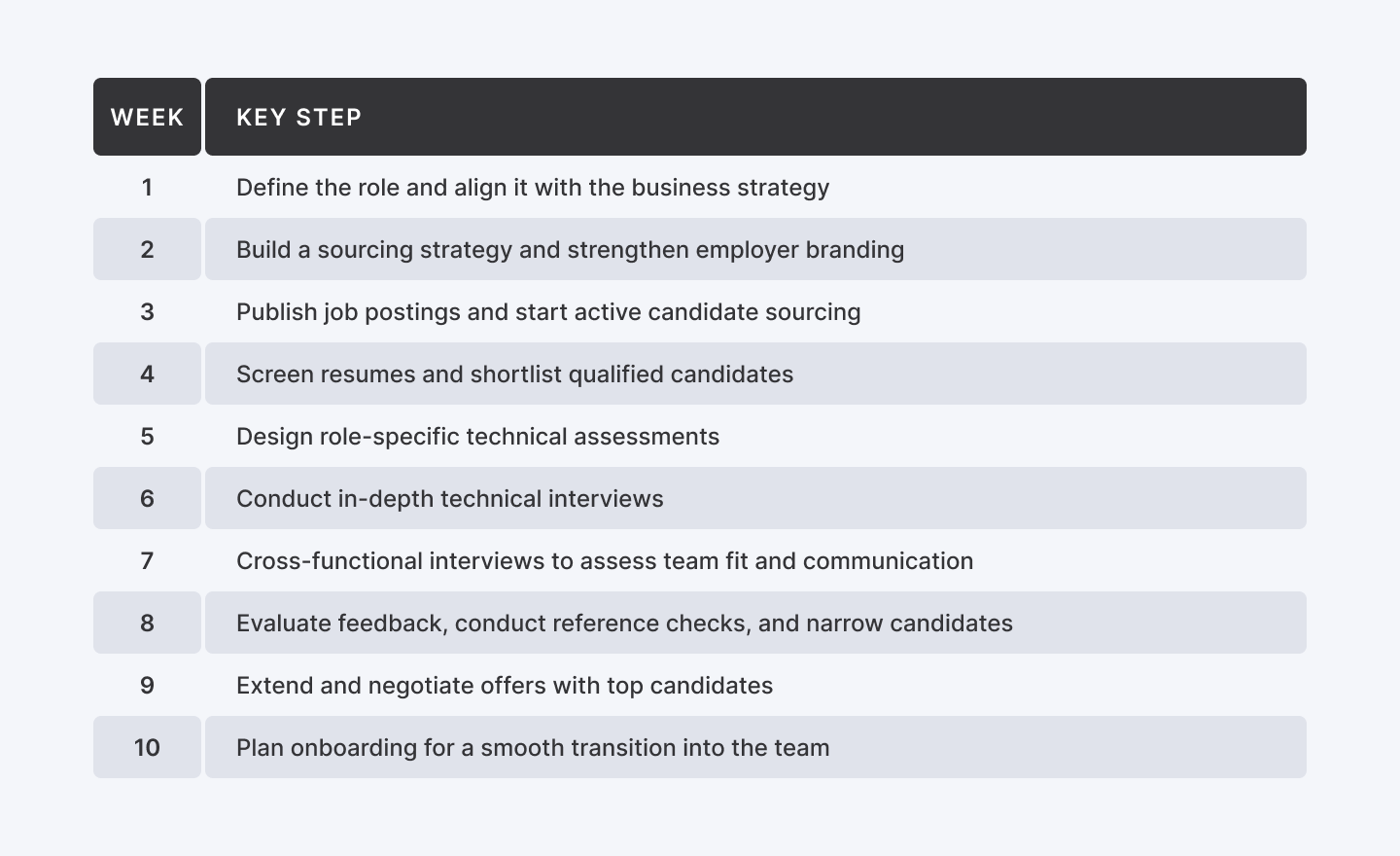
This sample AI recruiting timeline offers a flexible yet actionable process adaptable to your organization’s size, urgency, and role complexity, helping you reduce time-to-hire without sacrificing quality.
Week-by-Week Breakdown of the AI Recruiting Process
Week 1 – Define Role & Strategic Alignment
Start by aligning with leadership to better understand the organization's strategic goals and AI talent requirements. Define the role explicitly, including the necessary skills, experience level, and desired outcomes.
An ML Engineer, for example, concentrates on implementing models in production, whereas a Data Scientist analyzes and experiments with data, and an AI Researcher creates new algorithms. Clear role definitions help establish expectations throughout the AI hiring process and enhance applicant match.
Week 2 – Build Sourcing Strategy & Employer Branding
Choose appropriate sourcing channels, including job boards, LinkedIn, and specialty AI forums like KDnuggets Jobs. Create an employment branding statement emphasizing your company's innovation, beneficial AI initiatives, and growth prospects. Highlight your purpose to attract highly skilled expertise. A solid sourcing approach enhances applicant quality and shortens your recruiting timeframe.
Week 3 – Launch Job Post & Actively Source Candidates
Post job openings on targeted sites such as LinkedIn, Indeed, and AI-related forums. Active sourcing approaches, such as Boolean searches on LinkedIn and direct outreach via tailored email templates, should be used along with the job postings. The LinkedIn Talent Solutions Blog claims that proactive sourcing enhances applicant quality and time-to-hire. Maintain momentum by closely tracking responses.
Week 4 – Screening & Shortlisting Candidates
Conduct a first screening using resumes, portfolios, and publicly available contributions such as GitHub projects or research papers. Seek applicants with real AI experience rather than just academic qualifications. Set explicit minimum technical requirements to quickly screen out unqualified individuals. This stage guarantees that only the most relevant candidates advance, which streamlines the AI hiring process.
Week 5 – Technical Assessment Design
Create customized tests such as coding challenges, machine learning case studies, or real-world problem-solving exercises that are specific to the profession. Avoid generic examinations that do not capture job duties. Standardize evaluations with technologies like Codility or HackerRank for Data Science. Well-designed exams assist in objectively evaluating candidates' technical competence while reducing subjective bias.
Week 6 – Conduct Technical Interviews
Conduct systematic technical interviews led by internal or external AI specialists. Evaluate practical coding abilities, system design knowledge, algorithm comprehension, and machine learning competence. To better understand problem-solving strategies and team cooperation skills, combine technical evaluation with a behavioral fit interview. This enables a well-rounded evaluation, which is essential for advanced tasks.
Week 7 – Cross-Functional Team Interviews
Facilitate interviews with product managers, engineers, and business leaders to evaluate the candidate's ability to explain complicated AI ideas to non-technical stakeholders. Assess cultural fit and long-term partnership possibilities. Strong cross-functional alignment reduces friction after recruiting and increases team effectiveness.
Week 8 – Decision-Making & Reference Checks
To compare applicants objectively, consolidate interview input into standardized scorecards. Conduct reference checks to confirm technical abilities and work practices. The SHRM Guide on Reference Checking provides recommended practices. This phase is critical to ensure you make data-driven recruiting decisions.
Week 9 – Offer Negotiation & Closing
Create a compelling offer that includes competitive pay, a defined role vision, and career advancement chances. Understand market benchmarks to better prepare for prospective counter-offers. Ensure that the contract addresses all issues of legal compliance. A well-structured offer enhances the likelihood of applicant acceptance while shortening the total hiring period.
Week 10 – Onboarding Planning
Create a thorough onboarding strategy for the first 30 to 90 days that includes job objectives, significant tasks, and team integration activities. Assign a mentor and organize knowledge transfer to shorten the ramp-up period. FirstDay.io Onboarding Templates can assist in organizing the process. A successful onboarding program increases new employee retention and productivity.
Look past traditional developer roles and explore 10 emerging AI jobs you'll be hiring for in 2026.
Best Practices and Common Pitfalls
Best Practices
1. Maintain a constant communication cadence
- Keep applicants updated at all stages (interview schedule, assessment findings, future steps).
- Transparent updates minimize applicant turnover and increase trust in your employment brand.
- Send weekly status emails, even if there are no noteworthy updates.
2. Use a systematic scorecard for evaluation
- Establish objective criteria (technical competence, problem-solving abilities, cultural fit, and communication).
- Compare each applicant to these parameters to ensure fair, data-driven comparisons.
- Reduces prejudice and promotes clarity in decision-making.
3. Maintain continual alignment with hiring managers
- Consistently communicate about position priorities, candidate expectations, and assessment standards.
- Prevents misalignment, which might result in inappropriate personnel or longer schedules.
- For example, weekly check-ins to change the sourcing approach in response to initial applicant comments.
Common Pitfalls to Avoid
Rushing through technical assessments
- Skipping or simplifying evaluations to expedite recruiting leads to bad hires.
- AI positions need extensive technical examination; emphasis on quality over speed.
- As a result, there is a higher risk of hiring unqualified employees, which raises long-term expenditures.
Ignore retention planning
- Hiring without onboarding or development strategies leads to increased turnover.
- Create clear career routes, mentoring programs, and significant initiatives.
- Retention approach lowers future hiring expenses and increases team stability.
Emphasizing qualifications above actual skills
- Degrees and huge corporate names may not necessarily represent real-world competence.
- Analyze portfolios, GitHub contributions, publications, and open-source projects.
- Practical experience is more predictive of success in AI positions than formal qualifications alone.
Implementing these best practices and avoiding common pitfalls can make your AI recruitment process more structured, efficient, and effective, decreasing time-to-hire and assuring high-quality talent acquisition.
Discover 11 mistakes companies often make when hiring remote developers and learn how to avoid them to build the best team.
Final Thoughts
Hiring AI talent is a strategic investment that necessitates thorough preparation, structure, and alignment within your business. A well-defined AI recruitment strategy not only speeds up the hiring process but also guarantees that you attract high-quality individuals who can make a significant difference in the organization.
The sample 10-week AI recruiting timetable provided in this article serves as a useful starting point. It clarifies each aspect of the end-to-end AI hiring process, from defining the position to onboarding the top applicant. However, the schedule should be tailored to your team size, position, seniority, and urgency, whether you're recruiting an entry-level data scientist or a senior machine learning engineer.
By following a disciplined strategy and avoiding typical errors, talent directors may set realistic expectations, increase communication with recruiting managers, and make more data-driven hiring choices.
Have questions or need expert support for your AI hiring strategy? Our expert data, systems and AI talent help you train, fine-tune, and scale LLMs so you can build high-performing AI solutions for your business. Contact us at index.dev to get personalized help today.