With many employees now splitting time between home and office, hybrid hiring is the default. As a result of this, you’ll find cross-Atlantic teams in regular operation, and organizations now expect distributed collaboration as standard.
European time zones provide several hours of reliable same-day overlap with US business hours. That shared window shortens feedback loops, speeds reviews, and makes live pairing and demos realistic for remote engineering teams.
This guide shows which European countries line up with each U.S. time zone and why that matters for hiring, onboarding, and daily engineering work. It also explains how to hire European developers efficiently and outlines how Index.dev helps you secure vetted talent who provide a minimum 4-hour work overlap.
Hire top European developers aligned with your US hours. Index.dev connects you with vetted, timezone-fit engineers in 48 hours.
Why time-zone alignment beats asynchronous rescue
Teams lose momentum when questions sit overnight. That delay breeds bugs, rework, and missed deadlines. Time-zone gaps add friction that looks small on a calendar and large in delivery metrics.
Europe buys back hours. Shared business windows let a New York question get a same-day European answer. That changes decision rhythm: reviews, demos, and fixes happen within one work cycle instead of two. It shortens response times, enables live handoffs, and keeps engineering momentum moving forward.
Where the talent actually is
Europe is not a single market; it’s a stack of strong tech regions. In 2025, roughly 6.1 million developers live across Europe with Central & Eastern Europe accounting for a large chunk of ICT talent. That depth makes hiring for overlap realistic because there are specialists available where and when overlap matters.
Because the pool is large, teams can prioritize both skill and schedule. It’s realistic to find someone who matches the tech stack and keeps core hours that line up with the U.S. team.
How language and norms reduce friction
Along with this, English proficiency is high across many EU markets and reduces communication friction. In practice, that means fewer clarification threads and cleaner handoffs — not just overlapping clocks.
By 2025, hybrid and remote roles are standard. Teams expect some synchronous hours even when work is distributed. Hiring European developers lets you keep synchronous collaboration without forcing mass relocation. Set overlap windows in job specs and run paid mini-sprints to validate both hours and communication fit.
Read next: Introducing Index.hub U.S. — your gateway to top remote tech talent
European countries that share working hours with the U.S.
Cross-border hiring often creates wait states: blocked tickets and stalled reviews. Scheduling for Europe overlap eliminates those wait states and keeps work flowing.
Below is a country-by-country style mapping organized by U.S. time zone. Each block states the strict overlap (09:00 to 17:00 local intersection) and a short practical note for scheduling.
US Pacific Time (PST/PDT)
Target European markets:
- United Kingdom
- Ireland
- Portugal
- Iceland
- Canary Islands
(WET / WEST; Iceland stays on UTC year-round).
Overlap with US Pacific Time:
- Strict overlap (09:00-17:00 local-day intersection): 0-1 hour.
- Western European Time (WET) operates at UTC+0 during standard time and UTC+1 during daylight saving time. This positioning creates the most extensive overlap with US business hours.
- Daylight Saving: 5 hours of overlap; during DST transition weeks it can briefly expand to 1 hour (check dates).
Best collaboration window:
US companies that start very early (07:00–09:00 PT) can reach European late afternoons (16:00–19:00 local). This window accommodates both morning meetings for US teams and late-afternoon sessions for European colleagues. With mild scheduling shifts, that’s 1-3 hours of collaboration window.
Best use:
Demos, daily handoffs, and asynchronous follow-ups that close by next morning in the US. This is not ideal for full-day synchronous pairing.
US Mountain Time (MST/MDT)
Target European markets:
- Germany
- France
- Spain (mainland)
- UK
(CET/CEST and WET/WEST)
Overlap with US Mountain Time:
- Strict overlap (09:00-17:00 local-day intersection): 1-2 hours.
- Central European Time (CET) covers most of continental Europe at UTC+1 standard time and UTC+2 during daylight saving. This zone encompasses Europe's largest tech markets and talent pools.
- Daylight Saving: 6 hours of collaboration time; during DST transition weeks it can briefly expand to 2 hours (check dates).
Optimal meeting times:
The best collaboration window with modest flexibility would be 2–4 hours. Mountain teams that shift start times earlier or EU teams that run to 18:00 expand usable overlap.
Best use:
This timing works perfectly for daily standups, sprint planning, project reviews. short pairing sessions, and bug triage.
US Central Time (CST/CDT)
Target European markets:
- Germany
- Poland
- Czechia
- Austria
- Netherlands
- Belgium
- Switzerland
(CET/CEST)
Overlap with US Central Time:
- Strict overlap (09:00-17:00 local-day intersection): 2 hours.
- Typical intersection: US 09:00–11:00 CT ↔ EU 15:00–17:00 CET/CEST.
- Daylight Saving: usually 1 hour of overlap; during DST transition weeks it can briefly expand to 2 hours (check dates).
Best collaboration window:
A practical and flexible time window of 3-4 hours is assumed for predictable same-day interaction. If Central teams start earlier or EU teams extend to 18:00, multi-hour pairing and longer workshops become workable.
Best use:
This timing is ideal for daily standups, real-time code reviews, product demos, and live QA.
US Eastern Time (EST/EDT)
Target European markets:
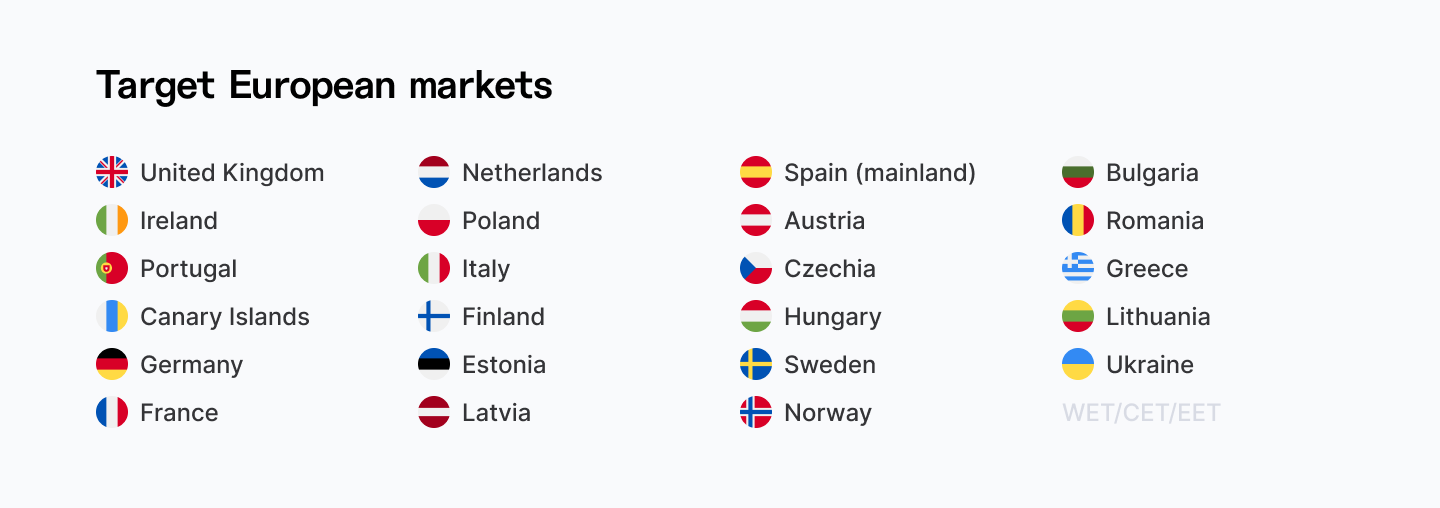
- United Kingdom
- Ireland
- Portugal
- Canary Islands
- Germany
- France
- Netherlands
- Poland
- Italy
- Spain (mainland)
- Austria
- Czechia
- Hungary
- Sweden
- Norway
- Bulgaria
- Romania
- Greece
- Finland
- Estonia
- Latvia
- Lithuania
- Ukraine
(WET/CET/EET)
Overlap with US Eastern Time:
- Strict overlap (09:00-17:00 local-day intersection):
- WET/WEST: 3 hours (US 09:00–12:00 ET ↔ WET/WEST 14:00–17:00).
- CET/CEST: 2 hours (US 09:00–11:00 ET ↔ CET/CEST 15:00–17:00).
- EET/EEST: 1 hour (US 09:00 ET ↔ EET 16:00–17:00), though small flex expands this.
- Eastern European Time (EET) operates at UTC+2 standard and UTC+3 during daylight saving. Countries in this zone offer cost-effective talent with solid overlap windows.
- Daylight Saving: usually 1 hour of overlap; during DST transition weeks it can briefly expand to 2 hours (check dates).
Best collaboration window:
A practical window (with routine flexibility) of 3–5 hours across mixed pairings provides predictable same-day interaction. East-coast teams that reserve late-morning blocks will find extended afternoon availability in most EU markets.
Best use:
This timing works perfectly for full-team syncs, multi-hour pairing, design reviews, and customer demos that need live participation.
Leverage daylight saving time variations
US and European Daylight Saving Time switch dates differ. That shifts the overlap by one hour for several weeks each year. Verify calendars around DST transitions and update recurring invites so overlap windows stay correct.
Key transition periods:
- March differential: Europe transitions 2-3 weeks after the US, reducing overlap by 1 hour
- October differential: Europe transitions 1 week before the US, extending overlap by 1 hour
- Spain uses CET (mainland) while the Canary Islands use WET—don’t assume Spain = WET
- Annual impact: 21-28 days of modified collaboration windows
Strategic planning around transitions:
- Schedule critical project phases during stable overlap periods
- Adjust recurring meeting times during transition weeks
- Communicate schedule changes proactively to European teams
The practical cost–quality balance
Pay rates vary across Europe. Eastern markets often offer senior talent at notably lower total cost than Western Europe, while Western markets command closer parity with U.S. salaries. That range gives you levers: choose CEE when overlap-plus-value matters; choose Western Europe when market parity or local language matters.
This is not about buying the cheapest seat. It’s about buying predictable hours and reliable skills. When overlap reduces delay, the ROI on each hired engineer rises. You can compare 2025 European developer rates and regional hiring bands in this Index.dev’s guide.
How to make overlap real (brief, human)
Say which hours matter in the job post. Hire in the zones that reliably cover those hours. Validate with a short paid sprint during the overlap window and watch whether communication stays crisp.
When those three things line up, clear hours, targeted sourcing, and a short validation sprint, cross-Atlantic teams stop being an experiment and become a steady part of delivery rhythm.
Run trials, not guesses: what to test in a paid mini-sprint
- Response time: time between question and actionable reply during overlap.
- Live collaboration: pair on a bug or feature for 60-90 minutes and evaluate tooling fluency.
- Documentation handoffs: check clarity of end-of-day notes.
- Stakeholder demo: run a 15-minute demo during the overlap and gather feedback.
These tests validate both timezone fit and team fit quickly. Use them to scale safe hires.
For practical vendor help and vetted candidates ready to overlap with U.S. teams, explore Index.dev’s hiring resources and matching engine.
Also explore: LATAM vs Eastern Europe — 9 AI hiring insights that might surprise you
Conclusion
The European talent market gives US companies direct access to large pools of skilled developers who work in overlapping hours with US teams. Use that overlap for same-day code reviews, live pairing, and faster release cycles. Small timing changes cut days off feedback loops.
Make it work by enforcing clear meeting windows, written handoffs, and simple communication norms. Train teams on cultural expectations so coordination stays predictable.
Teams that adopt this model ship faster, reduce rework, and raise code quality. Those gains show up in sprint velocity and fewer reopened tickets.
Time-zone alignment is more than scheduling convenience. It extends development hours, improves support coverage, and opens access to specialist skills that may be hard to hire locally.
As remote work normalizes, companies that build reliable European partnerships secure steady talent pipelines and a clear operational advantage.
Ready to Transform Your Development Capacity?
Index.dev specializes in connecting US companies with pre-vetted European talent optimized for time zone collaboration. Our platform ensures successful matches based on both technical skills and collaboration compatibility.