The World Economic Forum estimates roughly 170 million new jobs will be created this decade by global macro trends, and expects about 39% of workers’ core skills to change by 2030 as employers adopt technologies like generative AI. In the next few years the most valuable professionals will blend AI literacy and data analytics with human problem solving, people who can work confidently alongside intelligent systems.
CompTIA’s State of the Tech Workforce finds tech employment growing at about twice the overall rate, with roughly a 7% replacement rate each year and a total turnover rate near 37%. In plain terms: hiring pressure stays high, churn keeps roles opening, and the skills you need tomorrow are not the ones you hired for yesterday.
This list focuses on ten specific tech roles that will see outsized demand over the next decade. A practical, evidence-backed guidance you can use when planning hires, re-skilling, or reorganizing teams.
Access senior engineers, AI specialists, STEM experts, or complete software delivery teams through Index.dev's global talent network →
The Macro Forces Behind All of It
Today, a couple of distinct macro forces are entirely redrawing the boundaries of tech employment, creating massive supply gaps that traditional hiring pipelines cannot fill.
1. AI is eating the job description
AI isn't replacing tech workers wholesale, but it is fundamentally changing what they're expected to do. It's killing off repetitive, rules-based work and creating urgent demand for people who can build, train, deploy, and govern the systems doing the replacing. Think ML engineers, AI product managers, and prompt engineers, roles that barely existed five years ago and are now on every serious engineering org's headcount plan.
2. The cyberthreat surface keeps expanding
The old playbook of reactive cybersecurity — detecting a breach, aggregating logs, and alerting a team — is no longer enough to protect an enterprise. Bad actors are using generative AI to execute highly automated, lightning-fast social engineering and network infiltration attacks. Because of this, the industry is forcing a transition toward specialized architects who use predictive AI to continuously harden network terrains and stop attack chains before they even begin. According to CompTIA, demand for cybersecurity analysts and engineers is outpacing the national job growth average by a staggering 346%. The talent gap here is widening because a generalist IT background is no longer enough to handle automated, multi-vector threats.
3. Data has become a core business asset
For years, companies hoarded data with a vague promise that it would eventually become useful. That patience has run out. Boards and CEOs are demanding immediate, compounding business value from their data pipelines. However, generic AI models are falling short on highly specialized tasks. This has triggered a massive push toward Domain-Specific Language Models (DSLMs) — AI systems trained on specialized, proprietary datasets for specific industries, whether that is healthcare, logistics, or compliance. CompTIA’s long term data shows that demand for Data Scientists and Analysts is projected to explode at 420% over the national average rate. The pressure is on to find experts who can structure data so precisely that it can power localized, highly accurate enterprise decision-making.
4. Automation is forcing a skill shift
The baseline for automation has shifted. We are no longer just automating repetitive data entry or basic scripts. Gartner’s strategic technology tracking highlights a massive pivot toward AI-Native Development Platforms and Multiagent Systems (MAS). Instead of tools that simply assist, organizations are deploying autonomous AI agents that co-create, test, and self-correct software workflows. This shift doesn’t eliminate the need for engineers; it exponentially multiplies what a single engineer must manage. It is driving an immediate surge in demand for specialists who know how to build the infrastructure, constraints, and feedback loops that keep autonomous systems operating reliably in production without going rogue.
Up next: Curious how a talent gap actually slows down what you ship? Our data study on engineering capacity and product delivery breaks it down.
…
Together, these forces create a structural talent gap that's only going to widen. The ten roles ahead sit directly at the intersection of all of them.
1. Cybersecurity Analyst
The global cybersecurity workforce gap stands at 4.8 million professionals — and it's widening, not closing. That number doesn't represent open job postings. It represents the people organizations need but simply don't have.
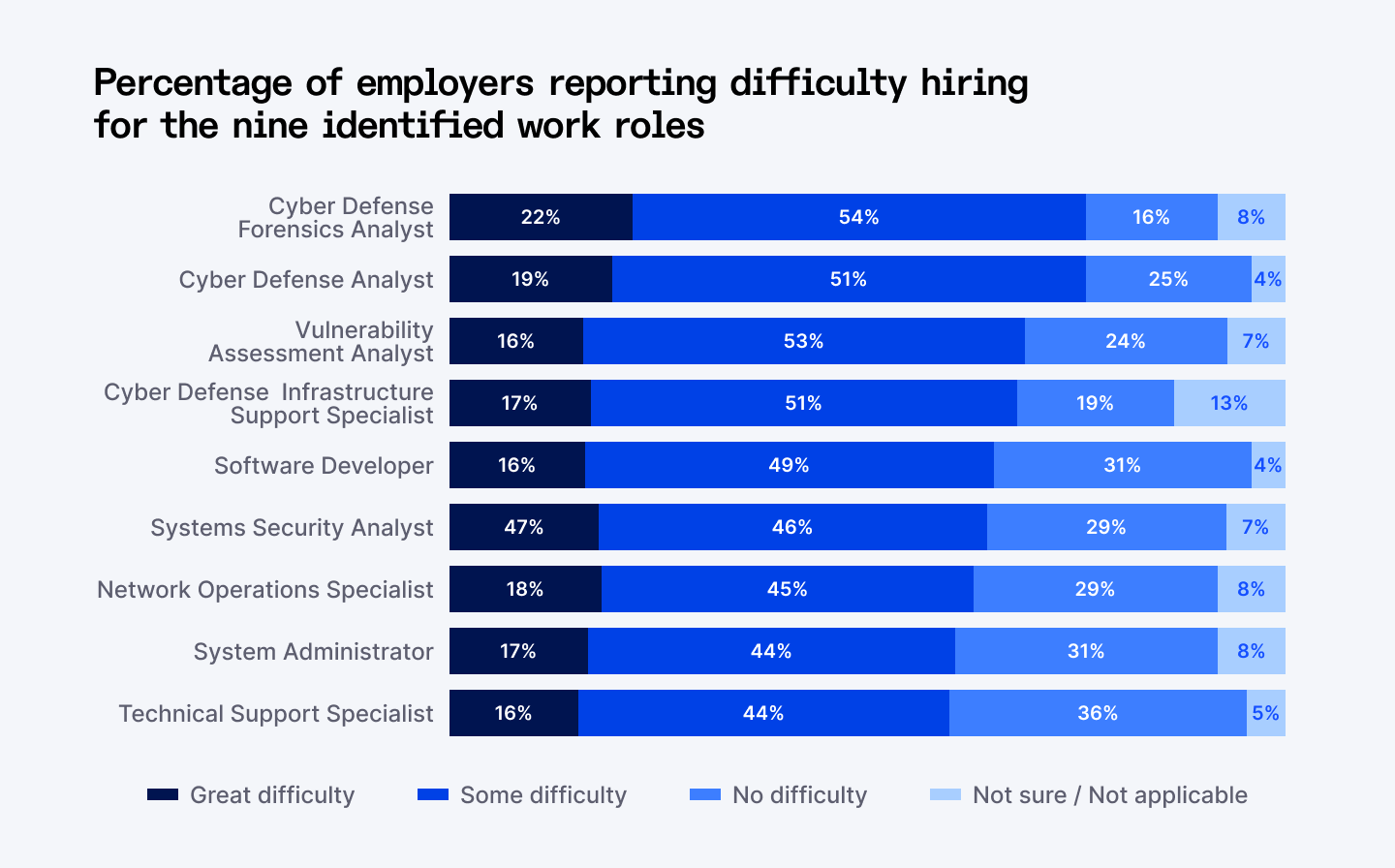
Here's why. Threats are evolving faster than teams can hire. AI has made attacks cheaper and faster to launch. Nation-state hacking has become routine foreign policy. And boards that once left "the cyber stuff" to IT now treat it as a business risk on par with legal and financial exposure. Every time a company moves more infrastructure to the cloud, opens a new digital product, or expands into a new market, the attack surface grows, and so does the need for someone to defend it.
The skill shortage isn't just about headcount either. The skills themselves are hard to find. Cloud security, AI threat modeling, zero trust architecture — these are relatively new disciplines and the training pipeline hasn't caught up. Most teams are understaffed and under-skilled at the same time, which is why experienced analysts command serious leverage in the market right now.
What to look for when hiring. Prioritize people who think architecturally, not just reactively. You want someone who can design systems that are harder to breach, not just respond after the fact. Strong candidates will have hands-on experience with firewalls, SIEM tools, and IDS/IPS systems, solid knowledge of compliance frameworks relevant to your industry, and increasingly, fluency in AI-enabled threat detection. That last one matters more every year.
2. Data Scientist
Data has been called the new oil for years. The difference now is that companies are finally building the refineries. And a data scientist is the person running them.
Every organization of any meaningful size is sitting on enormous amounts of data: customer behavior, operational metrics, financial performance, product usage. The ones that know how to turn that raw material into real decisions are pulling ahead. The ones that don't are guessing. That gap is what makes this role so consequential, and honestly, so hard to fill well.
The U.S. Bureau of Labor Statistics projects data scientist employment growth of 34% from 2024 to 2034, with roughly 23,400 new openings per year on average. That's one of the fastest growth rates of any professional role in the country. And the demand isn't concentrated in tech. Finance, healthcare, retail, logistics — every sector is competing for the same pool of talent right now.
What's accelerating the shortage is how much the role itself has shifted. A few years ago, a data scientist was essentially an analyst with strong statistics skills. Today the job sits much closer to AI and machine learning. Machine learning now appears in 69% of data scientist job postings. Demand for natural language processing skills jumped from 5% to 19% in a single year. The bar has moved significantly, and the talent supply hasn't kept pace.
Organizations don't want someone who builds dashboards or runs queries anymore. They want someone who can design models, interpret what they're actually telling you, and connect findings to decisions that move the business.
What to look for when hiring. Strong candidates bring a solid foundation in statistics and machine learning, fluency in Python, and real experience working with messy, incomplete, real-world data. But here's what actually separates a good data scientist from a great one: the ability to ask the right question before writing a single line of code. Look for someone who has worked closely with business stakeholders, can explain their methodology in plain language, and has a track record of their work genuinely influencing decisions, not just producing reports that get filed away. Cloud data platform experience and MLOps familiarity are increasingly expected. And a purely technical data scientist who can't communicate findings to a non-technical audience is, frankly, only half as useful as they could be. You're hiring for both.
3. AI Product Manager
Most companies now have an AI strategy. Far fewer have someone who actually knows how to execute it. That's the gap the AI Product Manager fills, and right now it's one of the most acute mismatches in the entire tech hiring market.
Productboard's CPO Survey found that 85% of product leaders are actively investing in AI tools, yet only 2% are prioritizing talent development to support it. That disconnect is telling. Organizations are buying the technology, but they haven't built the human layer needed to turn it into something that actually ships.
The role exists because AI products are genuinely different to manage. A traditional PM can define user stories and work a backlog. An AI PM has to understand model behavior, data dependencies, confidence thresholds, and the uncomfortable reality that AI systems can fail in unpredictable ways. They have to know what's technically feasible, communicate it in business terms, and build products that people can trust. That requires a rare combination of technical literacy, product judgment, and ethical grounding that most PMs simply don't have yet.
What to look for when hiring. Prior product management experience is the foundation, but the real differentiator is someone who has actually built or shipped something with AI or ML at its core. They must comprehensively understand the differences between fine-tuning a model, training an embedding, and deploying Retrieval-Augmented Generation (RAG). They should easily talk architecture with your machine learning engineers and be comfortable working directly with data science and engineering teams, fluent in the language of model evaluation and iteration, and able to articulate tradeoffs clearly to non-technical stakeholders. Bonus points for anyone who has navigated AI ethics, bias, or compliance questions in practice. That's going to matter more and more.
Learn more: The best teams aren't just adopting AI faster. They're doing it smarter. Here's what separates them.
4. Data Annotator
Let’s burn the old stereotype right now: data annotation is no longer a low-wage, mindless task of clicking boxes around images of traffic lights. The explosion of generative AI and domain-specific LLMs has completely inverted the value chain.
Today, a model’s competitive advantage is determined by the quality of its training data. If you feed an advanced model garbage, unstructured data, it will output expensive, confident garbage. Because of this, data annotation has evolved into a highly specialized, mission-critical discipline.
This isn't a transitional job that AI will eventually replace. It's a permanent layer of the AI development stack, and demand is scaling with every new model being built. Upwork's 2026 In-Demand Skills report now ranks annotation as the top-growing skill in data science, with demand growing 154% year-over-year. As more companies move from experimenting with AI to deploying it in production, the need for high-quality labeled data compounds.
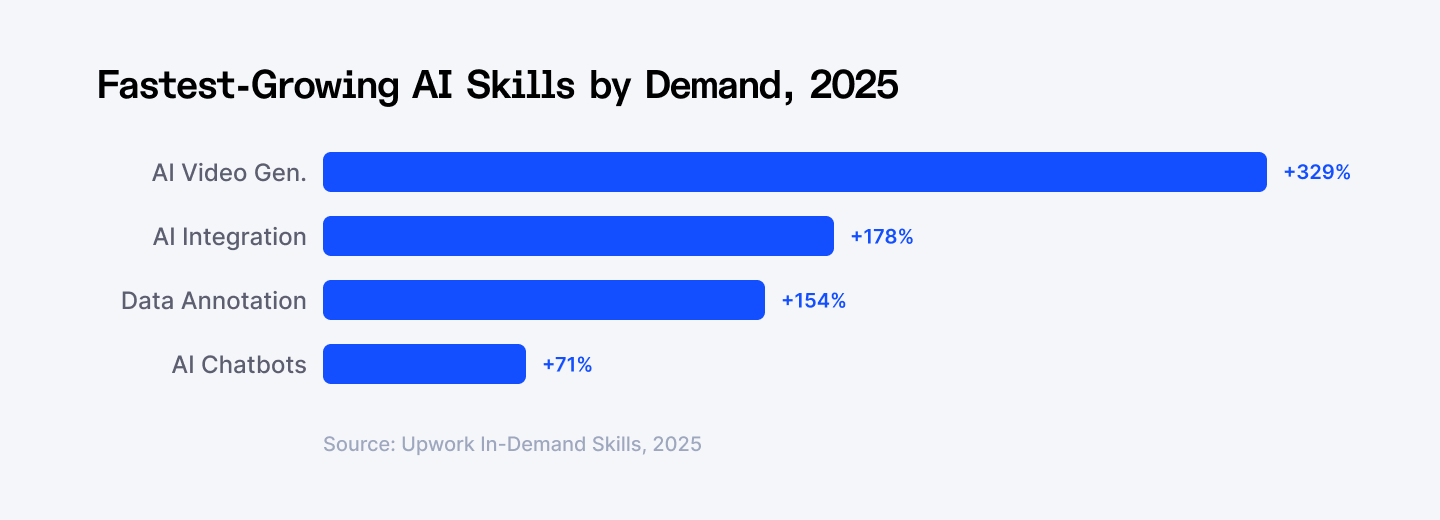
The nature of the work is also shifting upward. Basic image labeling is increasingly automated. What can't be automated is judgment. Domain experts who can annotate medical records, legal documents, financial data, or complex human interactions bring something a labeling script never can — real contextual understanding. This is also where RLHF (reinforcement learning from human feedback) comes in. The quality of a model's reasoning, tone, and judgment is directly shaped by the humans who evaluate and rank its outputs during training. The people doing that work well are genuinely hard to find.
What to look for when hiring. For general annotation roles, attention to detail and consistency matter above everything else. But if you're building or fine-tuning models for specific industries, prioritize domain knowledge first. A data annotator with a medical background is worth far more to a healthcare AI team than a fast generalist. Look for familiarity with annotation platforms, experience with quality assurance workflows, and ideally some understanding of how labeled data influences model behavior. The more they understand about what they're feeding, the better the output.
5. Data Privacy Officer (DPO)
When multi-billion dollar enforcement actions hit the headlines, it becomes clear that paper-thin compliance policies are no longer a defense.
The DPO went from a compliance checkbox to a strategic function almost overnight. And now AI has made it significantly more complex. Every AI system that processes personal data triggers a privacy review. Every new product feature touching user information requires oversight. The regulatory perimeter keeps expanding, and someone has to manage it.
According to IAPP's Privacy Governance Report, only 40% of organizations headquartered in North America currently have a DPO, with most of those having less than one full-time officer per organization. In Europe, where GDPR mandates the role more strictly, the numbers are better but still stretched. In the rest of the world, the gap is even wider, even as regulations multiply.
The real bottleneck, though, is a very specific combination of skills. You need someone who understands the law well enough to interpret regulations across multiple jurisdictions, and also understands the technology well enough to know how data actually flows through systems. Legal fluency and technical fluency, in the same person. That's genuinely rare. Add AI governance to the mix and the stakes go up further.
What to look for when hiring. Legal background in data protection law is the foundation, whether that's GDPR, CCPA, or the growing patchwork of global frameworks. But don't hire a lawyer who can't read a data flow diagram. The most valuable candidates can walk into a product review meeting, understand the architecture on the whiteboard, and immediately identify where the risks are. Experience with AI governance or data ethics is rapidly becoming a differentiator. Certifications like CIPP or CIPM from IAPP are a reasonable signal of baseline competence.
6. DevSecOps Engineers
GitLab’s global Intelligent Software Development Era report highlights a striking industry bottleneck called the AI Paradox. While teams are writing code exponentially faster, 76% of engineering professionals find that more compliance and security issues are discovered after deployment rather than during development.
Not long ago, security was something you bolted onto software after it was built. You'd ship the product, then hand it to a security team to review. That model is dead. It was too slow, too expensive, and too easy to exploit. What replaced it is DevSecOps: the practice of baking security directly into every stage of the development pipeline, from the first line of code to production deployment.
The shift sounds simple. The execution is not, and that's exactly where the talent gap lives. 37% of IT leaders report a lack of DevSecOps skills as the top technical gap on their teams. This is a role that requires genuine fluency in three disciplines at once — software development, infrastructure operations, and security. People who are strong in all three are rare. Most engineers specialize. DevSecOps demands breadth.
The demand is driven by a convergence of pressures. Regulatory requirements around software security are tightening globally. Cloud-native architectures have made attack surfaces dramatically more complex. And AI-generated code has introduced a new category of risk: roughly one in four AI-generated code samples contains at least one confirmed vulnerability when tested without security-specific prompts. As more teams lean on AI to write code faster, someone needs to make sure that code is actually safe to ship.
What to look for when hiring. The strongest candidates come from a development or infrastructure background first, and bring security into their skill set from there, not the other way around. That foundation is what lets them integrate security into workflows without becoming a bottleneck. An engineer who understands how code gets built is far better positioned to protect it than a security specialist who's never shipped anything. Look for hands-on experience with CI/CD pipeline security, infrastructure as code, and container security across Kubernetes and Docker. Automated vulnerability scanning and secrets management should be second nature. And increasingly, familiarity with compliance frameworks — SOC 2, ISO 27001, FedRAMP — is becoming a hard requirement as enterprise clients make it a condition of doing business.
7. AI Ethics and Bias Specialist
This role exists because AI systems make consequential decisions — who gets hired, who gets a loan, who gets flagged by a security system — and those decisions can be wrong in ways that are invisible until real damage is done. And the damage is legal, financial, and increasingly, regulatory.
The stories are already well documented. Hiring algorithms that systematically disadvantaged women. Facial recognition systems with significantly higher error rates for people with darker skin tones. Credit models that reproduced historical lending discrimination. Each one of these wasn't a bug in the traditional sense. The systems worked as built. The problem was how they were built, what data they were trained on, and what assumptions were baked in from the start.
In 2025 alone, 29% of companies paused or restructured their AI recruitment tools due to bias findings. That's nearly a third of organizations discovering, after deployment, that their systems had a problem. Regulation is now hardening the demand. The EU AI Act has created formal obligations around high-risk AI systems. New York City already requires annual bias audits for automated hiring tools. More jurisdictions are following. AI governance is now a top-five priority for nearly half of all organizations, yet only 1.5% say they're satisfied with their current staffing levels in this area.
Part of why is that this role is genuinely hard to staff. It sits at an uncomfortable intersection — technical enough to evaluate model architecture and training data, but also grounded in law, social science, and organizational design. The people who can do all of it credibly are few, and most organizations haven't even started building the function yet.
What to look for when hiring. You're not looking for a philosopher with an AI hobby, and you're not looking for a machine learning engineer who took an ethics elective. You're looking for someone who genuinely operates across both worlds. A foundation in machine learning or data science is the starting point. From there, look for real experience with bias testing methodologies, fairness frameworks, and the regulatory landscape, particularly the EU AI Act and the emerging patchwork of U.S. standards. Someone who can open a model card, interrogate a dataset, identify where the risk lives, and then explain it clearly to a board is exactly the profile you want.
8. Robotics Engineers
The robots-replacing-humans narrative has been around for decades. What's happening is more nuanced, and for engineers, far more interesting. Robots aren't replacing entire workforces. They're filling the gaps that human workforces are leaving behind.
In the U.S. alone, 2.1 million manufacturing positions could go unfilled by 2030 due to a simple lack of available workers. Factories, warehouses, hospitals, and logistics networks can't afford to wait for the labor market to sort itself out. They're automating instead. And they need engineers to make it work.
AI is what's making this moment different from every previous wave of industrial automation. Robots used to be rigid, rules-based machines that only functioned in tightly controlled environments. Change the product line and you'd spend weeks reprogramming. Now, AI-enabled robots can adapt to their environment, learn from variation, and take on tasks that once required human judgment. The cobot market — collaborative robots designed to work directly alongside people rather than behind safety cages — is one of the fastest-growing segments in the field precisely because it opens robotics to environments that were previously off-limits. Healthcare. Retail. Agriculture.
Every serious robotics roadmap today is gated by people, not ambition. The capital is available. The use cases are proven. The demand signal is loud and getting louder. What breaks execution is hiring. That's the bottleneck, and it isn't going away soon.
What to look for when hiring. The era of hiring a narrow robotics specialist, someone who does one thing well in a controlled lab environment, is fading fast. What companies need now is breadth. Mechatronics, embedded systems, mechanical design, control systems, and software, ideally with exposure to the specific operational environment you're deploying in. That last point matters more than it sounds. There is a genuine and significant gap between an engineer who can build a robot that works in a lab and one who can make it perform reliably on a factory floor, in a hospital corridor, or in a fulfillment center running three shifts. If you're building cobots, human-robot interaction experience is non-negotiable. If you're in industrial automation, ROS proficiency and a track record of actual deployments should be your baseline. Ask candidates to walk you through something they've shipped. The answer will tell you everything.
9. Systems Administrator
This is one of the most consistently underestimated roles in tech. It doesn't carry the glamour of AI engineering or the urgency of cybersecurity. But when a systems administrator isn't in place, or isn't skilled enough for the current environment, everything else slows down or breaks.
The job itself has changed dramatically. Even mid-sized companies today operate across a complex blend of on-premises systems, SaaS platforms, cloud instances, remote endpoints, containers, identity platforms, and automation pipelines. The environment a systems administrator has to manage is wider, faster, and less forgiving than it was five years ago.
The demand spike is tied directly to cloud migration. IDC projects that more than 90% of organizations will face IT skills shortages by 2026, at an estimated cost of $5.5 trillion, and a significant share of those shortages will be in cloud skills specifically. As companies accelerate their shift to hybrid and multi-cloud environments, they need people who can keep those environments stable, secure, and performant. That's a harder brief than managing a server room.
What makes this role genuinely hard to fill is that the skill set has expanded without the title changing. You're not just looking for someone who can install patches and troubleshoot hardware anymore. You're looking for someone who can manage cloud infrastructure, implement automation, handle identity and access management, and flag security vulnerabilities before they become incidents.
What to look for when hiring. The strongest candidates are the ones who treated the shift to cloud as an opportunity rather than a disruption. The sysadmin who came up through on-premises environments and then deliberately built cloud skills on top of that foundation is exactly the profile worth pursuing. Same instincts. Broader toolkit. Significantly higher market value. Look for hands-on experience across hybrid environments, real scripting and automation capability — not just awareness of it — and strong troubleshooting instincts developed through production incidents, not just lab work. A clear grasp of backup, recovery, and business continuity matters too. These aren't exciting skills to interview for, but they're the ones you'll desperately need. Cloud certifications like AWS SysOps and Azure Administrator are a reliable signal that someone has stayed current. Security fluency is increasingly the differentiator that separates candidates worth hiring from candidates worth passing on. If they can't speak to identity governance and zero trust principles, they're already behind the curve.
10. Bio-Digital Software Engineer
Data from Towards Healthcare highlights that the global synthetic biology market is scaling aggressively, projected to balloon from $25.6 billion to $239.3 billion over the next decade, advancing at a staggering compound annual growth rate of 25%. This means the demand for engineers who can bridge wetware and software is hitting an absolute bottleneck.
This is a field born from a real collision between two disciplines that used to have almost nothing to do with each other. The gap between biology and computing is closing fast, and the industries sitting at that intersection — pharma, genomics, synthetic biology, biotech — are starting to realize they have a talent problem. They need people who can write software and understand what happens inside a cell. That combination is extraordinarily rare.
What's driving the urgency right now is that this work is no longer confined to research labs. AI has moved to the center of drug discovery, genome sequencing, and disease modeling. Machine learning is being used to predict biological outcomes, design proteins, and streamline clinical pipelines — which means someone needs to build and maintain those systems, not just theorize about them. Synthetic biology is generating entirely new categories of engineering work: organisms designed for industrial use, DNA-based data storage, interfaces between hardware and living tissue. Biocomputing is crossing from academic experimentation into early enterprise deployment. This is becoming an engineering discipline.
The talent infrastructure hasn't caught up. The shortage is structural and it won't self-correct quickly. The pipeline simply doesn't exist yet. The people who can move fluidly between a codebase and a genomic dataset — who understand the constraints of biological systems and can model them computationally — are in a category of their own. And right now, demand is outpacing supply by a margin that's only going to widen as investment in the sector accelerates.
What to look for when hiring. The foundation here is genuinely dual. You're looking for someone with real grounding in computational biology, bioinformatics, or biomedical engineering alongside solid, practical software development experience. Not one with a passing interest in the other. Both, with depth. Look for hands-on experience with biological data pipelines, genomic analysis tools, and simulation modeling. Familiarity with how machine learning is applied to protein modeling, drug interaction prediction, or synthetic gene design is increasingly the differentiator between candidates who can contribute immediately and those who need a long runway. But beyond the technical profile, pay attention to curiosity. The best people in this space are genuinely fascinated by the science, not just the engineering problem it presents. That intellectual drive is what keeps them sharp in a field that's moving faster than any textbook or curriculum can track.
Explore more: Hiring for these roles is one thing — scaling the team around them is another. Here's the hard truth about growing from 1 to 100+ engineers.
Summary Table: 10 Tech Jobs Exploding in Demand
| Industry | Example Roles | Demand Level | Key Growth Driver |
| Artificial Intelligence & Product | AI Product Manager, Data Annotator | Critical / High | Shifting from experimental AI features to proven product ROI and specialized domain models. |
| Cybersecurity & Compliance | Cybersecurity Analyst, Data Privacy Officer (DPO) | Extreme | Polymorphic AI threats, sprawling cloud infrastructure, and aggressive state-level privacy enforcement. |
| Engineering & Infrastructure | DevSecOps Engineer, Systems Administrator | High / Baseline Bedrock | The "AI Paradox" where rapid code generation creates massive software debt and pipeline friction. |
| Deep Tech & Physical Automation | Robotics Engineer, Bio-Digital Software Engineer | Emerging / High | Bridging software with the physical world through Edge AI, Cobots, and synthetic DNA processing. |
| Data Strategy & Architecture | Data Scientist | Extreme | The massive transition from historical reporting to building custom Domain-Specific Language Models. |
How Index.dev Can Help You Hire for These Roles
When you are scaling an engineering organization through a major technological shift, your primary bottleneck is time. You cannot afford to lose months trying to find, vet, and onboard specialized engineers who can operate autonomously in complex environments. Index.dev acts as a strategic talent partner, closing these critical talent deficits through three core capabilities:
1. Access to a senior talent network
- Companies can tap into a curated network of engineers, data professionals, and AI specialists
- Talent is pre evaluated for technical depth and real world experience
- Helps reduce time spent on sourcing and filtering candidates
- Useful for hard to fill roles like AI engineers, cybersecurity specialists, and data scientists
2. End to end software development and delivery support
- Dedicated engineering teams can support full product build and delivery
- Covers architecture, development, testing, deployment, and scaling
- Helps companies move from hiring individuals to solving complete technical problems
- Particularly relevant for AI products, infrastructure systems, and security heavy platforms
3. AI training and STEM focused expertise
- Access to specialists in data annotation, model training, and domain specific AI workflows
- Supports industries where context and precision matter, such as healthcare, robotics, finance, and cybersecurity
- Helps improve data quality, model performance, and real world usability of AI systems
As these roles become more complex and interconnected, companies are shifting from traditional hiring toward more flexible access to expertise. The focus is less on filling roles one by one, and more on being able to assemble the right skills when needed, across engineering, data, AI, and security layers.
Final Thoughts
If the last decade of technology was defined by the race to migrate to the cloud and aggregate data, the next ten years will be defined by the race for algorithmic optimization and system autonomy. The mainstream adoption of automated code generation, agentic workflows, and domain-specific models means the sheer velocity of software delivery is skyrocketing. But as velocity increases, the margin for error shrinks.
We are moving away from generalist software engineering teams and pivoting aggressively toward highly specialized architects. The market is demanding professionals who can secure automated pipelines, enforce rigorous data privacy boundaries, optimize physical machinery via edge computing, and defend enterprise margins against runaway infrastructure costs.