Tools like ChatGPT are evolving at lightning speed, making us all wonder:
- What skills will AI take over, and which ones will always belong to humans?
Think about it.
While AI excels at processing vast amounts of data and following logical patterns, it stumbles when faced with the beautiful complexities of being human.
An algorithm can write a report, but can it read the room during a tense negotiation?
An algorithm can generate ideas, but does it understand which ones will resonate with actual people?
The most durable skills in today's market are those deeply rooted in our humanity. Emotional intelligence. Creative problem-solving. Ethical judgment. Adaptability. The biggest question today isn’t should you hire for skills. It’s which skills should you hire for? And how do you focus on the ones AI can’t replace?
Get all your questions answered below.
Hire the best 5% of vetted developers through Index.dev, with 48-hour matching and a 30-day free trial, to find talent with the skills AI can't replace.
Where Do We Stand Today?
Remember the old sci-fi movies where robots take over the world? That anxiety has crept into our workplaces. The truth is, while AI is incredible at crunching numbers and automating repetitive tasks, it can't capture what makes us fundamentally human. It doesn’t have intuition, emotional intelligence, or the ability to think in a nuanced, creative way. In fact, according to Indeed’s chief economist, there are “literally zero” skills where AI could fully replace humans.
Zero. Not "a few" or “hardly any”, but none.
And companies seem to agree. Despite the surge in AI-related job postings, a report from Cornerstone OnDemand found that demand for human skills still outpaces demand for digital skills across all regions. Communication, interpersonal collaboration, and problem-solving consistently top the list of most-requested abilities in job descriptions.
So why are we still worried?
Perhaps because we're asking the wrong question. Instead of "Which jobs will AI take?", what if we asked, "How can we amplify uniquely human qualities that AI can't touch?" This shift in thinking will change everything.
But what exactly do we mean by "skills" anyway?
Deloitte breaks it down into three main categories:
- Technical skills: Things like coding, data analysis, or accounting.
- Human skills: Think critical thinking, emotional intelligence, or leadership.
- Potential: The untapped abilities, passions, and adaptability that make people unique.
They see the word 'skills' becoming short-hand for more granularly defining workers as unique, whole individuals, each with an array of interests, passions, motivations, work or cultural styles, location preferences and needs, ability to grow, and more. And in an AI-powered world, that’s more important than ever.
Explore More: Your 5 Biggest AI Hiring Questions, Answered
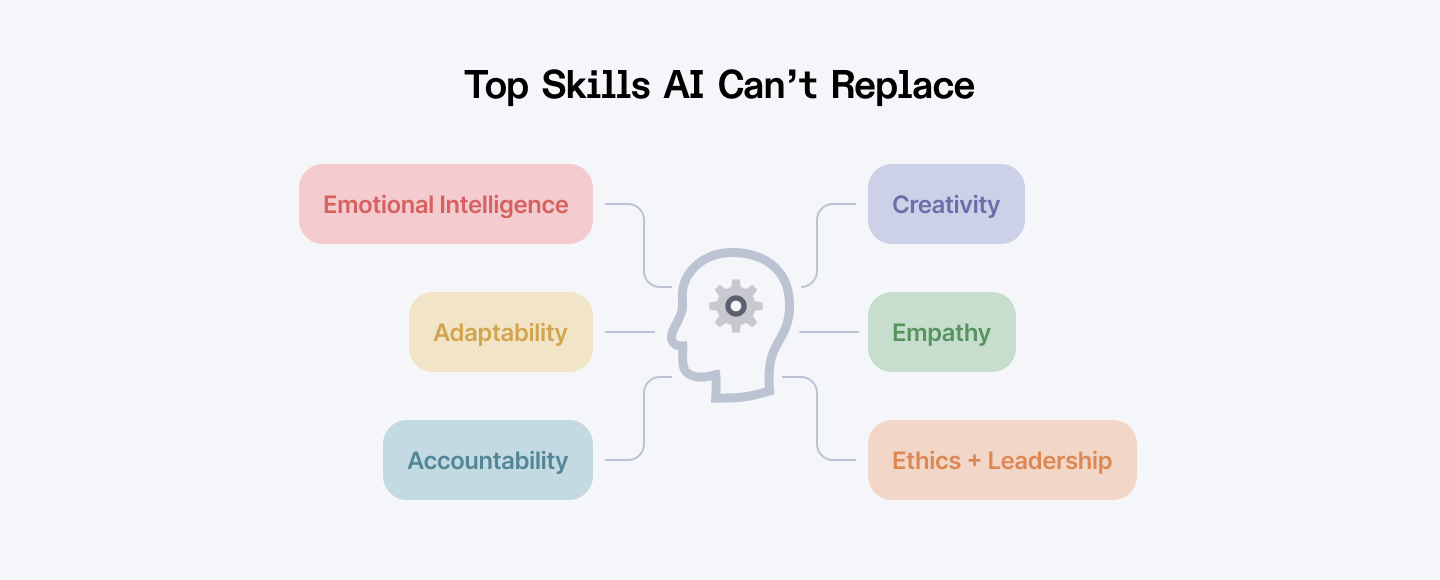
Top Skills AI Can’t Replace
It has become evident that while AI can easily replace certain technical skills, it falls short when it comes to human skills. Traditional resumes and interviews, which have long prioritized technical expertise, often overlook the intangible qualities that truly set candidates apart—soft skills. In many ways, they are the most important line on a resume, defining what makes us uniquely human.
They include:
1. Emotional Intelligence
Emotional intelligence (EQ) accounts for 58% of job performance. Yet this is precisely where AI hits its hardest wall. Sure, ChatGPT can analyze text sentiment or Dall-E can create an image of "sadness," but neither truly understands what it feels like to be sad. They're mimicking patterns without experiencing the emotions behind them.
Humans, on the other hand, can pick up on subtle cues: a slight change in tone, a shift in body language, and adjust their approach accordingly. We build genuine connections based on shared emotional experiences. We know instinctively when a teammate needs encouragement, when a client isn't saying what they're really thinking, or when tension needs diffusing.
Think about it: who would you rather have leading a team through a tough project? A chatbot that follows scripts or a leader who can sense frustration, calm tensions, and inspire people? Great managers and leaders understand this. They know when to push and when to support. That’s the power of emotional intelligence. And no AI can replace it.
Pro Tip: How to Hire for Emotional Intelligence?
Look for candidates who can tell stories about managing difficult interpersonal situations. Ask how they've handled conflicts or motivated struggling team members. The most valuable answers won't be about what they did, but how they understood what others needed.
2. Creativity
While AI can generate impressive content based on what it's learned, it fundamentally lacks the spark of true creativity. AI can remix existing ideas, but it can't have a genuinely original thought. It's limited to variations on themes it's already encountered.
Creativity isn't just about making pretty things. It's about connecting seemingly unrelated concepts in surprising ways. It's the marketer who builds a campaign that makes you laugh and cry simultaneously. It's the engineer who combines existing technologies to solve a problem nobody else saw. It's the entrepreneur whose wild idea sounds crazy until it changes an entire industry. None of that comes from an algorithm. It comes from human intuition, experience, and imagination.
Think about those moments when you've been wrestling with a problem for days. You've tried everything logical. You've analyzed every angle. Nothing works. Then suddenly, while walking your dog or washing dishes, the solution appears from nowhere. That's not just pattern recognition; that's creativity. It comes from uncertainty, exploration, and a willingness to challenge the status quo.
Pro Tip: How to Hire for Creativity?
Look beyond portfolios and past accomplishments. Ask candidates about their process. How do they approach seemingly unsolvable problems? When have they connected dots that others missed? The most creative minds often don't follow straight lines—they explore, they get lost, they discover.
3. Adaptability
AI excels at structured, predictable tasks. Give it clear parameters and historical data, and it performs beautifully. But throw in a once-in-a-century pandemic or an unexpected market shift, and AI stumbles. Why? Because it can only operate within the boundaries of what it's learned before. If you always stick to the same methods, you’ll always get the same results.
In contrast, humans can pivot and adapt on a dime. We can take limited information about an unprecedented situation and somehow make it work. Look at how we handled remote work during the pandemic. Overnight, millions had to reinvent how they collaborated, communicated, and maintained boundaries between work and home. Some people thrived while others struggled, but those who succeeded weren't necessarily the most technically skilled. They were the most adaptable.
Adaptability is a mindset. It's keeping an open mind when everything changes. It's considering wildly different perspectives. It's embracing change rather than digging in your heels against it.
And the most valuable professionals are those who can go off-script when necessary and connect dots that weren't obviously related.
Pro Tip: How to Hire for Adaptability?
Look for candidates with diverse experiences. Ask about times when their plans fell apart. What did they do? The strongest answers won't focus on how quickly they returned to normal, but how they redefined what normal could be.
4. Empathy
Empathy is what makes us human. It’s what allows us to step into someone else’s shoes, understand their struggles, and respond with care. When we interact with each other empathetically, we create spaces where people feel seen, heard, and valued. This human connection forms the foundation of trust in any relationship—professional or personal.
Sure, an AI assistant might say, "I'm sorry to hear that," or “That must be frustrating,” but there's a profound difference between this programmed response and genuine empathy. The AI doesn't feel sorry. It can't. It's following patterns learned from data—if [user expresses negative emotion], then [provide sympathetic response].
Pro Tip: How to Hire for Empathy?
Look for candidates who naturally connect with others during the interview process. Those with strong empathy will talk not just about what they did, but how they considered others' feelings and perspectives throughout.
5. Accountability
When was the last time you heard an AI say, "I made a mistake, and I'm going to fix it"? Probably never. And that highlights another uniquely human quality that remains irreplaceable: accountability.
Accountability is a skill that plays a huge role in any workplace. It goes beyond simply acknowledging errors. It's about taking ownership of your actions and their consequences. It's standing up and saying, "This was my decision, and I'll handle whatever comes next." This ownership builds the foundation of trust that allows organizations to function effectively.
Think about that software development scenario. When a coder discovers their error affected user experience, true accountability isn't just admitting the mistake. It's staying late to fix the bug. It's communicating transparently with the team and customers. It's documenting what happened so others can learn from it. And most importantly, it's making the personal commitment to improve processes so the same error doesn't happen again.
This sense of personal responsibility is deeply human. You understand that your actions affect others. You feel the weight of your decisions. You experience the discomfort of admitting failures and the satisfaction of making things right.
Pro Tip: How to Hire for Accountability?
Ask candidates about their biggest professional mistakes and listen carefully to how they talk about them. Do they own the outcome or deflect blame? Did they take concrete steps to fix the problem? Did they learn and grow from the experience? The professionals who take genuine responsibility for their work, who care deeply about outcomes and stand behind their decisions, will always remain essential.
6. Ethics + Leadership
Ethics isn't just about following rules and knowing right from wrong. It's about wrestling with moral complexity in situations where there's no clear "correct" answer.
Take a financial app, for example. An ethical developer wouldn’t just build a functional product. They ask deeper questions: How might this tool be misused? Are we being transparent about risks? Are we protecting vulnerable users? Am I creating something that makes the world better or worse? These questions require moral reasoning that goes beyond data and algorithms. AI can't do this, it can only optimize for whatever objectives we program into it.
Leadership, too, remains uniquely human. Think about the best leader you've ever worked with. What made them special? Was it just their decision-making skill, or something more intangible? Great leaders inspire us. They help us see possibilities we couldn't imagine on our own. They make us want to be better.
An AI model might analyze patterns in successful leadership behaviors, but it can't generate the authentic vision that drives innovation.
Pro Tip: How to Hire for Ethics and Leadership?
Look for candidates who can articulate their personal values and describe how those values have guided difficult decisions. Ask about times they've taken an unpopular stand because it was the right thing to do. Look for evidence of inspiring others and creating positive change.
Also Check Out: Effective Ways to Assess Developer's Problem-Solving Skills in Tech Hiring
Hiring for Human Skills: 4 Best Strategies
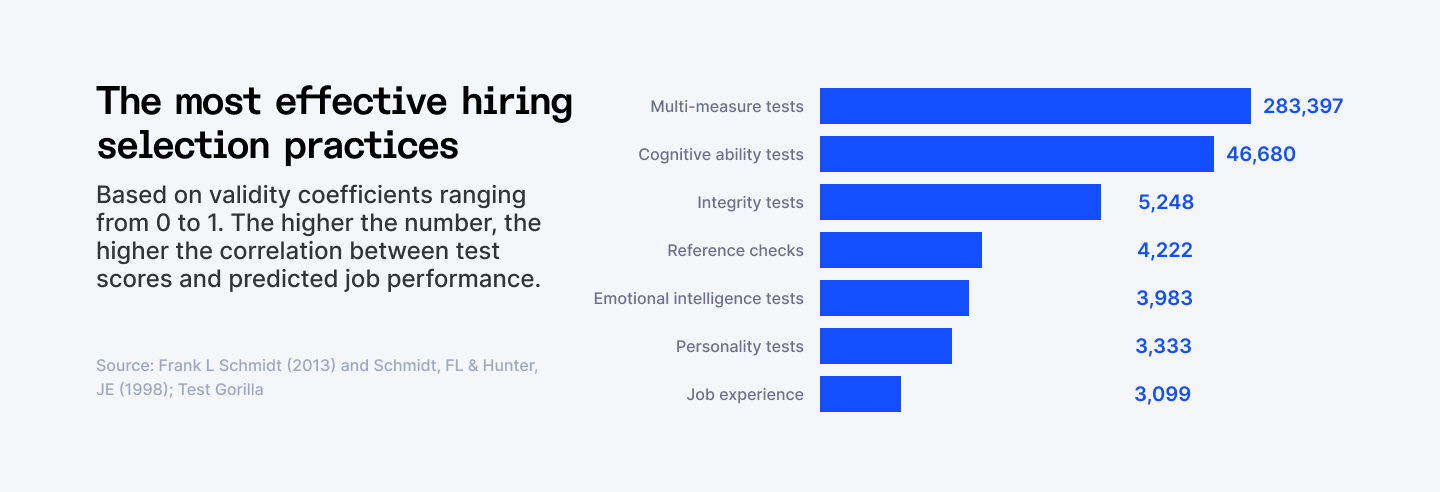
You'll need to fundamentally rethink how you evaluate candidates. The traditional resume-and-interview approach simply doesn't capture these irreplaceable human qualities effectively.
As a starting point, here are four practical strategies:
1. Behavioral Interviews
Candidates can talk brilliantly about their skills but struggle to demonstrate them in action. That's why behavioral interviewing is so powerful. Instead of asking, "Are you adaptable?" (which will almost always get you a "Yes!"), try "Tell me about a time when your team's priorities changed suddenly. How did you respond?" By focusing on specific past experiences, you'll get authentic insights into how candidates actually behave in challenging situations. Look for stories that reveal emotional intelligence, creativity in solving problems, adaptability when plans fall apart, and willingness to take ownership of mistakes.
2. Psychometric Assessments
Psychometric assessments are powerful tools for seeing beyond surface-level qualifications. These validated tools can measure factors like emotional intelligence, creative thinking patterns, adaptability to change, and personal accountability. While no assessment is perfect, they can provide objective data points to complement your subjective impressions. The key is using these assessments as conversation starters rather than final judgments.
3. Collaborative Tasks
Want to see how someone really works with others? Create a situation where they actually have to do it. Design group activities that simulate real workplace challenges. This could be a problem-solving exercise, a mock project planning session, or a creative brainstorming activity. Watch for who listens actively, builds on others' ideas, adapts when the parameters change, and takes responsibility for the group's success. You'll see authentic behaviors rather than rehearsed answers.
4. Reference Checks
When calling references, go beyond the standard questions about technical competence and reliability. Ask specific questions about how the candidate handled challenging interpersonal situations or responded to unexpected changes. Questions like "Can you tell me about a time when this person had to resolve a conflict within the team?" or "How did they adapt when priorities shifted unexpectedly?" will give you valuable insights into the human skills that truly determine workplace success.
Source: TestGorilla
Soft Skills Are the Skills of the Future
Have you ever thought about why we call them "soft" skills? There's nothing soft about them, they're actually the hardest skills to develop and the most valuable to possess.
That's why experts are increasingly referring to them as ‘durable skills’, because they endure through technological shifts and workplace transformations. While technical skills might become obsolete overnight, the ability to connect with others, adapt to change, and think creatively never goes out of style.
What makes these skills particularly fascinating is how they're communicated. You can list technical certifications on a resume, but how do you demonstrate empathy or creativity on paper? These qualities shine through in how you carry yourself, your facial expressions, your tone of voice, and countless other subtle cues that we unconsciously register when interacting with someone.
That's why savvy recruiters are shifting their interview processes to better capture these essential human qualities. So what does this mean for you? If you're a leader:
- Recognize that your organization's competitive advantage increasingly depends on these human capabilities.
- Create environments where they can flourish.
- Hire for them intentionally.
- Reward and recognize them consistently.
Remember this:
The skills that make your employee most irreplaceably human are precisely the ones that will prove most valuable to your workplace in the age of AI. The future belongs to those who bring their full humanity alongside it.
For Tech Companies:
Access the top 5% of developers with exceptional human skills through Index.dev's vetted talent network—get matched in 48 hours with a 30-day risk-free trial.
For Tech Talent:
Join Index.dev talent network today and showcase your uniquely human skills to global companies seeking irreplaceable talent for remote opportunities.