Remote work has changed the fintech business in many ways in the last 5 years. According to the U.S. Bureau of Labor Statistics, nearly 20% of the U.S. workforce was working from home in 2023. These trends have taken an upward path in 2025 as remote hiring brings concrete benefits to the table.
As per Deloitte, large-scale development companies saved close to 30% on running costs by hiring remote developers for fintech development. With a switch to remote hiring, companies are able to dip their toes in global specialized talent pools.
Looking beyond DeFi and AI-driven fraud detection, the fintech industry is witnessing growing demand for quantum computing and ethical AI implementations. It is high time for financial companies to onboard adaptive developers who understand the needs of the hour.
Leading fintech companies have proven that remote hiring is the way ahead. Revolut leveraged talent from Eastern Europe to scale up its remote team by 40% in 2022.
With the continuous development of the fintech landscape, it is best to know how to effectively hire remote developers for fintech. Learn how to be a pro at onboarding developers from the global talent pool to tap into a competitive advantage.
Use Index.dev's carefully screened online FinTech talent today to skip the early stages of hiring.
Skills Essential for Fintech Developers
A unique blend of technical expertise, domain knowledge, and soft skills is required for a fintech developer to ace the game. Furthermore, these skills should be tailored to a remote work environment and strict regulatory demands.
Technical and Domain Knowledge
To help you understand the level of competence required for every domain in the field of fintech, we have listed down the skills in a detailed format:
Payment Domain
- Languages: Python, Java, & JavaScript
- Key Tools & Framework: Stripe API, Square, PCI DSS, & OAuth 2.0
- Certifications: PCI DSS & AWS Certified Security – Specialty
- Compliance & Regulatory Frameworks: PCI DSS, PSD2, & GDPR
- Domain-Specific Knowledge: Payment processing systems, & digital wallets
Lending Domain
- Languages: Python, R, & SQL
- Key Tools & Framework: Scikit-learn, TensorFlow, & Tableau
- Certifications: Chartered Financial Analyst (CFA) & Certified Credit Analyst
- Compliance & Regulatory Frameworks: Fair Lending Laws & GDPR
- Domain-Specific Knowledge: Credit risk assessment & loan origination systems
Investment/Trading Domain
- Languages: C++, Java, & Python
- Key Tools & Framework: FIX Protocol, Bloomberg API, & QuantLib
- Certifications: Chartered Financial Analyst (CFA) & Financial Risk Manager (FRM)
- Compliance & Regulatory Frameworks: SEC Regulations & MiFID II
- Domain-Specific Knowledge: Algorithmic trading & portfolio management
Wealth Management Domain
- Languages: Python, R, & JavaScript
- Key Tools & Framework: Tableau, Power BI, & CRM platforms
- Certifications: Chartered Financial Analyst (CFA) & Certified Financial Planner (CFP)
- Compliance & Regulatory Frameworks: FINRA Regulations & GDPR
- Domain-Specific Knowledge: Financial planning & asset allocation
Insurtech Domain
- Languages: Java, Python & Scala
- Key Tools & Framework: AWS, Azure, & Risk modeling tools
- Certifications: CPCU & Certified Risk Manager
- Compliance & Regulatory Frameworks: Insurance Regulatory Information System (IRIS)
- Domain-Specific Knowledge: Underwriting, claims processing
RegTech Domain
- Languages: Python, Java, & SQL
- Key Tools & Framework: Compliance APIs & GRC platforms
- Certifications: Certified Regulatory Compliance Manager (CRCM)
- Compliance & Regulatory Frameworks: AML/KYC Regulations & GDPR
- Domain-Specific Knowledge: Regulatory reporting & compliance monitoring
Blockchain Domain
- Languages: Solidity, Rust, & Go
- Key Tools & Framework: Ethereum, Hyperledger, & Truffle
- Certifications: Certified Blockchain Developer & Ethereum Developer Cert.
- Compliance & Regulatory Frameworks: FATF Guidelines & SEC Regulations
- Domain-Specific Knowledge: Smart contracts & decentralized applications (dApps)
Cybersecurity Domain
- Languages: Python, C++, & Java
- Key Tools & Framework: Wireshark, Metasploit, & SIEM tools
- Certifications: CISSP & CEH
- Compliance & Regulatory Frameworks: ISO/IEC 27001 & NIST Framework
- Domain-Specific Knowledge: Threat modeling & intrusion detection systems
Soft Skills
When you hire remote developers for fintech, soft skills become just as crucial as technical abilities:
1. Communication
- Ability to provide concise & actionable updates on project status
- Clear articulation of complex concepts to non-technical stakeholders
2. Problem-Solving
- Creative thinking to overcome technical limitations
- Ability to troubleshoot and resolve issues independently
3. Adaptability
- Willingness to learn and adapt to new technologies
- Openness to feedback and continuous improvement
Process of Vetting and Onboarding Developers
Below is a step-by-step guide to help technical hiring managers design a process that aligns with fintech's demands for security, compliance, and remote collaboration.
Vetting Process
This will include three essential aspects for gauging the abilities of a fintech developer:
1. Technical Assessments
To test candidates' ability to solve domain-specific, complex problems, present real-world scenarios that a development company faces from time to time:
Challenges:
- Build a mock lending platform with encryption and audit logging.
- Simulate a DDoS response on a payment processor.
- Test for blockchain, API integration, or AI fraud scoring.
Tools:
Test knowledge of tools such as HackerRank, CoderPad, or GitHub with automated tests (pytest, JUnit).
Criteria:
Code quality, security (OAuth 2.0, input validation), performance, and documentation.
2. Behavioral Interviews
In a development team’s context, these interviews assess candidates’ ability to navigate challenges such as remote work, regulatory pressures, and team dynamics:
- "How do you handle a data breach in a remote team?" (Expect containment, secure communication via Signal, root cause analysis)
- "How do you prioritize tasks during a PSD2 regulatory change?" (Expect Jira task tracking, risk prioritization)
Process: Use Zoom (E2E encryption), structured scoring, and include a compliance expert.
3. Portfolio Deep Dive
Sticking to the traditional verification method is not a bad approach if one wishes to identify if the candidate has practical experience with fintech technologies and compliance requirements.
Verify:
- Financial API integrations (Plaid, Stripe)
- Blockchain projects (ERC-20 tokens, Solidity, audited via Mythril)
- Compliance docs (GDPR, PCI DSS)
Process:
Review GitHub repos and ask about security/scalability challenges.
Learn the best practices for vetting software developers.
Onboarding Strategies
Before remote fintech developers take on the tasks, it is advisable to run them through compliance policies and work ethics. Keep in mind that for financial software development companies, proper onboarding establishes a secure foundation.
1. Compliance Training
- Modules:
Instill a deep understanding of regulations and policies followed by your fintech software development company through training modules like GDPR (data minimization), PCI DSS (cardholder data), and AML/KYC (identity verification).
- Process:
Use TalentLMS, require quizzes, and schedule compliance Q&A
2. Secure Environment Setup
Modules:
Set up VPN requirements (NordLayer), multi-factor authentication (Duo), encrypted communication channels (Signal), and more to help the candidate ease into a secure environment for fintech development.
Process:
Provide a setup checklist to the new joinee, use AWS WorkSpaces, and conduct an audit within 7 days.
The successful assimilation of a remote developer into the team can play a major role in boosting productivity and innovation, while boosting employee retention.
Discover 10 common remote developer onboarding mistakes.
Optimizing Your Fintech Talent Strategy
The ideal way to zero in on the hiring model for a company is to consider needs, budget constraints, and security requirements. The following is a comparison between the most preferred hiring models:
Aspect | Outsourcing | In-house Development | Platform-Based Development |
| Cost Structure | Lower upfront costs with variable expenses | High fixed costs that include salaries, benefits, infrastructure & more | Predictable subscription/usage-based pricing, or pay-for-value model |
| Talent Access | Limited to the vendor's team and potential quality inconsistency | Restricted by geographical location and hiring competitiveness | Access to global, pre-vetted experts across multiple domains |
| Onboarding Speed | Depends on the vendor’s availability | Slower due to hiring processes and team formation | Fastest deployment through ready-to-use solutions and immediate expert access |
| Security | Potential data exposure risks and complex compliance verification | Tighter control, but dependent on internal expertise | Enterprise-grade security measures, compliance certifications, and data sovereignty options |
| Scalability | Contract renegotiations are needed with potential vendor lock-in | Limited by hiring capacity and training speed | On-demand scaling with flexible resource allocation based on project needs |
| Innovation Pace | Limited to the vendor's capabilities and incentives | Constrained by team size and current expertise | Access to cutting-edge technology & cross-industry knowledge transfer |
| Quality Control | Complex oversight requiring dedicated management | Direct control but limited by team expertise | Transparent metrics, reputation systems, performance guarantees |
| Risk Management | Contract-based risk transfer, limited recourse | Full risk ownership, direct accountability | Distributed risk model, multiple redundancies, expertise redundancy |
| Maintenance | Often requires separate maintenance contracts | Ongoing team overhead regardless of maintenance needs | Built-in support, continuous improvement models, community-backed solutions |
When selecting platform-based development as a mode for talent acquisition, the teams need to evaluate different platforms. Each platform has its strengths and can cater to varied requirements.
Platforms to Find Best Fintech Talent
Finding the right platforms to source exceptional fintech talent is crucial. This section explores the most effective recruiting channels where companies can connect with exceptional developers.
Platform | Pricing Model | Vetting Process | Talent Quality | Flexibility | Strengths |
Toptal | Premium hourly rates, which are 40% higher than average | 5-step technical assessment with a <3% acceptance rate | Senior-level talent with typically 5+ years of experience | 2-week trial period and easy termination | Elite talent with proven fintech experience |
Index.dev | Mid-range rates and custom packages offered | Security-focused vetting with fintech domain tests | Mid to senior level with specific fintech expertise | Project-based or full-time options | Specializing in fintech security and compliance knowledge |
Andela | Cost-effective and 20-30% lower than US rates | Technical assessment, plus soft skills evaluation | Junior to mid-level with training potential | Long-term contracts preferred | Scalable teams are good for ongoing projects |
Turing | Competitive rates with flexible tiers | AI-powered vetting, technical interviews and domain expertise assessment | Mid to senior level with 3+ years of experience | Monthly contracts with option to convert to full-time | Large talent pool with specialized matching algorithm |
Lemon.io | Market-competitive hourly rates | Pre-vetted developers and focus on European talent | Senior developers with 4+ years of experience | Weekly contracts are available with quick developer replacement | Fast matching (48 hours) that specializes in startups |
Explore 10 top-rated Toptal alternatives for 2025.
Security and Compliance Considerations
Remote work can be the biggest threat to your development company. You need to prioritize security and compliance, when you hire remote developers for fintech.
Data Access Controls
- Create controlled development environments using virtual desktops like Citrix
- Restrict access to unauthorized locations through IP whitelisting
- Enforce role-based access controls (RBAC)
- Use audit logging tools such as Splunk for system interaction visibility
- Adopt a zero-trust security model
- Implement end-to-end encryption for all data in transit
Compliance Verification
- Conduct background checks relevant to compliance requirements
- Draft a confidentiality agreement with specific fintech clauses
- Undertake regular security clearance reviews
- Document security practices for audit trials
- Implement compliance checklists for financial regulations
- Opt for continuous verification through automated compliance monitoring
Tools for Secure Development
- Identify vulnerabilities through Burp Suite deployment
- Target critical financial functions with regular red team exercises
- Perform API security testing
- Identify security issues during development using Checkmarx
- Integrate SAST/DAST tools into CI/CD pipelines
- Adopt CERT Secure Coding standards
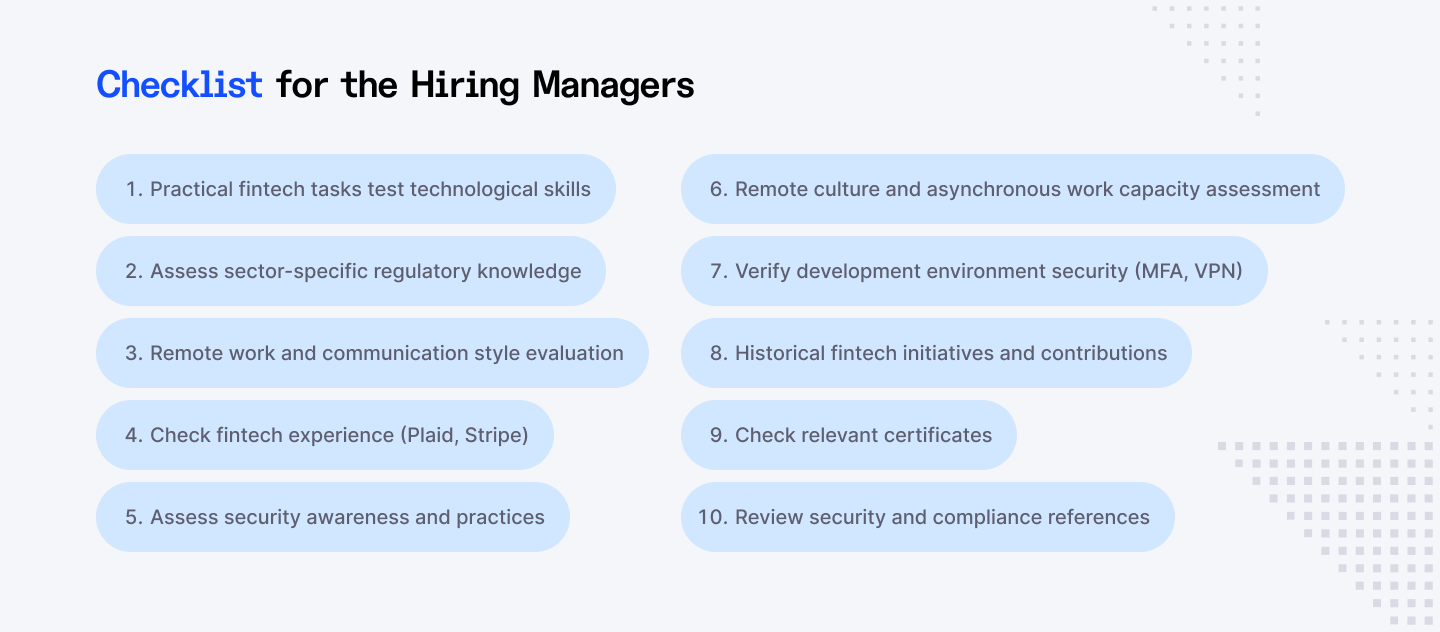
Checklist for the Hiring Managers
When hiring developers for your team, make use of this crisp checklist:
- Practical fintech tasks test technological skills
- Assess sector-specific regulatory knowledge
- Remote work and communication style evaluation
- Check fintech experience (Plaid, Stripe)
- Assess security awareness and practices
- Remote culture and asynchronous work capacity assessment
- Verify development environment security (MFA, VPN)
- Historical fintech initiatives and contributions
- Check relevant certificates
- Review security and compliance references
Summing Up
When recruiting remote fintech developers, consider their professional qualifications, field knowledge, security procedures, and capacity to work from home. By hiring the right candidate, you can establish a competent team that meets your demands. You can use platforms to scale up your team without investing time.
If you wish to hire remote developers for fintech, look no further than Index.dev as your partner in flawless development.
The development companies that simultaneously improve hiring procedures and follow DeFi & AI developments will succeed. Change your methods based on your business needs and the advice of the development team. Distributed development is the future for finance software, prepare your hiring process.