According to McKinsey, large IT projects run 45% over budget and 7% over time, while delivering 56% less value than predicted.
We operate in an era where ‘good’ is no longer enough if it arrives too late. When you’re scaling, minor inefficiencies compound. A 10% lag in a small team becomes a massive bottleneck in a 100-person engineering org.
Research from the DORA (DevOps Research and Assessment) reports consistently shows that ‘elite’ performers—the companies dominating their sectors—have a lead time for changes that is measured in hours, not months. They are 2.6 times more likely to exceed profitability and market share goals.
In the next sections, we will walk through seven practical steps that help you speed up project delivery while protecting quality, team morale, and long term performance.
Still losing weeks to hiring? Index.dev delivers pre-vetted engineers in 48 hours, with contracts, IP protection, and flat-rate pricing built in. Scale your team as fast as your deadlines demand.
Step 1: Choose the Right Delivery Model
Many projects slow down not because your team lacks talent, but because your delivery model is working against you.
Too many teams are still running waterfall processes in an agile world. They plan everything upfront, lock in scope, then wonder why the product they ship six months later no longer matches what the market needs.
Traditional plan driven models like the Waterfall model were designed for predictability. Clear stages. Fixed scope. Heavy documentation. Sign off before execution. That works when change is rare and requirements are stable.
But software doesn't work that way. Requirements shift. Users surprise you. Competitors launch faster. AI tools evolve monthly. Compliance rules tighten. You are expected to ship quickly and adapt constantly. In that environment, rigid models create friction. Decisions get delayed. Feedback arrives too late. Teams deliver what was specified, not what is needed. And that is expensive.
Switching to Agile doesn't automatically fix this either. Many organizations adopt agile rituals, the standups, the sprints, the retrospectives, without changing how decisions get made or how strategy connects to execution. You end up with agile theater. Busy teams, poor outcomes.
Now add AI into the mix. AI powered development tools can accelerate code generation, testing, and documentation. But if your process is still sequential and approval heavy, you will not unlock that speed. You will create tension between innovation and compliance. Especially in regulated environments shaped by frameworks like General Data Protection Regulation (GDPR) and Health Insurance Portability and Accountability Act (HIPAA).
As your teams scale or become distributed, the cracks widen. Coordination overhead grows. Communication fragments. Duplicate work appears. Visibility drops. Traditional monolithic models struggle in multi-team environments, especially when you adopt continuous delivery and DevOps practices. A report by the Project Management Institute found that organizations with mature delivery practices are 2.5 times more likely to meet their goals and twice as likely to finish on time and within budget.
So what should you do? You need a delivery approach that is adaptive, iterative, and transparent. One that allows small releases, fast feedback loops, shared ownership, and clear accountability. One that scales across teams without creating bureaucracy. One that supports compliance and security by design
Your delivery model is your operating system. Run the wrong one and it doesn't matter how talented your engineers are.
Step 2: Automate Manual Processes
Time is the one resource you can't recover. Every hour your team spends on manual status updates, repetitive testing, or chasing down information in Slack threads is an hour not spent building. And yet, most engineering organizations are still burning significant time on work that shouldn't require human attention at all.
Think about what a typical week looks like without automation. Developers context-switching between tools to piece together project status. QA teams running the same regression tests by hand. Managers compiling progress reports from five different sources. None of this moves the product forward. It's overhead, and it compounds quickly across a team of twenty, fifty, or two hundred people.
A Zapier study found that 94% of workers perform repetitive, time-consuming tasks in their roles, and 90% said automation improved their jobs. But don't just automate for the sake of it. Target the high-friction zones that keep your team in a state of reactive ‘firefighting’:
- If a developer has to wait more than 10 minutes for a build or a test result, they’ve already checked Facebook.
- Use BI tools and project management integrations (like Jira or Linear) to create a single source of truth. If you have to ask "where are we on this?", your system has already failed you.
- Stop letting humans decide if code is ‘safe’ to merge based on a gut feeling. Automate your linting, security scans, and regression suites.
The goal isn't full automation. That's neither realistic nor desirable. Judgment, creativity, and human decision-making still matter enormously in software delivery. But every manual task that doesn't require judgment is a candidate for automation.
When your delivery engine runs with minimal manual friction, your team can focus on what creates value. Building, learning, and improving.
Step 3: Add Capacity Carefully
At some point you will feel it. The pressure. Deadlines tighten. Scope expands. A key engineer leaves. The instinct is natural: add more people and push harder. Sometimes that is the right call. But most leaders underestimate how complex this decision really is.
Staff augmentation can unlock speed when done well. Bringing in experienced engineers, product managers, or delivery leads can increase execution capacity without long hiring cycles. In fast moving markets, that flexibility matters. You gain access to skills you do not have internally. You protect your core team from burnout. You keep momentum. But capacity is not linear.
This is where Frederick P. Brooks Jr. comes in. His famous observation, known as Brooks's law, states that adding manpower to a late software project makes it later. Why? Because communication scales faster than headcount.
A two person team has one communication path. A five person team has ten. Coordination overhead increases quickly. More meetings. More alignment. More onboarding. More context sharing. You do not just add hands. You add complexity.
| Team Size | Connection Paths | Communication Complexity |
| 2 People | 1 | Simple |
| 5 People | 10 | Manageable |
| 10 People | 45 | High Friction |
| 12 People | 66 | Potential Gridlock |
Research over the years has shown that Brooks was directionally right, but not absolute. Modern scale-ups are moving toward flash teams—highly specialized, external squads that come with their own internal chemistry and processes. Instead of onboarding full-time individuals (which drains your senior devs' time), you bring in a pre-integrated software delivery pod to plug specific gaps.
When to use it:
- The "Specialist" gap: You don't need a generalist; you need a security expert for a two-week audit.
- The "Buffer" strategy: Use augmented staff for the ‘toil’ (maintenance, documentation, migrations) so your core team can stay focused on the high-value architectural sprint.
- Early influx: The data shows that adding resources early in the lifecycle works. If you wait until you're already late, you’re just paying for people to watch the ship sink.
Throwing more people at a failing project is a desperate leadership. In software, 1 + 1 rarely equals 2. Often, it equals 1.5 and a lot of frustrated Slack messages. If you’re going to scale your headcount to hit a deadline, you have to do it with surgical precision. Sometimes the right move is augmentation. Sometimes it is sharper prioritization.
Step 4: Outsource Strategically
There is a difference between building capability and buying speed. As a leader, you need to know when to do which.
Outsourcing gets a bad reputation because it's often done for the wrong reasons. Companies turn to it primarily to cut costs, then wonder why the quality doesn't meet expectations or why integration becomes a nightmare. Used strategically, however, outsourcing is one of the most powerful levers you have to accelerate delivery without overloading your core team.
If a specialized firm can do in two weeks what your internal team would need two months to figure out, the math isn't really about cost. It's about time-to-value. Bringing in experts who live and breathe a specific technology, whether that's a niche API integration, a compliance framework, a legacy system migration, or advanced data engineering, means you're not paying for their learning curve. You're buying their already-accumulated expertise and applying it directly to your timeline. According to Deloitte, 80% of executives are planning to maintain or increase investment in third-party outsourcing. Companies increasingly outsource not just for cost savings, but for access to specialized capabilities and speed to market. And speed has become the primary driver.
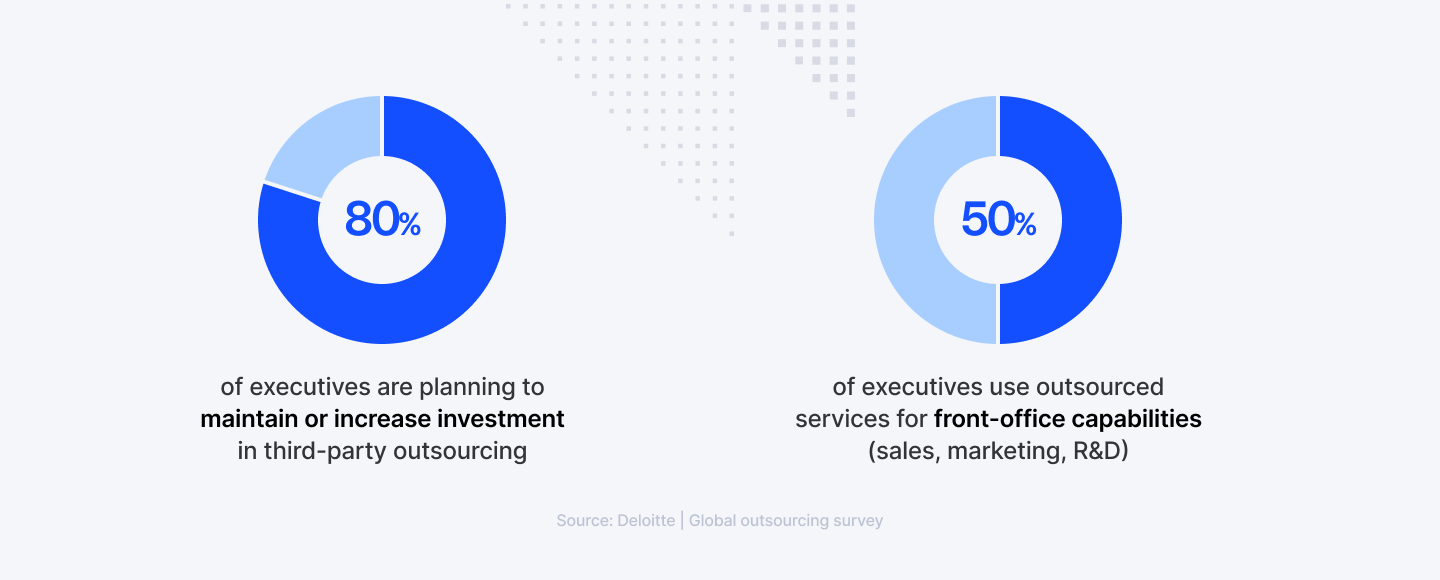
Source: Deloitte | Global outsourcing survey
The companies that outsource well treat their vendors as delivery partners, not just contractors. They invest in clear documentation, tight feedback loops, and regular alignment checkpoints. They're specific about what success looks like before the engagement starts. So approach outsourcing with clarity. You can outsource the code, but you can’t outsource the architecture or the vision. Keep the ‘brain’ of the project in-house. Outsource the ‘limbs’ that do the heavy lifting.
⭢ Know what the market looks like. Explore the top 10 most in-demand IT jobs.
Step 5: Fast-Track Tasks
In 2026, the "Minimum Viable Product" has evolved into the "Minimum Lovable Product."
According to recent product management studies, 64% of features in typical software are ‘rarely or never used.’ Think about that. More than half of what your team is building might be irrelevant.
Most project schedules are built the same way. Step one finishes, then step two starts. Step two finishes, then step three begins. It feels logical. It's also one of the biggest reasons projects run late. Sequential thinking made sense when dependencies were rigid and communication was slow. Today, it's often just a habit. And breaking it is one of the fastest ways to compress your timeline without adding a single resource.
Fast-tracking means identifying tasks that are scheduled sequentially and running them in parallel. If two workstreams can run in parallel without creating blockers for each other, there's no reason they shouldn't. You're not cutting corners. You're just being smarter about how you use the time you have. The biggest gains often come not from working more hours, but from removing waiting time between teams.
Of course, not everything can run in parallel. Some tasks are deeply dependent. Architecture decisions, infrastructure migrations, regulatory approvals. These require sequence.
Even where true parallelization isn't possible, overlap usually is. Instead of waiting for phase one to be 100% complete before phase two kicks off, start phase two when phase one is 80% done. You'll catch the final details in stride rather than in sequence. This approach, sometimes called schedule compression, can shave weeks off a delivery timeline without touching scope or quality.
Speed lives in the gaps between activities. In approvals. In handoffs. In unclear decisions. Remove those gaps and your timeline shrinks naturally.
Step 6: Reduce Scope
When a project is under pressure, the instinct is to protect everything. Every feature feels essential because someone fought for it. Every task feels urgent because it's on the list. But when everything is a priority, nothing is. And trying to deliver everything under a compressed timeline is a reliable way to deliver nothing well.
The Pareto Principle is worth taking seriously here. In most projects, roughly 20% of the work drives 80% of the value. That means a significant portion of your backlog, the features, tasks, and deliverables your team is burning cycles on, is producing a fraction of the outcome. The Eisenhower Matrix offers a practical starting point. Separating tasks by urgency and importance forces an honest conversation about what genuinely needs to happen now versus what feels urgent but isn't truly critical. Most teams, when they do this exercise seriously, find more room to cut than they expected.
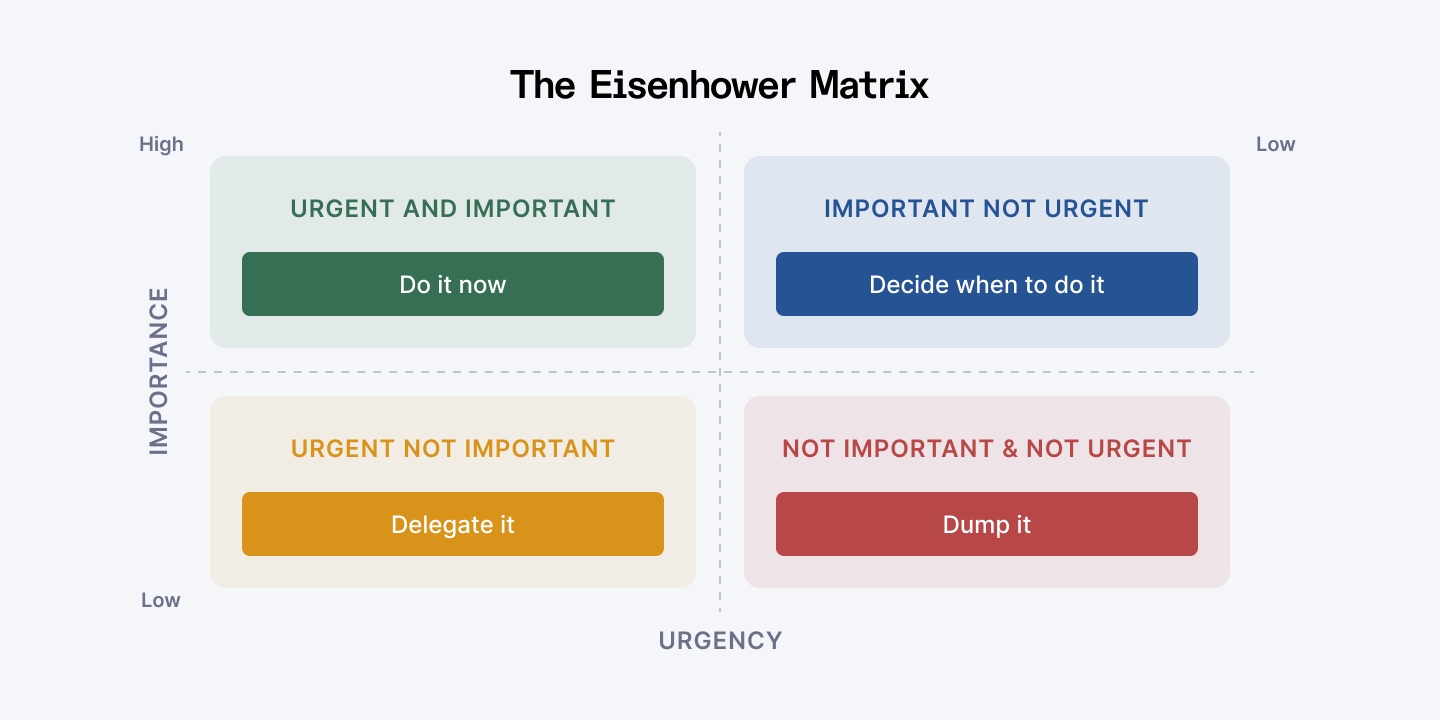
The Eisenhower Matrix
Reducing scope isn't failure. Done deliberately and early, it's one of the sharpest strategic decisions a leader can make. A focused product shipped on time creates more momentum, more user trust, and more organizational confidence than an overbuilt one that lands late and half-finished.
If scope reduction is the right call, don't make it unilaterally. You need your sponsor and key stakeholders to agree on what gets cut or postponed. It may require change requests and replanning. And that’s fine.
Scope is not a promise. Value is. When timelines tighten, protect value first. Trim the rest. You can always build phase two. You cannot recover from a missed market window.
Step 7: Build a Dedicated Core Team
Multitasking is one of the most accepted productivity myths in the modern workplace. Research from the American Psychological Association suggests that task-switching can reduce productivity by as much as 40%. Yet most organizations still assign their best people across three, four, or five projects simultaneously and wonder why delivery slows to a crawl.
The math is simple. A developer splitting their attention between four projects isn't giving 25% to each. They're giving each project a fraction of their focus, plus paying a tax every time they context-switch. That tax is invisible on a resource plan but very visible on a timeline.
To truly accelerate a critical project, you need a core project team. This is a dedicated squad of professionals whose only job is to get this one project across the finish line. Decisions get faster. Blockers get cleared sooner. The team develops a shared rhythm that distributed, part-time contributors simply can't replicate.
There's a cultural dimension to this too. Shared focus creates shared ownership. When a team knows this is their project, not one of several they're juggling, they invest differently. They care about the outcome more.
This doesn't mean every person on a project needs to be dedicated full-time. Specialists, consultants, and subject matter experts can contribute on a part-time basis. But your core delivery team, the people making daily decisions and driving execution forward, should have their attention protected.
So, if you truly want to accelerate, stop fragmenting your best people across too many initiatives. Pick the priority. Fund it properly. Staff it properly. And protect it fiercely.
⭢ Find out which 5 industries are on the edge of an AI transformation.
Key Methods for Effective Software Delivery
If you want to speed up delivery, you cannot rely on isolated tactics. You need a system. A way of working that makes speed repeatable. Here are the five approaches worth knowing and applying:
Agile
Agile is not about standups and sprints. It is about shortening feedback loops. Instead of trying to predict everything upfront, you deliver working software frequently, gather real feedback, and adjust.
Four principles drive this in practice.
First, collaboration over process. Agile teams communicate constantly and fluidly, which means better decisions made faster.
Second, customer focus. You're delivering to a person with a problem, and their satisfaction is the only real metric that matters.
Third, value-based prioritization. Agile teams ruthlessly rank work by its potential to deliver real value, which means the most impactful things ship first.
Fourth, iterative development. Instead of one big launch, you build in smaller, reviewable cycles. Each iteration is a chance to learn, improve, and course-correct.
Lean
Derived from the Toyota production philosophy, Lean focuses on reducing waste, limiting work in progress, and improving flow. In software, waste looks like unused features, long approval chains, handoff delays, and rework caused by unclear requirements.
Five principles guide Lean software delivery.
- Eliminating waste by cutting anything that doesn't directly serve the customer.
- Building quality in from the start, through practices like test-driven development and pair programming.
- Amplifying learning by treating every iteration as a source of insight shared across the entire team.
- Delivering fast, because real feedback only comes from real users.
- Respecting people by creating an environment where every voice contributes and healthy debate is welcomed.
DevOps
For years, development and operations teams operated like separate countries with separate cultures, separate tools, and separate incentives. Developers wanted to ship fast. Operations wanted stability. The result was friction, blame, and slow, risky releases.
DevOps removes the wall between development and operations. In practice, this means:
- Rigorous version control so every change is tracked and reversible.
- Automated build processes so software can be reliably compiled and packaged at any point. Comprehensive automated testing, covering unit, integration, acceptance, and regression tests, so bugs get caught early rather than in production.
- Staging environments that mirror production closely enough to surface real issues before they reach users.
- Fast rollback capabilities so a failed deployment doesn't become a prolonged outage.
- And continuous post-deployment monitoring so you know immediately when something isn't behaving as expected.
According to the DOGE State of DevOps Report, elite DevOps teams deploy 973 times more frequently than low performers and restore service 6,570 times faster after incidents.
Shape Up
Basecamp's Shape Up methodology flips the traditional project model on its head. Instead of fixing scope and letting time slip, you fix the time and let scope flex within it. Teams work in six-week cycles with clearly shaped, well-defined problems but significant autonomy over how to solve them.
The result is accountability without micromanagement. Teams own their delivery window. And because scope is intentionally constrained to what can realistically fit the cycle, you avoid the feature bloat that kills so many projects.
Scaled Agile Framework (SAFe)
Agile works beautifully for a single team. Scaling it across dozens of teams, multiple product lines, and complex organizational structures is a different challenge entirely. That's where SAFe comes in.
SAFe provides a structured way to apply agile principles at the enterprise level, aligning strategy, portfolio management, and delivery teams around shared objectives and synchronized release cycles called Program Increments. Every eight to twelve weeks, teams across the organization align on what they're delivering, surface dependencies, and commit to a shared plan.
It's not without critics. SAFe can feel heavyweight for smaller organizations, and poorly implemented it can recreate the bureaucracy agile was meant to replace.
How Remote Teams Accelerate Project Delivery
The traditional assumption is that co-location equals speed. Everyone in the same room, same time zone, same office. But the data tells a different story. A Stanford study found that remote workers are 13% more productive than their in-office counterparts. And for project delivery specifically, a well-structured remote team is a strategic advantage.
Here's how it actually works in practice.
1. You get the right talent faster. Hiring locally means competing for a limited pool, running lengthy recruitment cycles, and waiting weeks before someone contributes. Remote talent networks give you immediate access to verified professionals who are ready to start. You skip the long sourcing cycle. You skip the repeated screening. You move from need to execution in days.
2. You unlock near-continuous delivery. Time zones are usually framed as a challenge. The smarter way to see them is as extended operating hours. When your in-house team wraps up for the day, a remote team in a different region picks up where they left off. By the time your team logs back in, progress has already happened.
3. You handle spikes without the long-term commitment. Project demand isn't linear. Some quarters are intense, others are quieter. Remote teams let you scale your capacity to match the work, not the other way around. You bring in specialists for a specific phase, scale back when it's done, and avoid carrying overhead through slower periods.
4. You access specialized skills on demand. Not every project fits your existing team's capabilities. Rather than turning work away or spending months training, you bring in a remote expert with exactly the niche knowledge the project requires. Faster delivery, fewer errors, better outcomes.
⭢ See how hybrid talent models are redefining the mix of full-time, contract, and fractional experts.
How Index.dev Fuels Your Delivery Engine
Remote delivery only works if the talent is strong, aligned, and legally secure. That is where Index.dev steps in.
Speed with precision
Every candidate is matched against your tech stack, seniority requirements, and team dynamics, not just job titles. Qualified profiles reach you within 48 hours.
Global legal readiness
Don't let your legal team become a bottleneck. We handle the cross-border contracts, IP assignments, and local tax protocols. You get global talent with the administrative simplicity of a local hire.
Retention and continuity
Losing a key engineer mid-project is hard. We stay embedded in the lifecycle, tracking KPIs and managing escalations to ensure your project delivery remains stable and focused.
Transparent flat rate pricing
And the pricing is straightforward. Flat hourly rates, disclosed upfront, with no commission percentages, no deposits, and no platform fees. One engineer or fifteen, the rate stays the same.
You need structure, accountability, and continuity. That is the difference between outsourcing work and building scalable engineering capacity.
Final Thoughts
A McKinsey analysis found that companies in the top quartile of organizational health, which includes delivery discipline and execution consistency, outperform their peers by 2.2 times in total returns to shareholders.
The strategies in this article aren't complicated. Choose a delivery model that fits how you actually work. Automate what doesn't need human judgment. Resource deliberately instead of reactively. Outsource to specialists when it makes strategic sense. Fast-track work by challenging assumptions about what has to happen sequentially. Cut scope early and consciously when you need to. And protect your core team's focus like it's your most valuable asset, because it is.
None of this requires a bigger budget or a larger team. It requires clearer thinking and the discipline to act on it before problems force your hand.
Speed up your project delivery not by doing more, but by being smarter about what you do, who does it, and how the work flows from a concept to a customer's screen.