Just a few months ago, Business Insider revealed that Morgan Stanley teamed up with ChatGPT to roll out a chatbot for its 16,000 financial advisors. The bank has doubled down on AI, even promoting its head of wealth tech to lead firmwide product innovation.
Meanwhile, Reuters reported that Google DeepMind used AI to predict the structure of over two million new materials, work that would’ve taken human researchers decades. These breakthroughs could redefine how we build batteries, solar panels, and even computer chips.
These aren’t isolated stories. This is the quiet revolution happening behind the screens of industries that once felt untouchable.
Yet, most professionals are still planning their careers as if they have a decade to adapt. They don’t.
AI isn’t coming for jobs, it’s coming for systems. And when systems change, entire industries tilt.
I’ve analyzed adoption patterns, investment flows, and technical roadmaps across more than 200 global companies. What I found paints a clear picture: five tech-driven industries are about to be redefined from the inside out. These are the sectors where machine learning, automation, and generative intelligence are already shifting the balance of power, and by 2026, will completely reshape how we build, code, diagnose, create, and manage.
Here are the five industries AI will take over first, and what you, as an tech leader or AI engineer, need to do right now to ride the wave instead of getting swept under.
Looking to hire AI engineers? Index.dev connects you with vetted ML engineers, data scientists, and domain experts ready to train, fine-tune, and deploy your LLM models.
1. HealthTech
If there’s one industry where AI isn’t just supporting humans but actively outperforming them, it’s healthcare. Right now, AI systems can detect diseases, design drugs, and even predict medical outcomes before symptoms appear. Google
DeepMind’s latest model, for example, can diagnose over 50 eye diseases with greater accuracy than most ophthalmologists. PathAI ML models based on human interpretable features predict clinically-relevant molecular phenotypes across cancers.
Hospitals across the US, Europe, and Asia are already integrating AI into their diagnostic and operational pipelines. Beyond diagnostics, practice management software is also being transformed by AI to streamline scheduling, billing, and patient records.
Radiology and pathology departments are the first to feel the shift, and by 2026, it's projected that AI will handle up to 80% of initial diagnostic screenings. That means many specialists will no longer be reading scans all day; they'll be verifying, interpreting, and communicating AI-derived insights to patients instead.
While some roles will shrink, others will explode in demand. AI needs human context. It needs the empathy, intuition, and decision-making that algorithms can’t replicate. And that’s where the new wave of healthcare professionals, and AI engineers, come in.
Jobs at Risk
Routine diagnostic roles like radiologists, pathologists, and screening specialists are the most vulnerable. These jobs rely heavily on pattern recognition, which AI now does faster and more accurately.
Roles on the Rise
AI-human collaboration specialists who bridge the gap between algorithmic output and patient care. Medical AI trainers who teach systems to recognize edge cases and cultural differences in disease presentation. Clinical validation engineers who ensure AI systems work safely across different patient populations.
AI developers who build real-time predictive models for chronic illness prevention. AI implementation consultants in healthcare and biomedical engineers who can design AI-integrated medical devices.
Interventional radiologists are suddenly the hottest specialty because you can't automate a procedure that requires real-time human judgment and dexterity.
Breakthroughs to Know
- DeepMind:
- Predicts acute kidney injury 48 hours before it happens.
- Predicts acute kidney injury 48 hours before it happens.
- Zebra Medical Vision:
- FDA-cleared AI that reads CT scans and X-rays faster than radiologists.
- FDA-cleared AI that reads CT scans and X-rays faster than radiologists.
- Insilico Medicine:
- Used AI to design a drug candidate in 46 days, a process that used to take 5 years.
- Used AI to design a drug candidate in 46 days, a process that used to take 5 years.
Three Hard Truths for AI Engineers in HealthTech
1. Learn the language of healthcare
Don’t just understand models; understand the data they’re reading. Learn the basics of medical imaging, genomics, and clinical workflow systems.
2. Build explainable systems
In healthcare, accuracy isn’t enough. Trust matters. Focus on explainable AI and ethical AI frameworks. If your model can’t show why it made a diagnosis, it won’t survive regulation.
3. Focus on real-world usability
The best medical AI isn’t just technically brilliant, it’s usable by nurses and doctors under pressure. Prioritize design simplicity and clarity of insight.
Read next: How National Scoliosis Clinic grew their AI spinal scan app with remote AI talent from Index.dev.
2. FinTech
Finance was built for AI. It’s data-heavy, rule-based, and ruthlessly fast. Every transaction, trade, and decision is a number waiting to be optimized. And that’s exactly what’s happening right now. Major banks, insurance companies, and investment firms are already running their core operations on machine learning models.
JPMorgan is set to become the world’s first fully AI-powered megabank. Goldman Sachs’ trading algorithms handle about 80% of all equity transactions.
The shift is simple: humans used to analyze data, now they oversee the machines that do. The skillset that once made you valuable – manual modeling, data crunching, report writing – is becoming obsolete. What matters now is your ability to build, interpret, and challenge the algorithms themselves.
Jobs at Risk
Entry-level financial analysts are disappearing fast. Insurance underwriters doing standard risk assessment are being automated away. If your job is reviewing applications, checking boxes, and applying predetermined criteria, that's exactly what AI does best. The industry expects 70% reduction by 2026.
Junior investment researchers who gather data, write summaries, and prepare reports. AI can read every earnings call transcript, SEC filing, and news article about a company in seconds. Back-office processors handling loan applications, claims verification, account reconciliation. Compliance officers doing routine regulatory checks. Customer service reps answering basic banking questions.
Roles on the Rise
A whole new set of jobs is emerging around AI governance and transparency.
- AI model validators are the new kingmakers. Someone needs to ensure these algorithms aren't making biased lending decisions or taking insane trading risks.
- Algorithmic fairness specialists who audit AI systems for discrimination, ensure compliance with lending laws, and document model decisions for regulators.
- Human-AI collaboration specialists who design workflows where algorithms handle volume and humans handle exceptions.
- Quantitative strategists who design new trading algorithms, risk models, and pricing systems.
- AI implementation consultants helping regional banks and credit unions modernize before they get left behind.
Breakthroughs to Know
- JPMorgan Chase:
- Replaced hundreds of thousands of legal review hours with a contract analysis AI.
- Replaced hundreds of thousands of legal review hours with a contract analysis AI.
- Goldman Sachs:
- Uses deep learning models to predict market fluctuations in real time.
- Uses deep learning models to predict market fluctuations in real time.
- Mastercard & Visa:
- Deployed AI-powered fraud detection systems that block suspicious transactions in milliseconds.
- Deployed AI-powered fraud detection systems that block suspicious transactions in milliseconds.
Three Hard Truths for AI Engineers in FinTech
1. Master interpretability and bias control
Financial AI is about accountability. Learn how to explain model decisions to non-technical regulators and clients. Build defensively. Test obsessively. Document everything.
2. Build for trust, not just speed
In finance, a false positive can cost millions. Reliability and transparency will define the next generation of fintech solutions.
3. Follow the money, literally
Smaller firms and emerging markets will adopt AI next. Those late adopters are your opportunity to build systems from the ground up instead of optimizing someone else’s.
Up next: Learn how a US-based research software company scaled faster with expert full-stack talent from Brazil.
3. Manufacturing
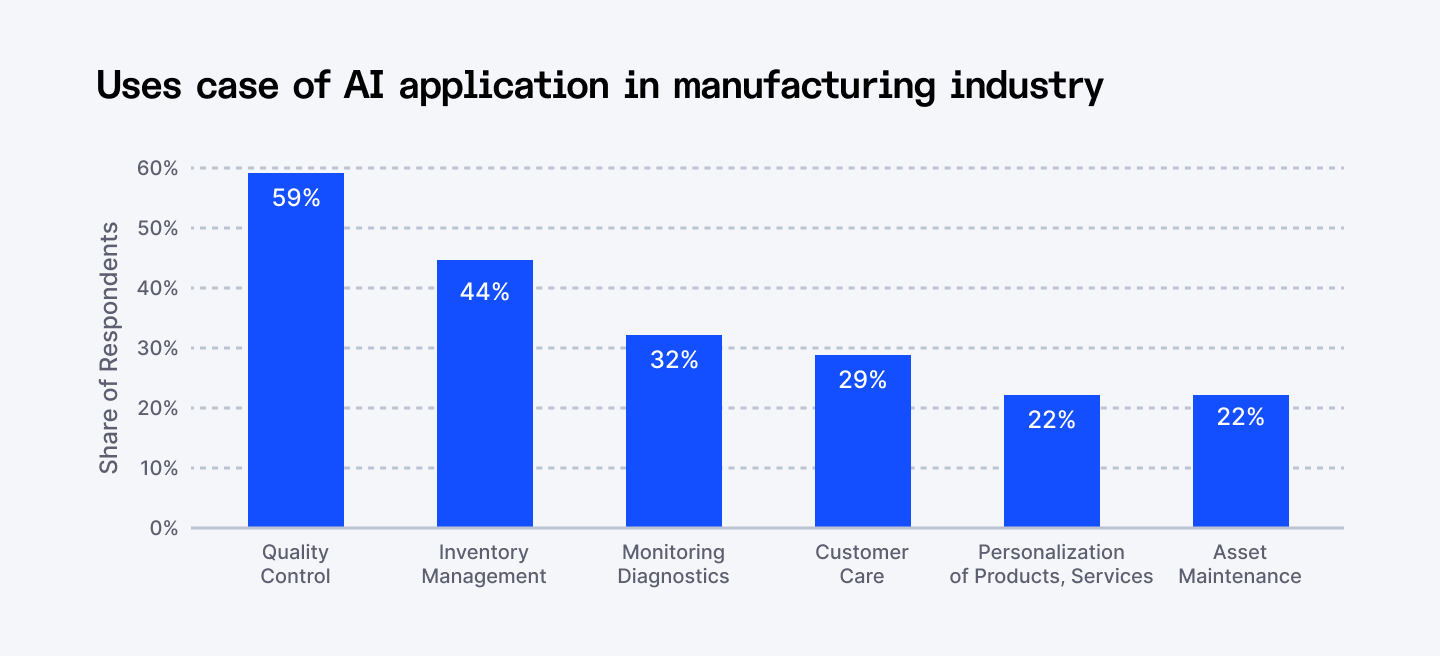
Walk into a modern factory today, and it looks nothing like it did ten years ago. The noise is lower, the lights are dimmer, and the humans are fewer. Machines learn, predict, and optimize.Factories are becoming ecosystems of sensors, data, and decision-making algorithms. Siemens has factories where AI manages the entire production line. General Electric's turbines have sensors feeding data to AI systems that predict equipment failures. And that’s the new normal.
AI is now in charge of planning, scheduling, and inspection – the very backbone of manufacturing. Visual inspection cameras detect product defects with superhuman precision. Production monitoring software tracks real-time performance across every line, feeding data into these AI systems so they know when to slow down, speed up, or stop altogether.
Machine learning models decide when a line should stop, when it should run, and how resources should be allocated. This shift toward AI in manufacturing isn’t about replacing workers one by one; it’s about replacing how work happens at a systemic level.
Jobs at Risk
Repetitive, rule-based tasks are being automated fastest. Quality control inspectors doing visual checks are being automated at scale. Production planners who schedule manufacturing runs, allocate resources, and sequence orders. Inventory managers tracking stock levels and placing reorder requests. Traditional maintenance technicians who do scheduled maintenance whether equipment needs it or not, or who react to breakdowns after they happen. Line supervisors doing routine monitoring and basic troubleshooting. All these jobs are being replaced by systems that can monitor thousands of data points in real time and make decisions instantly.
Roles on the Rise
Smart factories need a new kind of workforce: people who can manage, maintain, and guide the systems. That means:
- AI system supervisors who oversee autonomous production lines, handle exceptions the algorithms can't resolve, and make judgment calls when unexpected situations arise.
- Human-robot collaboration specialists designing workflows where humans and AI-powered robots work side by side safely and efficiently.
- Smart factory data analysts who interpret the massive amounts of data these systems generate, identify optimization opportunities, and translate insights into operational improvements.
- AI maintenance engineers who keep the AI systems themselves running.
- Digital twin architects building virtual replicas of production environments.
- IoT integration engineers connecting physical equipment to AI systems.
- Computer vision specialists training models to recognize quality issues specific to your products.
Breakthroughs to Know
- Siemens:
- Uses neural networks to continuously optimize production parameters.
- Uses neural networks to continuously optimize production parameters.
- General Electric:
- Predictive AI tools cut maintenance costs and downtime across aviation and energy divisions.
- Predictive AI tools cut maintenance costs and downtime across aviation and energy divisions.
- BMW & Tesla:
- Employ AI vision systems for millimeter-level quality assurance during assembly.
- Employ AI vision systems for millimeter-level quality assurance during assembly.
Three Hard Truths for AI Engineers in Manufacturing
1. Learn how machines think
Understanding industrial IoT data and control systems is your new edge. Dive into predictive analytics, sensor data interpretation, and AI-driven robotics.
2. Design for collaboration, not replacement
The best AI systems in manufacturing are those that amplify human skill, not erase it. Think of automation as an assistant, not a replacement.
3. Specialize in complexity
Mass production is being automated away. The next frontier is custom, low-volume, high-precision manufacturing, areas where human creativity still rules.
4. Retail and eCommerce
Retailers using AI personalization report 25 to 35% higher revenue. This isn't e-commerce anymore. It's algorithmic commerce where AI mediates every interaction between retailers and customers. Product recommendations, dynamic pricing, inventory allocation, customer service, fraud detection, marketing spend.
Amazon, Shopify, and Alibaba aren’t winning because they sell better stuff. They’re winning because their algorithms understand you. They know what you’re likely to buy, when you’ll buy it, and what price will make you click “Add to Cart.”
That same AI-driven shift is also opening up opportunities in personalized eCommerce categories like customized wall art, where sellers can respond faster to consumer preferences, test creative concepts more efficiently, and offer more tailored products without the overhead of traditional inventory.
AI is now running nearly every layer of retail, from marketing campaigns to warehouse logistics. Walk into any major retailer's headquarters and you'll find data scientists outnumbering traditional buyers.
On the marketing side, much of that day-to-day work now sits inside retail automation software, which segments shoppers by behavior, schedules the right promotion to the right buyer, and shifts ad spend across channels on its own, so the campaigns keep adapting in the background while the team focuses on strategy rather than manual execution.
Recommendation systems tailor your shopping feed. Smart chatbots handle 24/7 customer support. Predictive algorithms forecast demand before humans can even spot the trend. And dynamic pricing models adjust costs in real time, optimizing sales while you browse. Meanwhile, bot detection systems continually distinguish real user interactions from automated or fraudulent traffic so analytics and personalization remain accurate.
Jobs at Risk
Traditional retail buyers who used to select products based on experience and intuition. Customer service representatives handling routine inquiries. Chatbots now resolve 70 to 80% of common issues, returns, order tracking, product questions without human involvement. Pricing analysts who manually set prices and manage promotions.
Store associates doing basic customer assistance, especially in tech-forward retailers. Marketing analysts doing manual segmentation and campaign optimization. AI systems test thousands of variations, identify high-value customer segments, and optimize ad spend across channels automatically.
Roles on the Rise
On the flip side, new roles are exploding:
- Personalization engineers building recommendation systems, customized shopping experiences, and individual customer journey optimization. This combines machine learning, behavioral psychology, and business strategy.
- Demand forecasting specialists using AI to predict inventory needs across locations, products, and timeframes.
- Dynamic pricing strategists who design and manage algorithmic pricing systems, balancing revenue optimization with brand perception and competitive positioning.
- Computer vision engineers building visual search, automated checkout systems, and in-store customer tracking.
- Customer data platform specialists who integrate data from every touchpoint (website, app, store, customer service, social media) into unified profiles that AI systems can act on.
Breakthroughs to Know
- Amazon:
- Its AI recommendation engine drives roughly 35% of total revenue.
- Its AI recommendation engine drives roughly 35% of total revenue.
- Stitch Fix:
- Uses machine learning to personalize fashion selections at scale.
- Uses machine learning to personalize fashion selections at scale.
- Walmart:
- Predictive analytics now manage millions of products across global supply chains in real time.
- Predictive analytics now manage millions of products across global supply chains in real time.
- Sephora:
- Employs AI-driven virtual assistants that recommend makeup shades using facial recognition.
- Employs AI-driven virtual assistants that recommend makeup shades using facial recognition.
Three Hard Truths for AI Engineers in eCommerce
1. Understand behavioral data
The future of retail AI isn’t just about product data. It’s about people data. Learn how to interpret user behavior patterns, preferences, and sentiment.
2. Focus on personalization algorithms
AI personalization is what drives conversion and retention. Get comfortable with recommendation systems, NLP for customer intent, and reinforcement learning models.
3. Think omnichannel
AI in retail is about connecting online and offline experiences. Build for integration, from mobile apps to physical stores.
5. Customer Service and Support
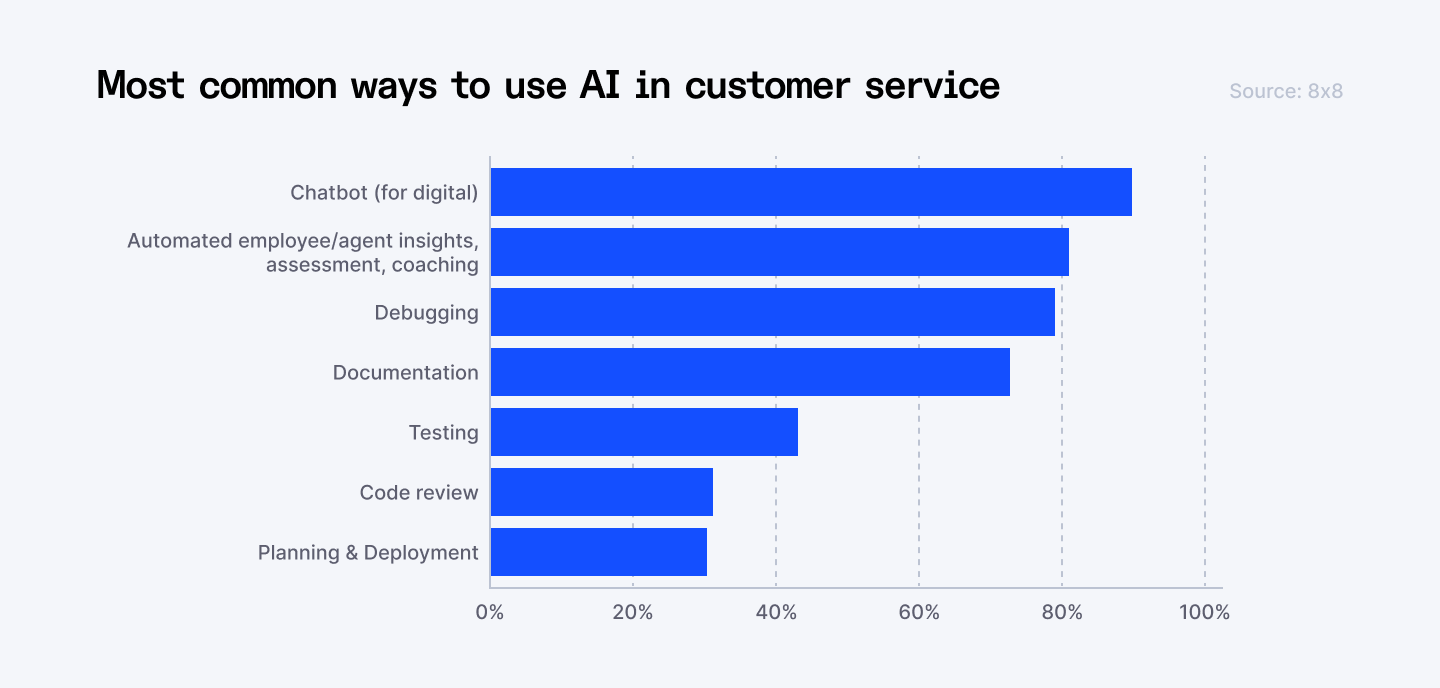
Most customer support work is repetitive, predictable, and exhausting. For years, companies hired armies of agents to answer the same questions over and over. Now, AI is quietly taking over that load, and doing it better, faster, and without coffee breaks.
For SMBs without dedicated contact center infrastructure, AI customer service software offers a faster on-ramp than building internal automation teams, especially when the platform already integrates with the CRMs and chat channels the team is using.
Bank of America's AI assistant Erica handles over 1 billion customer requests every year. Shopify’s Kit runs marketing campaigns for half a million merchants with minimal human oversight. Zendesk AI resolves roughly 70% of support tickets without ever pinging a human agent.
What ties these isolated wins together is the rise of the AI contact center, a single layer that unifies voice, chat, and email so context follows the customer across every channel.
This is the industry where AI proved itself first and hardest. For real-time phone support, teams are adopting AI call handling technology that powers ultra-low-latency voice agents (built and deployed in minutes) to understand intent, manage natural turn-taking, and escalate to humans without delays.
Jobs at Risk
Routine roles are disappearing fastest. Level one customer support representatives handling routine inquiries are being eliminated at scale. Call center agents for basic troubleshooting and information requests. Chat support specialists doing text-based customer service for straightforward issues. Email support teams processing routine customer service requests. Basic technical support roles walking customers through simple troubleshooting steps.
Roles on the Rise
- AI conversation designers creating dialogue flows, personality, and decision trees for chatbots and voice agents.
- AI training specialists who continuously improve bot performance by reviewing failed interactions, identifying gaps in the AI's knowledge, and updating training data.
- Customer success strategists focused on high-value accounts and proactive relationship building.
- Conversational AI developers building the underlying systems.
- Natural language processing engineers improving comprehension and response quality.
- Integration specialists connecting AI systems to customer databases, order management, and technical systems.
- Voice AI engineers building systems that sound natural, understand diverse accents, and handle the messy reality of phone conversations.
- Sentiment analysis specialists ensuring AI recognizes when customers are frustrated and need human attention.
Breakthroughs to Know
- Bank of America’s Erica:
- Answers millions of questions daily, from balance inquiries to bill payments.
- Answers millions of questions daily, from balance inquiries to bill payments.
- Shopify Kit:
- Runs automated campaigns, freeing marketers to focus on strategy.
- Runs automated campaigns, freeing marketers to focus on strategy.
- Zendesk AI:
- Handles routine support tickets, allowing humans to focus on high-impact problems.
- Handles routine support tickets, allowing humans to focus on high-impact problems.
Three Hard Truths for AI Engineers in Customer Support
1. Design AI that sounds human
It’s not just about resolving queries. It’s about building conversations people actually understand and trust.
2. Focus on edge cases
The “easy” stuff is gone. Your value comes from teaching AI to handle exceptions, escalate appropriately, and learn from mistakes.
3. Integrate with business strategy
Customer service AI is part of your brand. Learn how to align AI workflows with revenue, retention, and customer experience goals.
Keep learning: Using AI to hire developers — what works, what doesn’t.
How Index.dev Helps Businesses Embrace AI Development
Building production AI isn't just about having good algorithms. It's about having people who understand what they're training models to do.
You can hire machine learning engineers. But can they explain quantum mechanics to your physics simulation model? Do they understand medical terminology well enough to annotate clinical data accurately? Can they debug robotics control systems or evaluate whether your model's mathematical reasoning is actually sound? Probably not. And that's why most AI projects underperform.
Index.dev helps your AI lab connect with elite STEM talent for model training, optimization, and deployment.
Specialists Across Critical Domains
- Data Scientists & ML Engineers – Model architecture, pipelines, optimization
- Domain Experts – Physics, biology, engineering, mathematics
- Research Annotators – Context-aware data labeling
- Evaluation Specialists – Benchmarking and diagnostic testing
- Applied Mathematicians – Reasoning, logic, quantitative modeling
- Coding & Robotics Experts – Simulation, control, algorithmic implementation
- Deep Learning & NLP Engineers – Fine-tuning, prompt engineering, custom AI
Every person we connect you with is vetted, English-fluent, and intentionally matched to your specific needs.
End-to-End AI Development Support
From raw data to intelligent systems, Index.dev delivers full-cycle AI expertise:
- Algorithmic & Software Engineering – Scalable pipelines, robust models
- STEM Reasoning & Problem-Solving – Physics, math, and engineering depth
- Multimodal AI – Image, text, and audio fusion
- Scientific Research & Annotation – High-quality, domain-grounded data
- Robotics & Embodied AI – Real-world control and simulation
- Custom Domain Training – Legal, finance, healthcare, and beyond
AI development is hitting a wall, and it's not a technology wall. It's a talent wall. The models are capable. The infrastructure exists. What's missing is people who can bridge the gap between generic AI and domain-specific intelligence.
You can't train a medical AI with annotators who don't understand medicine. You can't build a physics simulation model without people who understand physics. You can't create reliable reasoning systems without mathematicians evaluating the outputs. We solve that by connecting you directly with people who already have the expertise your AI needs.
Final Thoughts
AI isn’t coming. It’s already here, quietly rewriting how every industry works. The real question isn’t if your job or company will change, but how fast you’ll adapt when it does.
Most people underestimate the speed of this shift. It’s a five-year window where half the workforce will need to rethink what they do. And here’s the uncomfortable truth: very few are preparing for it.
You don’t have to outsmart the algorithms. You just have to stay more human than them. Strategic thinking. Ethical judgment. Creative problem solving. Building relationships. Handling ambiguity. Making decisions with incomplete information. That’s what will set you apart in the age of intelligent systems.
➡︎ Ready to position yourself in the AI transformation? Index.dev connects talented developers and AI specialists with companies building the future across HealthTech, FinTech, Manufacturing, and beyond. Whether you're a machine learning engineer, domain expert, or AI implementation specialist, work on projects that matter with teams pushing the boundaries of what's possible. Apply today →
➡︎ Serious about building AI that works reliably in specific domains? Index.dev connects you with elite STEM talent who understand both the algorithms and the domain expertise your models need. From data scientists and ML engineers to physics PhDs training simulation models and medical researchers annotating healthcare data, we match you with specialists who can bridge the gap between generic AI and industry-specific intelligence. Get matched with expert AI talent →
➡︎ Want to understand the complete AI hiring landscape? Discover which countries have the strongest AI developer talent pools, explore the essential tech stack AI-first companies are building with in 2026, and learn how leading companies are solving remote AI hiring challenges. We've compiled practical guides on emerging AI roles beyond traditional developers, strategies to hire faster using AI without recruiters, and real solutions to the biggest obstacles in scaling distributed AI teams.