Talent is everything. It's what keeps your systems running, your products shipping, and your business moving forward. But finding the right IT talent, at the right time, at a cost that makes sense? That's where most companies hit a wall.
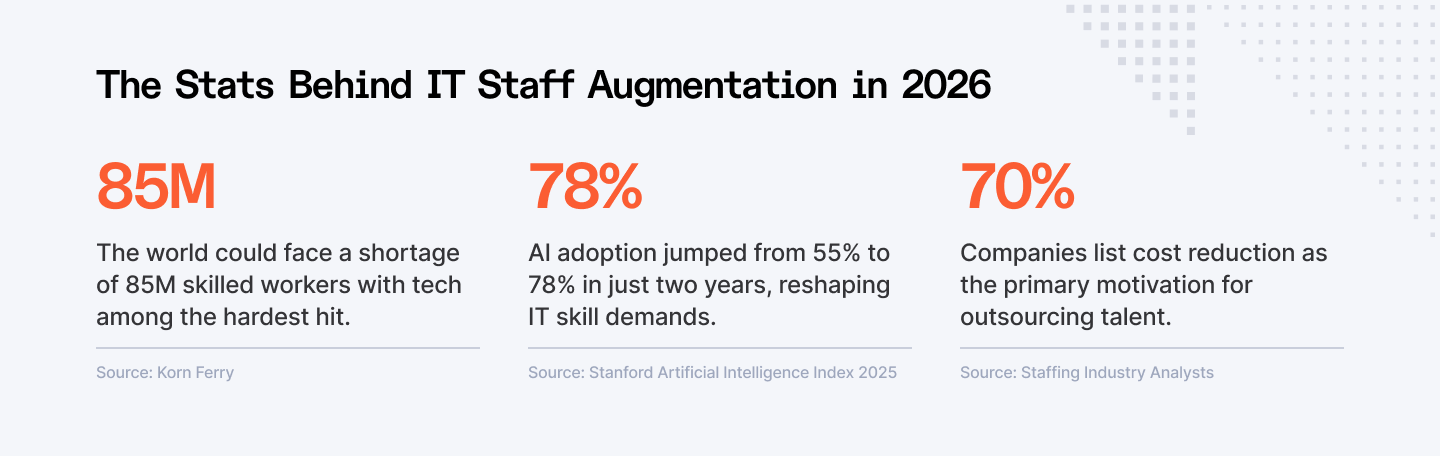
Hiring full-time is expensive. Training takes time. And the global IT talent shortage isn't getting better anytime soon. According to Korn Ferry, the world could face a shortage of more than 85 million skilled workers by 2030, with the technology sector among the hardest hit.
So companies are doing what smart businesses do: they're adapting. IT staff augmentation has emerged as one of the most practical responses to this challenge. Instead of scrambling to fill permanent roles, you bring in skilled professionals exactly when you need them, for as long as you need them, without the overhead of a full-time hire.
Struggling to find the right tech talent? Index.dev gives you access to verified engineers, complete teams, and AI-enabled talent that ships 70% faster, at flat, transparent pricing.
Why Companies Are Turning to Staff Augmentation
Finding skilled IT talent has become one of the biggest headaches for companies today. According to HCAMag, 77% of employers worldwide struggle to find the right people, and in tech, that number jumps to 78%.
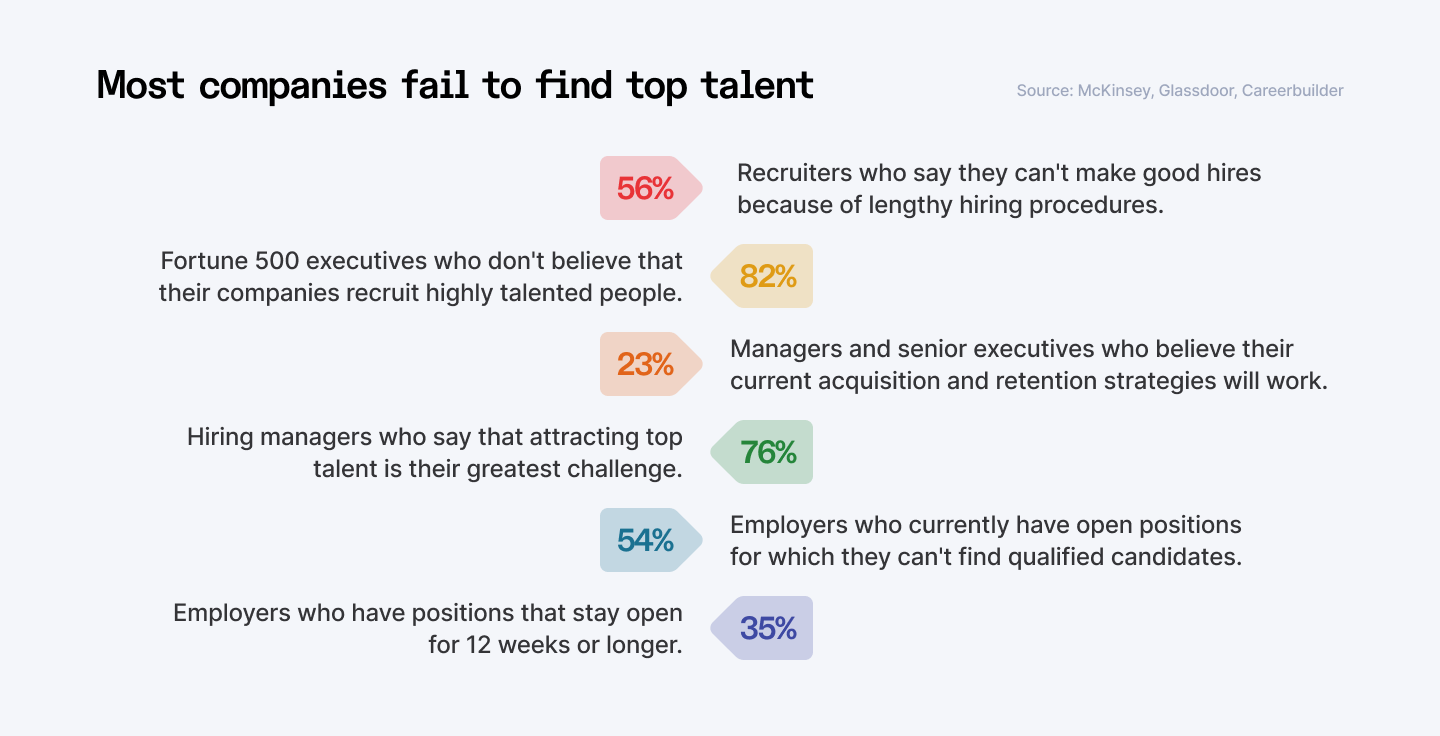
Cybersecurity engineers, AI specialists, multi-cloud DevOps pros — these people don't sit on the market for long. Traditional hiring can’t keep up. It can take three to six months just to get someone productive. By the time you finally hire, the market has moved on.
That's exactly why engineering leaders are rethinking how they build teams. IT staff augmentation solves three problems at once:
- Access. Top augmentation providers already have relationships with the specialists you need. Instead of months of recruiting, you get talent in weeks. Sometimes faster.
- Speed. Augmented engineers slot into your existing workflows from day one. There's no long ramp-up, no learning curve on how your team operates. They come ready to contribute.
- Cost control. This might be the most underrated benefit. Augmentation turns fixed payroll costs — salaries, benefits, equity, overhead — into flexible, project-based spending. You scale up for a product launch. You scale back after the release. No layoffs, no restructuring, no awkward conversations.
The Talent Crunch: Key Hiring Metrics in IT and Technology 2026
Demand is outpacing supply, costs are climbing, and the gap is widening. Here's what you need to know.
The ‘unfillable’ roles
Some roles are nearly impossible to fill fast. The most difficult positions to hire for in 2026 include AI/Machine Learning engineers, cybersecurity specialists, and data scientists. Full-stack and systems engineers also surface as persistent pain points. These aren't niche roles. They are foundational to virtually every tech‑enabled initiative today: AI, automation, cybersecurity, cloud platforms, and data‑driven products.
The reason they're so hard to fill comes down to a simple equation: the skills required are evolving faster than the talent pool is growing. Universities aren't producing enough graduates. Bootcamps can't close the gap. And the professionals who do have these skills? They already have offers.
The global talent shortage
Companies report large gaps between the open jobs they have and the people available to fill them. Bain and Company reports that demand for AI skills has grown 21% annually since 2019 and expects the shortage to persist through at least 2027. The firm estimates that up to half of all AI jobs could remain unfilled by then. Gartner takes it further, predicting that by 2030, 75% of organizations will face disruption due to insufficient AI talent. Meanwhile, capital keeps flowing. Goldman Sachs forecasts global AI investment approaching $200 billion. The money is there. The people aren't.
The time-to-hire
Time matters more than ever. For tech roles globally, the average time to hire sits at around 45 to 60 days. For specialized roles like ML engineers or cloud security architects, that timeline stretches even further, sometimes beyond three months from the moment you post the job to the moment someone starts contributing.
Every week that role sits open is a week your project slips and your team carries extra load. It's no coincidence that this metric alone is one of the biggest drivers behind the shift toward staff augmentation.
The cost of hiring
According to SHRM, the total cost to hire a new employee can be three to four times the position's salary. That means if you're hiring for a job that pays $50,000, you may spend $150,000 or more to fill that role. For specialized tech roles, add another 20 to 30% in onboarding, tooling, and ramp-up costs before that person is genuinely productive. When you factor in economic volatility, rapid AI adoption, and the risk of a bad hire, the financial case for staff augmentation becomes hard to argue with.
⭢ Know what the market looks like. Explore the top 10 most in-demand IT jobs.
Key Trends Driving IT Staff Augmentation in 2026
1. AI‑enabled talent is core to how teams work today
The real shift now is about who you bring in and how they work. It’s about bringing in people who use AI as a force multiplier in their daily workflows. According to Stanford’s Artificial Intelligence Index 2025, 78% of organizations are using AI, up from 55% just two years earlier. That’s mainstream adoption. And it’s reshaping what it means to be “skilled” in IT.
Today, the most valuable augmented team members are people who understand how to use AI to design systems, write better code faster, debug more effectively, optimize performance, and even anticipate problems before they surface. They think with AI, not around it.
2. Cybersecurity talent is in high demand
With AI-powered threats becoming the norm, the gap in specialized security talent has hit a global deficit of nearly 4 million professionals. Security isn’t just IT’s problem anymore. Breaches hit your finances, reputation, and customers. Companies in fintech, healthcare, and SaaS know this better than anyone. Roles in cloud security, endpoint protection, data privacy, and zero-trust frameworks are in highest demand. Staff augmentation gives you immediate access to cybersecurity professionals. Instead of a generalist, you can bring in a specialist for exactly what your roadmap demands right now:
- Cloud Security Engineers: To harden your multi-cloud infrastructure.
- Compliance Architects: To navigate the shifting sands of GDPR, SOC 2, and new AI-specific regulations.
- Vulnerability Management Experts: To find the gaps before the bad guys do.
3. AI‑powered IT staffing is the new reality
Finding the right engineer used to mean weeks of manual resume screening, back-to-back interviews, and gut-feel decisions. AI is changing that, and fast. AI-powered staffing platforms now match candidates to roles based on actual skills, code repositories, past project histories, and team fit, not just scan for ‘Java’ or ‘Python’ The result is better hires with higher certainty. The adoption numbers back this up. In the U.S. alone, about 80% of US organizations were expected to integrate AI into HR and recruitment functions by 2025.
4. The age of multi-cloud and multi-skill teams
Single-cloud strategies are largely a thing of the past. Today's engineering organizations run workloads across AWS, Azure, and Google Cloud simultaneously, choosing each platform based on capability, cost, and risk. But it creates a real hiring challenge. Companies are no longer augmenting one skill in isolation.
They're looking for cross-functional professionals who combine expertise across Salesforce, AWS, Azure, MuleSoft, and AI integration, people who can operate across projects without needing constant context-switching support from your core team.
Organizations that rely on Salesforce for customer management often implement a Google Analytics integration with Salesforce to connect website engagement data with CRM records and improve cross-functional reporting.
What's also changing is the unit of augmentation itself. It used to be about bringing in an individual contributor to fill a gap. Increasingly, the most effective augmentation providers are delivering structured teams, groups that already have established working rhythms, complementary skills, and clear collaboration patterns.
5. New AI roles are shaping the future of tech teams
Two years ago, ‘Prompt Engineer’ wasn't a job title. Today it's one of the fastest growing roles in tech. According to a 2025 jobs report, AI Engineer roles have grown 143% year over year. AI Solutions Architect positions are up 109.3%. These are new ways of working. The way you write job descriptions, evaluate candidates, and plan your team's capacity needs to change.
The new profiles worth understanding:
- AI Engineer builds and deploys machine learning models and AI-powered systems at scale.
- Prompt Engineer designs and refines the inputs that guide generative AI, a skill that's become surprisingly nuanced and genuinely valuable.
- AI-Assisted Developer is your traditional full-stack engineer, but one who uses tools like GitHub Copilot or Claude to ship faster and at higher quality.
Upskilling your existing team matters too. A healthcare analyst learning to work with predictive models creates more value than hiring an ML engineer who doesn't understand patient care workflows.
6. Outcome-based engagement beats hourly billing
We are seeing a massive migration toward outcome-based engagement models. According to recent market data, outcome-linked agreements jumped to 18% of all new IT contracts this year, nearly double what we saw just two years ago. Instead of tracking hours, you define what success looks like: features shipped, bugs resolved, performance benchmarks hit. Compensation is tied to delivery, not duration. Costs become predictable. Accountability becomes clear. And your vendor now has a direct financial incentive to work efficiently, because the faster they deliver quality results, the better their margins.
7. Nearshore is having its moment
Remote work proved that geography doesn't define talent. But it also revealed something that anyone who's managed a distributed team already knew: time zones matter more than people admit. A mere one-hour increase in time zone difference can reduce synchronous communication by 11%. Extreme differences slow collaboration and create friction. That’s why nearshore staff augmentation is on the rise, especially Latin American teams supporting North American clients. And the cost advantage is real. Nearshore rates typically run 30 to 50 percent below comparable North American talent. That's significant savings without the communication overhead that often quietly eats into the value of cheaper offshore options.
8. Augmentation as a learning strategy
When you treat augmentation purely as a resourcing solution, the knowledge leaves when the contract ends. When you treat it as a deliberate learning opportunity, your internal team grows alongside the engagement. Deloitte's 2024 Global Human Capital Trends report found that organizations prioritizing workforce learning and internal capability building are 1.5 times more likely to anticipate change effectively and respond with agility. That edge compounds over time.
Structure your augmentation engagements so knowledge transfer is built into the scope. Pair external specialists with internal team members. Document what gets built and why. Make capability building part of the success criteria.
9. The Fractional Leadership surge (on-demand C-suite)
In 2026, the traditional full-time CTO is no longer the only way to steer a tech ship. We are seeing a massive rise in Fractional Leadership, where high-growth companies bring in a veteran "CTO-as-a-Service" for 10 hours a week instead of 40. A series A startup often doesn't need a $300,000-a-year executive to manage daily tickets; it needs that executive’s architectural wisdom and network. Fractional augmentation lets you "rent" the brain of a leader who has scaled three unicorns already. They provide the roadmap, mentor your senior devs, and secure your infrastructure, then move on when the foundation is solid.
⭢ See how hybrid talent models are redefining the mix of full-time, contract, and fractional experts.
Industry-Specific Staff Augmentation Trends
Not every industry faces the same talent challenge. The pressures shaping hiring in fintech look very different from those in healthcare or e-commerce. Here is how the most competitive sectors are surgically using talent this year:
SaaS & Cloud
Speed is everything in SaaS. Teams scale up and down weekly to match agile release cycles, and there's no room for slow hiring processes. With the cloud market projected at $950B by 2026, containerization, service mesh, and cost-optimization skills are crucial. Organizations are augmenting DevOps specialists, site reliability engineers, and containerization experts who can contribute immediately without a long ramp-up.
Fintech
Fintech operates under a dual mandate that most industries don't face: innovate fast and stay compliant.
With the sector growing at 4.5% annually, demand is concentrated around cybersecurity specialists fluent in PCI DSS and GDPR, blockchain developers for modern payment infrastructure, and DevSecOps engineers who bake security directly into CI/CD pipelines. Augmentation lets you innovate quickly while staying audit-ready.
E-Commerce
Leading retailers scale their frontend engineering capacity by 40 to 60% ahead of peak periods, bringing in performance optimization specialists who handle traffic spikes without breaking the experience. With six in ten shoppers preferring mobile apps, and AI-powered recommendation engines now standard, the skills required are increasingly specialized. Augmentation delivers them precisely when needed, then scales back without the disruption of layoffs when the season ends.
Healthcare
Healthcare might be the most compliance-intensive environment in tech. Every line of code that touches patient data carries regulatory weight. HIPAA-compliant developers, telehealth platform engineers, and interoperability specialists working with HL7 and FHIR standards are in high demand. Augmented teams with the right regulatory and technical background are often the only realistic way to staff them without permanent overhead.
⭢ Find out which 5 industries are on the edge of an AI transformation.
The Business Case for IT Staff Augmentation
According to Staffing Industry Analysts, 36% of businesses report IT augmentation assignments lasting between 18 and 23 months. That's a sustained approach to building team capacity. And approximately 70% of companies cite cost reduction as their primary motivation for outsourcing talent.
Here's what you actually get when you do this right:
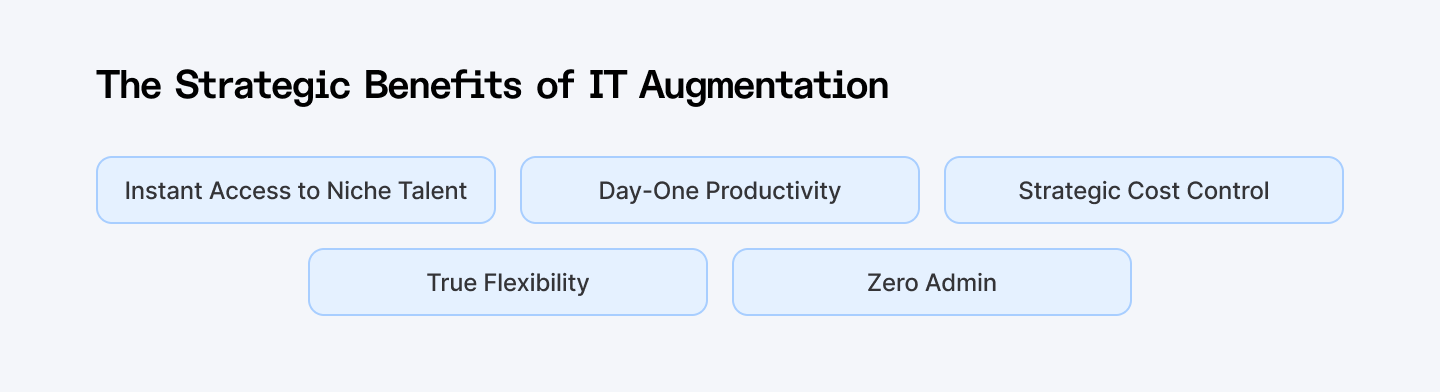
- Flexibility that matches reality. Project needs change. Budgets shift. Priorities evolve. IT Staff Augmentation Services lets you scale your team up or down without the organizational friction that comes with permanent headcount decisions. You staff for what you need today, not what you might need in two years.
- Niche skills. Geography no longer limits who you can work with. Niche skills that don't exist in your local market, whether that's a FHIR integration specialist or a multi-cloud DevOps architect, are accessible through augmentation.
- Real cost efficiency. You pay for skills, not overhead. No benefits packages, no equity negotiations, no training budgets for roles that may only be needed for one product cycle. The savings are significant, and they're predictable.
- Reduced administrative burden. Payroll, taxes, compliance, HR paperwork. Your augmentation partner handles it. You stay focused on building.
- Lower risk across the board. If a project changes direction or a skill set is no longer needed, you adjust without the legal, financial, and human complexity of letting a permanent employee go.
Used strategically, staff augmentation is one of the most efficient ways to build capable, agile, high-performing teams in a market where talent is scarce and speed matters.
Conclusion
With tech skills now having a shelf life of just 2.5 years, the traditional five-month hiring cycle is a bottleneck. IT staff augmentation has evolved from a tactical backup plan into a strategic leadership lever. Whether you’re injecting AI-native developers into your workflow, scaling up a nearshore security pod for a compliance deadline, or bringing in fractional expertise to handle a cloud migration, you are building an organization that is flexible by design.
This Is Where Index.dev Comes In
If you’ve just raised a new round—whether it’s Seed, Series A, or beyond—you are in a race against time. You need a software delivery partner who can protect your runway while actually hitting your product milestones. Index.dev doesn't just find you a contractor; it provides the engineering capacity you need to win.
- AI-enabled, verified talent. Every engineer in our network is rigorously verified for technical skill, communication, and real-world delivery experience. They work with modern AI-assisted development tools as a baseline. That means faster shipping cycles, higher output quality, and a team that compounds its own productivity over time.
- Complete teams, ready to build. From senior engineers and tech leads to QA specialists, product managers, and DevOps architects, we assemble the full team your product needs.
- Engineering capacity that scales with you. Whether you need to move fast on a product launch, expand capacity after a funding round, or bring in specialist expertise for a defined phase, we scale with your roadmap.
- Flat, transparent pricing. No hourly surprises, no hidden fees, no invoices that require a spreadsheet to decode. You know what you're paying, what you're getting, and what success looks like before the engagement begins.
- A network that runs deep. With access to a wide global talent network spanning key nearshore and offshore markets, we find the right people faster than a traditional search ever could.
If your company has the vision, the funding, and the roadmap, Index.dev provides the engineering muscle to execute on it. Get in touch at Index.dev!