If you are a CTO or a Head of Engineering in a major bank or healthcare system, you already know the weight of your ‘run’ budget. Right now, global enterprises are essentially bleeding capital just to stand still. On average, you are likely spending 70% to 80% of your entire IT budget simply keeping legacy systems on life support.
Think about that. For every dollar you get, only twenty cents goes toward the future. The rest is a tax paid to outdated code and crumbling infrastructure.
For years, we treated modernization as a nice-to-have incremental goal, something to tackle when the technical debt became too loud to ignore. But the age of AI has changed the math. You cannot bolt a high-performance AI engine onto a mainframe chassis. If your data is locked in silos and your logic is buried in undocumented COBOL or legacy Java, your AI strategy is dead on arrival.
So, how do you modernize the systems that are too big to fail and too complex to replace overnight?
In this article, we’ll dive into three proven strategies to modernize your legacy estate without putting your core operations at risk. We are going to move past the hype and look at what it takes to get your organization ready for what comes next.
Accelerate your program, own key workstreams, or build new systems with the right engineering capacity. Let’s talk about your modernization roadmap →
Why modernize legacy systems
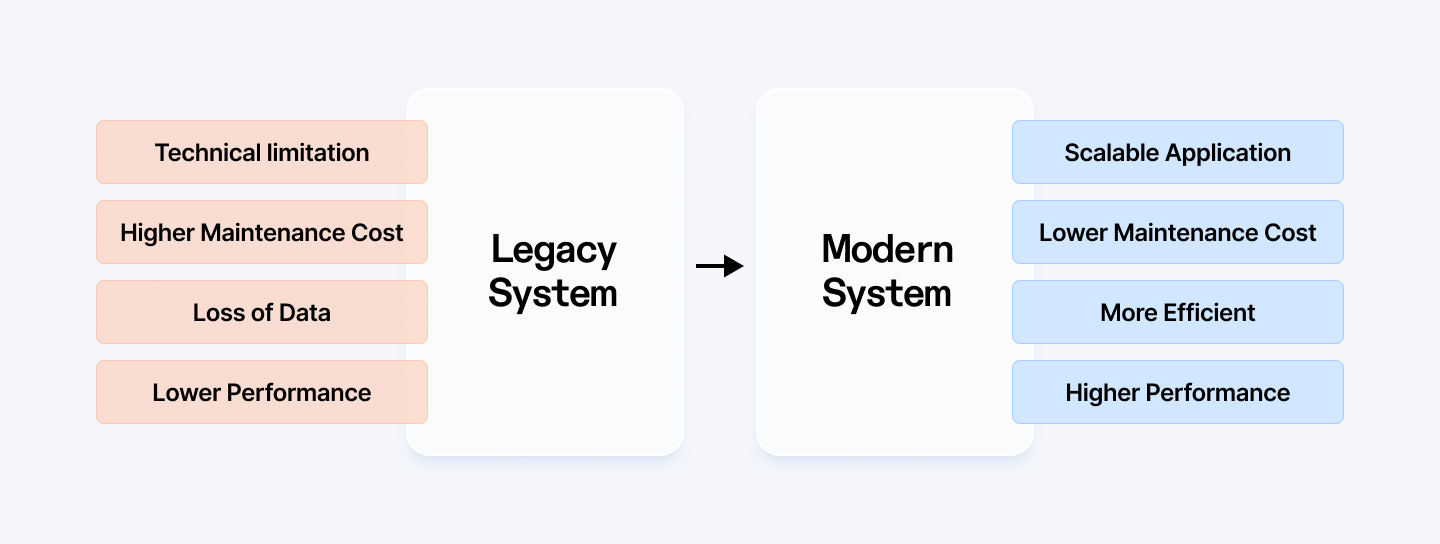
Legacy systems are now out of step with how modern companies need to operate. They are harder to integrate, slower to change, and more exposed to security risk than systems designed for cloud, mobile, and security by design. When the core code is old and brittle, even a small change can turn into a long, expensive project. In most legacy environments, the system is the documentation — and when key people leave, that knowledge walks out with them. In fact, 42% of critical business logic in legacy systems is at risk the moment key personnel exit.
The hidden cost runs deeper than maintenance invoices. McKinsey found that technical debt accounts for as much as 40% of organizations' total technology estate value, eroding enterprise value while generating zero business return. Developers are spending a third of their time on maintenance alone — not on features, not on innovation, not on the AI capabilities your business strategy depends on. And you can't attract strong engineering talent to a codebase that makes their best skills irrelevant.
Every day you delay modernization, your business is losing ground in five critical areas:
- Speed to market: You cannot launch new revenue streams or digital channels if your back-end systems require six months of integration work for a simple feature update.
- The talent gap: The best engineers want to build the future, not spend their careers patching the past. If your tech stack is outdated, you will struggle to attract and keep the talent you need to innovate.
- Data paralysis: AI thrives on clean, accessible data. If your data is trapped in a legacy silo, you are effectively “data rich but insight poor.” You can't build data-driven services when data sits fragmented across systems that can't talk to each other.
- Security at scale: Modern security models like Zero Trust are nearly impossible to implement on legacy architectures. You are essentially trying to put a high-tech security system on a house with no locks on the doors.
- AI adoption: You can't adopt AI in any meaningful way when your architecture wasn't designed to support it. 68% of organizations report that legacy systems are actively obstructing their AI adoption.
➡︎ Learn more about the barriers to AI adoption and what effective leaders do to fight back.
Core Strategies to Legacy System Modernization
Strategy 1: AI-Augmented Incremental Modernization
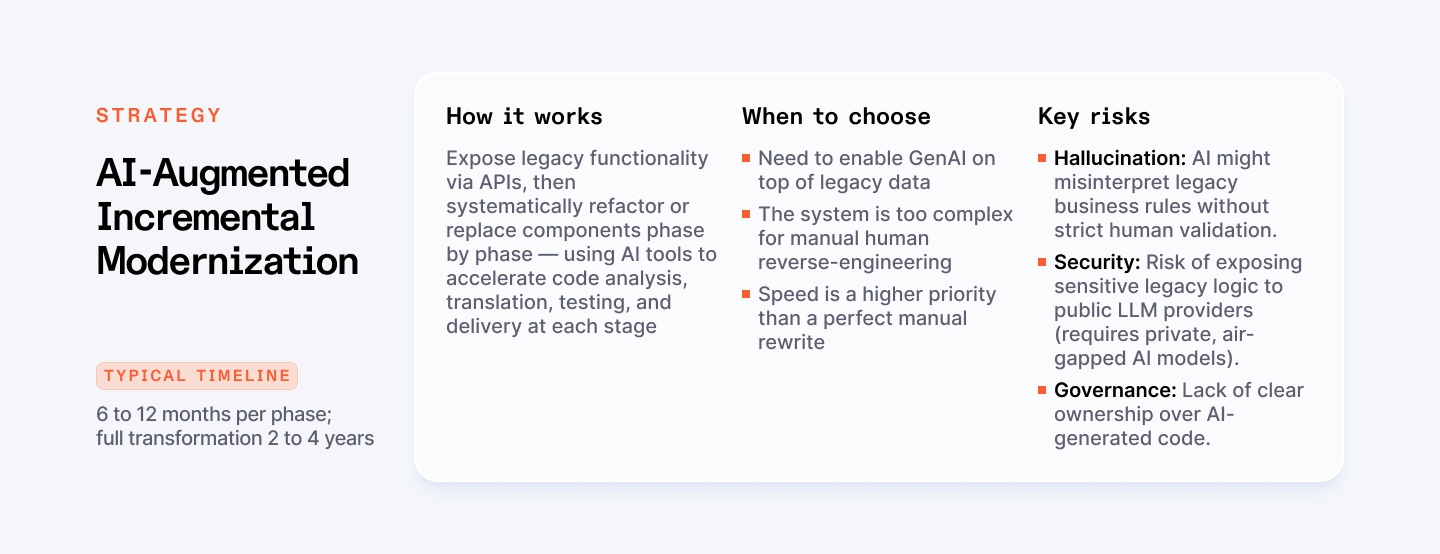
Most organizations don't need to tear everything down to move forward. What they need is a way to make progress without stopping the business, and that's exactly what AI-augmented incremental modernization offers.
The core idea is straightforward:
You keep existing systems running while gradually replacing or refactoring what's holding you back. You modernize in stages, prioritizing the parts that create the most risk or slow down your teams the most.
This approach works best when you have many systems, many handoffs, and too much manual effort hidden inside your IT processes. AI can help teams analyze old code, map dependencies, summarize logs, draft API specs, assist with testing, and speed up documentation.
In banking, the pressure is acute. COBOL-powered mainframes process an estimated 70% of global banking transactions, yet the developers who understand that code are retiring faster than they can be replaced. Citigroup has already deployed AI coding assistants to 30,000 developers as part of its modernization effort. Banks that haven't started are falling behind — not just in efficiency, but in their ability to compete on speed.
Traditional banks typically take 12 to 24 months to launch new products, compared to 3 to 6 months for fintechs. That gap doesn't close without modernizing the systems underneath. For financial institutions, core banking transformation is becoming essential to modernize underlying infrastructure while maintaining continuity across critical financial services.
Generative AI changes the equation in two important ways:
First, it helps teams understand code that no one fully documents anymore. Tools like IBM watsonx Code Assistant, Claude Code, or Codex can analyze millions of lines of legacy code, map interdependencies, extract business logic, and generate modern equivalents in Java or Python — tasks that previously required months of specialist work. Nearly three-quarters of enterprises are now using generative AI tools to help modernize mainframe applications, according to IBM's latest survey of global technology executives.
Second, AI accelerates the delivery work itself. Research has shown a 55.8% increase in developer performance when using GitHub Copilot on defined programming tasks. When you're managing a modernization program spanning multiple phases over several years, that kind of productivity gain compounds significantly.
But tools alone don't deliver the outcome. Forward-thinking CIOs are using generative AI to go beyond basic code generation — analyzing legacy systems, extracting business rules, and automating processes end-to-end. This requires rethinking operating models with AI-integrated workflows. The technical work and the organizational work have to happen together.
When to choose this strategy
- Your core system still works but is too rigid to evolve — small changes take too long, carry too much risk, or require specialists you can barely find.
- You can't pause operations for a migration window, and a big-bang replacement would put critical services at risk.
- You need to show tangible progress quickly, either to build internal buy-in or to justify a broader modernization budget.
What it requires
You need a modern engineering base, even if the core systems are still old. That usually means source control, CI/CD, test automation, logging, observability, and a secure way to connect internal data to AI tools.
Typical teams use API layers, code analysis tools, event data, and controlled AI assistants for tasks like documentation, test generation, dependency mapping, incident summarization, and migration planning. The most effective setup usually includes platform engineering, application engineers, security, data governance, and a few senior domain experts who know where the real system risk sits.
The stack is usually a mix of Git-based workflows, cloud or hybrid infrastructure, API gateways, observability tools, LLM access with guardrails, and data controls for privacy and compliance. In regulated sectors, human review stays mandatory. AI should accelerate decisions, not replace accountability.
⭢ Up next, explore the 6 key barriers blocking enterprise AI adoption and what leaders can do to overcome them and move faster with AI.
Strategy 2: AI-Driven Core Replatforming
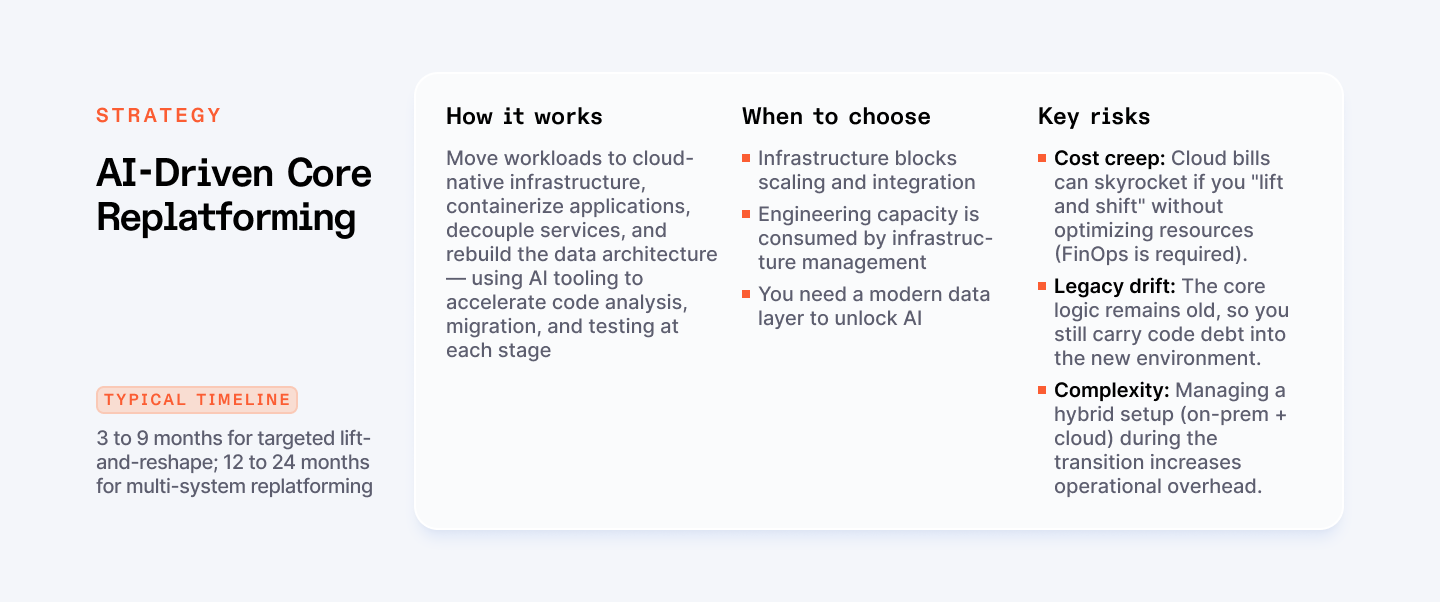
Sometimes the problem isn't the logic inside your systems. It's the infrastructure underneath them. Your core functionality works, but the platform it runs on can't scale, can't integrate with modern tools, and can't support the data or AI capabilities your business increasingly depends on. That's when replatforming makes sense.
Unlike incremental modernization, which works at the component level, replatforming addresses the structural layer: moving workloads to cloud-native environments, decoupling tightly bound services, containerizing applications, and rebuilding the data architecture so it can serve AI and real-time operations. Done well, it's the closest thing to a clean foundation without the risk of a full rebuild.
What's changed is that AI tooling has made this approach substantially faster and cheaper than it was just a few years ago. When Amazon applied AI-assisted transformation to its own internal systems — migrating tens of thousands of production applications to Java 17 — the average time to upgrade a single application dropped from 50 developer days to just a few hours. The result was an estimated $260 million in annualized efficiency gains, with developers shipping 79% of auto-generated code reviews without any additional changes. That's the scale of what changes when AI handles the mechanical work of migration.
The case for replatforming is especially strong in banking and financial services, where the infrastructure problem is acute and the cost of standing still is rising fast. Financial institutions that have adopted cloud-native microservices architectures report deployment frequency improving by up to 61% and time-to-market for new features decreasing by an average of 53% compared to traditional monolithic systems. For a sector where launching a new product takes 12 to 24 months under legacy constraints, those are meaningful competitive gains. Banks adopting cloud-native technologies have reduced their total cost of ownership by up to 40% compared to traditional systems.
One of the most underappreciated reasons to replatform is what it unlocks for AI and data. Most legacy environments were not designed for distributed data ownership, real-time ingestion, or the kind of structured, accessible data that AI models require to deliver value. Replatforming is the moment to fix that. Organizations with strong system integration achieve 10.3 times the ROI from AI initiatives compared to those with poor connectivity — a gap that traces directly back to architectural decisions made at the infrastructure layer.
The risks are real though. PwC's Financial Services Industry Survey found that 54% of executives cite integration complexity as the primary barrier to technology initiatives, and 43% have already delayed or reduced major technology investments because of it.
Replatforming without proper refactoring tends to recreate the same inefficiencies in a new environment: The cloud version of a legacy system is still a legacy system.
When to choose this approach
- Your core business logic is sound, but outdated infrastructure blocks your ability to scale, integrate with modern tools, or move to the cloud.
- Your operations team spends more time managing infrastructure than enabling product delivery — you're losing engineers to maintenance rather than building.
- You need a viable data layer to support AI and analytics initiatives, and your current architecture can't provide it.
What it requires
Technically, replatforming centers on containerization and orchestration. Kubernetes is the standard for managing workloads at scale. Teams migrate applications to cloud platforms (AWS, Azure, GCP) using infrastructure-as-code tools like Terraform or Pulumi to make environments reproducible and auditable. CI/CD pipelines (GitHub Actions, ArgoCD) handle deployment automation. For financial institutions running complex data environments, event streaming platforms like Apache Kafka become the connective tissue between services, enabling real-time data flow that legacy systems couldn't support.
Organizationally, this approach works best when product, engineering, security, and operations are aligned early. You need clear ownership of data migration, dependency mapping, cloud cost control, and compliance. Without that, replatforming can simply move old problems into a new environment.
Strategy 3: Agentic AI-Led Business Transformation
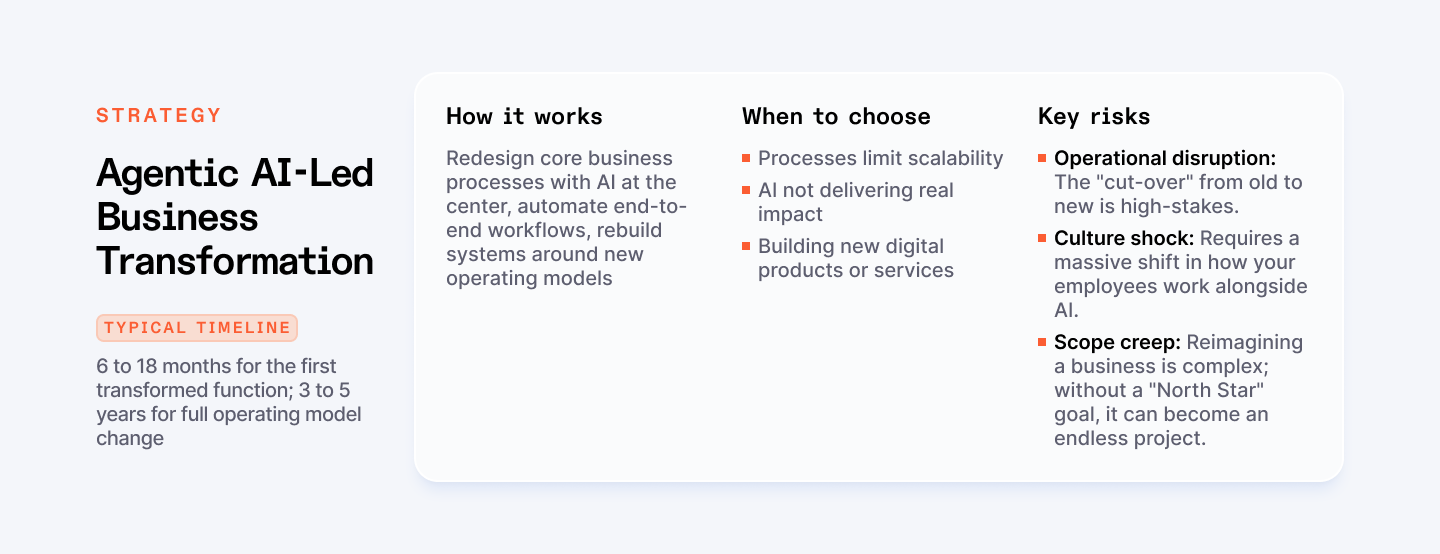
The first two strategies ask a version of the same question: how do we modernize what we have? This one asks a different question entirely:
What should your business look like when it's rebuilt around what AI can now do? This is the most ambitious path. Rather than automating existing processes with AI, you reimagine the processes themselves. You don't digitize the old workflow. You question whether the workflow needs to exist in its current form at all. The result is a genuinely new operating model.
The case for going this far is getting harder to ignore. A 2025 MIT Technology Review survey of 250 banking executives found that 70% of institutions are already using agentic AI in some form — 16% with live deployments and 52% through active pilots. The early results are substantial. A 2024 Gartner report found that more than 40% of global banks already use agentic AI across compliance, payments, and risk management, with early adopters reporting up to 50% faster processing times. And according to McKinsey, agentic AI in banking operations is already enabling zero-touch workflows and reducing manual workloads by 30 to 50%, with that impact expected to compound as adoption scales. In 2025 alone, 50 of the world's largest banks announced more than 160 agentic AI use cases.
What makes this different from earlier waves of automation is the scope of what AI agents can now handle. In banking, processes like KYC onboarding, loan approvals, compliance reviews, and fraud monitoring used to require sequential human steps bottlenecked by legacy systems. Agentic AI allows KYC to be reimagined entirely, no longer constrained by sequential processing. Agents can perceive transaction data, reason against regulatory policy, coordinate across departments, and act, all within defined governance guardrails.
But this path demands more than technology decisions. It requires organizational redesign, strong product ownership, and disciplined governance. Unlike previous technology waves, success with agentic AI requires an organization-level mindset shift and a fundamental rewiring of how work gets done, and by whom. The organizations that stall here are usually not short on ambition. They're short on the readiness to act at that scale. BCG and McKinsey consistently find that 70% of digital transformation initiatives fail to meet their objectives. The most common reason isn't the technology, it's culture and organizational alignment. That is worth sitting with. The boldest modernization approach carries the highest risk not because the AI doesn't work, but because organizations underestimate what has to change around it.
Most successful organizations start function by function — reimagining a high-value, well-understood process like loan origination, compliance reporting, or customer service triage, proving ROI, then expanding. They start with simpler agentic systems addressing specific process needs, then scale over time to automate larger workflow components, avoiding the complexity trap that can derail ambitious projects.
When to choose this approach
- Your legacy system is no longer viable: maintenance costs are unsustainable, code ownership is concentrated in one or two people, or previous modernization attempts have stalled.
- Your competitive position depends on a fundamentally different operating model, not just faster delivery of the same processes.
- You have executive alignment, product ownership, and the organizational capacity to see a multi-year program through.
What it requires
Technically, this approach requires building on modern foundations from the start: cloud-native infrastructure, event-driven architecture (Kafka or Pub/Sub for real-time data flow), and an API layer that connects business capabilities as composable services. AI agents are typically orchestrated using platforms like LangChain, AWS Bedrock Agents, or Microsoft Azure AI Foundry. The data architecture matters enormously, which means investing in clean, structured, real-time data pipelines before scaling any agentic workflow.
Organizationally, you need cross-functional product teams that include engineers, domain experts, compliance leads, and AI specialists working in tight cycles. This approach is expensive and slow, so governance matters. You need clear scope, phased delivery, and a plan for cutover, rollback, and data validation. Without that discipline, full rebuilds can become very long, very costly programs with uncertain payoff. 72% of financial institutions now have executive-level accountability for AI adoption, and 24% of AI applications already operate with partial autonomy under human supervision.
⭢ Learn more about the 5 core elements of successful AI adoption and how top teams consistently turn AI into real business impact.
Embedding security into modernized systems
Modernization is not a security reset by default. If you treat security as something to add once the new system is live, you'll carry old vulnerabilities into new infrastructure and create new ones along the way.
Legacy systems face three times more cyberattacks than modern ones, largely because they can't be patched quickly, can't be segmented effectively, and often run on unsupported software with no vendor remediation path. When you modernize, that attack surface doesn't disappear on its own. Transitional periods — migrations, hybrid environments, data movement between systems — are when organizations are most exposed.
The financial stakes are real and rising. In the United States, the average cost of a data breach hit $10.22 million in 2025, an increase of 9% from the prior year. In financial services, where legacy infrastructure is most concentrated, breach costs consistently run higher than any other industry. And the timelines for detection remain alarming. Organizations spent on average 241 days from breach to containment.
The good news is that security embedded early pays off measurably. Organizations using AI and security automation extensively identified and contained breaches 80 days faster and saved an average of $1.9 million per incident compared to those that didn't. IBM's 2025 report identifies a DevSecOps approach as one of the top cost-mitigating factors, which means integrating security checks into every phase of development rather than reviewing them after delivery.
In practice, embedding security into modernization means three things.
- First, shift left with DevSecOps. Automate security testing in your CI/CD pipeline so vulnerabilities are caught during development, not in production.
- Second, design for Zero Trust from the start. Assume breach, enforce least-privilege access, segment services, and require identity verification at every layer.
- Third, govern your data movement. Many of the most costly breaches stem from gaps in oversight during cloud migrations and AI implementations, when large volumes of sensitive data move between legacy systems, cloud platforms, and AI pipelines without adequate controls.
You are no longer securing a system after it is built. You are building a system that is secure by default.
Guiding principles for engineering the AI future
Most modernization efforts fail for one simple reason. They try to do everything at once. To avoid that, leaders need to think in principles, not projects.
1. Separate operational systems from product innovation.
- Not everything in your tech estate should evolve at the same speed. Operational systems keep the business running. Product systems create growth. Mixing the two slows both down. You need to clearly decouple them. Stability first for operations. Speed and experimentation for products. This separation is what allows banks and large enterprises to modernize without disrupting core revenue systems.
2. Start where value is already visible.
- Not all systems carry the same strategic weight. A mature organization does not modernize everything at once. It focuses where the impact is highest and risk is lowest. That might be customer service automation before core banking systems. Or claims processing before underwriting engines. Start with what moves the business now, not what looks ideal on paper.
3. Choose build, buy, and AI orchestration deliberately.
- There is no single right answer anymore. Some capabilities should be built. Some should be bought. Increasingly, many are orchestrated using AI and modular services. The key is speed with control. A hybrid approach allows you to integrate modern capabilities without locking yourself into long rebuild cycles. This is especially relevant in banking and healthcare, where vendor ecosystems, compliance requirements, and legacy dependencies are deeply intertwined.
From modernization to transformation
In 2026, the speed of business is dictated by the speed of your tech stack. If your infrastructure is an anchor, you will lose. If it is a launchpad, you will lead. Success today is measured by three simple metrics: Speed to market, product differentiation, and system integrity. These are the primary drivers of shareholder value.
How Index.dev helps enterprises modernize legacy systems
Most organizations facing a legacy modernization program don't have an engineering problem on paper. They have a capacity problem in practice. The internal teams that understand the existing systems are already stretched keeping them running. Hiring senior engineers with the right combination of legacy knowledge, cloud-native experience, and AI capability takes months, time most modernization programs don't have.
That's exactly the gap Index.dev fills.
We give banks, healthcare organizations, manufacturers, and technology companies access to senior engineers (people with 5 to 8 years of focused experience) who can step into a modernization program and contribute from week one. Whether that means embedding engineers directly into your team to accelerate delivery, or taking ownership of a specific product or capability end-to-end, we adapt to what the program actually needs.
And we've done this in practice. For MyBackHub, we assembled a team that successfully developed and launched an AI-enabled, and personalized spine-care navigation platform designed to help individuals understand, manage, and recover from back pain and scoliosis from home. Clinical results show 31% pain reduction in six weeks and prevention of 1 surgery for every 9 users.
Where Index.dev fits
We support companies across three critical layers of transformation:
1. Legacy system modernization
You are not replacing everything at once. You are gradually decoupling, refactoring, and rebuilding core systems.
Index.dev engineers help teams:
- Break monolithic systems into modular services
- Build APIs to expose legacy functionality safely
- Refactor critical components without disrupting operations
- Support phased cloud migration and replatforming
This is especially relevant in banking and insurance, where systems cannot go offline and change has to be controlled.
2. AI and data modernization
Modernization today is not complete without AI readiness.
We help teams build:
- Data pipelines and lakehouse architectures
- Real-time event processing systems
- AI-ready data structures and feature stores
- Agent-based workflows and orchestration layers
This is the layer where most enterprises struggle, especially when data is fragmented across decades of systems.
3. AI product and workflow engineering
Beyond infrastructure, companies are now rebuilding how work gets done.
Index.dev engineers help design and build:
- AI copilots for internal operations
- Automation systems for customer service and claims
- Decision-support systems for risk, fraud, and pricing
- LLM-powered enterprise applications
This is where modernization becomes business transformation.
How to help by industry
For banks
Index.dev can provide engineers for core banking modernization, API enablement, security hardening, data platform work, and AI assisted process improvement. This matters because banks are under pressure to move faster while staying compliant and secure.
For healthcare
Index.dev can support platform modernization, interoperability, patient data workflows, AI enabled operations, and secure cloud migration. The need is especially strong where legacy systems block data exchange and slow down digital patient experiences.
For manufacturing
Index.dev can help with industrial software modernization, connected systems, internal tools, IoT adjacent platforms, and AI driven operational visibility. This is where engineering capacity often determines whether modernization remains a plan or becomes a real delivery program.