Product managers, engineering leaders, and CTOs are continually seeking methods to reduce delivery times while maintaining high team efficiency and ownership. The POD model is emerging as a go-to framework for modern product teams seeking to expand innovation while maintaining agility.
Unlike traditional models, PODs are outcome-driven and cross-functional by design, allowing for faster releases, improved stakeholder alignment, and increased team responsibility.
In this post, you'll learn about six important benefits of the POD model, as well as real-world examples from organizations like Google, Spotify, and Accenture that have used PODs to improve product velocity and growth.
Need a high-performing POD-ready team? Hire top 5% vetted talent with Index.dev to reduce project timelines and save thousands in development costs.
What Is the POD Model?
A POD is a small, self-contained, cross-functional team designed to produce a full product or feature with few external dependencies. Each POD normally consists of a product manager, designer, frontend and backend engineers, QA, and, on occasion, a data analyst or DevOps engineer, depending on the product scope.
Unlike typical team structures that operate in functional silos, PODs control the whole development lifecycle, from conception to deployment. This promotes accountability, speed, and customer-centric innovation, allowing teams to move and learn quicker.
PODs frequently use agile cycles and are governed by outcome-based goals like KPIs or OKRs rather than inflexible feature checklists.
Learn how agile PODs differ from regular Scrum teams.
Why Product Teams are Moving to PODs
Legacy product development frequently suffers from fragmented processes and reliant handoffs across design, development, QA, and deployment teams. This not only slows delivery but also reduces accountability.
The POD model addresses this by forming self-contained, outcome-driven teams that can operate autonomously. PODs reduce delays, boost cooperation, and expedite time-to-market by bringing cross-functional tasks under one roof.
According to a McKinsey analysis, agile, cross-functional teams may boost productivity by up to 30% while cutting time-to-market by 40%. PODs provide a scalable template for technology organizations dealing with quick product cycles to keep up with changing customer requirements and market fluctuations.
Benefit #1: Better Cross-functional Collaboration
One of the most significant inefficiencies in traditional product development is the handoff between functions: design to engineering, engineering to QA, and so on. These changes frequently result in confusion, delays, and rework. PODs reduce these silos by combining all necessary responsibilities into a single, closely knit unit.
Designers, developers, product managers, and quality assurance specialists work together on a regular basis in a production environment. With this configuration, teams can make choices on the fly, rapidly align on needs, and resolve roadblocks in real time. This lowers friction and enables teams to react to user input or technological restrictions more quickly than previous methods.
Furthermore, strong teamwork promotes innovation. When designers and engineers share ownership of the issue and solution area, they develop more user-centric, technically possible solutions. This synergy leads to higher-quality products with fewer iterations.
Spotify, which pioneered the usage of "squads" (their word for PODs), credits much of its product pace and originality to this structure. As stated in Spotify's Engineering Culture video, "squads are autonomous, aligned teams that can innovate rapidly because they are not waiting for other teams to move."
This methodology guarantees that innovation occurs within the POD rather than through endless cross-departmental discussions. It enables all members to contribute to idea generation and issue resolution, transforming cooperation into a daily practice rather than a planned ritual.
Ultimately, PODs elevate cooperation from a procedure to a culture. They transform each release cycle into a streamlined co-creation loop in which speed, quality, and innovation coexist, without the burden of cross-functional dependencies.
Benefit #2: Faster Time-to-Market
Speed is essential in today's product market. Consumer expectations shift rapidly, and organizations that can adapt swiftly gain a huge economic edge. PODs shorten time-to-market by managing the whole product delivery pipeline, from planning and design to deployment and iteration.
Unlike traditional models, in which features become caught between teams, PODs are self-sufficient. Each POD is given the responsibilities, tools, and authority required to ship changes autonomously. This autonomy significantly decreases the time spent in cross-team coordination or approval loops.
PODs also thrive on agile approaches such as design sprints and CI/CD pipelines, which enable teams to get from issue discovery to tested solutions in days rather than weeks. This cycle of quick testing and deployment promotes regular delivery and continual improvement.
Google has had experience utilizing UX-PODs to speed product launches. These customized PODs bring together UX researchers, designers, and frontend developers to accelerate product delivery by eliminating the requirement for external alignment across functions. This approach helps reduce release cycles while maintaining high design quality.
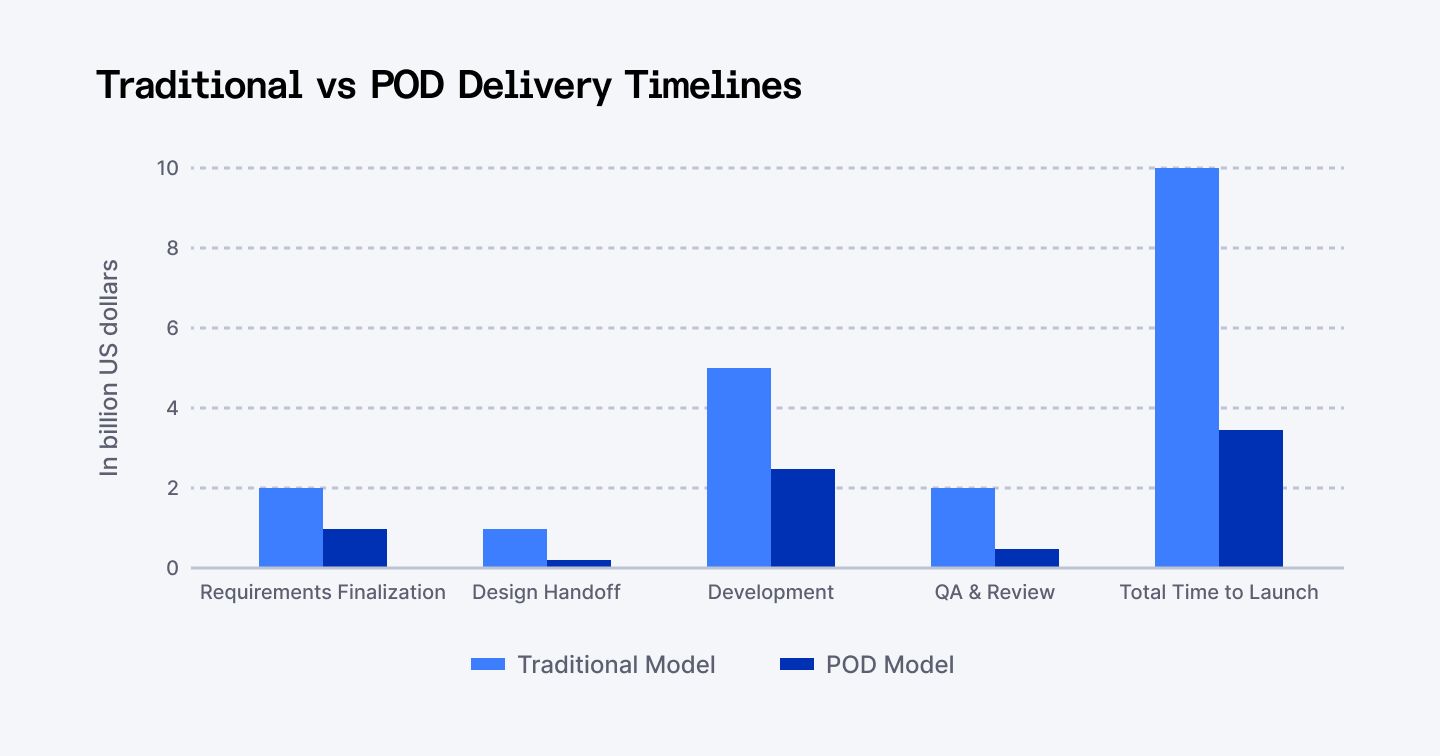
Faster delivery does not imply worse quality, quite the reverse. Bugs and usability concerns are fixed more quickly with the POD because of tighter feedback loops. This guarantees that the final product is developed and ready for market faster.
To summarize, PODs minimize the time between concept and implementation. Whether you're developing a new product or responding to customer input, PODs allow you to operate at the speed your market requires, without the normal delays and constraints.
Benefit #3: Autonomy and Ownership
The POD model's most powerful concept is autonomy. Each POD functions like a mini-startup, completely accountable for achieving results that correspond with corporate goals, rather than merely creating code or deploying features.
This autonomy promotes increased team participation, faster decision-making, and more responsibility. The POD controls its backlog, strategy, and KPIs, thus, there is no need to rely on centralized leadership for every decision. Teams may immediately respond to real-time analytics, user behavior, and internal input.
More crucially, PODs are judged by outcomes rather than just production. Instead of measuring velocity or ticket completions, PODs are assessed using key performance indicators (KPIs) such as feature uptake, retention rates, and NPS increases. Tracking those KPIs in practice usually means a product analytics platform that ties feature usage to retention and revenue. This supports a shift in thinking from job completion to effect creation.
Spotify's well-known Squads model is based on this premise. Each squad (POD) decides how to work, what tools to employ, and which approaches are ideal for their mission, as long as they are consistent with the overall product vision. This "aligned autonomy" balances freedom with responsibility.
Autonomy promotes a higher sense of ownership. When teams are accountable for the success or failure of their product slice, motivation rises. Members take pride in their releases, aggressively resolve concerns, and iterate to get better outcomes.
In a world where speed and creativity are valued, empowering teams via ownership is more than a bonus; it is a requirement. PODs provide teams with the framework and independence they need to innovate, iterate, and succeed on their terms, while also including responsibility.
Explore more how to vet software developers effectively.
Benefit #4: Better Alignment with Business Goals
Traditional team structures frequently base success on output—lines of code produced, narrative points fulfilled, or tickets closed. However, these measures do not always accurately reflect business performance. The POD model tackles this by connecting each team with a specific product line, customer journey, or company goal.
To reinforce this goal-oriented POD structure, an OKR template for Excel can be used to translate strategic objectives into measurable key results, giving teams a simple, centralized way to track progress against product and customer outcomes.
This outcome-first approach guarantees that every item provided, issue corrected, and user story finished contributes directly to quantifiable goals, such as client retention, conversion rates, or revenue impact. Because each POD is associated with a specific business purpose, it is easier to analyze ROI and assess the genuine effect rather than depending on abstract metrics.
PODs also improve the agility with which businesses pivot. When priorities evolve, for as in response to market trends or regulatory changes, individual PODs can adapt their focus without disturbing the overall organizational flow. This decentralized responsiveness allows businesses to stay competitive without going through extensive cross-departmental reorganization.

Stakeholders gain from improved accountability. Rather than collaborating across several functions to determine who owns what, executives may work directly with a single POD to assess progress, provide feedback, or adjust priorities.
With explicit links between company strategy and team execution, the POD model lowers misalignment, improves focus, and increases transparency throughout the organisation. Whether you're launching a new product or refining an existing journey, PODs let teams focus on what matters most: business impact.
Benefit # 5: Improved Feedback Loops
Rapid, relevant feedback is the foundation of iterative product development, and PODs excel at establishing tight, efficient feedback loops that keep teams on track and focused on actual customer requirements.
Traditional models frequently suffer from delayed stakeholder input, which causes rework, mismatched features, and failed expectations. PODs address this issue by scheduling frequent demonstrations, retrospectives, and check-ins as part of their regular sprint cycle. These interactions enable product managers, designers, and engineers to obtain real-time input from stakeholders and end users, even before the final release.
PODs also foster early and ongoing involvement with both internal and external stakeholders. Whether it's product leadership, customer success, or real users, input is received when it's most useful: during development, not after.
Modern collaboration platforms such as Jira, Notion, Loom, and Miro make it simple to gather and respond to input asynchronously, particularly in remote or dispersed environments. For example, Loom videos enable team members to guide stakeholders through new features, receive contextual feedback, and answer questions without having to schedule another meeting.
This asynchronous feedback technique maintains momentum while minimizing bottlenecks caused by unavailable decision-makers.
Furthermore, retrospectives inside PODs are more than simply about sprint performance; they serve as strategic checkpoints to question, "Is what we're building still aligned with the problem we set out to solve?"
In summary, tighter feedback loops make PODs more flexible, user-focused, and iterative, resulting in improved product-market fit and increased customer satisfaction.
Benefit #6: Scalable Team Structure for Enterprises
One of the most difficult difficulties that businesses have as they develop is retaining team agility and product focus across locations, business groups, and product lines. The POD model provides a highly scalable framework for handling this complexity without compromising speed or autonomy.
With clearly defined roles and duties, PODs can be duplicated across teams and geographies, making it simple to scale from 3 to 30 pods utilizing playbooks and onboarding guidelines. Each new POD gets a proven framework, which includes sprint cycles, tools, rituals, and goal-setting templates, allowing them to get started right away.
At the same time, PODs retain local authority. While organizational governance may provide wider norms or guardrails (such as compliance, architecture, or data protection), individual PODs can design and optimize operations depending on their domain.
This hybrid paradigm of distributed autonomy and shared governance is particularly effective for global product launches and multi-region support teams. For example, if a company is launching a financial product in five regions, it may allocate one POD to each location, tailoring the product to local compliance and user demands while maintaining fundamental brand and technology standards.
Accenture's Agile Operating Model states, "Organizations that scale POD-like structures across global teams see up to 40% faster product delivery and a 25% improvement in stakeholder alignment."
This technique scales without turmoil, providing adaptability at all levels of growth. Whether you're a mid-sized company expanding quickly or a major corporation upgrading your distribution methodology, the POD structure can scale with you.
Conclusion
PODs offer a disruptive approach to product development by speeding innovation, lowering cross-functional overhead, and giving teams autonomy and accountability. PODs achieve demonstrable results and shorter time-to-market by closely matching with company goals and allowing for quick iteration. Whether you're a startup looking for speed or a business expanding across several countries, the POD model offers a scalable, outcome-driven framework for modern teams.
Are you thinking of rearranging your product team? Begin with a single POD pilot. Assess its impact on delivery velocity, team engagement, and customer happiness before scaling confidently throughout your business to ensure long-term agility and growth.
For Clients:
Need a high-performing, project-ready team? Hire top 5% vetted talent with Index.dev to accelerate delivery, cut costs, and build better, faster.
For Developers:
Join Index.dev’s global talent network! Work in agile PODs, get matched with top companies, and build your remote tech career today.