Hiring skilled talent has become harder for enterprises across industries. Skill gaps are growing due to the rising demand for technical, digital, and role-specific expertise.
For the same role, companies often struggle to find candidates with the right mix of technical and soft skills. It makes hiring and workforce planning a major challenge for business growth.
In this statistical guide, we break down real data on the top skills enterprises struggle to hire, across industries, company sizes, and regions.
You will also see insights into emerging skill gaps in AI, cloud, and cybersecurity, as well as workforce trends and hiring challenges. All data is collected from verified sources and is listed at the end of the article for transparency.
Struggling to close critical skill gaps? Index.dev gives companies fast access to verified AI-first engineers and senior tech talent ready to support delivery, scale teams, and accelerate product development →
Key takeaways: Top skills enterprises struggle to hire
- 76% of employers struggle to fill roles in 2025, while 72% still cannot find skilled talent.
- 59% of organizations face skill shortages, up from 44% in 2024.
- 75% of companies with 1,000 to 4,999 employees struggle to hire, compared to 34% of smaller firms.
- 75% of the information industry and 74% of the Healthcare and Hospitality sectors face hiring difficulty.
- 46% of companies struggle to hire for technical skills such as AI, cloud, and data.
- 59% of employers report a lack of communication skills, as well as gaps in teamwork and problem-solving.
- 95% of cybersecurity teams report skill gaps, and there is a global shortage of 4.8 million professionals.
- Demand for AI and machine learning skills has grown by 370%, and 60% of data roles are the hardest to fill.
- 68% of companies retrain employees, while 49% use freelancers to fill skill gaps.
- 25.5% of workers are underskilled, 37.3% face skill mismatch, and 80% feel unprepared for new jobs.
What percentage of employers struggle to hire skilled talent?
Most employers struggle to hire skilled talent, with over 70% reporting difficulty in 2025. While there is a slight drop from 2024, the overall shortage remains high. A large share of organizations still face critical skill gaps, showing that hiring challenges continue to impact business operations globally.
- 76% of employers report difficulty filling roles in 2025, compared to 80% in 2024, while more than 72% still struggle to find skilled talent.
- 59% of organizations report critical or significant skill shortages, rising from 44% in 2024.
- 47% of employers specifically struggle to recruit candidates with the required skills.
Talent shortages remain persistent and continue to affect most employers despite slight improvements.
How big is the global talent shortage problem?
The global talent shortage is large and affects tens of thousands of companies across industries. Most organizations face skill gaps that delay hiring and impact productivity, even after active recruitment efforts.
- Talent shortages affect more than 39,000 employers globally, with 88% reporting problems due to missing skills.
- Nearly 19,768 companies cannot fill roles even after 30 days of job postings.
Up next: Explore the biggest barriers blocking enterprise AI adoption and what business leaders can do to scale AI successfully.
Which company sizes face the most hiring challenges?
Hiring challenges exist across all company sizes, but larger companies face more pressure due to the need for specialized skills. Smaller companies also struggle due to limited hiring budgets and resources.
Hiring difficulty varies with company size
This table shows how hiring difficulty increases as company size grows. Larger companies report slightly greater challenges in finding the right talent than smaller teams do.
| Company Size (Employees) | Hiring Difficulty (%) |
| Less than 10 | 64% |
| 10–49 | 72% |
| 50–249 | 73% |
| 250–999 | 72% |
| 1,000–4,999 | 75% |
| 5,000+ | 74% |
Larger firms report more skill gaps: 59% face this issue, compared with 34% of smaller firms.
Which industries struggle the most to hire talent?
Most industries report hiring difficulty above 70%, especially those that depend on technical or service-based roles. Skill shortages are consistent across sectors, with some industries facing slightly higher pressure.
Hiring Difficulty by Industry
This table shows how hiring difficulty varies across industries. Information and service-heavy sectors report the highest challenges.
| Industry | Hiring Difficulty (%) |
| Information | 75% |
| Hospitality | 74% |
| Public Sector | 74% |
| Health & Social Services | 74% |
| Professional Services | 73% |
| Manufacturing | 72% |
| Construction | 71% |
| Finance | 71% |
| Trade & Logistics | 69% |
| Utilities | 68% |
Industries that rely on skilled labor and technical expertise face the highest hiring pressure.
Which countries face the highest talent shortages?
Talent shortages vary across countries, but many economies with strong industrial and digital demand report very high hiring difficulty. Some countries show relatively lower shortages but still face skill gaps.
Talent Shortages by Country
This table shows how talent shortages differ across countries. Some countries report very high hiring difficulty, while others face relatively lower shortages but still struggle with skill gaps.
| Category | Country | Talent Shortage (%) |
Highest talent shortage
| Slovakia | 87% |
| Greece | 84% | |
| Japan | 84% | |
| Germany | 83% | |
| India | 82% | |
| Lower talent shortage | Colombia | 61% |
| Czech Republic | 61% | |
| Finland | 60% | |
| Poland | 57% | |
| China | 48% |
What are the top skills enterprises struggle to hire?
Enterprises struggle to hire both technical and core workplace skills, which are essential for business operations. The shortage is strongest in technical roles, but problem-solving and teamwork are also major gaps.
- Technical skills are the hardest to hire, with 46% of employers struggling to find them. Problem-solving skills follow at 34%, and teamwork skills at 33%.
- Communication skills also reflect the biggest skill gap, with 59% of employers reporting shortages. Problem-solving skills also show a gap at 29%, and collaboration skills at 24%.
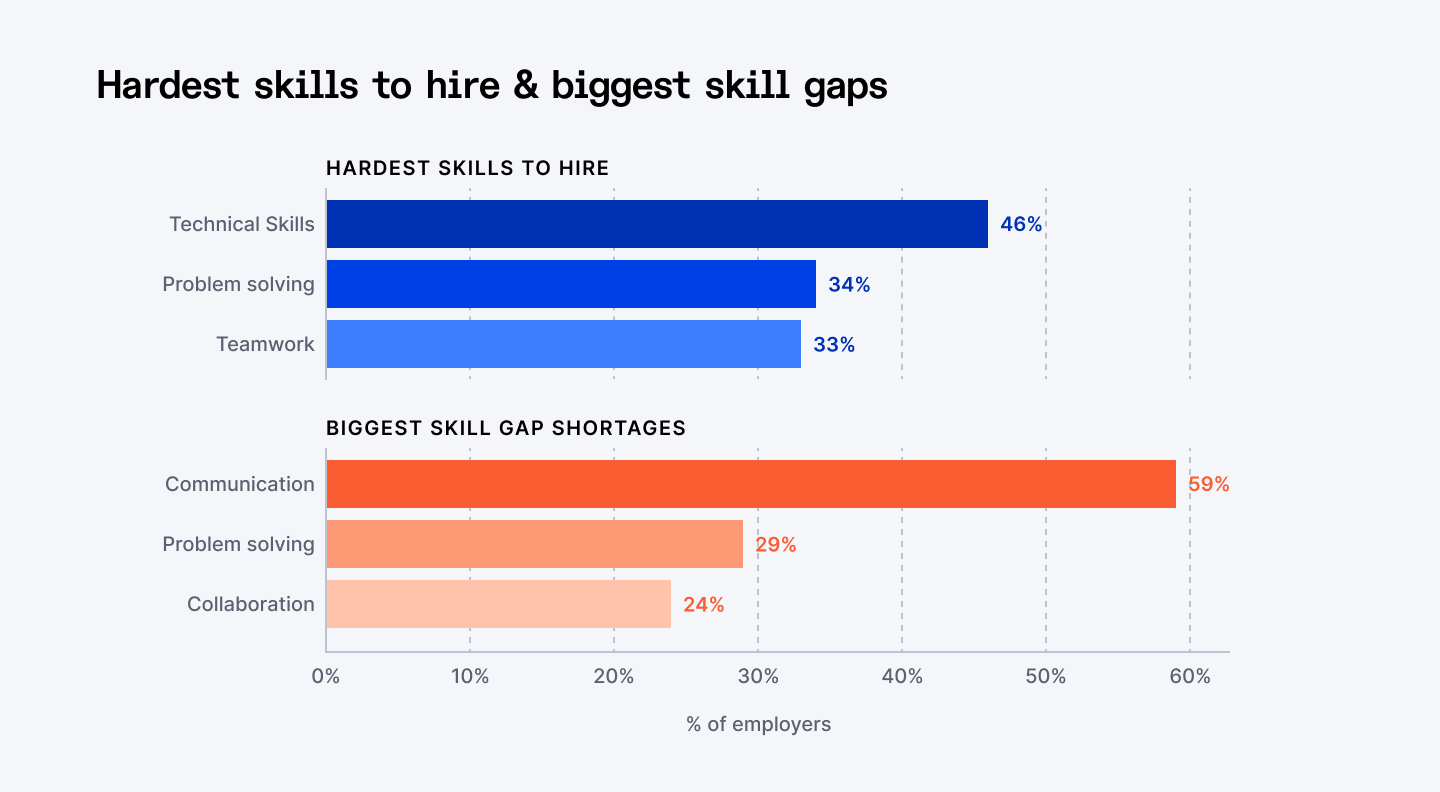
Both technical and soft skills shortages impact hiring, with technical skills leading the global skill gap and concerning companies.
What specific skill shortages exist in tech, cloud, and security?
Tech, cloud, and cybersecurity roles face severe shortages due to high demand and limited talent supply. These roles require specialized expertise, making hiring more difficult.
- AI skills are hard to hire, with 41% of employers struggling to find them. Cloud security skills follow at 36%, risk assessment at 29%, application security at 28%, and compliance or security engineering at 27%.
- Cloud-related skill gaps are also high. Architecture skills show the biggest gap at 50%, followed by cloud security at 41%, deployment at 38%, and identity and access management at 35%.
- Cybersecurity talent shortages are widespread. About 95% of cybersecurity teams report skill gaps, with a global shortage of 4.8 million professionals and 47.1% of demand still unmet.
Why do companies struggle to hire skilled talent?
Companies struggle due to a lack of qualified candidates, high salary expectations, and retention issues. Many roles now require advanced technical and practical skills, but the number of people with these skills is not enough.
These factors create strong competition for skilled professionals and limit hiring success.
About 30% of companies say they cannot find candidates with the required skills. This shows a clear gap between what businesses need and what the workforce offers.
Reasons Companies Struggle to Hire Skilled Talent
This table shows the main reasons why companies face hiring challenges. The biggest issues are skill gaps, high salary expectations, and retention problems.
| Reason | Percentage (%) |
| Cannot find candidates with the required skills | 30% |
| Cannot afford candidates (high salaries) | 29% |
| Cannot retain employees | 23% |
Overall, talent shortage is driven by both limited supply and increasing competition. Companies compete for the same pool of skilled workers, raising salaries, lengthening hiring cycles, and reducing overall hiring success.
What impact do skill shortages have on businesses?
Skill shortages directly affect business performance by increasing workload, raising costs, and reducing efficiency. Companies often face operational risks due to a lack of skilled employees. They make more errors, face system issues, and struggle to use technology properly.
Impact of Skill Shortages on Businesses
This table shows the key ways skill shortages affect business operations and performance.
| Impact Area | Percentage (%) |
| Increased workload | 63% |
| Higher costs | 50% |
| Difficulty implementing new processes | 46% |
| Security mistakes | 26% |
| Hiring underqualified talent | 25% |
| System errors | 24% |
| Adopting technology before readiness | 21% |
Overall, skill shortages reduce productivity, increase costs, and slow long-term business growth.
How big is the digital and AI skill shortage?
The digital and AI skill shortage is growing rapidly due to rising demand for advanced technologies. Many organizations struggle to find the talent needed for digital transformation.
- 60% of APEJ organizations will face shortages by 2027, while AI/ML demand has grown 370% over five years.
- 1 in 8 jobs require digital skills, and over 75% of disrupted jobs are digital.
- 60% say data science roles are hardest to fill.
Digital transformation is increasing in demand faster than talent supply can keep up.
Do companies have enough AI talent, and what are the hiring barriers?
Most companies lack sufficient AI talent and face multiple barriers to adopting AI. This slows innovation and limits business growth.
- 51% of companies say they lack the right AI talent, while 49% say they do. This shows that about half of organizations still struggle to build strong AI teams.
- To close this gap, 31% of companies plan to upskill their existing workforce, while 14% plan to hire new talent. However, 6% already expect hiring to be difficult, which highlights ongoing challenges in finding the right candidates.
- About 40% of companies face a lack of skilled talent, 32% face budget constraints, and 28% lack the right tools. In addition, 26% struggle with data availability, 24% face collaboration issues, and 19% report a lack of leadership support.
These challenges show that AI skill shortages are not only about hiring. Companies also need better resources, planning, and internal alignment to fully adopt AI.
Learn more: Discover how AI skills, workforce transition, and leadership readiness are reshaping hiring and the future of work.
What skills are companies hiring for in AI teams?
Companies hire a mix of technical, analytical, and governance skills to build and run AI systems. These skills help teams develop models, manage data, and apply AI in real business use cases.
Core technical skills such as coding and software development are important for building and deploying AI solutions. At the same time, companies need strong data skills. This includes data analytics and visualization to turn raw data into useful insights.
Skills Companies Are Hiring for in AI Teams
| Skill Area | Percentage (%) |
| Coding and software development | 35% |
| Data governance and security | 34% |
| Data analytics and visualization | 33% |
| Advanced AI education | 27% |
These numbers show that companies are not only hiring developers but also looking for strong data and governance capabilities. AI teams need people who can build models, manage data securely, and turn insights into business value.
How are companies solving skill gaps?
68% of companies retrain their existing employees, 58% hire talent from other companies, and 49% hire fresh graduates from universities to fill skill gaps.
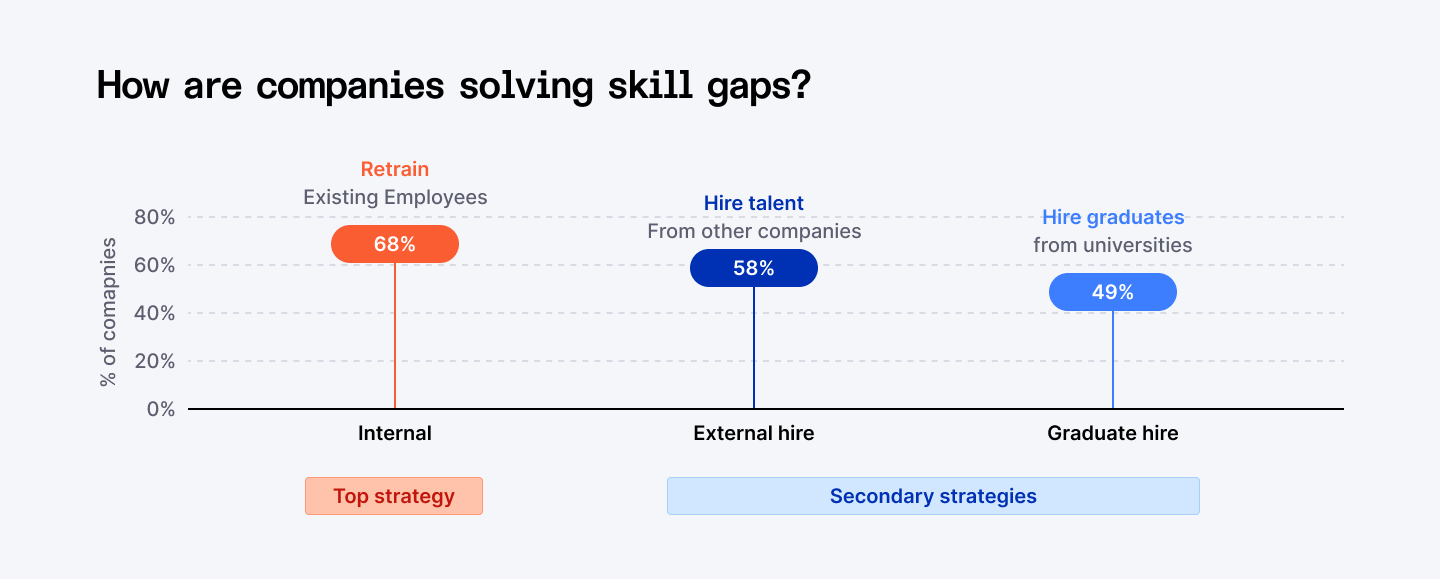
These numbers show that most companies focus on reskilling their current workforce. Training existing employees helps businesses close gaps faster, reduce hiring costs, and retain experienced staff who already understand the company.
At the same time, many companies hire experienced professionals from other organizations to bring in ready-to-use skills. This approach helps fill urgent roles but also increases talent competition.
Companies also invest in long-term talent pipelines by hiring from universities. This helps them build future-ready teams, although it may require additional training before new hires become fully productive.
How fast are job skills changing?
39% of key job skills are expected to change by 2030, compared to 44% reported in 2023. This shows that skill change remains high as technology and automation continue to reshape job roles across industries.
As tools and systems evolve, employees must learn new skills to stay effective in their roles. Companies also need to update training programs to keep their workforce ready.
Continuous skill development is now essential for both employees and businesses to stay competitive and relevant.
What freelance trends highlight skill shortages?
Freelance hiring is increasing as companies seek flexible ways to fill skill gaps quickly. Businesses are shifting focus from degrees to skills.
- 49% of businesses use freelancers to fill critical skill gaps, showing strong reliance on flexible talent
- 48% of CEOs plan to increase freelance hiring, which indicates growing demand for on-demand skills
- 77% of business leaders say AI is increasing the need for specialized freelance talent, especially in high-skill areas
- 74% of executives say degrees are not important when hiring freelancers, which shows a shift toward skill-first hiring
- 78% of CEOs say freelancers deliver more value than degree-holding employees, due to speed, expertise, and flexibility
- AI freelance skills have grown by over 100%, and skilled freelancers can earn up to 22% higher rates, showing strong market demand
Which skills are growing the fastest?
New and emerging skills are growing rapidly, especially in AI and digital domains, driven by technology adoption.
| Skill Area | Growth Rate (%) |
| AI video editing | +329% |
| Generative AI | +220% |
| AI integration | +178% |
| AI data annotation | +154% |
| Chatbot development | +71% |
| Social media strategy | +36% |
These numbers show that AI-related skills are growing the fastest and are in high demand across industries.
What technologies and tools are most in demand?
Modern development and cloud tools are in high demand as businesses shift toward digital infrastructure and software-driven operations. Companies need strong programming, cloud, and database skills to build, deploy, and manage applications.
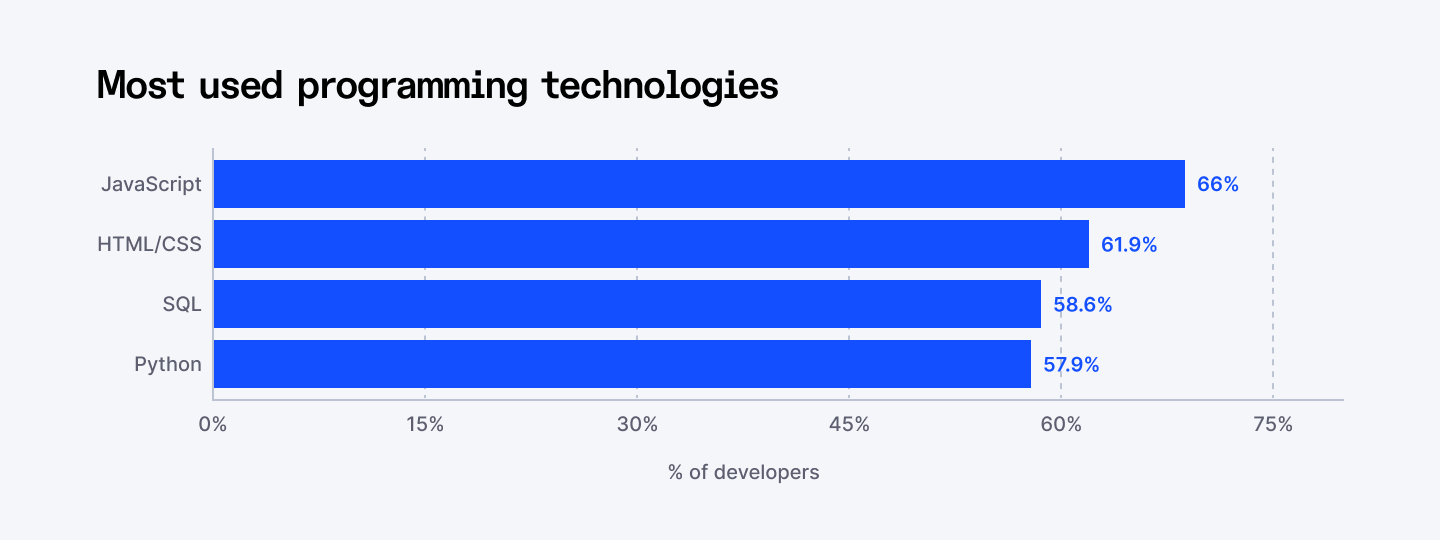
- JavaScript (66%), HTML/CSS (61.9%), SQL (58.6%), and Python (57.9%) are the most used programming technologies.
- In cloud and DevOps, Docker leads at 71.1%, followed by AWS (43.3%), Azure (26.3%), and Google Cloud (24.6%).
- Database technologies like PostgreSQL (55.6%) and MySQL (40.5%) also remain essential for managing data.
Which programming languages and frameworks are most admired?
Rust leads with 72% admiration, followed by Gleam at 70%, Elixir at 66%, and Zig at 64%. These languages are gaining strong developer preference, which makes them more attractive for hiring.
High admiration means developers enjoy using these languages, trust their performance, and prefer them for modern applications. This directly influences hiring as companies choose tools that attract and retain talent.
Among the frameworks, Phoenix stands out, with the highest admiration at 79%. This shows strong developer satisfaction and consistent trust.
Overall, companies follow developer preference trends when selecting technologies to improve productivity and hiring success.
Explore more: See which programming languages are leading in 2026 and why enterprises are investing in these in-demand developer skills.
What is the demand for tech jobs and emerging roles?
Demand for tech roles continues to grow, especially in AI and software development, creating more pressure on talent supply.
- Software jobs are expected to grow by 15% from 2024 to 2034. This growth is driven by rising demand for digital products, cloud systems, and software-based services across industries.
- AI jobs have increased by 70% year over year in the US, with around 1.3 million jobs added globally. This shows the rapid adoption of AI across sectors such as healthcare, finance, and automation.
Several emerging roles are gaining strong demand.
Emerging High-Demand Job Roles
This table shows the fastest-growing job roles based on demand across industries.
| Job Role | Number of Jobs |
| Cybersecurity | 595,000 |
| Artificial Intelligence (AI) | 522,000 |
| Renewable Energy | 516,000 |
| Blockchain | 163,000 |
| Augmented Reality (AR) | 63,300 |
What workforce trends are increasing skill shortages?
Demographic and structural changes in the workforce are widening the talent gap and creating long-term challenges for employers.
- The EU workforce is expected to decline from 265 million to 258 million by 2030. This drop shows a shrinking labor pool, which will increase pressure on companies to fill roles and maintain productivity.
- An estimated investment of €1.7 billion to €4.1 billion is required for reskilling. This highlights the scale of effort needed to train workers in new and emerging skills to meet future job demands.
- About 86% of shortage roles are not gender balanced. This shows a major gap in workforce diversity and indicates that improving gender inclusion can help reduce talent shortages.
What is the global skill mismatch problem?
There is a major mismatch between workers' skills and job requirements, reducing workforce efficiency and employability.
- 25.5% of workers are underskilled, 37.3% work in roles that do not match their field, and 25% are underutilized. This shows a large gap between workforce capabilities and job requirements.
- 22% of workers are underskilled at the entry level, but this drops to 6% as they gain experience. This indicates that learning on the job helps reduce skill gaps over time.
- 80% of workers feel unprepared for new jobs. This highlights a strong need for continuous training and skill development to keep up with changing job demands.
What is the demand for new roles, such as prompt engineers?
There are around 2,585 prompt engineering jobs available globally, with 2,274 posted in the last 30 days. This means a large number of roles remain open even after a month, indicating a clear talent shortage.
Companies are actively hiring, but they are unable to find enough candidates with the required AI and prompt-engineering skills. This gap between demand and available talent shows that new roles are growing faster than the workforce can adapt to.
Open roles that remain unfilled highlight a strong skill gap in emerging AI jobs.
What challenges do companies face in AI adoption?
Companies face several challenges when adopting AI, mainly due to skill gaps and operational complexity. These issues slow down implementation and increase risks. Organizations also struggle to balance cost, governance, and workforce readiness as they scale AI initiatives.
AI Adoption Challenges
| Challenge | Percentage (%) |
| Lack of skills | 54% |
| Need for human oversight | 41% |
| Risk and privacy concerns | 39% |
| High cost | 36% |
| Lack of AI skills in the workforce | 29% |
Do companies clearly understand their skill gaps?
Many companies still lack a clear understanding of their own skill gaps. This lack of clarity makes it harder to plan hiring, training, and workforce strategies. When businesses cannot identify what skills they are missing, they struggle to take the right actions to close those gaps.
Without proper assessment, companies may invest in the wrong areas, delay hiring decisions, or fail to build future-ready teams. This slows down growth and reduces overall efficiency.
Example:
- 18% of companies in the Netherlands are unsure about their skill gaps
- 15% of companies in Hungary are unsure about their skill gaps
Lack of clarity in skill assessment slows down workforce planning and hiring decisions.
Final Words
Skill gaps continue to grow across technical, digital, and human capabilities. Enterprises struggle not only to hire but to find talent that matches real business needs. Roles in AI, cloud, and product development demand precise skills, while communication and problem-solving remain equally critical for execution. Hiring strategy now plays a direct role in business speed and output.
Companies cannot solve this challenge by increasing hiring volume alone. Teams need talent that can contribute from day one. Delays in hiring or poor skill alignment often lead to higher costs, slower delivery, and missed growth opportunities. This creates a need for faster and more accurate hiring models.
Platforms like Index.dev help companies access vetted developers and ready-to-deploy engineering teams based on exact skill requirements. Businesses can match with interview-ready talent in 48 hours and start work without long onboarding cycles.
Real examples show the impact. Entrupy hired 12 developers and reduced hiring costs while improving delivery speed. National Scoliosis Clinic built an AI-focused team that improved efficiency and accelerated product development.
By combining skill gap insights with access to pre-vetted global talent, enterprises can move from reactive hiring to building high-performing teams that match real business needs. This shift helps companies scale faster, reduce hiring risks, and stay competitive in a skill-driven economy.
FAQs
1. Why do enterprises struggle to hire skilled talent?
30% of companies cannot find candidates with the required skills, 29% cannot afford them, and 23% struggle to retain them. Enterprises face hiring challenges due to limited talent supply, rising salary expectations, and intense competition, making it difficult to attract and retain skilled professionals across industries.
2. Which skills are hardest for companies to hire?
46% of companies struggle to hire for technical skills, 34% face gaps in problem-solving, and 33% in teamwork skills. In addition, 59% of employers report a lack of communication skills, indicating that both technical and soft-skill shortages affect hiring success and workplace performance.
3. How serious is the global talent shortage problem?
76% of employers struggle to fill roles, and 88% report issues due to missing skills. The shortage affects more than 39,000 employers globally, and thousands of roles remain unfilled for over 30 days, showing that talent shortage is a widespread and persistent challenge.
4. Which industries face the highest hiring challenges?
75% of companies in the Information industry and 74% in Healthcare and Hospitality struggle to hire skilled talent. These industries face greater pressure due to strong demand for skilled workers and limited availability, especially in technical and service-based roles.
5. How big is the AI and digital skill gap?
Demand for AI and machine learning skills has grown by 370%, and 60% of hiring managers say data roles are the hardest to fill. In addition, 60% of organizations expect digital skill shortages by 2027, showing a growing gap between demand and available talent.
6. How are companies solving skill shortages?
68% of companies retrain employees, 58% hire from other companies, and 49% hire from universities. Many businesses also use freelancers, with 49% adopting this approach, to quickly fill skill gaps and reduce hiring delays in critical roles.
7. What impact do skill shortages have on businesses?
63% of companies report increased workload, 50% face higher costs, and 46% struggle to implement new processes. Skill shortages also lead to 25% of candidates being hired underqualified and 24% of system errors, which directly affect productivity and overall business performance.
Data Sources
- https://www.manpowergroup.co.uk/b_talent-shortage-survey-2025/
- https://my.idc.com/getdoc.jsp?containerId=prAP53193125
- https://www.manpowergroup.com/en/insights/2026-global-talent-shortage
- https://www.oecd.org/content/dam/oecd/en/publications/reports/2024/12/understanding-skill-gaps-in-firms_c8331908/b388d1da-en.pdf
- https://www.ilo.org/sites/default/files/wcmsp5/groups/public/@ed_emp/documents/publication/wcms_726816.pdf
- https://static1.squarespace.com/static/6197797102be715f55c0e0a1/t/6388b6daaae0b3075d6c7658/1669904091972/SkillsDisruption_Final_2022.pdf
- https://www.isc2.org/Insights/2025/12/2025-ISC2-Cybersecurity-Workforce-Study#Skills
- https://www.bls.gov/ooh/computer-and-information-technology/software-developers.htm
- https://www.snaplogic.com/resources/infographics/ai-skills-gap-research
- https://www.linkedin.com/jobs/prompt-engineer-jobs-worldwide/?currentJobId=4391251620
- https://www.linkedin.com/jobs/search/?currentJobId=4391251620&f_TPR=r2592000&keywords=prompt%20engineer&location=worldwide&origin=JOB_SEARCH_PAGE_JOB_FILTER
- https://www.weforum.org/stories/2025/01/future-of-jobs-report-2025-jobs-of-the-future-and-the-skills-you-need-to-get-them/
- https://www.glassdoor.co.in/Job/us-cyber-security-jobs-SRCH_IL.0,2_IN1_KO3,17.htm
- https://www.glassdoor.co.in/Job/us-cyber-security-jobs-SRCH_IL.0,2_IN1_KO3,17.htm
- https://app.stationx.net/articles/cybersecurity-job-market-statistics
- https://www.jobspikr.com/report/global-skill-index-report-2024/
- https://survey.stackoverflow.co/2025/technology#worked-with-vs-want-to-work-with-ww-language-language-worked-want-prof
- https://www.staffingindustry.com/news/global-daily-news/tech-talent-shortage-hits-76-of-it-employers-globally#:~:text=Despite%20global%20economic%20uncertainty%2C%20most,to%20a%20report%20by%20ManpowerGroup.
- https://www.weforum.org/stories/2026/01/ai-has-already-added-1-3-million-new-jobs-according-to-linkedin-data/
- https://ec.europa.eu/commission/presscorner/detail/sv/ip_23_3704
- https://www.linkedin.com/jobs/search/?currentJobId=4395882151&f_TPR=r2592000&geoId=92000000&keywords=full%20stack%20engineer&location=Worldwide&origin=JOB_SEARCH_PAGE_JOB_FILTER
- https://investors.upwork.com/node/11546/pdf
- https://investors.upwork.com/node/12681/pdf
- https://www.imf.org/-/media/files/publications/sdn/2026/english/sdnea2026001.pdf