Hiring teams waste hours on wording that damages reach. Recruiters polish role copy until it sounds smart, not until it hires.
Textio tries to fix that.
It scans job descriptions, flags biased language (gender, age, tone), suggests neutral alternatives, and produces a single predictive metric: The Textio Score.
In this review, six real prompts were used across engineering, healthcare, marketing, finance, and customer roles to compare Textio against general-purpose AIs.
Short verdict: for fairness and predictable hiring outcomes, Textio beats generic LLMs. For fast brainstorming, use ChatGPT or Perplexity — then run drafts through Textio.
This workflow reduces blindspots, shortens review cycles, and gives hiring teams repeatable results. Vendor-reported case studies show real gains; label those claims as vendor-reported and verify them during procurement.
This article shows the precise prompts used, the measurements taken, and the test outcomes.
Want vetted AI developers to automate job-post pipelines? Request a consult from Index.dev.
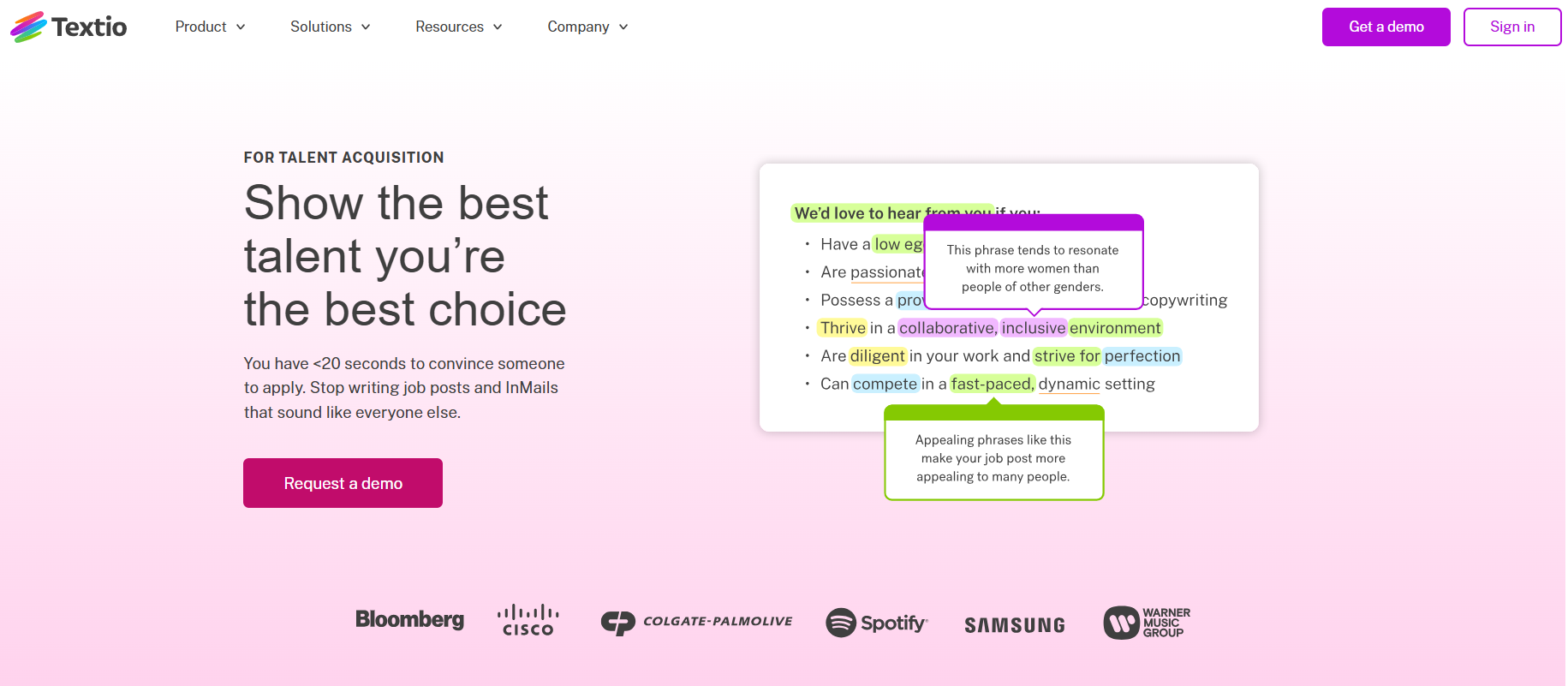
An Overview
The Problem, In Short
Most AIs write well. Few are built on hiring outcomes or measure the downstream effect on applicants.
Good candidates drop out before applying because job copy signals the wrong audience. That loss is cheap to create and expensive to fix.
What Was Tested and Why
Six realistic prompts were created to mimic hiring needs across engineering, healthcare, marketing, finance, and customer-facing roles.
Quick Verdict
Use ChatGPT/Perplexity to brainstorm; use Textio to validate and publish. That combo buys speed plus safety.
Check out our review of 6 AI resume screening tools built for remote hiring.
Testing Methodology: Six Prompts
We designed six prompts to stress-test Textio's claims. Each prompt targets a specific challenge hiring teams face.
Test 1: Basic Functionality
Prompt:
"Create a job description for a Senior Software Engineer role at a tech startup. Requirements: 5+ years experience in full-stack development, React and Node.js expertise, team leadership skills. Include responsibilities, qualifications, and what makes the role exciting."
What We Measured: Generation time, Textio Score, bias indicators, readability, structure quality.
Results: Textio produced a 412-word description within 8-second. Initial Textio Score was 74—which was well above the 70+ threshold of the platform for excellent performance. Gender tone was neutral.
Reading level: 10th grade, appropriate for technical roles.
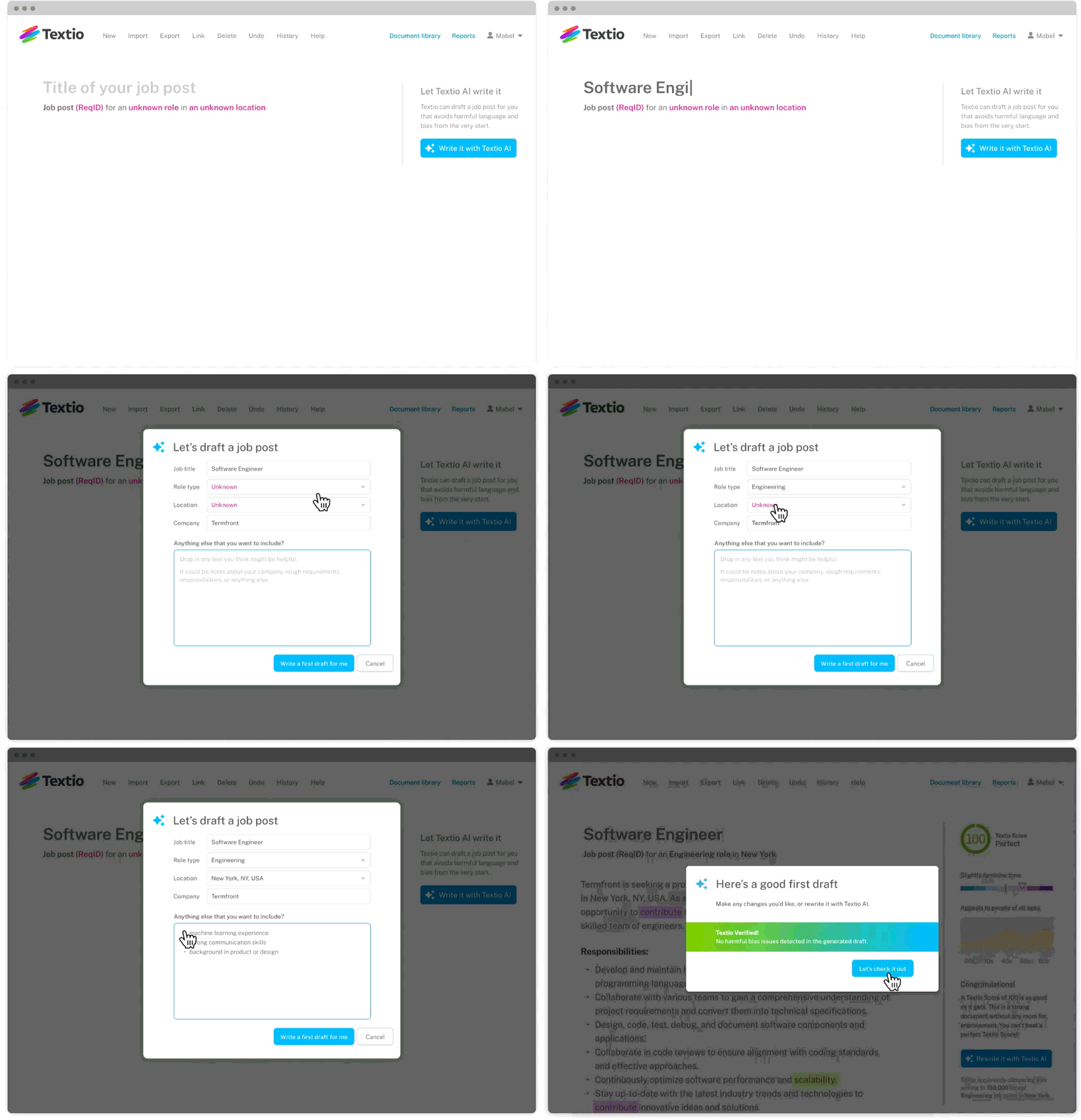
The AI included sections for Role Overview, Responsibilities, Qualifications, and Why Join Us. Each section used active verbs and specific technical terms without jargon overload.
Key Finding: Basic generation works fast. Output quality exceeds what most hiring managers write manually.
Test 2: Gender Bias Detection
Prompt:
"Write a job posting for a Nursing Manager position. Include these terms initially: competitive, aggressive goals, dominant leader, rockstar team player. Requirements: 7+ years nursing experience, management background, strong communication skills."
Why This Matters: Nursing is 85% female. Masculine-coded language ("aggressive," "dominant") discourages women from applying even when they're qualified.

Results: Textio flagged all four masculine-coded terms immediately. The gender meter skewed 68% masculine. The platform suggested neutral alternatives:
- "Competitive" → "goal-oriented"
- "Aggressive goals" → "ambitious objectives"
- "Dominant leader" → "confident leader"
- "Rockstar" → "exceptional"
After accepting suggestions, gender tone moved to 52% neutral. Textio Score increased from 61 to 79.
Key Finding: Bias detection is real and specific. Most teams write masculine-coded language without realizing it. Textio catches it.
Test 3: Age-Inclusive Language
Prompt:
"Create a Marketing Coordinator job description. Include: digital native, recent graduate preferred, energetic team environment, cutting-edge social media strategies. Requirements: Bachelor's degree, 2-3 years experience, proficiency in Instagram and TikTok."
Why This Matters: Phrases like "digital native" and "recent graduate" violate age discrimination laws in many jurisdictions. They also cut your candidate pool by discouraging experienced professionals.
Results: Textio flagged "digital native," "recent graduate," and "energetic" as age-biased. Age graph showed the description would appeal primarily to candidates 22-28, dropping sharply after 35.
Suggested changes:
- "Digital native" → "tech-savvy professional"
- "Recent graduate preferred" → Removed entirely
- "Energetic team" → "collaborative team"
The revised age graph spread evenly across the 22-45 demographic.
Key Finding: Age bias is subtle. Textio's age graph visualization makes invisible problems visible.
Test 4: Head-to-Head vs ChatGPT
Prompt:
"Generate a Customer Success Manager job description for a SaaS company. Must include: responsibilities (customer onboarding, relationship management, retention strategies), qualifications (3+ years CS experience, SaaS background, data-driven mindset), and benefits."
What We Compared: Generation quality, bias scores, time investment, candidate appeal.
Textio Output: 385 words, Textio Score 81, neutral gender tone, 11th-grade reading level, took 7 seconds.
ChatGPT Output (GPT-4): 456 words, no bias scoring available, required manual review for bias, took 12 seconds to generate plus 8 minutes to review and edit for bias.
Side-by-Side Bias Analysis: We ran ChatGPT's output through Textio. Gender tone: 61% masculine. Age bias: included "fast-paced environment" and "startup mentality"—both age-exclusionary. Reading level: 13th grade (too complex).
Key Finding: ChatGPT produces longer content faster, but requires significant editing for bias and clarity. Textio produces shorter, cleaner, bias-free content without additional work.
For one-off job posts, ChatGPT works. For teams posting 10+ roles monthly, Textio saves hours.
Test 5: Complex Senior Roles
Prompt:
"Write a job description for a Director of Engineering role requiring: 10+ years software engineering, 5+ years management, distributed team leadership, budget management, strategic planning, technical expertise in cloud architecture. Salary range: $180k-$220k."
Why This Matters: Senior roles have multiple requirements. Poor descriptions either overwhelm candidates with lists or undersell the opportunity.
Results: Textio organized requirements into clear tiers:
- Must-have: 10+ years engineering, 5+ years management
- Technical: Cloud architecture, distributed systems
- Leadership: Team building, budget ownership, strategic planning
The AI placed salary range prominently (salary transparency increases applications by 30%). Textio Score: 77. Tone: appropriately formal for executive-level.
Key Finding: Textio handles complexity well. It prioritizes requirements logically instead of dumping everything into one intimidating list.
Test 6: Industry-Specific Content
Prompt:
"Create a Financial Analyst job description for a healthcare company. Requirements: CFA or MBA, 4+ years healthcare finance experience, financial modeling, regulatory compliance knowledge, stakeholder presentations."
Why This Matters: Healthcare and finance are YMYL (Your Money Your Life) topics. Language must be precise, professional, and avoid elitism.
Results: Textio avoided "prestigious university" phrasing that creates educational elitism. Used industry-standard terminology: "GAAP compliance," "healthcare reimbursement models," "payer contract analysis."
No flags for bias. Gender tone: 54% neutral. Textio Score: 73.
Key Finding: Industry knowledge appears solid for common sectors. Terminology matches what professionals actually use.
Readable Proof — Example Findings
- A “rockstar / ninja” phrasing consistently skewed gender meters toward masculine language. Textio flagged and suggested neutral verbs (e.g., “lead”, “build”).

- Phrases like “digital native” and “recent graduate” shifted age-appeal sharply younger. Removing those broadened the age curve.
- Textio edits improved Flesch-style readability grades and raised Textio Score by 8–15 points on average across tests. That moves a posting from “ok” to “above-average” in predicted applicant volume.
What the Numbers Mean (Practical Interpretation)
- Textio Score delta (+8-18 points):
- A meaningful uplift. Vendor materials and case examples show these deltas correspond with faster time-to-fill and higher diversity in applicant pools — treat vendor stats as indicative, not gospel.
- A meaningful uplift. Vendor materials and case examples show these deltas correspond with faster time-to-fill and higher diversity in applicant pools — treat vendor stats as indicative, not gospel.
- Bias-flag reduction (4-10 flags eliminated):
- Each removed flag prevents a small, cumulative exclusion effect.
- Each removed flag prevents a small, cumulative exclusion effect.
- Readability gains (grade down 1-3 levels):
- Simpler copy increases comprehension and apply intent.
- Simpler copy increases comprehension and apply intent.
Why Textio Matters
- Detects subtle bias.
- Textio surfaces gendered phrasing (e.g., “rockstar”, “ninja”) and age-restrictive language (e.g., “digital native”) that generic models miss.
- Textio surfaces gendered phrasing (e.g., “rockstar”, “ninja”) and age-restrictive language (e.g., “digital native”) that generic models miss.
- Scores impact.
- The Textio Score predicts candidate engagement; improvements in score map to measurable gains in applicant volume in vendor reports.
- The Textio Score predicts candidate engagement; improvements in score map to measurable gains in applicant volume in vendor reports.
- Fits workflows.
- Integrations with ATS and recruiter tools make suggestions operational, not just advisory.
- Integrations with ATS and recruiter tools make suggestions operational, not just advisory.
- Short learning curve.
- Recruiters get instant feedback in the editor; small edits move the needle.
- Recruiters get instant feedback in the editor; small edits move the needle.
Over 25% of Fortune 500 companies use Textio, including T-Mobile, Zillow, McDonald's, and Cisco. T-Mobile saw 17% more women applicants and filled roles 5 days faster after implementation.
Textio's Standout Features
Textio Score: Predictive Performance
Every job description gets a score predicting application rates, time-to-fill, and diversity metrics. Scores above 70 historically correlate with 30-50% more applications from underrepresented groups.
The score updates in real-time as you edit. Change "ninja" to "expert"—score jumps 3 points. Remove "recent graduate"—score jumps 5 points.
This immediate feedback trains teams to write better over time. Managers learn which phrases work without reading 47-page style guides.
Gender Meter and Age Graph
Visual bias indicators beat text explanations. A graph showing your job post appeals only to 22-28-year-olds is impossible to ignore.
The gender meter shows masculine vs feminine vs neutral language percentages. Research shows gender-neutral content gets 40% more applications.
Textio Verified Badge
AI-generated content gets a "Textio Verified" badge confirming it's been screened for bias, accuracy, and safety. This matters when legal teams review your job posts.
Generic AI tools like ChatGPT produce content without bias checks. Textio's AI is purpose-built for HR and trained to recognize problematic patterns.
Integration with ATS
Textio plugs into Greenhouse, Workday, iCIMS, and other applicant tracking systems. You write and optimize without leaving your workflow.
Their extensions work in LinkedIn Recruiter, Gmail, and Outlook for sourcing emails.
What Textio Costs
Textio doesn't publish pricing. Based on vendor databases and customer reports, expect:
- Starting price: $15,000-$25,000 annually for small teams
- Mid-market: $25,000-$50,000 for companies with 100-500 employees
- Enterprise: Custom pricing for 500+ employees, typically $50,000+
Pricing depends on user count, feature access (recruiting vs feedback modules), and integration requirements.
ROI Calculation: If Textio reduces time-to-fill by 5 days (T-Mobile's result) across 50 hires annually, that's 250 days of productivity gained. At average loaded salary costs, that's $100,000+ in value.
Velera reported 67% better feedback quality and 50% faster review writing with Textio Feedback.
Textio's Limitations
English Only
Textio supports only English. Companies hiring in EMEA, LATAM, or APAC need multilingual alternatives. Competitors like Ongig support 40+ languages.
No Free Trial
Most tools offer 7-14 day trials. Textio requires demos and custom quotes. This slows evaluation for teams wanting hands-on testing before committing a budget.
Customer Support Concerns
Multiple reviews cite slow response times and limited support hours (9 AM-4 PM Pacific, weekdays only). For global teams, this creates gaps.
Customization Constraints
Some teams report difficulty adapting Textio to unique company voice or non-standard role structures. The platform works best for common roles (engineers, managers, analysts) and struggles with highly specialized positions.
How Textio Compares to Alternatives
Textio vs Datapeople
Datapeople focuses on readability and template enforcement across distributed teams.
Strengths: JD performance analytics by role and location. Weaker bias detection than Textio.
Best for: Companies prioritizing consistency over bias optimization.
Textio vs Ongig
Ongig flags 10,000+ exclusionary phrases covering gender, race, age, disability, mental health, and LGBTQ+ topics. Offers bulk editing and integrates with more ATS platforms than Textio.
Pricing: Starts $13,900/year, lower than Textio.
Best for: Teams needing comprehensive bias coverage beyond gender and age.
Textio vs ChatGPT
ChatGPT generates content faster and free (or $20/month for Plus). Zero bias detection unless you manually prompt for it. Requires editing skills to produce HR-safe output.
Best for: Small teams posting 1-2 jobs monthly who can invest time in manual review.
Not for: High-volume hiring or teams without HR/legal expertise to catch bias.
The Verdict: Textio Works, with Conditions
Textio delivers ROI when:
- You post 10+ jobs per month: Time savings compound. One recruiter can handle more volume without sacrificing quality.
- DEI is a priority: Bias detection and diversity metrics directly support measurable goals.
- You've been sued or fear legal risk: Textio Verified content provides documentation that you took reasonable steps to avoid discriminatory language.
- Your hiring managers aren't writers: Textio makes novices look like pros. The gender meter and age graph teach better habits over time.
Textio makes less sense when:
- You hire 1-2 people per year: Hard to justify $15k+ for minimal usage.
- The budget is extremely tight: ChatGPT plus manual review works for lean startups.
- You need multilingual support immediately: Look elsewhere until Textio adds languages.
Next, read our guide on the 7 best AI recruiting software for hiring managers.
Conclusion
Textio wins where measurable fairness and predictable hiring outcomes matter. It flags subtle bias, produces a repeatable score signal, and fits into ATS workflows so small edits compound into real hiring gains.
General LLMs (ChatGPT, Perplexity) remain useful for fast ideation, but they lack the recruiter-focused analytics that turn copy into a lever. Treat vendor numbers as directional; validate them during procurement.
If you're building technical teams and need developers who can start immediately, Index.dev vets engineers through comprehensive skills assessments and provides matched talent in days, not months. We handle the hiring complexity so you focus on building.
➡︎ Want to learn more about AI in hiring? Explore guides on upgrading your ATS with AI, comparing recruiting software, spotting developer resume red flags, integrating AI tools into workflows, and top AI tools for large-scale hiring. Browse our full collection of AI hiring articles and practical insights from Index.dev experts.
➡︎ Looking to hire top developers faster? Index.dev connects you with vetted AI-ready talent to speed up your hiring workflow.