Entering the senior software engineer position is a demanding but fulfilling process that begins with careful planning, ongoing personal development, and purposeful training. There has been a constant need for efficient engineers in the industry over the years because many professionals have been wondering how to advance their profession since the use of technology in carrying out activities in industries has also increased.
The U.S. Bureau of Labor Statistics has forecasted that employment of software developers will grow at a 22% rate between 2020-2030 more than the overall employment growth rate for all occupations.
This kind of growth underlines the importance of acquiring technical proficiencies on the one hand and the leadership and problem-solving abilities essential in substantive executive roles on the other hand.
These are the factors that one should comprehend and therefore pump his/her effort into constant professional development to increase his/her possibility of excelling in this volatile field.
This blog talks covers topics like becoming a senior software engineer, years of experience as a senior software engineer, senior software engineer skill set,how to get a job as a software engineer, becoming a senior software engineer
Read: 20 Best Software Engineering Blogs to Follow (Expert Picks)
Understanding the Senior Software Engineer Role
What Defines a Senior Software Engineer?
It would be beneficial for the young developers, who want to create a career for themselves and the organizations who are planning to hire senior software engineers to understand the complex position of senior software engineers. A senior software engineer is not the position of a person who has been practising engineering for many years, it relates to the level of experience, leadership qualities, problem-solving skills, and mentoring skills.
From the survey conducted by Stack Overflow, only 57% of respondents became senior developers after mastering five or more years of experience, indicating the significance of practical experience in staging diversified and sophisticated software. They need to be technical and able to design complex solutions that may well incorporate over-the-top technologies and infrastructural methodologies to optimize large systems.
Another important component of their work is the leadership aspect, where they lead teams and/or facilitate problem-solving of projects. According to the National Center for Women & Information Technology report, firms that have good leadership in IT initiatives register a 20% enhancement in the success of projects supported by technology.
In addition, senior software engineers can be defined as excellent problem-solvers in charge of countering various technical issues which challenge their innovative imagination and profound knowledge of how software can be further developed. They also occupy the position of seniors, thus supporting the further development of junior developers through knowledge transfers.
This mentorship is critical in developing a competent workforce; research indicates firms that have structured mentoring initiatives enjoy 20% higher employee turnover levels. Therefore, the senior software engineer position combines expertise in computer programming, management capabilities, and an obligation to develop the subsequent generation of coders.
Explore: 10 Software Development Frameworks That Will Dominate 2025
Senior Software Engineer Skill Set
Technical Expertise
Core competencies are important for software engineers who would wish to be promoted to the next level in their career ladder mostly for senior engineers. Specialisation is key, first and foremost, programming skills. Python, Java and C++ are some of them which should be in command because these are used in numerous applications.
By mastering this subject, engineering professionals can develop software design patterns that reduce the complexity of the code. Also, there must be knowledge of system architecture and scalability; the report of the Bureau of Labor Statistics indicated that the software development positions will expand by 22 per cent for the period of 2020-2030, which shows the necessity of scalable solutions.
Technical Depth
In addition to programming, there needs to be a technical depth. This includes knowledge of algorithms and data structures as these are fundamental in solving problems faster. An understanding of cloud computing technologies is becoming essential as more businesses transfer to cloud environments; the global cloud computing market is expected to reach $832.1 billion by 2025, according to Statista.
Knowledge of microservices and distributed systems is also essential as it the enables development of more flexible and scalable applications. Additionally, a focus on DevOps best practices and CI/CD concepts strongly contributes to the productivity and efficiency of a deployment process.
Soft Skills
The second important aspect is soft skills, beginning with communication. The mechanics of communication enable the engineers to explain their ideas to nontechnical staff and integrate them with other functional areas.
A LinkedIn survey revealed that 57% of leaders believe that Soft skills are more important than the hard skills in Employees’ selection process. This underlines the fact that to succeed, software engineers have to be both brilliant in their work but also also be very able to communicate with a wide range of partners.
Leadership
Soft Skills is another aspect that is crucial in the senior software engineer profession, and it includes leadership skills. It has become relevant to train junior developers because it increases collaboration and shared exchanges within a team.
A strong level of technical decision-making is needed when it comes to setting the direction of projects and their compliance with the goals of the business. Project management is also an important skill as first-level senior engineers are usually in charge of projects and their schedules. Lastly, they can navigate future problem areas, and predictions reserved for potential future opportunities.
Read: https://www.index.dev/blog/remote-developer-hiring-mistakes
Career Progression Roadmap

Years Of Experience For Senior Software Engineer
Early Career Stage (0-3 Years)
For the growth phase, the development of a broad technical knowledge base is crucial within the first three years of a software engineer’s employment. It is this period where individuals acquire basic skills and relevant experience that will determine their careers in the future.
The employment of software developers in the United States is expected to increase by 22% from 2020 to 2030, the report shows employment outlooks and rates of change by occupation are much higher in the United States compared to the average rate of change for all occupations, implying that employment of software developers is a fast-growing occupation.
Young engineers should aim to master as many programming languages as possible so they can be versatile in the modern world. A poll on Stack Overflow provided proof that more than a third of developers use at least two or more programming languages per project, which confirms the significance of flexibility. Participating in different projects makes people more competent technically while simultaneously making them familiar with different aspects of software development.

The knowledge of how to solve problems is quite crucial in software engineering. McKinsey report indicates that, among employers, substantive thinking and problem-solving skills are most important for first-time recruits.
Hence, challenges should be sought out by engineers and these should be challenges that cannot be solved by conventional structures. However, the last and probably the most effective way to advance quickly is to find a proper role model: statistically speaking, workflow accelerates 5 times when there is a mentor personality.
During the first five years of their career, software engineers have ample opportunities to establish a technical foundation, advance their knowledge and skills, and take up different projects, gaining problem-solving skills and might find a mentor. In this way, the key areas will allow an individual to properly align him or herself for career enhancement within the overpowering technology marketplace.
Mid-Career Stage (3-5 Years)
The mid-career stage entails 3-5 years of experience the software engineers are well experienced to bolster their experience and champion more responsibility within their affiliated organizations. During this phase, it is advisable to specialize in certain technologies; engineers, who master high in demand technologies, including Cloud computing, Artificial Intelligence, or Cybersecurity, can create significant added value.
The World Economic Forum reported that up to 85 million jobs might be lost to automation by 2025, while up to 97 million more human-compatible occupations might be created pointing to the value of niche training in safeguarding careers.
Another important element of this career stage is taking full responsibility and ownership of complicated tasks. You are not only expected to spearhead tasks that involve technical processes but also organizing and coordinate functions. This ownership also demonstrates their capacity to assume and bear major responsibilities, and at the same time, they assume strategic roles on their teams. Likewise, a study conducted on the business networking site LinkedIn reveals that 94% of employees are willing to get retained in a company if the company offers to advance their career highlighting the need to have such duties for the organization’s retention and workers’ satisfaction.
Being involved in architectural decisions is also among the essential tasks that middle-career engineers should perform. As they progress, they participate in discussions regarding specific systems, their design and architecture which defines how scalable and performing applications are. This involvement involves an understanding of modern technologies and the trends that are likely to come in future, the overall vision on the possible impact of the current choices to the future ones.
At this stage, it becomes relevant to engage junior developers and help them improve themselves. Mid-career engineers not only contribute to their teams by mentoring junior engineers but also boost their leadership skills by leading such engineers. Another survey of women by the National Center for Women & Information Technology showed that career growth is closely related to mentorship – the person with a mentor is more successful than his counterpart without a mentor.
The mid-career level is a great opportunity to remain specialized on the technologies, make projects’ decisions, gain experience in mentoring, and leadership activities for software engineers. These elements are essential for promotions and sustained stable growth in the rapidly advancing sector of information technology.
Also Know This: https://www.index.dev/blog/front-end-vs-back-end-developer-skills-roles
Senior Level Preparation (5-7 Years)
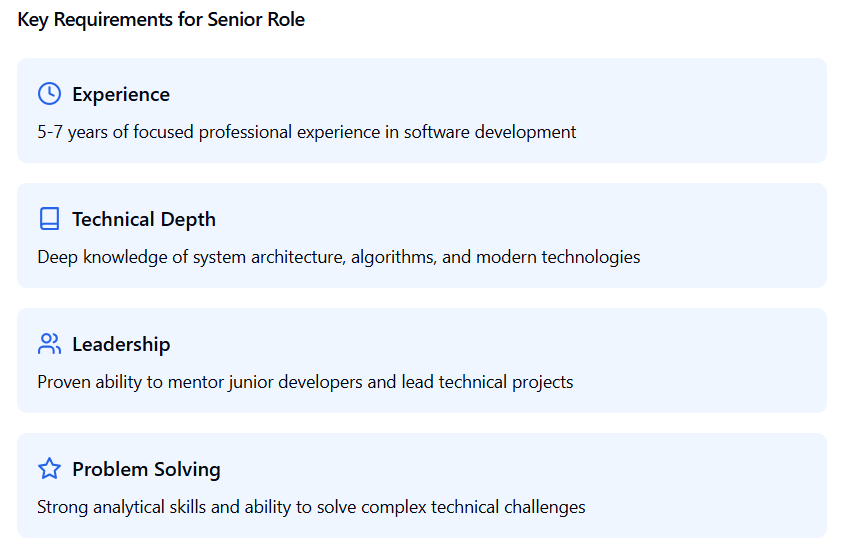
To develop one for a senior-level software engineering position usually takes approximately 5 to 7 years of focused professional experience. Through this period, the aspiring engineers should ensure that they go for positions where they get to provide technical direction by either getting to coordinate new projects or even supervise junior engineers. This is supported by the Bureau of Labor Statistics which reports that employment for software developers is expected to grow by 22 % between 2020 and 2030; much faster that average employment rate for all occupations; suggesting more job openings for team leaders in the near future.
Another important preparation is participation in decision making on strategic technical issues. Decision-makers involving technology stack and architectural decisions, at least, take a word, engage senior engineers. According to the McKinsey study it was discovered that companies where technical leadership was provided were 2.5 times likelyto outcompete other organizations in terms of profitability and productivity.
It is also important to develop a good professional network. Connecting with others on the Internet, for instance through LinkedIn or simply attending events in certain industries may lead to new cooperations. Stated statistics show that 70% of people get a job through contacts and hence the reason why networking is crucial.
It is critical to gain expertise in the newly advanced technologies to cope up with the rapidly growing tech environment. Readily available skills include AI, ML, and cloud computing among others. For example, Gartner says that it is anticipated that there will be AI in nearly every new piece of software created after 2025; therefore, senior engineers must have good knowledge of these technologies.
For those who aspire to become senior software engineers, it is recommended for such aspiring candidate to build up leadership qualities, disposition, networking skills, technological skills, as well as, excellent documentation skills in order to meet the challenges that is associated with an advanced position in the career.
How To Get Job As Software Engineer

1. Continuous Learning
To become a senior software engineer quicker, there is always a need to approach processes en route to the position keenly with important aspects of learning in mind. Taking online courses and certification are very valuable since they make it possible to improve your stock of knowledge and skills.
With organizations such as Coursera and Udacity, you can pursue specific courses in fields that are crucial to acquiring higher levels of proficiency in your work involving cloud computing, machine learning, and the new aged computing languages. The LinkedIn report showed that ninety-four per cent of employees are willing to work for a company longer if that organization will train and develop them, proving the significance of learning for retention and career growth.

Another good practice is to attend tech conferences and events and while networking with other professionals, learn from the best. Conferences like the Grace Hopper Celebration and Google I/O are not too dissimilar in introducing you to the trends in technologies, but also the people. Statistics show that within a given sector, its members who regularly attend events within such sector will have greatly improved their chances of promotion within that sector by about 70%.
Subscribing to blogs and journals that cover the software development field assists you in ensuring that you are informed on the advancements in this discipline. Tech and computing gurus writing on sites like Tech Crunch, Hacker news or Medium post articles by or in consultation with experienced developers that can offer incites on the qualifications of a senior developer. In addition to that, especially in the current world, getting to learn through workshops and online webinars ensures you acquire a practical touch on new tools and methodologies.
In general, the effectiveness of various educational opportunities – from online courses to conferences, blogs, and workshops – can help you advance far more quickly on your path to becoming a senior software engineer. This is not only beneficial when it comes to improving technical skills but also when applying for a job, when you are being prepared as someone who knows about the most complicated aspects of great technologies the world is going to see shortly.
2. Build a Strong Portfolio
Performing working on different projects to establish a well-developed professional portfolio is crucial for anyone who wants to be a senior software engineer. An effective portfolio is not just a way to promote one’s skills and experience, but it also proves one’s problem-solving addressing skills for employers and contribution to the tech society. Here are the major ways by which you can improve your portfolio effectively.
Contribute to Open-Source Projects: Contributing to open-source projects is a great opportunity to acquire practical experience and prove your coding abilities. Having 44 million software developers collaborating on open-source projects in 2024, the given statement also emphasizes the significance of team cooperation in software development. Adding to that, it lets you widen your range of skills in coding while enriching your list of connections which might come in handy when searching for a position as a senior developer.
Create Personal Technical Projects: Personal projects also help you explore new technologies and frameworks while providing great ideas for product concepts. Candidates for this survey by Stack Overflow suggested that 70% of working software developers carry out coding initiatives separately from their employment. These can be very valuable tools in demonstrating how you go about solving problems and your ability to apply technical knowledge practically, making them part of a portfolio.
Demonstrate Expertise Through Technical Blog Posts: Another very effective way to become recognized as a specialist in your chosen subject area is by writing technical blog posts. As stated in the report by Orbit Media, blogging has enabled 77% of bloggers to establish credibility within their fields. Posting related knowledge on platforms like Medium not only contributes to the outlet disseminating knowledge but also helps to popularize oneself as a representative of the technological community.
It includes contributing to open source projects, creating personal technical projects, demonstrating problem-solving and sharing knowledge through technologies in the form of writing. It not only ready you for the duties of a senior software engineer but is also based upon experience and skill sets needed in higher ranking positions. By following the above steps, one will be well prepared to compete among the many applicants seeking jobs in the tech industry.
Read: https://www.index.dev/blog/7-best-andela-alternatives-for-hiring-developers
3. Networking and Visibility
Security and exposure are stronger parts of the process which helps to become a senior software engineer. Overall the contribution to the tech communities can be highly beneficial and provide great contacts for your professional persona. For example, one can develop profiles in Internet communities such as Stack Overflow or GitHub where people can view one’s work and time spent on projects that are crucial in the contemporary world while looking for a job and creating one’s portfolio. In a recent survey using Stack Overflow, 92% of the participating developers stated that they wanted to emphasize that interaction with the actual community contributes to their career progression.
Another great way to get real-life experience in work and showcase your problem-solving skills is by organizing hackathons. Such competitive environments create opportunities to work with various groups of people, and to solve realistic problems, all in one go. Surprisingly, an analysis made by HackerRank for the participants of hackathons reported that as many as 60% of participants get job offers as a consequence of their participation in hackathons thus presenting the opportunity for career progression through such competitions.
Moreover, it is important to add people from the field interested in similar topics to your connections, for instance, on LinkedIn. LinkedIn statistics indicate that about 70% of the listed jobs are secured through networking implying the importance of the platform for job seekers and professional development. You also need to comment and contribute to your classmates’ findings to increase your visibility and potentially be put in the path of other senior software engineering positions.
4. Technical Certifications
Technical certifications are crucial in a career progression to being a senior software engineer. Increasing one’s likelihood for success with these measures is in direct proportion to how much demand for skilled professionals depends on certification.
Cloud Certifications: Due to the high usage of clients in the cloud, certifications from AWS, Azure, Google Cloud, among others, are well needed. In a Global Knowledge report, 92% of IT decision-makers said that cloud skills were a must for their teams, which underlines the relevance of the achievements becoming a manifestation of a specialist’s competence in the field of cloud solutions. Getting these certifications is beneficial not only because it proves your competency but also because you present yourself as a candidate who can oversee cloud solutions.
Programming Language Specializations: In the case of choosing specializations as our programming languages, it becomes highly advisable for any aspiring senior software engineer. Having certifications in languages such as Java, Python, or C# will make you stand out from the competition. For example, the TIOBE Index demonstrates that Java has retained a high ranking of the most utilized programming languages, which unquestionably would be useful for engineers to become adept in as well as to acquire certification in. It can also make one get a better job and earnings than others who have not specialized in a certain field.
DevOps and Architecture Certifications: As more organisations adopt DevOps in a move that improves the efficiency of communication between development and operational teams, certification in the area becomes useful. A study conducted by Puppet revealed that enterprises using advanced DevOps practices admitted to 46 times more frequent shipping, meaning there is a great need for advanced professionals in this area.
Holding as technical credentials current certifications in cloud computing technology, popular programming languages, DevOps culture, and security standards is wise for anyone who wants a standing in senior software engineering. Besides, these credentials not only affirm your skills but also give employment a competitive touch as they cater for the industry standards and outcomes to help you succeed in your chosen field or pathway.
https://www.index.dev/blog/how-to-vet-software-developers
Common Challenges and How to Overcome Them
Technical Challenges
Various technical and career development hurdles need to be surmounted when progressing towards senior software engineer status. Another technical difficulty is to be up to date with a fast-paced technology world. The tech industry is well known for the fast pace at which it evolves due to the release of new programming languages, frameworks, and other tools. For instance, the Global Mobile Application Development market has the potential to grow to $673.80 billion by 2027, which means that engineers must update themselves to fit in the market.
Having a growth mindset is the key; this means that one should always welcome change as an opportunity to grow and not as a threat. One of the most effective paths towards continuous learning is in The modular online courses, workshops and other industry-approved certifications that keep engineers contemporary and improve their skill set.
Career Development Challenges
From the career development perspective, interacting with peers and managers often for performance feedback is crucial to creating awareness of the right development needed. It is very important to build rapport with management to be guided on organizational culture and promotions since they matter most in moving through the career ladder well. Recent studies have also indicated that a paltry 30% of employees are privileged to receive feedback that could enhance their performance. Thus, the reporting of the career plans can be useful in the management of the career aspirations for the desired senior positions in the company.
Being able to determine the years of experience needed which ranges from about 4 to 10 years and other critical senior software engineer skills that can be deemed as commodities in this process is crucial. By dealing with these challenges well, potential engineers will be well-placed to become senior software engineers within the shortest time possible.
In a Nutshell,
Using platforms such as Index.dev could improve one’s career path on the way towards becoming a Senior Software Engineer. Index.dev provides a wide range of talent solutions in cases where companies want to attract top software engineers through a direct-introduce basis with numerous established startups and firms. This platform not only checks the technical competencies of the candidates but also the interpersonal skills that any good senior needs to adapt to his new position.
With the help of Index.dev, potential senior engineers can find a list of relevant opportunities that can help them advance in their careers. Furthermore, this has made the platform opportune for those in search of jobs that can quickly get them a new job within sometimes 48 hours of posting their applications, the platform is ideal for those that would want to grow their careers in software engineering.