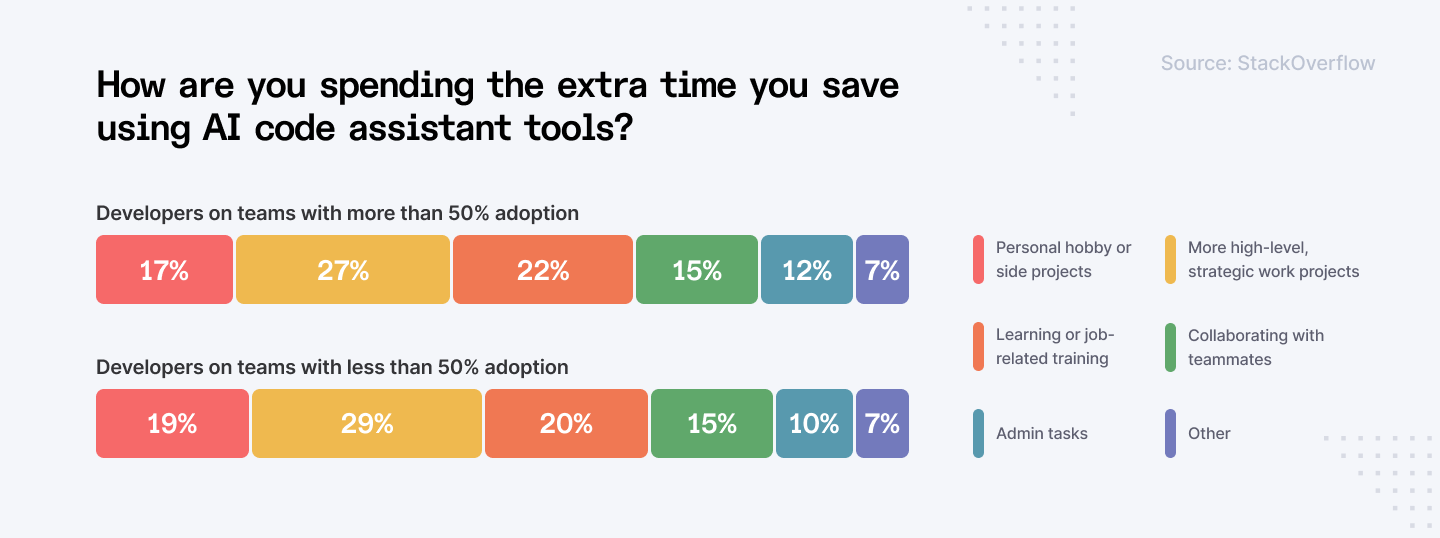
Faster time to market is critical for any software engineering team, and generative AI now delivers it across the whole software development lifecycle (SDLC), from coding to deployment, as covered in our guide to optimizing the SDLC with AI. Adoption is no longer experimental. A 2024 Stack Overflow pulse survey found most developers already use AI code assistants in their workflow, and Gartner predicts 75% of enterprise software engineers will use AI code assistants by 2028. What changed most recently is the rise of agentic coding tools that act, not just suggest. This guide walks through 11 impactful GenAI use cases already in production, the risks every team should plan for, current model choices for 2026, and a checklist to get real value from the technology.
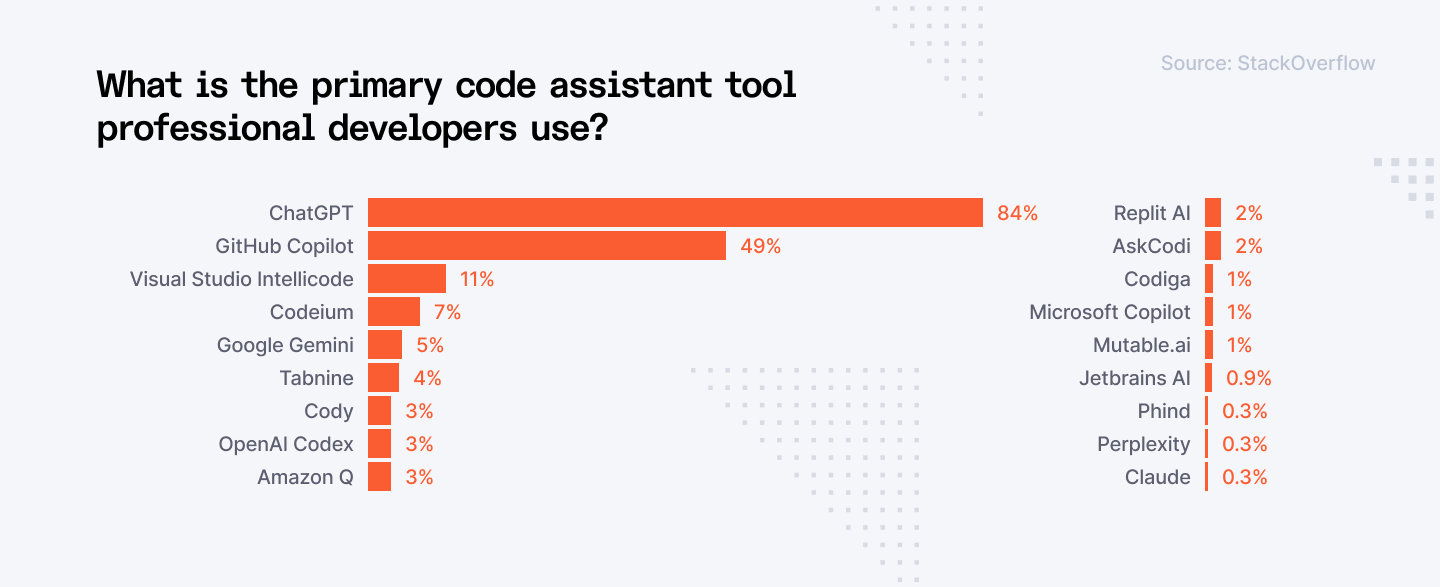
5 Key Takeaways
- GenAI spans the full SDLC. The 11 use cases below cover code review, generation, testing, debugging, documentation, deployment, conversational coding, security, refactoring, translation, and design.
- The productivity gains are measured, not hype. PwC estimates 20 to 50% developer productivity gains, and Gartner expects 75% of enterprise engineers on AI code assistants by 2028.
- 2026 is the agentic year. Tools such as Claude Code, Cursor, and GitHub Copilot agents now plan and execute multi-step tasks, powered by GPT-5.5, Claude Opus 4.x, and Gemini 3.1 Pro. This is the biggest change since inline autocomplete.
- The risks are real and must be managed. Transparency, bias, inaccuracy, privacy, IP exposure, and cybersecurity all need controls. Keep a human in the loop for security-critical and architecture decisions.
- For teams hiring. Index.dev matches you with the top 1% of senior, human-vetted GenAI engineers from LATAM and CEE, in 48 hours.
What is Generative AI?
Generative AI is designed to learn from the input data, recognize patterns, and generate new content on a large scale without duplicating the original data. This powerful technology can generate content in different formats such as images, video such as Higgsfield, offering easy-to-use AI video generator, speech, text, software code, and product designs.
Generative AI’s foundation lies in AI models that are trained on a diverse range of unlabeled data, allowing them to perform with auxiliary fine-tuning. It encompasses different technologies such as:
- Large Language Models (LLMs)
- Generative Adversarial Networks (GANs)
- Variational Autoencoders (VAEs)
- Autoregressive Models
- Recurrent Neural Networks (RNNs)
- Transformer-based Models
Risks of Generative AI
As beneficial as generative AI is, it also poses significant risks and limitations. Key oversight risks include:
1. Transparency:
Generative AI models are unpredictable in their outputs, and even developers may not always understand how these applications operate. This lack of transparency makes GenAI applications a bit troublesome.
2. Biases:
To detect and address biased responses and ensure their appropriate usage, it’s vital to have policies and controls in place.
3. Inaccuracy:
Generative AI systems may produce inaccurate responses or fabricated outputs. It is important to assess the accuracy and appropriateness of the generated content before distributing the information publicly.
4. Privacy:
Generative AI systems may be trained to recreate the content around sensitive or private information. This can be a major concern for enterprises who are implementing generative AI applications.
5. IP issues:
These models lack assurances for protecting confidential data, as they are often trained on proprietary and copyrighted data. Thus, companies should implement ethical and legal concerns to prevent the exposure of intellectual property.
6. Cybersecurity:
GenAI is often used in cyber or fraud attacks. Companies should implement mitigation strategies to determine coverage for AI-related breaches.
Read more: Comparing Unimodal vs Multimodal Models in Generative AI
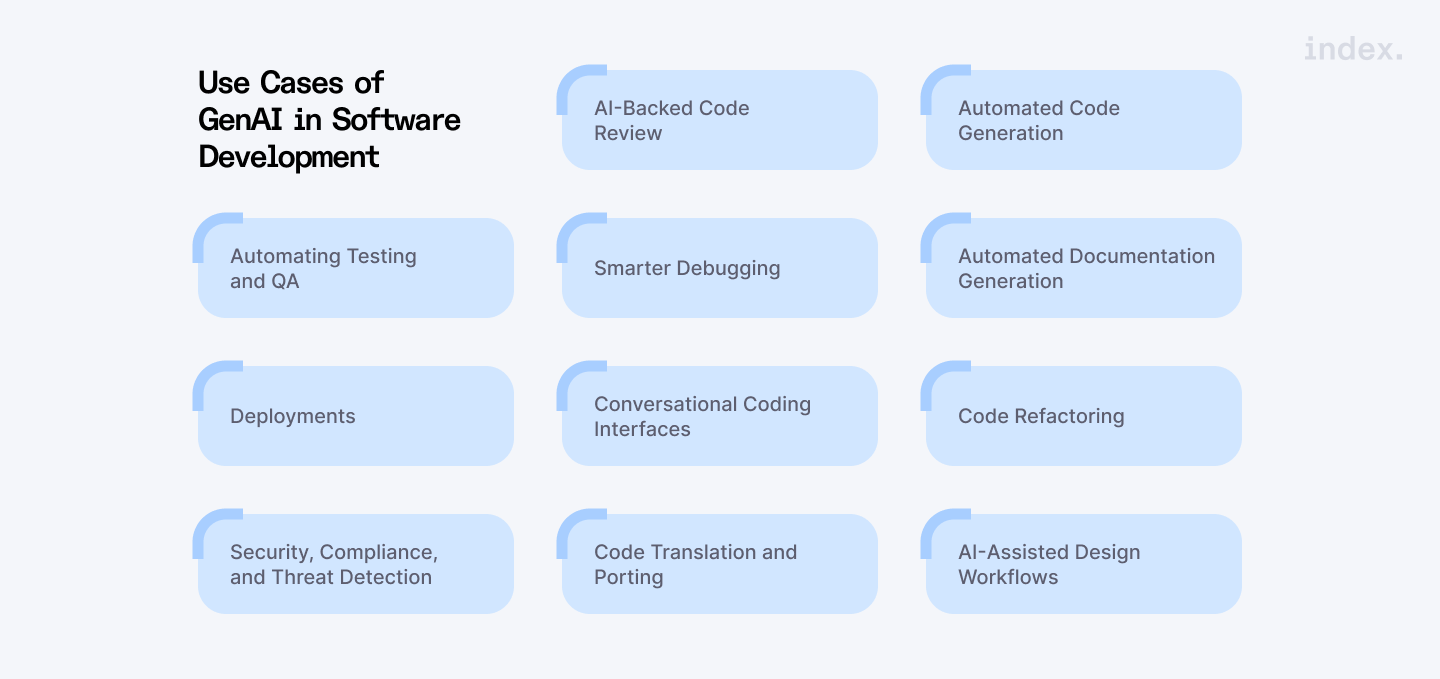
11 GenAI Use Cases that Transform Software Engineering Process
So how useful is generative AI in the software engineering industry? Generative AI can boost your developers’ productivity and speed by 20-50% , right now, making a real difference, from automating code reviews to smarter testing or debugging. Here are 11 ways it transforms software engineering workflow:
1. AI-Backed Code Review
AI-driven code review is one of the most noteworthy use cases of GenAI in the software development lifecycle. Contrary to traditional code reviews which are time-consuming and superficial, generative AI tools can help engineering talent analyze code quickly and in more detail, offering valuable suggestions for improvement.
These GenAI tools can help developers detect code bugs and security vulnerabilities, improve code quality, and ensure software robustness and reliability. In addition, tools that combine AI analytics with a human touch, like Reviewable, automatically organize code reviews into groups and suggest contextual code changes based on those reviews.
Tech teams can also create reliable software based on successful past implementations by leveraging automatic code regeneration capabilities. They can quickly predict technical performance and code issues before they complete architectural designs.
Best AI-driven code review tools include:
- GitHub Copilot provides inline code completions powered by deep learning. This tool turns developers’ natural language prompts into coding suggestions based on the project's context and style.
- Reviewable is a comprehensive code review tool that is fully integrated with GitHub.
- DeepCode is a code review platform powered by AI that assists developers in identifying coding issues, bugs, and vulnerabilities, all in real-time.
2. Automated Code Generation
The most straightforward application of GenAI is automated code generation. Instead of helping software developers with autocomplete suggestions, advanced AI systems can generate functions, classes, and even database queries taking into consideration the codebase’s context. For example, AI agents can create a custom CRUD REST API for a mobile app backend by analyzing existing code, data schemas, and documentation.
Developers can ask for complex requirements and the generative AI systems would take all the heavy lifting, automating a lot of the repetitive, low-level coding work that bogs developers’ workflow down.
Additionally, AI code generation enables quick prototyping, helping software engineers generate boilerplate code in a variety of programming languages and frameworks. Therefore, the AI assistant could provide customized starter code, organize folder structures, create configuration files, set up build scripts, and give specific instructions based on the developer's chosen tech stack.
Generative models like GitHub Copilot analyzes the developer intent and project context to suggest inline code and functions on the spot. This allows developers to translate their high-level intentions into quality code.
Below are other two examples of automated code generation tools:
- TabNine uses deep learning to suggest entire code lines and functions in over 20 programming languages.
- DeepCoder is a research project from Microsoft that uses machine learning to generate code from input-output examples.
Read more: 7 AI coding tools to help you become a 10x developer
3. Automating Testing and QA
Nearly half of the QA teams spend at least nine hours writing one test case for a complex scenario, involving the product logic and multiple integrations. Generative AI brings extra automation to the QA processes to enable comprehensive software testing. Deep learning models can analyze large amounts of codebase at a fast pace and with an improved accuracy than is humanly possible. These AI-powered testing tools can function like an assistant contributing to the code review process, executing test cases at scale, flagging bugs and security flaws, and identifying performance bottlenecks early in the development process. This not only assures that the software meets the desired standards and specifications but also allows software flaws to be addressed before they turn into bigger headaches.
GenAI-powered AI tools can also help engineering talent write unit tests and automate the creation of comprehensive test cases, covering edge cases, failures, and real-world usage patterns. This allows them to perform efficiently and focus on more complex tasks.
Notable AI-powered testing tools include:
- Testim is the AI-driven test automation platform for custom web applications, enabling fast authoring of AI-stabilized UI and end-to-end tests.
- Applitools is a cloud-based automated visual testing solution for web, mobile and desktop apps, helping companies verify that GUI & functionality are proeprly displayed to the end user.
4. Smarter Debugging
Generative AI can help developers with bug tracking as well. These AI assistants can analyze codebase content and provide thorough debugging recommendations. They are capable of categorising and prioritising bugs, tracing through complicated execution paths the human mind might overlook. They don’t just scan the codebase; they decipher it, pinpointing not just where code cracks emerge, but also how to address the root causes. Moreover, GenAI offers predictive bug hunting, meaning it can spot where bugs may appear next. These benefits impact software reliability and reduce costly issues making it into production.
Here is an example of generative AI tool for a more intelligent code debugging:
- Debugger.ai uses machine learning to analyse code executions and provide insights into bugs and performance problems.
5. Automated Documentation Generation
Documentation is a tedious, but crucial task in the software development lifecycle, and generative AI holds the immense potential to automate and efficientize this time-consuming process. With given code and usage context, these AI models can generate API references, library guides, and quality application documentation. They can provide documentation in different formats, from Markdown to HTML and interactive web interfaces. For apps and services, they can extract insights from textual data and create guides and reference manuals to explain all the inner workings. For APIs and libraries, they can offer code samples for each module, class, and method. Developers could list the APIs to document, usage examples to demonstrate, diagrams to render, and other parameters and the GenAI tools would then adapt the output accordingly.
When used wisely, generative AI documentation frees up developers’ time spent on writing tedious repetitive docs and allows them to take on higher-value tasks. However, it still requires a human quality check to verify accuracy and fill the gaps.
Prominent players that use generative AI for automated documentation generation include:
- Codex is an OpenAI research project that generates Markdown documentation for code by analyzing functions, inputs, outputs, and in-code comments.
- Docusaurus is an open-source tool that auto generates API reference docs and help guides by parsing JSDoc comments in code.
Sign up on Index.dev to hire the top 1% of senior, human-vetted engineers from LATAM and CEE, matched in 48 hours. Hire developers.
6. Deployments
Generative AI tools help tech teams automate deployments and significantly reduce time-to-market. Based on past data and trends, AI predicts the optimal times to roll out updates and ensure the deployment process runs smoothly. Moreover, it can also automatically trigger rollbacks whenever anomalies are detected, error rates are high or user engagement drops. Another use case is predictive scaling. GenAI analyzes data to predict traffic spikes and automatically scales your app in advance, preventing downtime during unexpected surges in traffic. This way, the infrastructure adjusts in real time with AI models spotting the bottlenecks and scaling resources automatically, keeping the application running at a peak performance.
The best GenAI tools used in deployments, include:
- GitHub Copilot helps generate and suggest code for deployment scripts and configurations based on project context.
- OpenAI Codex assists in writing and automating deployment processes, including generating code for CI/CD pipelines and infrastructure setup.
7. Conversational Coding Interfaces
Developers spend a significant amount of time consulting documentation and references to shape up syntax and research new coding approaches. With generative AI they can minimize this need through conversational coding interfaces. Rather than scrolling through documents, they can simply ask questions like "How can I implement server-side caching in a Node.js application using Redis?", "What are the steps to securely authenticate users via OAuth 2.0 in a React web application?, or "How do I implement authentication in React Native?". The AI systems will analyze the context and generate an accurate response to this inquiry.
Those AI assistants which integrate IDEs could even help programmers to perform tasks like committing changes, switching Git branches, running tests, and merging pull requests through voice commands or chats. This approach reduces the need to switch between different applications and websites, improving the workflow and overall productivity.
In conclusion, conversational interfaces are designed to help developers eliminate tedious tasks like Googling, browsing docs, and hunting for code snippets. However, they still need to be advanced enough to fully replace detailed API and framework documentation.
Powerful tools with conversational interfaces for coding include:
- TabNine allows developers to request code examples and documentation by simply describing their implementation goals in plain English.
- GitHub Copilot Chat offers conversational assistance directly within the IDE, helping programmers with code suggestions and learning new APIs.
Read more: Designing Generative AI Applications: 5 Key Principles to Follow
8. Security, Compliance, and Threat Detection
Generative AI makes deployment faster, more secure and compliant. It can learn from patterns, spot bottlenecks, and raise real-time concerns to prevent attacks. Isolating compromised systems or rerouting traffic can happen without developers’ constant monitoring.
These models can analyze network traffic and monitor system behaviour to identify unusual activities that could signal a security breach. Suspicious logins, data transfers or access requests are just some of the breaches that GenAI covers before they escalate.
Compliance is another aspect that can cause engineering friction for the tech teams. Whether it’s GDPR or HIPAA, GenAI ensures the deployments adhere to industry standards and regulations. The technology would examine code for any noncompliance issues, such as missing encryption, insufficient logging practices, or improper handling of information as outlined in the relevant rules, and by following this process, oversights regarding compliance can be decreased.
Among the major players that ensure infrastructures are secure, compliant, and threat-detected are:
- Darktrace detects and prevents cybersecurity threats, ensuring that applications and infrastructure remain secure and compliant with industry regulations.
- Snyk uses machine learning algorithms trained on vulnerability databases to scan codebases for security weaknesses.
9. Code Refactoring
In large-scale, long-running projects, technical debt slows down developer productivity due to large tangled legacy code. Refactoring, or cleaning up the code, becomes crucial.
Developers usually refactor the code based on their intuition, but with generative AI assistants they can analyze code more thoroughly and objectively. These tools can look at the entire project, measure complexity, and suggest improvements.
Some real-world examples include:
- Renaming unclear functions and variables
- Extracting duplicated logic into smaller functions
- Combining related logic into cohesive classes
AI-driven code refactoring tools keep code clean and maintainable and provide suggestions through natural language and comments, resulting in higher quality, optimized code. They can handle large-scale code refactoring, which otherwise will be time-consuming for developers to do manually.
Here are two examples of tools that leverage generative AI for code refactoring:
- RefactorHub analyzes code complexity metrics to identify refactoring opportunities, providing context-aware suggestions like extractions or encapsulations.
- CodeMR uses machine learning to recommend refactors that improve maintainability, providing semantic reasoning behind its suggestions.
10. Code Translation and Porting
Converting codebase from language or framework to another is a tedious and error-prone process. By using generative AI tools, developers can automate much of this grunt work and accelerate code migration.
These tools can convert applications written in Java, C++ or Python while keeping their semantics, behaviour, and performance intact. This makes it easier to adjust the code to a new environment, simplifying the project porting process to different tech stacks.
GenAI tools can automatically handle dependencies, wrappers and compatibility issues when migrating older code to modern technologies. Therefore, an generative AI assistant is capable of upgrading a Python 2 library to Python 3, handling all the nitty-gritty details effortlessly.
With these code translation tools, developers can focus on a broader architecture rather than line-by-line conversion, removing the friction and building multi-language and cross-platform applications across tech stacks. However, a human oversight is still required so that the transformed code operates correctly.
Here are two power players developers can use for an accelerated code transformation and porting:
- TransCoder converts code between C#, Java, and Python using supervised learning.
- CodeConverter uses machine learning to translate code across web frameworks like Angular, React, and Vue.
11. AI-Assisted Design Workflows
So far we’ve focused more on generative AI’s code generation capabilities. However, the technology is often used for design workflow, helping creative roles like UX designers achieve significant workflow improvements.
Visual design generation models enable designers to instantly convert text prompts into creative images. Designers can also iterate on prompts to generate different concepts. This way, GenAI becomes a tool for brainstorming, allowing graphic or UX designers to turn creative ideas into visual concepts or explore design possibilities before delving into mockups or assets.
Interface designers can also prototype quickly by describing UI components and layout for the generative AI tools to render. This allows them to validate ideas early on, before heading into the software engineering phase. Certainly, while GenAI speeds up visualization, designers are still in charge of creative direction, iteration process, or final touches. By offloading mundane and repetitive tasks, designers can focus more on strategic challenges, in which the AI models can act as creativity amplifiers rather than replacers.
Here are two examples of AI-assisted design workflow tools:
- Anthropic built an AI assistant called Claude that translates text prompts into UI mockups, icons, and design assets.
- Runway lets designers describe visuals in natural language for the AI to generate.
Read more: How to Select the Best AI Model for Your Project
A Hypothetical Use Case
Consider a developer working on a mobile app that requires implementing a sophisticated user authentication system with multi-factor authentication (MFA).
To improve his workflow, he decides to use a generative AI tool specifically designed for security features. First, he describes the requirements for the MFA system to the AI tool, including the need for email verification, SMS-based codes, and integration with third-party authentication services. The AI, trained on a vast dataset of security protocols and authentication frameworks, generates a comprehensive code framework that includes functions for handling email and SMS verification, as well as integrating with services like Google Authenticator or Authy. The AI tool also provides suggestions for securing sensitive data and ensuring compliance with industry standards like GDPR or HIPAA.
Developer then reviews the generated code, making adjustments to fit the app’s specific design and security policies. He incorporates the AI-generated code into the app’s codebase and proceeds to test the MFA system thoroughly. The generative AI tool helps by automatically generating test cases and scenarios to ensure the authentication system performs as expected under various conditions.
By using AI, the developer reduces the time spent on writing boilerplate code and ensures that the authentication system is robust and secure. This allows him to focus more on user experience and adding innovative features to the app.
Sign up on Index.dev to hire the top 1% of senior, human-vetted engineers from LATAM and CEE, matched in 48 hours. Hire developers.
Strategies To Maximizing The Value of GenAI
To maximize the value of generative AI use cases in software development, organizations can follow these impactful strategies:
- Ensure that generative AI tools align with your development process and goals.
- Collect feedback from developers, testers and stakeholders to improve AI-driven models, algorithms, and processes over time.
- Build cross-functional teams between AI developers and software development teams to work together to identify areas where GenAI can add value.
- Implement robust data protection measures and prioritize compliance with data privacy regulations.
- Consider the scalability of generative AI technologies and ensure they accommodate your organization’s further growing needs.
- Provide training and support to engineering talent using AI tools to maximize their productivity and efficiency.
- Regularly measure how well AI-driven processes perform in terms of development speed, code quality, and security.
- Invest in ongoing AI education and training to ensure your development teams use AI technologies to their full potential.
Read more: 6 AI Model Optimization Techniques You Should Know
What Changed in 2025 and 2026: Agentic AI Coding
The use cases above describe assistance: the tool suggests, the developer decides. The biggest shift since then is agentic coding, where the tool plans and executes a multi-step task on its own, then reports back for review. Instead of autocompleting a line, an agent can read an issue, edit several files, run the tests, and open a pull request.
The current generation of models behind these tools is GPT-5.5, Claude Opus 4.x, and Gemini 3.1 Pro, with much larger context windows than the 2024-era models. Agentic tooling such as Claude Code, Cursor, and GitHub Copilot agents now sits alongside the autocomplete assistants in this guide. A new standard, the Model Context Protocol (MCP), lets these agents connect to your repositories, issue trackers, and internal tools in a consistent way. For a technical lead, the job is shifting from writing every line to specifying intent clearly and reviewing agent output with discipline.
Where GenAI Wins and Where It Still Loses in Production
Adoption is high, but value is uneven. After two years of production use, a clear pattern has emerged.
| Where GenAI wins today | Where it still loses |
|---|---|
| Boilerplate, scaffolding, and config | Novel architecture and system design |
| Unit tests and edge-case generation | Security-critical and irreversible changes |
| Documentation and code explanation | Ambiguous or poorly specified requirements |
| Refactoring and code translation | Anything where a confident wrong answer is costly |
The honest takeaway is that GenAI accelerates the work around the hard decisions, and it does not replace the decisions. Teams that get the most value pair AI speed with strong review, tests, and a human in the loop for security and design. Measuring success by volume of generated code is a trap, because more code that nobody has truly reviewed is review debt, not progress.
Wrapping Up
Used well, GenAI-driven tools automate, simplify, and accelerate nearly every phase of software development, including coding, testing, security, documentation, deployment, and design. Companies still need to manage the drawbacks: data privacy, model bias, training cost, and the risk of skill erosion. The winning approach in 2026 is not to replace engineers with AI, but to give strong engineers AI leverage, with clear guidelines and review standards that keep quality high.
For Clients
Focus on innovation. Index.dev connects you with senior, human-vetted generative AI engineers, the top 1% from LATAM and CEE, matched in 48 hours. Clients save 40 to 60% on engineering costs and 97% return for a second engagement. Hire generative AI developers or explore Index.dev.
- Index.dev's senior generative AI engineers excel in data analytics and machine learning model training.
- They combine statistics, programming, and data visualization to help enterprises navigate complex data, extract insights, and refine decision-making.
- They also offer custom generative AI development services, building with foundation models such as GPT-5.5, Claude Opus 4.x, Llama, and Gemini 3.1 Pro to unlock transformative capabilities.
For AI Developers
Index.dev is an AI-first engineering talent platform that connects companies with the top 1% of senior engineers from LATAM and CEE, around 30,000 developers, each human-vetted through technical and live interviews from a pool of 2.5M+. Roughly a 1.2% acceptance rate, with matches in 48 hours. If you are a skilled generative AI engineer seeking a long-term remote opportunity with leading companies, apply to join Index.dev.
About Index.dev: Index.dev is an AI-first engineering talent platform that connects companies with the top 1% of senior engineers from LATAM and CEE to build software and AI products. Clients include Omio, Vodafone, Entrupy, and Stuart, as well as companies backed by Kleiner Perkins, Goldman Sachs, and Y Combinator.