AI productivity metrics have emerged as a vital lens for assessing modern software engineering performance, as development teams increasingly rely on intelligent technologies to create quicker, higher-quality code.
AI use has increased quickly in engineering teams in recent years, transitioning from experimental to embedded, day-to-day operations. Gartner's predicted insights show that AI is increasingly affecting how developers create code, manage infrastructure, and operate large-scale production systems, indicating a fundamental shift in software delivery models.
As a result, output volume and sprint velocity are no longer the only metrics used to quantify efficiency. Instead, teams are measuring AI in application development statistics, which show significant advantages in code quality, reduced rework, shorter deployment cycles, and increased system stability. Organizations are increasingly focusing on tangible effects, such as how AI reduces development timeframes while boosting consistency and robustness.
This article examines the facts underlying that transition, focusing on AI-powered coding and IDE integration, cloud infrastructure automation, and quantifiable AI in DevOps metrics that are changing the future of software engineering.
Need developers who leverage AI for maximum output? Index.dev connects you with vetted engineers experienced in AI-driven development, cloud automation, and modern DevOps.
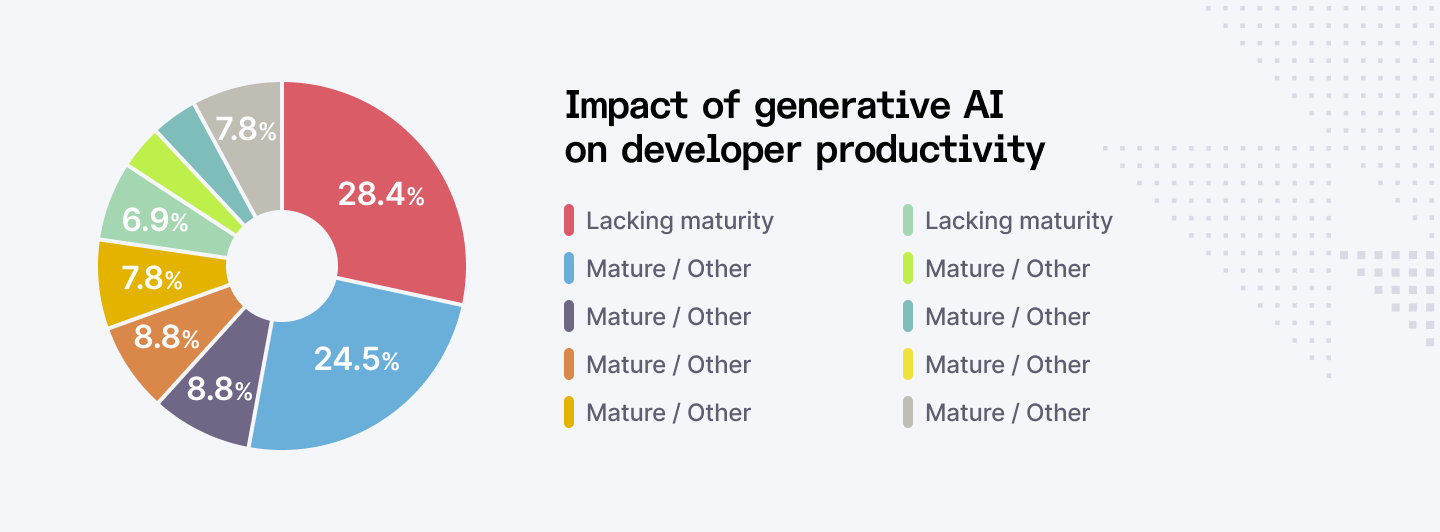
Impact of Generative AI on developer productivity
AI-Powered Code Generation: Impact on Developer Output
Overview: What Is AI Code Generation?
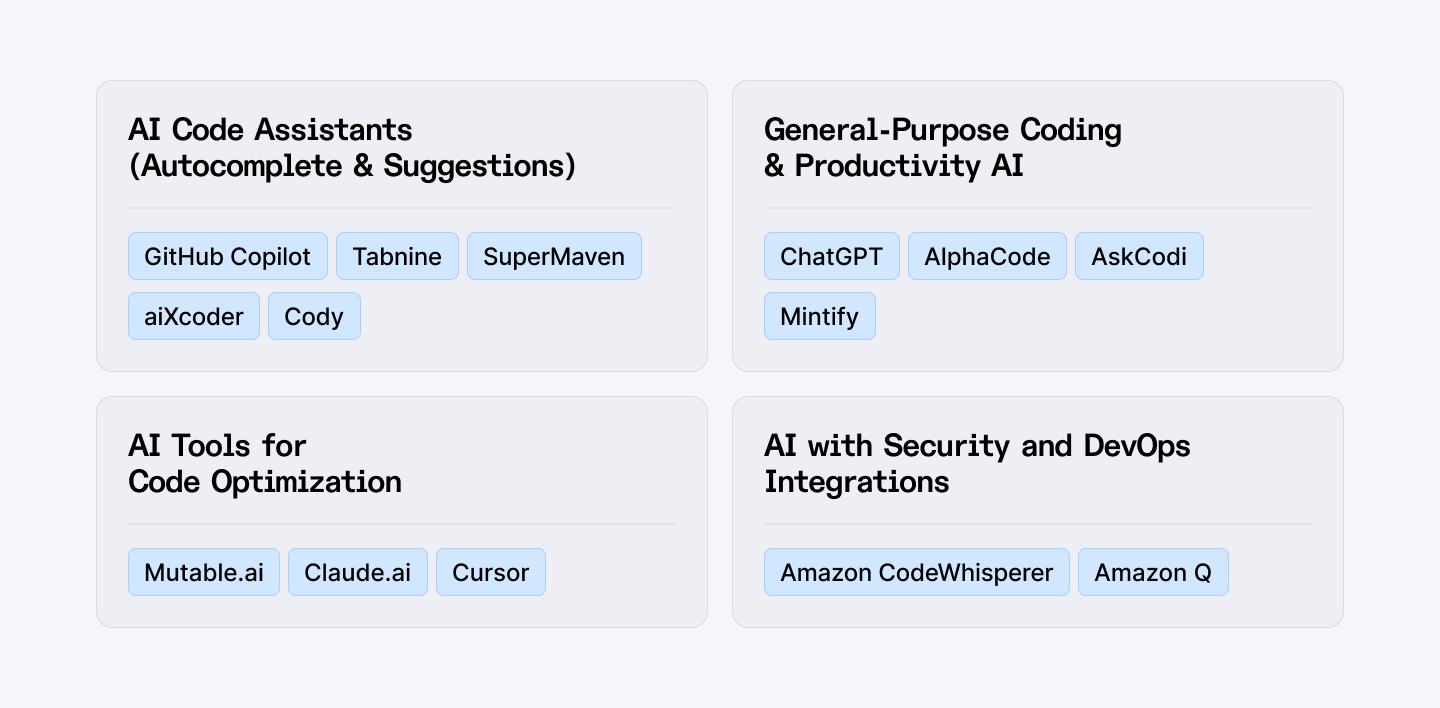
AI-powered code creation involves the use of machine learning models, specifically large language models (LLMs), to help developers throughout the coding process. Tools like GitHub Copilot, Amazon CodeWhisperer, and Tabnine interface seamlessly with popular IDEs, offering real-time code recommendations, auto-completions, and context-aware snippets. These systems are trained on large code repositories and technical literature, allowing them to produce boilerplate code, recommend functions, rearrange logic, and even fix frequent syntax or runtime problems.
“AI is not replacing developers. It’s helping them focus on more creative work by taking away the repetitive tasks.”
— Thomas Dohmke, CEO, GitHub
From an engineering viewpoint, this reflects a transition from manual coding to AI-augmented development, in which engineers concentrate on problem-solving and design while mundane chores are automated. As a result, generative AI coding statistics have emerged as a critical component of overall AI in app development statistics, assisting teams in quantifying how much labor is delegated to intelligent helpers.
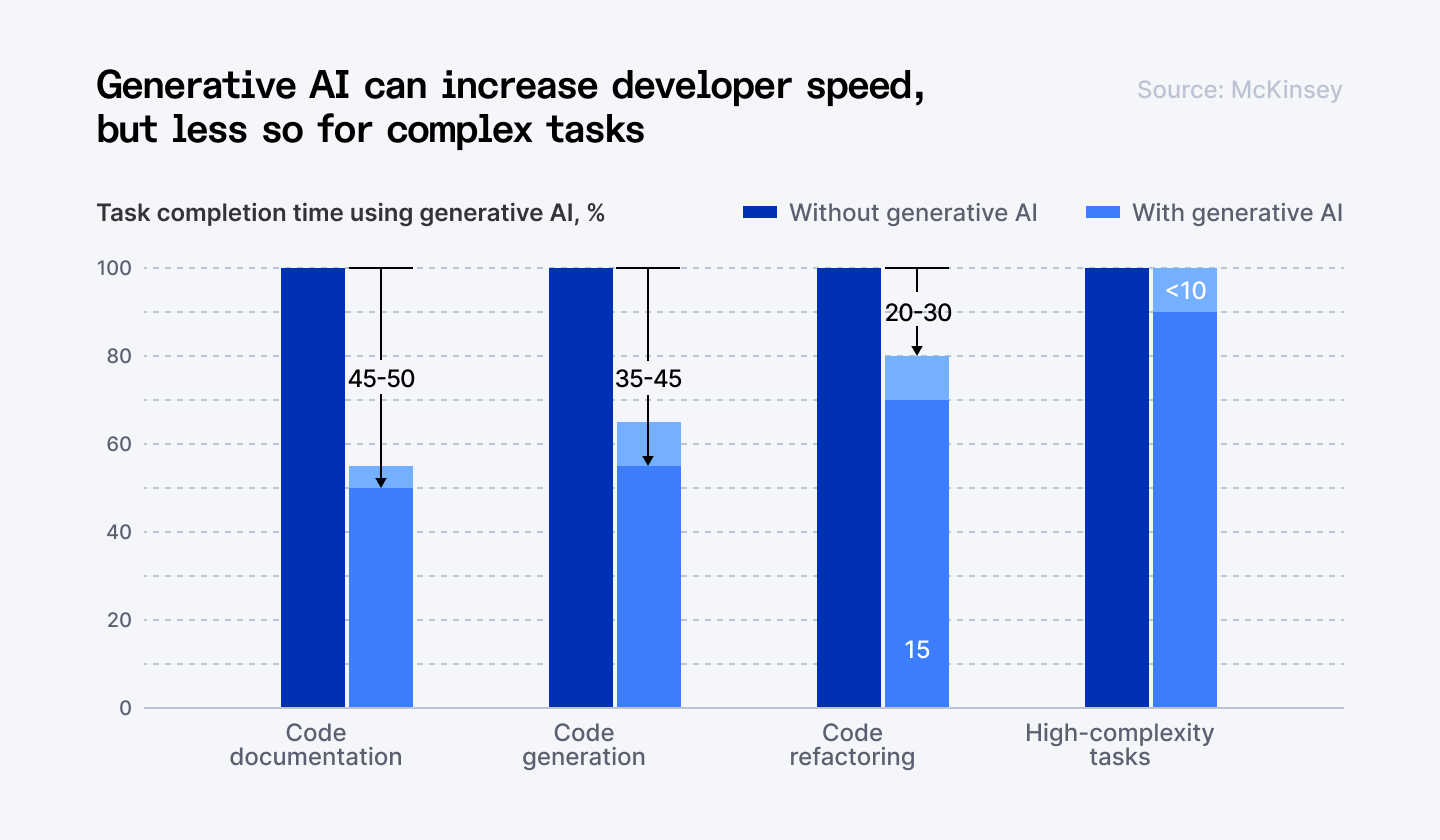
Task completion time using generative AI | Source: McKinsey
Productivity Metrics: Developer Output and Time Savings
Measuring the impact of AI code development necessitates monitoring specific productivity measures. According to a recent study from GitHub's Octoverse, developers who use AI coding assistance accomplish work substantially quicker, particularly repeated or well-scoped projects. Commonly cited metrics include:
- Time savings: Developers report significant reductions in the time spent creating boilerplate and repetitive code.
- Output velocity: The amount of functional code produced each hour, particularly for standardized components.
- Bug reduction: Early mistake identification and consistent patterns help to reduce defect rates in early commits.
- Reduced context switching: AI ideas reduce the need to explore manuals or forums while working on a task.
For developers working in the Apple ecosystem, exploring the following AI apps for Mac can also help them find solutions that streamline everyday workflows beyond coding, from writing and research to time tracking and other repetitive tasks.
Together, these numbers demonstrate how AI effectively improves developer performance without raising effort correspondingly. To accurately track performance, organizations are adopting to tools like software engineering intelligence platform to gain real-time visibility into development workflows and ensure that AI-driven gains translate into consistent business value.
“Developers using AI coding tools complete tasks significantly faster, especially for routine and well-defined coding work.”
— GitHub Octoverse Report
Developer Sentiment and Adoption Rates
Adoption rates amplify the impact. According to the Stack Overflow Developer Survey, an increasing number of professional developers utilize AI coding tools daily, with many reporting good opinions of code quality and increased productivity. Satisfaction rates are especially high among engineers working under tight deadlines, indicating that AI code generation is quickly becoming a typical productivity layer in modern software engineering.
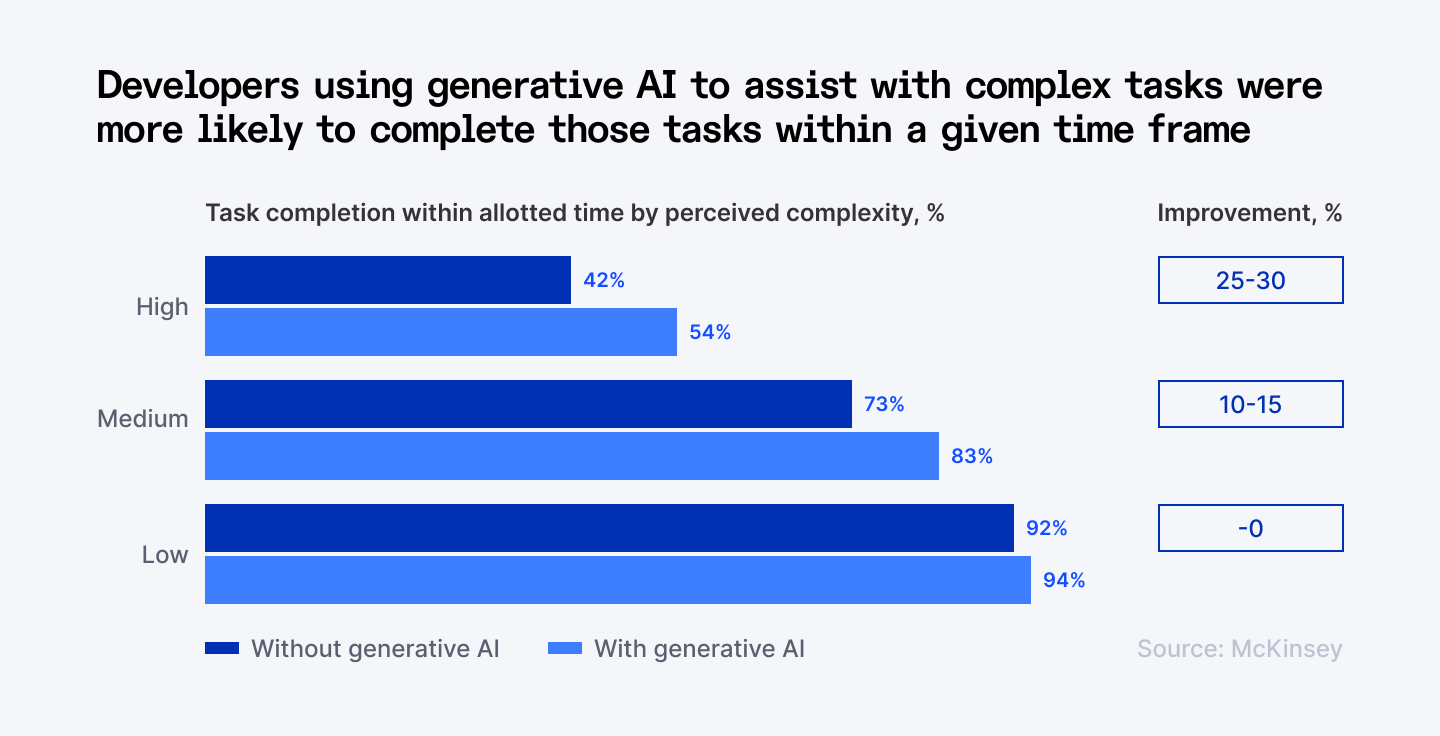
Task completion within allotted time using GenAI & not using it | Source: McKinsey
See the real numbers behind how AI coding tools are changing developer productivity in 2026.
Cloud Automation and AI Infrastructure Intelligence
AI in Cloud Management
AI has become a fundamental component of modern cloud management, allowing infrastructure to run with increased autonomy, efficiency, and resilience. Cloud providers are already integrating machine learning into core services to assist auto-scaling, cost optimization, and anomaly detection. AWS, Microsoft Azure, and Google Cloud Platform (GCP) utilize AI models to forecast demand surges, dynamically assign resources, and detect anomalous behavior across dispersed systems.
In reality, this implies that infrastructure can adjust to demand in real time without requiring continuous human involvement. These capabilities are increasingly being measured using cloud automation metrics and AI in cloud infrastructure statistics, which assess how well AI minimizes operational overhead while preserving performance and availability. AWS, for example, demonstrates how AI-driven operations (AIOps) assist teams in proactively managing large-scale settings and minimizing service interruptions.
“AI-driven operations allow teams to move from reactive firefighting to proactive and predictive system management.”
— Forrester Research, AIOps Industry Analysis
Measurable Cloud Efficiency Gains
The productivity benefits of AI-powered cloud automation are evident in unambiguous, quantitative increases. Organizations report a considerable reduction in manual infrastructure management, as operations such as capacity planning, load balancing, and issue triage become more automated. Provisioning periods for new environments are shorter, allowing development teams to deploy resources in minutes rather than hours or days.
AI-driven monitoring also helps to enhance uptime by recognizing possible faults before they worsen. : To evaluate trade-offs across platforms, teams can consult a comparison of 13 options detailing pros and cons, key features, and pricing for each cloud monitoring tool, aiding selection.
Predictive autoscaling reduces overprovisioning, leading to quantifiable cost reductions in computing, storage, and networking. In practice, teams often combine these approaches with downtime detector tools to identify outages in real time and respond before they impact users.
According to Forrester's industry research, organizations that implement AI in cloud operations find significant improvements in operational efficiency and infrastructure cost control. These results make cloud automation an important contributor to overall developer productivity.
AI-Powered Security and Compliance Monitoring
Beyond performance and cost, artificial intelligence (AI) is becoming increasingly important in cloud security and compliance. Machine learning models continually examine logs, traffic patterns, and user activity to detect possible risks more quickly than traditional rule-based systems. Key KPIs include time to detection and time to remediation, both of which increase when AI allows for earlier alarms and automated actions.
Microsoft Azure's AI-powered security services illustrate how intelligent monitoring improves security posture while decreasing the workload for engineering and operations teams. This is one of the reasons why Azure consulting services are so popular these days.
AI-enabled DevOps Performance Statistics
DevOps: Where AI Fits
Artificial intelligence has been deeply ingrained across the DevOps lifecycle, improving how teams design, test, deploy, and run software. AI models examine build patterns, test results, and deployment signals to identify hazards before they affect production in continuous integration (CI) and continuous delivery (CD) pipelines. Automated testing systems are increasingly using artificial intelligence to prioritize test cases, detect flaky tests, and optimize execution order, whilst predictive maintenance solutions monitor infrastructure health to anticipate failures.
These skills are now quantified using AI in DevOps metrics and larger AI DevOps productivity statistics, which emphasize speed, dependability, and operational effectiveness above raw activity alone.
“High-performing teams deploy more frequently, recover faster, and have significantly lower change failure rates, automation and intelligence play a critical role in enabling this.”
— DORA State of DevOps Report
Deployment and Cycle Time Improvements
One of the most obvious advantages of AI in DevOps is faster deployment performance. Key quantitative KPIs include deployment frequency, time from code commit to production, and change failure rate. AI-enhanced pipelines enable teams to deploy more often by minimizing human checks and speeding up approvals, while predictive analytics identify problematic changes earlier in the process.
According to the DORA State of DevOps Report, high-performing teams, many of whom use sophisticated automation and intelligence, deploy code more frequently, with shorter lead times and lower failure rates. AI improves these results by combining past deployment data with real-time signals to drive safer and quicker releases.
Test Automation and Defect Detection
AI-powered testing greatly boosts quality metrics in DevOps operations. Teams report increased automated test coverage because AI generates test cases and maintains test suites as applications change. Defect leakage into production is decreased when models detect abnormalities and edge situations that traditional testing may overlook.
AI-based test suite optimization also reduces feedback cycles by prioritizing the most impactful tests. IBM demonstrates how AI-powered test automation boosts productivity while retaining quality.
DevOps Collaboration Metrics
Beyond technical KPIs, AI fosters better communication between development and operations teams. Faster feedback loops, clearer alarms, and shared dashboards minimize friction, resulting in increased developer satisfaction and more robust delivery workflows.
Case Studies and Real-World Examples
Tech Companies Using AI for Development
Large corporations are increasingly utilizing AI to accelerate software delivery and increase operational efficiency at scale. For example, Microsoft has openly stated that AI-supported development and DevOps automation help engineering teams in shortening release cycles and improving code consistency across big, scattered teams. Organizations that have integrated AI into their coding workflows, testing pipelines, and production monitoring have experienced faster deployments, fewer post-release issues, and increased developer concentration on high-value work.
These AI developer productivity case studies focus on quantifiable benefits such as shorter release schedules, increased deployment confidence, and enhanced system reliability. Deloitte's industry research reveals that organizations that deploy AI across development and operations find significant advantages in speed, quality, and cost efficiency when AI is integrated into key engineering processes.
Startup Success Stories
AI has emerged as a force multiplier for startups and rapidly developing technology enterprises. Smaller teams can now expand products and infrastructure with fewer engineers by leveraging AI-powered code creation, automated testing, and cloud analytics. This enables companies to sustain quick release cycles while avoiding the expense of big DevOps and platform teams.
One of the most notable benefits identified is faster onboarding for new engineers. AI coding assistants and intelligent documentation tools help new workers become more productive by giving contextual coaching within programming environments — a shift that's also driving demand for structured upskilling in generative ai for software development, covering everything from prompt engineering to agentic workflows and cloud deployment.
According to McKinsey's AI adoption research, firms that integrate AI into engineering workflows are better positioned to expand effectively while preserving quality and velocity.
These real-world AI DevOps statistics show how AI is transforming productivity in enterprises of all sizes.
Challenges and Risks: Interpreting Statistics
Common Pitfalls of Productivity Metrics
While AI-driven productivity data is enticing, it should be viewed with caution. One of the most prevalent errors is associating the amount of production with actual efficiency. Metrics like lines of code created or jobs performed do not necessarily accurately indicate code quality, maintainability, or business effect. Similarly, the "time saved" varies greatly depending on how it is measured, whether it solely considers initial coding speed or includes downstream processes like debugging, testing, and review.
These challenges underscore the significance of careful developer data interpretation, in which AI productivity measurements are weighed against qualitative indications such as code clarity, system reliability, and developer experience. Without this background, teams risk exaggerating advantages while ignoring hidden costs. As talks around AI productivity threats intensify, firms are fine-tuning how they define and quantify success.
Bias and Security Issues in AI Tools
AI development tools can pose new dangers in terms of bias and security. Code recommendations may accidentally reproduce vulnerable patterns from training data, raising vulnerability exposure. Compliance hazards emerge when developed code violates license, data protection, or industry rules. Excessive dependence on AI-generated patterns might have long-term consequences if teams lose deep system understanding.
Security frameworks, such as OWASP's recommendations on AI security concerns, give useful help for addressing these issues.
What The Future Holds (2027 and Beyond)
Emerging Trends
As AI capabilities advance, the future of software engineering will shift away from helping tools and toward more autonomous systems. Self-healing infrastructure is predicted to become the norm, with AI detecting, diagnosing, and resolving faults without human involvement. At the application layer, AI will get more involved in architectural design, proposing system patterns, performance improvements, and scalability techniques based on historical data and real-time usage. These advancements hint at autonomous development processes, in which AI handles a bigger piece of the build-test-deploy cycle.
These shifts define the future of AI in development productivity, which aligns with larger 2026+ AI development trends centered on robustness, speed, and reduced operational complexity.
Predictions Based on Data
Analyst estimates suggest that as AI usage expands across development and DevOps teams, productivity will continue to increase year after year. As AI-driven automation becomes more prevalent, enterprises may expect to see modest improvements in deployment frequency, system dependability, and developer productivity. According to IDC's AI projection, intelligent automation will remain a top investment priority for engineering teams looking to achieve scalable productivity gains.
Up next: Discover the AI risks most leaders underestimate—and how to stay ahead of them.
Conclusion
Artificial Intelligence is no longer a hypothetical productivity boost in software engineering; it is a measurable, compounding force that is transforming how code is produced, infrastructure is managed, and software is delivered at scale. The data regularly indicates considerable advantages in AI-assisted development, cloud automation, and intelligent DevOps pipelines, including faster cycle times, increased deployment confidence, decreased operational overhead, and improved developer experience.
What distinguishes high-performing teams is not whether they employ AI, but how carefully they assess its impact. Organizations that monitor the relevant KPIs, deployment frequency, defect leakage, infrastructure efficiency, mean time to recovery, and developer satisfaction transform AI from a tactical tool to a strategic advantage. Those who rely on surface-level measurements may mistake activity for advancement.
As we approach 2026 and beyond, AI will continue to transition from supportive tools to autonomous systems that actively enhance engineering operations. The winning teams will be those who combine AI adoption with disciplined measurement, strong technical basics, and the necessary expertise to properly steer these systems.
➡︎ Building faster with AI-powered developers? Index.dev delivers pre-vetted remote engineers who master AI coding tools and modern DevOps practices.
➡︎ If this sparked your interest in AI-driven modernization, you might want to explore how autonomous coding agents perform in real development workflows, what productivity gains teams are seeing when AI tools enter daily coding, and which AI tools truly improve developer focus and delivery. We also dive into how organizations measure the real ROI of AI coding assistants, share up-to-date statistics on AI adoption in application development, and break down which AI code assistants work best for SaaS teams across debugging, CI/CD, and code review—perfect if you’re thinking beyond modernization and into long-term engineering efficiency.