Your best candidate ghosted you yesterday. The one before that accepted a counter-offer. The three before that? Never responded to your carefully crafted outreach messages.
Meanwhile, you've got 200+ applications sitting in your inbox—most of them from people who clearly didn't read the job description.
This isn't a horror story. It's recruiting in 2025 without automation.
67% of organizations now use AI in recruitment—up from 26% just last year. 99% of hiring managers use AI in some capacity, and 98% report significant efficiency improvements. The platforms handling automated candidate outreach don't just save time—they're delivering 31% faster hiring and 30-40% higher response rates than manual methods.
We spent three weeks analyzing platforms, tracking adoption patterns, reading user reviews, and cross-referencing industry data. These seven platforms consistently deliver results—not because they're perfect, but because they solve real bottlenecks without creating new ones.
Looking to hire developers faster? Index.dev connects you with vetted, interview-ready engineers in 48 hours, making your AI-powered hiring even more effective.
What You'll Pay (The Cost Breakdown)
Before diving into features, let's address the question most articles dodge: How much does this cost?
The pricing paradox: Almost every AI recruiting platform hides prices behind "contact sales." That's intentional. They want to customize quotes based on your hiring volume, which means identical companies pay wildly different amounts.
Here's what we found:
High-Volume Automation (Paradox, Gem)
- Typical range: $2,000–$10,000/month depending on application volume
- What you get: Unlimited candidate interactions, full ATS integration, advanced analytics
- ROI math: If you hire 20+ people/month, you're saving $40,000+ in recruiter time annually
- Hidden cost: Setup takes 2-4 weeks; implementation distracts your TA team
Niche Sourcing (Juicebox, HireEZ)
- Typical range: $1,500–$6,000/month
- What you get: Access to 30-800 million profile databases, automated outreach, feedback-learning AI
- ROI math: You source 3x more passive candidates in the same time; offering process gets faster
- Hidden cost: These tools are sourcing engines, not screening tools—you still need downstream vetting (hello, Index.dev)
Hybrid Human-AI (Fetcher, SeekOut)
- Typical range: $3,000–$8,000/month (Fetcher includes actual recruiters)
- What you get: AI + human judgment; expert-curated lists; managed campaigns
- ROI math: Slower than pure automation but higher quality matches; reduces wasted interviews by 40-50%
- Hidden cost: You're paying for recruiter time; it's expensive but often worth it
Enterprise All-in-One (Gem)
- Typical range: $8,000–$25,000+/month
- What you get: Sourcing + screening + application review + scheduling + analytics + CRM integration + everything
- ROI math: Large teams (100+ hiring managers) see massive time consolidation; small teams rarely break even
- Hidden cost: Steep learning curve; adoption takes 8-12 weeks
Intelligence & Documentation (Metaview)
- Typical range: $1,500–$4,000/month
- What you get: Automated interview notes, sourcing assistance, analytics
- ROI math: Primarily a productivity tool for recruiting teams; indirect ROI through better data
- Hidden cost: Doesn't solve your top-of-funnel problem (finding candidates)
Key Insight: Platforms aren't priced on features—they're priced on outcomes. High-volume = higher cost because you're generating more recruiting work. The platform that costs $5K/month might be cheap if you're hiring 50 people annually but expensive if you're hiring 5.
Which Platform Fits Your Situation?
Before we dive into each tool, understand the decision architecture. Your recruiting challenge typically falls into one of five patterns:
Pattern 1: Drowning in Volume (1,000+ monthly applications)
Your problem isn't finding candidates—it's processing them. Manual screening consumes 40+ hours/week. Your recruiters are burned out.
Platforms that win: Paradox, Gem
Why: Automated screening + scheduling eliminate bottlenecks
What to expect: 30-50% faster hiring; happier TA teams
Cost reality: $2K–$10K/month, but ROI is fast
Pattern 2: Can't Find Niche Talent (Technical roles, passive candidates)
LinkedIn only shows 10-15% of qualified developers. Your ideal candidates don't check job boards daily. Manual sourcing is painfully slow.
Platforms that win: Juicebox, HireEZ
Why: Multi-platform sourcing + AI learning expand your reach beyond LinkedIn
What to expect: 2-3x more sourcing options; quality candidates LinkedIn doesn't show
Cost reality: $1.5K–$6K/month; ROI depends on your hiring velocity
Pattern 3: Quality Issues (High rejection rates, poor culture fit)
You're hiring fast, but half your hires don't work out. You need better screening, not just more candidates.
Platforms that win: Fetcher (human curation), Metaview (better data)
Why: Human judgment catches what AI misses; better documentation prevents mistakes
What to expect: Higher offer acceptance rates (5-12% improvement); fewer bad hires
Cost reality: Higher than pure automation but saves money on failed hires
Pattern 4: System Chaos (Tools don't integrate; data lives in 5 places)
Your ATS doesn't talk to your email platform. Analytics are scattered. Recruiting is inefficient because your systems are broken.
Platforms that win: Gem
Why: Unified platform eliminates integration headaches
What to expect: Single source of truth; recruitment transparency
Cost reality: $8K–$25K/month; ROI is high for teams with 20+ active hires
Pattern 5: Speed Obsession (You need quality candidates in 3 days, not 30)
You found a great engineer leaving their job in 2 weeks. You need interview-ready candidates immediately.
Platforms that win: SeekOut Spot
Why: Expert recruiters + AI agents working together move fast
What to expect: Candidates in 3 days instead of weeks; higher quality than pure automation
Cost reality: $3K–$8K/month; ROI is fast if you value speed over cost
Be honest about your problem. Most companies pick the wrong platform because they try to solve Pattern 1 (volume) with a Pattern 2 tool (sourcing). That's why they fail.
The Platforms
1. Paradox (Olivia): The AI That Handles Everything You Hate About Recruiting

The Problem It Solves:
You're hiring for 50 frontline roles. The candidate asks a question at 11 PM. You're asleep. They accept another offer before you wake up.
In high-volume hiring, speed is quality. Every hour matters.
How It Works:
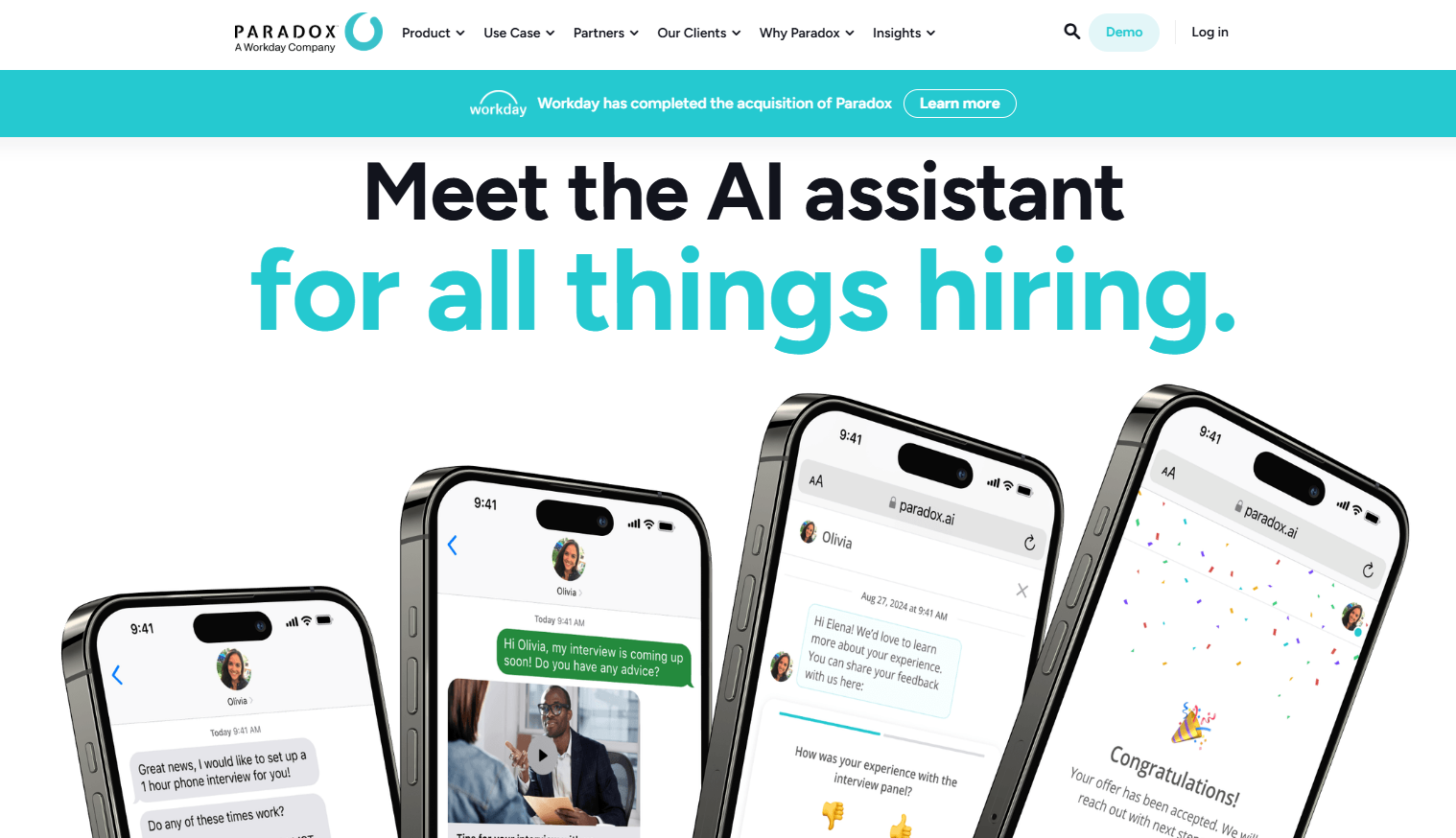
Paradox built Olivia—a conversational AI that handles the 80% of recruiting work that's mostly administrative: screening questions, application walks-through, assessments, interview scheduling.
All through SMS, email, and WhatsApp. Where candidates actually respond, not where your ATS lives.
Olivia learns your hiring criteria, your scheduling preferences, your culture signals. It gets smarter with each hire. Unlike chatbots that feel robotic, Olivia's conversations pass the "is this a human?" test.
Real Numbers:
- Response times dropped from 7 days to under 24 hours
- Time-to-hire decreased by 30-50% for high-volume hiring teams
- McDonald's, FedEx, 7-Eleven use it to manage thousands of applications without their recruiting teams drowning
Some new hires were so comfortable with Olivia they wanted to meet "her" on their first day.
Technical Detail: Workday acquired Paradox in August 2025, signaling that conversational AI moved from experimental to "we're betting the company on this." Paradox also launched Immersive Job Preview this year—AI-generated video combined with conversation interactions to set realistic job expectations. Won HR Executive's 2025 Top Product award.
Best For:
- Frontline/hourly hiring (50+ roles/month)
- High-volume application processing
- Teams drowning in screening work
- 24/7 availability requirement
What It Doesn't Solve:
Paradox handles engagement brilliantly but doesn't vet technical depth. You get high-volume screening; you still need downstream vetting for actual capability assessment. That's where Index.dev's multi-step process kicks in—filtering Paradox's volume to only the top 5% actually worth interviewing.
Price Range: $2K–$8K/month depending on volume
Next up: See how Paradox’s AI chatbot is transforming recruitment—find out if it lives up to the hype.
2. Juicebox (PeopleGPT): The AI That Gets Smarter Every Time You Say "No"

The Problem It Solves:
You're manually building Boolean strings. Filtering thousands of profiles. Personalizing outreach. Repeating next week.
That's traditional sourcing. It's soul-crushing.
How It Works:
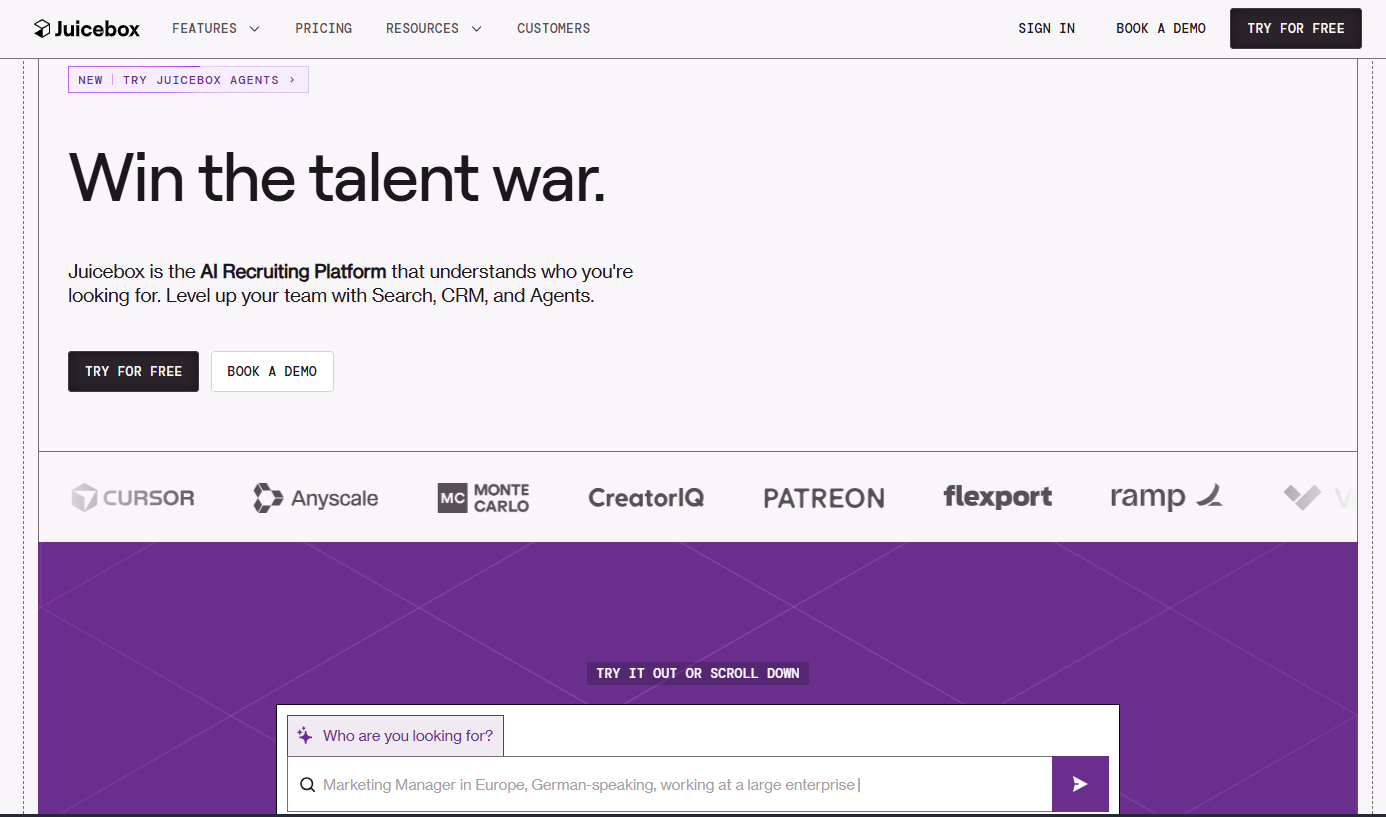
Tell Juicebox what you're looking for. It searches 800 million+ profiles across 30+ sources and surfaces candidates. You approve or reject with feedback: "Needs more enterprise experience" or "Perfect, find 10 more like this."
Juicebox doesn't execute static searches. It learns. Every rejection refines its understanding of what "good" looks like. By week three, the AI sources candidates better than you ever could manually.
The AI personalizes outreach by referencing specific details from candidate profiles—GitHub projects, published papers, career milestones. Outreach feels relevant instead of mass-produced. Result: 3x more replies than traditional cold emails.
Real Numbers:
Juicebox's adoption is "exceptionally rare" in recruiting tech. Teams choose it because solo founders can hire a dozen people without hiring professional recruiters. That's the proof point.
Technical Detail: Unlike keyword-matching tools, Juicebox uses semantic search. It understands context. A developer who built "distributed systems" and one who built "microservices scaling" might look different to keyword search but similar to Juicebox's AI. It finds talent keyword searches miss.
Best For:
- Technical/niche talent sourcing
- High-growth startups (small teams, ambitious hiring)
- Agency recruiters juggling multiple searches
- Teams hunting passive candidates
- Founders hiring without a dedicated TA function
What It Doesn't Solve:
Juicebox's magic is sourcing. It finds candidates; it doesn't screen them. You still need vetting. And when Juicebox surfaces 50 qualified profiles, which 3 should you actually interview?
Price Range: $1.5K–$5K/month
3. HireEZ: When LinkedIn Isn't Enough

The Problem It Solves:
LinkedIn has 930 million users. Your ideal candidate isn't one of them. They're building open-source projects on GitHub. Publishing technical articles. Contributing to Stack Overflow. HireEZ finds them.
How It Works:
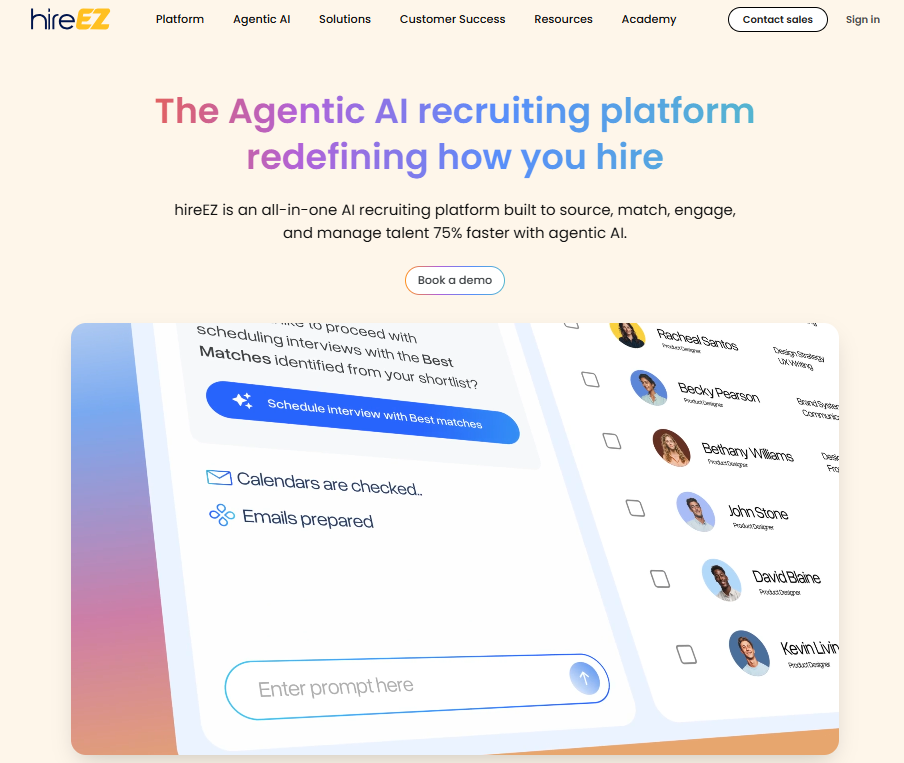
HireEZ aggregates data from 45+ platforms—LinkedIn, GitHub, Google Scholar, Stack Overflow, AngelList, tech forums—and automates sourcing and outreach across all simultaneously.
The platform's contact-finding rate hits 87%. That's not typo. It delivers verified email addresses and phone numbers for candidates you want to reach. Most platforms get you 40-60% valid contact info. HireEZ gets 87%.
Real Numbers:
- Contact discovery rate: 87%
- Open-web coverage: 45+ platforms vs. LinkedIn's single source
- Response rates: 15-25% (2-3x industry average) due to multi-channel outreach
HireEZ released EZ Agent in 2025—an agentic AI recruiting assistant that autonomously handles sourcing and outreach in your voice. Email sequences, drip campaigns, everything. It transformed HireEZ from a sourcing tool into a fully automated recruiting agent.
Technical Detail: Machine learning continuously refines searches as you provide feedback. The system learns which profiles match your criteria. It gets smarter with every hire.
Best For:
- Technical/specialized talent (developers, engineers, data scientists)
- Passive candidate sourcing (people not actively job hunting)
- Niche roles where LinkedIn is insufficient
- Global hiring (HireEZ's multi-platform approach catches international talent)
What It Doesn't Solve:
HireEZ excels at breadth. It finds 100 qualified candidates. Problem: now you need to vet who are actually qualified and interested.
Price Range: $2K–$6K/month
4. Fetcher: When You Need Humans (Because Sometimes Robots Get It Wrong)

The Problem It Solves:
Pure automation is tempting until the AI sources someone who left the industry three years ago. Or sends outreach to someone who explicitly said "no recruiter contact."
Sometimes you need a human filter.
How It Works:
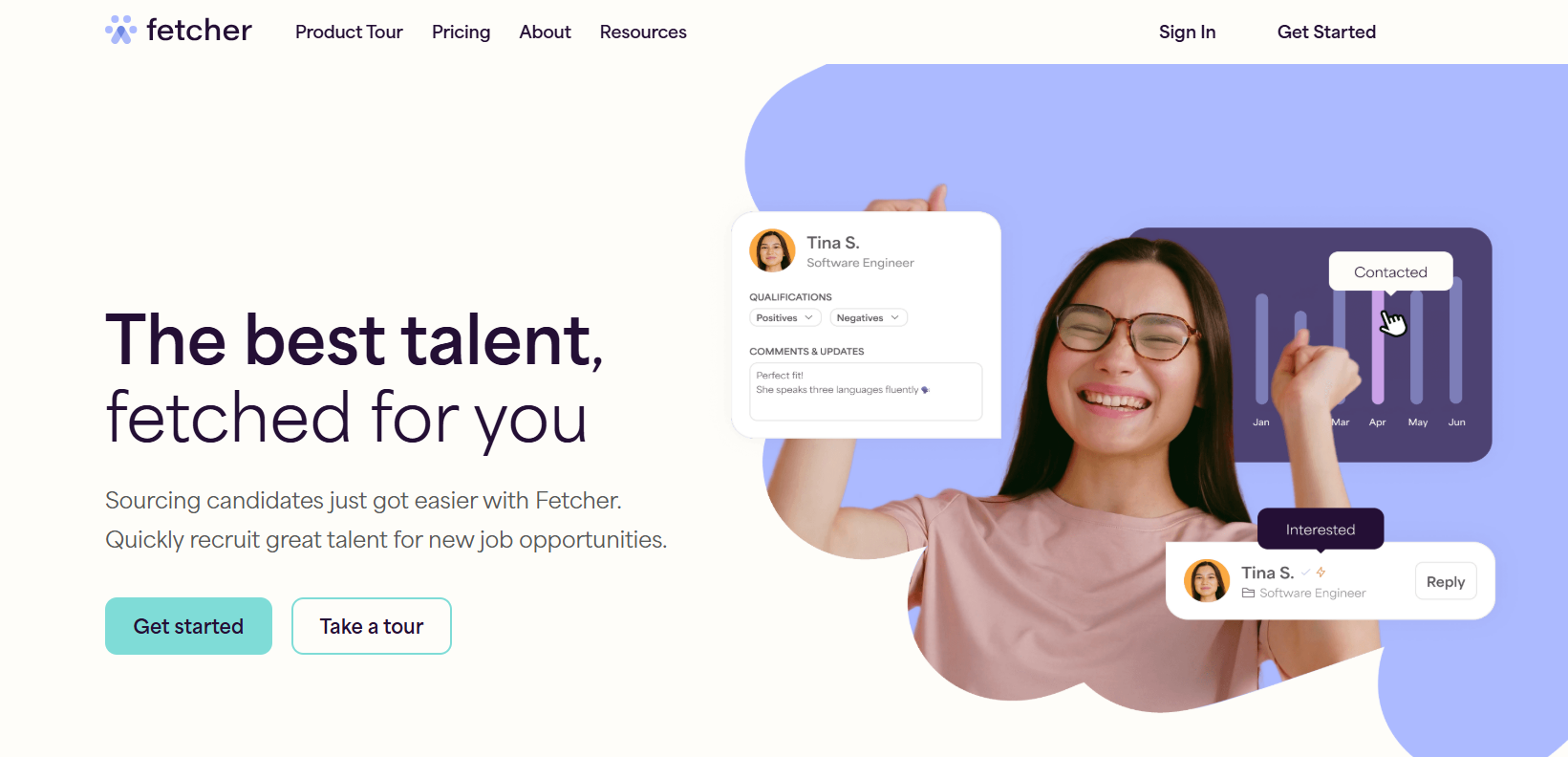
Fetcher combines AI-driven sourcing with actual human recruiters who review candidates, manage outreach, and catch context that automation misses.
Here's the workflow: Fetcher's AI searches 500 million global profiles and identifies potential matches. Human recruiters review those matches, flag edge cases, then manage outreach campaigns on your behalf.
You get AI efficiency (it sources fast) + human judgment (it doesn't make stupid mistakes) = the best of both.
Real Numbers:
- Automated email sequences: 40% response rates (significantly higher than generic cold email)
- Recruiter time saved: Average 30 hours/week on manual sourcing
- Quality control: Human review catches 15-20% of matches that pure automation would have missed
Technical Detail: Fetcher includes diversity-focused sourcing filters (critical if you have DEI hiring goals), pipeline analytics, and ATS integrations. The human-in-the-loop approach maintains quality control while scaling outreach volume.
Best For:
- Internal TA teams (you have recruiting staff who appreciate quality sourcing)
- Recruiting agencies (quality matters; reputation risk is high)
- High-stakes hiring (executive search, specialized talent)
- Teams that got burned by pure automation before
What It Doesn't Solve:
Fetcher's human recruiters curate sourcing lists. They don't assess technical depth.
Price Range: $3K–$7K/month (includes actual recruiter time)
5. Metaview: Finally, an AI That Remembers What Candidates Actually Said

The Problem It Solves:
You finish an interview. Open your notes app. Try to remember what the candidate said about their last project while the details are still fresh. Your next interview starts in three minutes.
Meanwhile, you can't find the notes from yesterday's screening calls. Your hiring team evaluates the same candidate differently because you're all working from fuzzy memory and incomplete documentation.
How It Works:
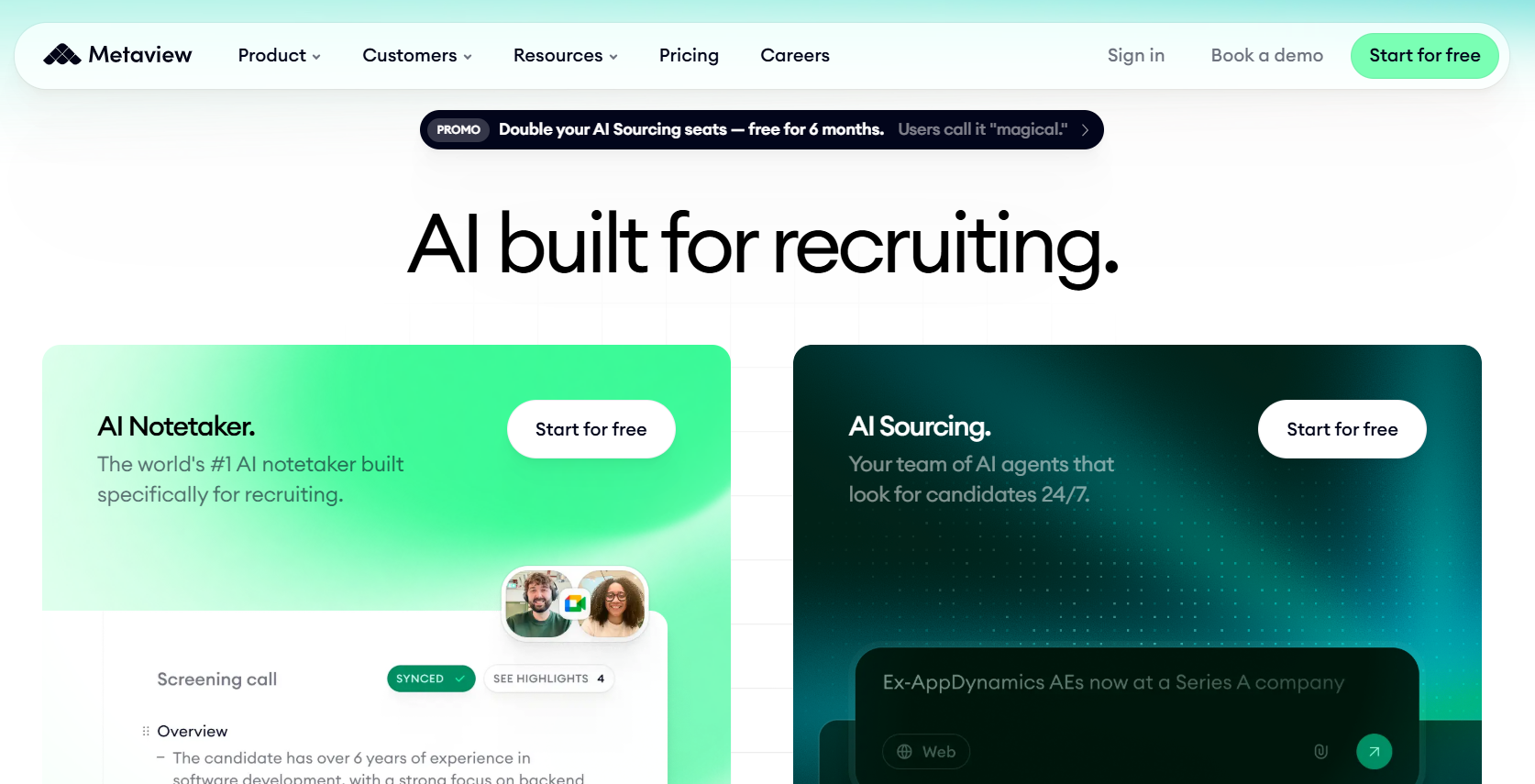
Metaview automates documentation across sourcing, screening, interviews, and reporting. The AI listens to interviews, generates summaries, extracts key details, and flags performance signals.
No more frantically typing during interviews or reconstructing conversations from memory.
Think of it as: every interview gets documented by someone who never forgets, never misses details, and captures context you'd miss while actively interviewing.
Real Numbers:
Metaview integrates with major ATS platforms, providing unified data flow. Built-in analytics measure sourcing effectiveness and recruiter productivity—revealing bottlenecks that manual processes hide.
Technical Detail: The AI-assisted sourcing identifies candidates based on role requirements, then automatically generates interview summaries and candidate performance analytics. It doesn't just transcribe; it analyzes.
Best For:
- Recruiting teams that need documentation consistency
- Executive search/specialized hiring (you need detailed notes)
- Talent leaders managing complex hiring processes
- Teams juggling multiple roles simultaneously
- Organizations that care about quality hiring data
What It Doesn't Solve:
Metaview centralizes hiring intelligence. It makes your recruiting data better. But it solves a mid-funnel problem—documentation and insights. It doesn't source candidates (that's Juicebox/HireEZ) or screen at scale (that's Paradox). Metaview makes your hiring team more organized.
Price Range: $1.5K–$4K/month
6. Gem: When Enterprise Teams Need Everything in One Place

The Problem It Solves:
Your sourcing tool doesn't talk to your ATS. Your messaging platform doesn't sync with your CRM. Analytics live in three spreadsheets. This fragmentation kills productivity.
Large enterprises can't afford that chaos.
How It Works:
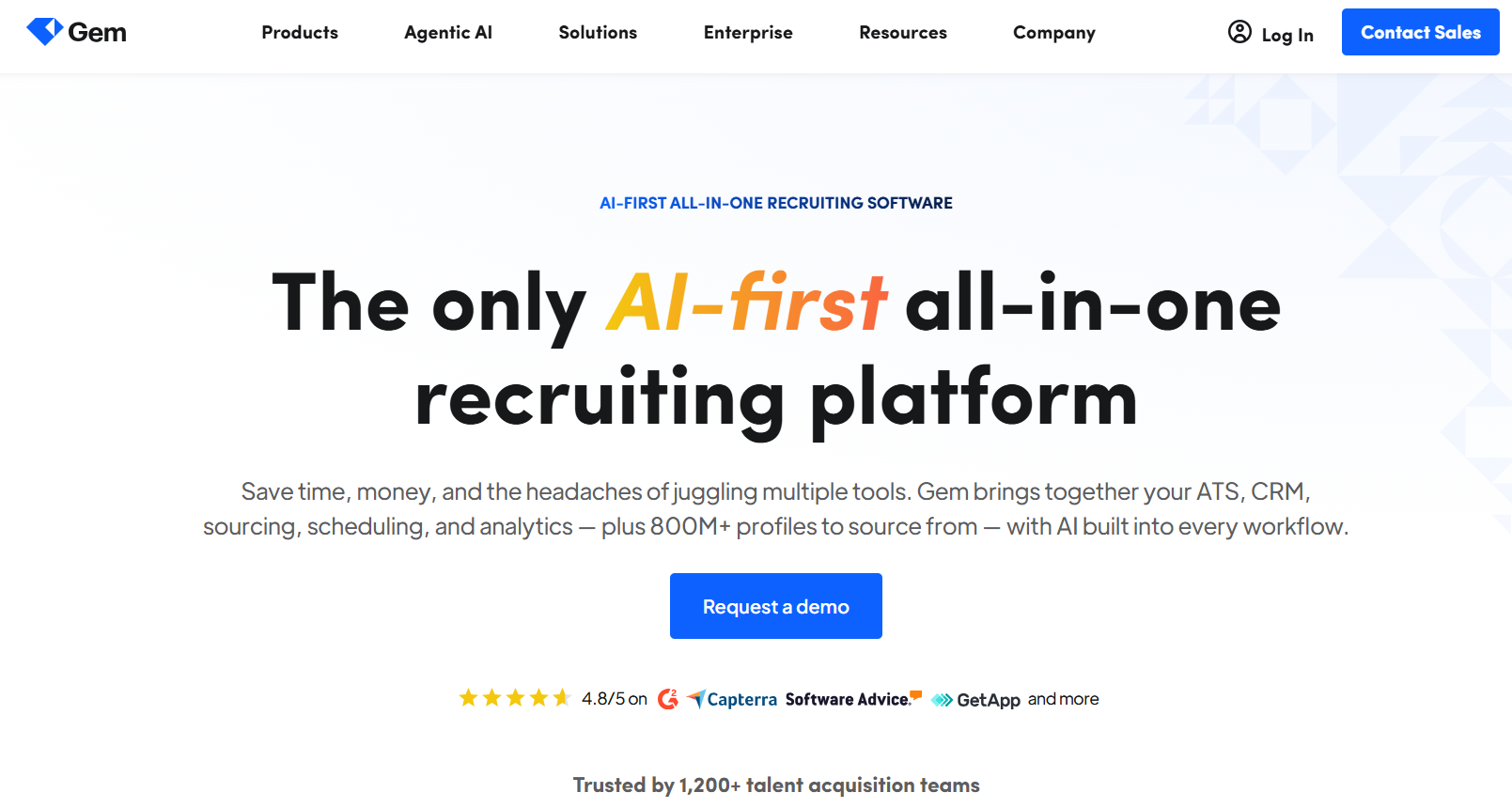
Gem embeds AI across every recruiting stage in one unified platform—sourcing, messaging, application review, scheduling, talent rediscovery.
Here's what's actually powerful: Gem's AI application review automatically ranks candidates based on natural language criteria and explains why it ranked them that way. Transparency matters.
One customer processing 6,000 applications used Gem to flag top matches in seconds—work that would have consumed 2,000+ manual hours. That's not incremental improvement; that's transformational.
Real results from Gem customers:
Zillow achieved a 50-75% reduction in resume screening time and a 57% acceptance rate for AI-sourced candidates (compared to 10-20% with manual LinkedIn searches). Mission Cloud made 43 hires in 90 days with only two recruiters and reduced time-to-hire by 12%.
Technical Detail: Gem's AI Sourcing captures nuanced criteria—funding stage experience, B2B vs. consumer, career progression patterns, specialized expertise. It searches inbound applicants, ATS databases, CRM records, and new profiles simultaneously. One system, multiple data sources, zero manual consolidation.
Best For:
- Enterprise teams (100+ hiring managers)
- High-volume hiring (500+ applications/month)
- Organizations scaling recruiting without proportional headcount increases
- Companies that need unified recruiting intelligence
- Teams frustrated with tool fragmentation
What It Doesn't Solve:
Gem is brilliant at scale but overkill for small teams. Setup takes weeks; adoption takes months. It also screens for culture fit and role match but doesn't validate technical depth specifically.
Price Range: $8K–$25K+/month
7. SeekOut: Agentic AI That Actually Delivers Interview-Ready Candidates

The Problem It Solves:
You found a great engineer leaving their job in 2 weeks. You need interview-ready candidates now. Not in a month. Not in a week. Three days.
Most platforms can't move that fast. SeekOut can.
How It Works:
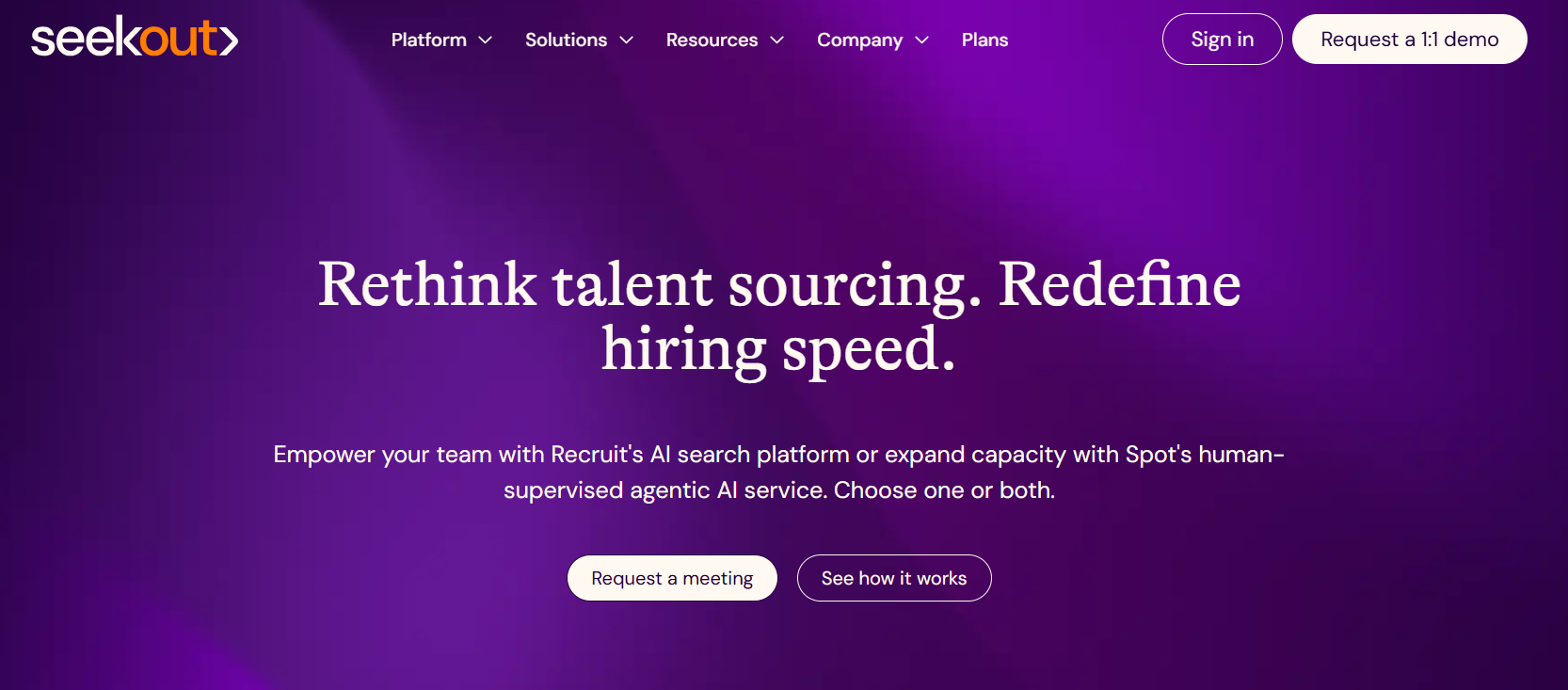
SeekOut launched Spot in 2025—agentic AI recruiting combining autonomous AI agents with expert recruiters who guide the entire process from sourcing through outreach.
The platform aggregates data across over a billion profiles from LinkedIn, GitHub, company alumni databases, and past applications.
Semantic search identifies candidates whose accomplishments match requirements even when they don't use standard terminology. A developer who "built distributed consensus algorithms" looks identical to one who "engineered blockchain infrastructure" to SeekOut's AI. It finds talent keyword-based tools miss.
Multiple specialized AI agents handle different aspects: sourcing, filtering, personalized outreach, preliminary screening. Expert recruiters validate AI matches, ensuring only top-tier candidates reach your team.
Real Numbers:
- Sourcing timeline: Qualified candidates in 3 days vs. 30+ days traditionally
- Expert recruiter involvement: Real humans guide the process, not just automation
- Candidate quality: High because expert recruiters validate before outreach
- Perfect for: Startups needing speed; enterprise with aggressive diversity hiring goals
Technical Detail: SeekOut's semantic search understands context in ways keyword-matching misses. A developer who led three companies to acquisition and one who built billion-dollar-scale infrastructure might look different on paper but similar to SeekOut's evaluation model.
Best For:
- Startups with aggressive hiring timelines
- Enterprise with diversity hiring goals
- Resource-constrained teams (you need expert help without long-term contracts)
- High-stakes positions (C-level, key technical roles)
- Global hiring
What It Doesn't Solve:
SeekOut Spot moves fast, but speed requires expert oversight. That's why they include recruiters—but also why costs are higher.
Price Range: $3K–$8K/month
Read next: Compare Greenhouse, Lever, and Ashby to find the best ATS for your tech hiring needs.
What Separates Tools That Work from Tools That Waste Time
Not all AI recruiting platforms deliver. Some over-promise. Others automate the wrong tasks or create robotic experiences that damage your employer brand.
The platforms that work share specific characteristics:
Real-time learning
The best platforms learn from your feedback and improve over time. Juicebox's agentic learning and Gem's natural language inputs exemplify this.
Multi-channel engagement
Email alone isn't enough. Effective platforms reach candidates through SMS, LinkedIn, WhatsApp—wherever candidates actually respond. Paradox's omnichannel approach and HireEZ's multi-platform sourcing demonstrate this.
Authentic personalization
Generic mass emails get ignored. AI-personalized outreach increases response rates by 5-12%, but only when personalization feels genuine. Gem and Juicebox excel by referencing specific candidate details and past interactions.
Human-AI collaboration
Pure automation without oversight creates quality problems. The strongest platforms—Index.dev and Fetcher—combine AI speed with human judgment.
Seamless integrations
Standalone tools create data silos. Platforms that integrate with existing systems—like Metaview and HireEZ—ensure unified workflows without forcing teams to rebuild processes.
The Numbers You Should Actually Care About
43% of organizations used AI for HR tasks in 2025, up from 26% in 2024. That's a 65% increase in one year. Enterprise companies lead adoption at 78%. 99% of hiring managers use AI in some capacity.
What's driving this? Results.
- AI sourcing tools expand candidate pools by 340% while reducing sourcing time by 67%.
- AI screening achieves 89-94% accuracy—matching or exceeding human performance.
- Candidates chosen by AI are 14% more likely to pass interviews and 18% more likely to accept offers.
- Automated sourcing reduces prospecting time by 50%.
- Organizations report 31% faster hiring times.
These aren't marginal gains. They're fundamental improvements in hiring effectiveness.
2025 marks the dividing line between teams embracing AI-first recruiting and those falling behind. Organizations clinging to manual processes face mounting disadvantages as competitors hire faster and scale recruiting without proportional cost increases.
Matching Platform to Problem
Not every platform fits every use case.
- For high-volume frontline hiring:
- Paradox's conversational AI handles screening and scheduling at scale, reducing time-to-hire by 30-50%.
- Paradox's conversational AI handles screening and scheduling at scale, reducing time-to-hire by 30-50%.
- For niche technical roles or passive candidates:
- Juicebox and HireEZ excel at finding hard-to-source talent through multi-platform aggregation and AI search beyond LinkedIn.
- Juicebox and HireEZ excel at finding hard-to-source talent through multi-platform aggregation and AI search beyond LinkedIn.
- For teams wanting hybrid AI-human sourcing:
- Fetcher balances automation with human curation, delivering quality-controlled candidate lists with high response rates.
- Fetcher balances automation with human curation, delivering quality-controlled candidate lists with high response rates.
- For centralizing recruiting intelligence:
- Metaview automates documentation and insights across the hiring lifecycle, ensuring consistent evaluation.
- Metaview automates documentation and insights across the hiring lifecycle, ensuring consistent evaluation.
- For enterprise teams scaling recruitment:
- Gem provides an all-in-one AI-first platform unifying sourcing, engagement, application review, and analytics.
- Gem provides an all-in-one AI-first platform unifying sourcing, engagement, application review, and analytics.
- Startups needing speed and quality:
- SeekOut Spot delivers interview-ready candidates in 3 days with expert recruiter support.
- SeekOut Spot delivers interview-ready candidates in 3 days with expert recruiter support.
The platforms that win solve your specific bottlenecks without creating new problems.
For developer hiring specifically, learn more about hiring developers faster with AI.
What's Coming Next
The AI recruitment market will reach $860.96 million by 2030, growing at 7.63% annually.
Three trends will define the next phase:
1. Agentic AI becomes standard
Platforms like Juicebox and HireEZ already offer AI agents that work autonomously, learning preferences and executing tasks with minimal oversight. Expect this across all major platforms.
2. Predictive analytics mature
AI will move beyond matching resumes toward forecasting future talent needs, identifying skills gaps, and modeling long-term hire success.
3. Ecosystem integration
Winning platforms will connect talent acquisition with performance management, learning systems, and workforce planning, creating unified talent intelligence instead of isolated tools.
Teams adopting these platforms now gain compounding advantages—better candidate pools, faster cycles, and data-driven insights manual processes can't deliver.
What This Actually Means for You
The seven platforms represent different approaches to AI-powered recruiting. No single platform fits every scenario, but each excels at specific use cases.
The real decision isn't whether to adopt AI recruiting. It's which bottleneck you solve first and which platform fixes that bottleneck fastest.
Paradox if you're drowning in volume. Juicebox if you can't find niche talent. Fetcher if you need human curation. Gem if you want everything integrated. Metaview if you need better documentation. SeekOut if you need speed.
For developer hiring specifically, the strongest combination is: sourcing platform (Juicebox/HireEZ) + engagement platform (Paradox/Gem) + technical vetting (Index.dev).
That's not three platforms fighting each other. It's a stack where each handles what it does best.
➡︎ Want to skip the outreach entirely and get pre-vetted candidates? Index.dev makes hiring simple, efficient, and truly global. Reduce no-shows and scale your team efficiently with our pre-vetted talent network.
➡︎ Want to explore more about AI in hiring and recruiting automation? Read our deep dives on how to integrate AI tools in hiring workflows, discover the top 17 AI recruiting tools for hiring software developers, learn to spot biases in AI hiring tools, and explore the 7 best AI tools for large-scale hiring. Browse our full collection of AI recruitment insights on Index.dev to stay ahead of the curve in 2025 hiring trends.