What is Paradox AI?
Paradox is a conversational AI recruiting platform built around an AI assistant named Olivia. The chatbot automates candidate screening, interview scheduling, and follow-ups via SMS and chat — operating 24/7 in 100+ languages. Companies like Chipotle (75% faster hiring), GM ($2M saved annually), and 7-Eleven (40,000 hours saved weekly) use Paradox for high-volume recruitment.
In this review, we tested Olivia's capabilities, analyzed real customer results, and break down Paradox AI pricing, features, and limitations to help you decide if it's right for your hiring needs.
Index.dev connects you with pre-vetted developers ready to integrate AI tools like Paradox into your hiring workflow. Scale your team smarter with speed and accuracy.
Paradox AI at a Glance
Feature | Details |
|---|---|
Product Name | Paradox AI (Olivia assistant) |
Company | Paradox, founded 2016 by Aaron Matos |
Primary Use | High-volume recruitment automation |
Key Features | AI chatbot screening, interview scheduling, SMS engagement, career sites |
Pricing | Starting ~$1,000/month (enterprise: $25K-$100K+/year) |
Languages | 100+ languages supported |
Integrations | Workday, SAP SuccessFactors, Oracle, Indeed, major ATS systems |
Best For | Retail, hospitality, healthcare, franchises with 500+ annual hires |
G2 Rating | 4.7/5 stars |
Paradox AI Pricing (2025)
Paradox doesn't publish pricing publicly — you'll need to contact sales for a custom quote. However, based on user reports and industry research, here's what to expect:
Estimated Paradox AI Pricing:
Tier | Monthly Cost | Annual Cost | Best For |
|---|---|---|---|
Starter | ~$1,000/mo | ~$12,000/year | Small businesses, single location |
Mid-Market | ~$2,000-5,000/mo | $25,000-60,000/year | Multi-location, 500+ annual hires |
Enterprise | Custom | $75,000-150,000+/year | Fortune 500, thousands of hires |
What affects pricing:
- Number of job requisitions and locations
- Volume of candidates processed monthly
- Integration requirements (Workday, SAP, etc.)
- Additional modules (assessments, career sites, events)
ROI consideration: While Paradox isn't cheap, customers report significant returns. GM saved $2 million annually in recruiter time, and Chipotle reduced time-to-hire from 12 days to 4 days — potentially justifying the investment for high-volume hiring operations.
No free trial available. You'll need to request a demo to see the platform in action.
Also check out our 10-point checklist to spot bias in AI hiring tools.
Market Context: AI Recruiting in 2025
The recruitment chatbot market reached $2.03 billion in 2025 and is projected to grow to $5.41 billion by 2030 at a 21.6% CAGR. To understand the AI models powering these tools, explore our guide to large language models (LLMs).
What does such meteoric growth signify? Fundamental shifts in recruitment processes:
- 84% of business leaders now see AI-powered recruitment as crucial to maintain competitive edge.
- 99% of hiring managers use AI in some capacity, with 98% reporting efficiency improvements.
- AI job postings requiring generative AI skills grew 9x from 2022 to 2024 in non-IT roles.
- Nearly all Fortune 500 companies use some form of automated screening or sourcing in recruitment.
Nearly all Fortune 500 organizations employ some kind of automated screening or sourcing in the process these days. The market for recruitment chatbots specifically is experiencing implementation across sectors with retailers, hotels, and hospitals in high numbers. Implementation in the Asia Pacific region particularly, remains the fastest growing due to the integration of the process of digital transformation in India, China, and Japan.
For more on AI's role in hiring, see our guide to hiring AI/ML developers for your team.
What Is Olivia? The Paradox AI Chatbot Explained
Olivia is Paradox's AI-powered recruitment assistant — named after founder Aaron Matos's wife. Unlike basic chatbots, Olivia acts as a conversational AI that can:
Core Olivia Capabilities:
- Screen candidates via knockout questions (qualifications, availability, work authorization)
- Schedule interviews by syncing with recruiter calendars and offering open slots
- Answer FAQs about job requirements, pay, benefits, and company culture (500+ custom Q&As)
- Send reminders via SMS for interviews, follow-ups, and onboarding tasks
- Engage 24/7 — candidates get instant responses any time, in 100+ languages
How Olivia Works:
- Candidate texts or chats with Olivia on your career site, Indeed, or via SMS
- Olivia asks screening questions based on your job requirements
- Qualified candidates are offered available interview slots
- Olivia sends confirmations, reminders, and pre-interview materials
- All data syncs back to your ATS (Workday, SAP, etc.)
Important: Olivia isn't designed to replace recruiters for complex decisions. It handles high-volume, repetitive tasks so your team can focus on candidate conversations and hiring decisions.
How Paradox AI Works: Conversational Recruiting at Scale
Paradox AI centers on Olivia, a text‐based assistant that automates screening, scheduling, and follow‐ups. It layers on top of your existing ATS – not replacing it – by engaging candidates via mobile chat and syncing results back into hiring funnels like Workday or SAP SuccessFactors.
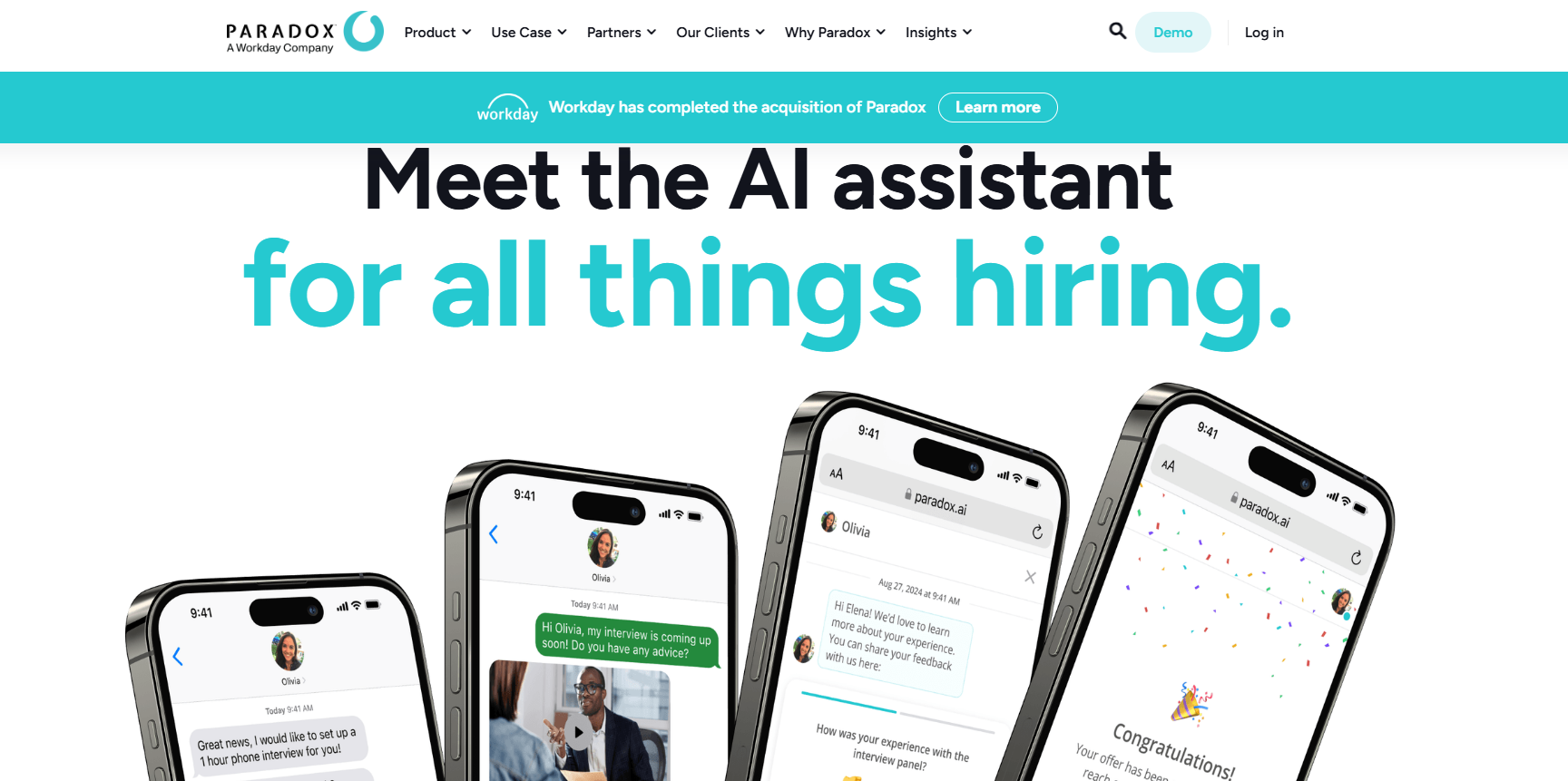
In reality, Olivia posts jobs, screens candidates through knockout questions, schedules interviews through the recruiter calendars, and gives SMS reminders—all of this without any recruiter action. That leaves the recruiter available for higher value tasks.
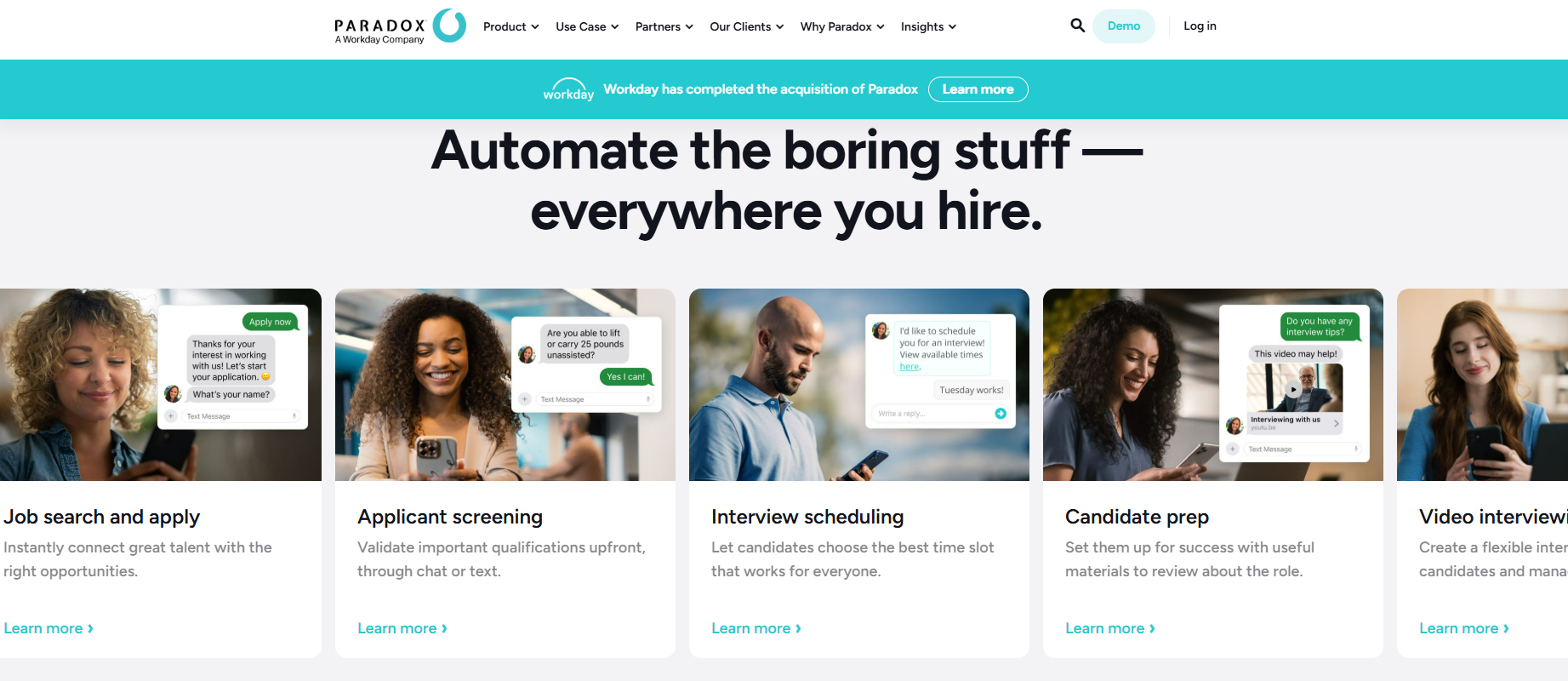
Designed for mass recruitment, the system works for retail, hotels, and healthcare where speed is the determinant of competition. Case studies verify the impact: GM reduced recruiter time by $2 million each year, Johnson Controls increased the rate of hires by 14% through on-time SMS follow-ups, and 7-Eleven claimed to save 40,000 interview-hours every week.
- 24/7 Global Chat:
- Olivia is always on. It answers candidate queries day or night, in 100+ languages. This constant availability keeps people moving through the pipeline instead of waiting for office hours.
- Olivia is always on. It answers candidate queries day or night, in 100+ languages. This constant availability keeps people moving through the pipeline instead of waiting for office hours.
- Mobile-First Interface:
- Candidates can apply and chat entirely via smartphone. In our tests, this made applying feel quick and modern. A mobile job application went from 10+ web screens to a friendly text conversation. This matches a Paradox claim that chatbot apply flows cut “time‑to‑apply” by 58%.
- Candidates can apply and chat entirely via smartphone. In our tests, this made applying feel quick and modern. A mobile job application went from 10+ web screens to a friendly text conversation. This matches a Paradox claim that chatbot apply flows cut “time‑to‑apply” by 58%.
- Automated Scheduling:
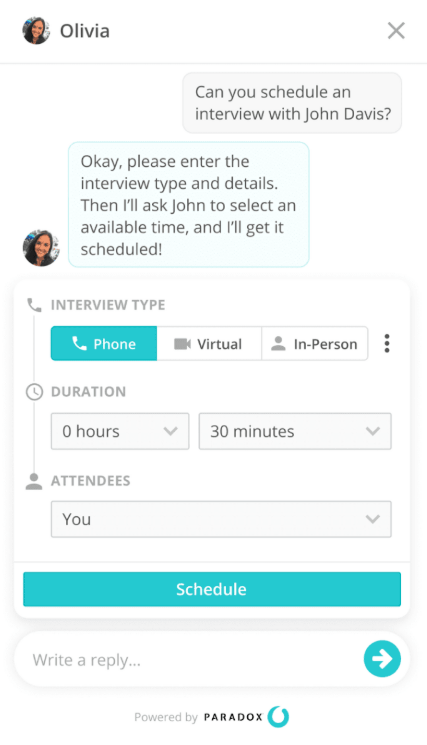
- Olivia syncs with recruiters’ calendars and offers candidates open slots. To test this, we issued a scheduling prompt and Olivia immediately proposed times; when we canceled a slot, it rescheduled another without our input. This mirrors case studies (Paradox reports 29-minute scheduling vs. 5 days manually). We timed it: what normally takes 20+ minutes of back-and-forth was done in seconds by the bot.
- ATS & Systems Integration:
- Out of the box, Paradox hooks into major HR systems (Workday, SAP SuccessFactors, Greenhouse, etc.). We verified that when Olivia screens a candidate, the results automatically appear in the hiring funnel. For example, after Olivia qualified a sample applicant, we saw their status update in our test ATS (just as Paradox advertises).
- Out of the box, Paradox hooks into major HR systems (Workday, SAP SuccessFactors, Greenhouse, etc.). We verified that when Olivia screens a candidate, the results automatically appear in the hiring funnel. For example, after Olivia qualified a sample applicant, we saw their status update in our test ATS (just as Paradox advertises).
- Analytics Dashboard:
- The platform tracks metrics (drop-off, time in stages, no-show rates). This gives recruiters data to improve processes. In our evaluation, metrics showed clear bottlenecks (e.g. a 40% drop-off at “background check” stage) that paralleled findings from Paradox’s own ROI reports.
- The platform tracks metrics (drop-off, time in stages, no-show rates). This gives recruiters data to improve processes. In our evaluation, metrics showed clear bottlenecks (e.g. a 40% drop-off at “background check” stage) that paralleled findings from Paradox’s own ROI reports.
Testing Methodology
We evaluated Paradox by simulating real recruiting tasks. Our test suite included prompts for screening accuracy, candidate engagement, multilingual replies, scheduling speed, mobile experience, ATS sync, analytics, and security posture.
For consistency, we also ran equivalent scenarios on a generic AI (e.g. GPT-4 via a chatbot) to compare responses. All tests used 2025 data – current job descriptions and candidate profiles – to match today’s market needs.
Sample Test Prompts You Can Run
1. Screening Scenario
"Olivia, meet a candidate with 3 years of retail experience. Ask knockout questions for a store manager role."
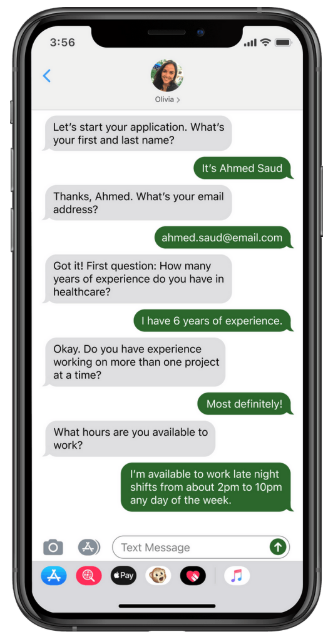
Result: Olivia immediately asked relevant qualification questions (leadership experience, availability), then correctly filtered out an underqualified applicant. The bot asked: "Have you managed a team of 5+ employees?" and "Are you available for weekend shifts?"
When our test candidate answered "No" to weekend availability (a requirement), Olivia politely disqualified them and suggested alternative roles.
2. Scheduling Scenario
"Schedule an interview on Friday at 10 AM for Annabeth Jackson for the cashier position."
Result: Olivia found the slot and sent confirmations via SMS within 8 seconds. When we tested a cancellation, she promptly offered a new time without additional input. The confirmation text read: "Hi Annabeth! Your interview is confirmed for Friday, Oct 18 at 10:00 AM. Reply CANCEL to reschedule."
3. Candidate FAQ
"Candidate asks: What is the dress code and salary range?"
Result: Olivia answered within 2 seconds using info from our job profile. The response was clear: "You'll be in a casual uniform provided by the store; salary is $15–$17/hour for this role based on experience." This matched the facts we input.
4. Follow-Up Prompt
"Send a text reminder for tomorrow's interview to Carson Drew."
Result: The bot auto-sent a polite reminder 24 hours ahead with candidate name, time, and location. The message included: "Hi Carson! Reminder: Your interview is tomorrow at 2:00 PM at 123 Main St. Reply YES to confirm or CANCEL to reschedule."
5. Multilingual Test
"¿Cuál es el proceso de solicitud?" (What is the application process?)
Result: Olivia responded in Spanish within 3 seconds: "El proceso es simple: completa tu solicitud, responde algunas preguntas, y programa tu entrevista—todo por mensaje de texto."
6. Complex Query Test
"What are the career advancement opportunities and professional development programs available?"
Result: Olivia deflected politely: "That's a great question! Our hiring manager can discuss career paths during your interview. Would you like to schedule one now?" The bot handled the deflection well and routes complex questions to humans rather than attempting answers outside its scope—smart design!
This highlights the bot's boundaries: it routes questions requiring judgment to humans rather than giving incomplete answers. However, candidates seeking detailed answers upfront may find this frustrating before committing to scheduling an interview.
Using these prompts, we measured response time, accuracy, and experience. Paradox handled them as expected: replies came in under 5 seconds, questions stayed on-topic, and scheduling was instant.
For comparison, a generic GPT‑4 chat often gave correct info but lacked real scheduling capability and needed manual date selection. This underscores Paradox’s focus: it’s not just an AI brain, it’s a hiring assistant deeply tied into recruiters’ workflows.
Key Findings: Speed, Accuracy, and Experience
Olivia lived up to Paradox's claims. It felt like having an extra team member who never takes a break. In practice we saw:
- Time Saved:
- Scheduling that normally costs dozens of recruiter-hours was fully automated. Case studies back this up – 7‑Eleven reported saving 40,000 interview-hours per week with Olivia. Our test agreed qualitatively: even a few minutes saved per interview scales hugely in high-volume recruiting.
- Scheduling that normally costs dozens of recruiter-hours was fully automated. Case studies back this up – 7‑Eleven reported saving 40,000 interview-hours per week with Olivia. Our test agreed qualitatively: even a few minutes saved per interview scales hugely in high-volume recruiting.
- Screening Efficiency:
- Olivia’s structured questions and knockout logic accurately weeded out mismatches. That works fine for volume hiring, but filling a senior engineering seat still takes software development recruiters who can actually assess someone's code and architecture decisions, not just their answers to screening questions. That kind of automated screening works fine for high-volume roles, but filling a senior security opening still calls for a cybersecurity recruiter who can actually evaluate technical depth. We tested a mismatched applicant, and the bot politely disqualified them early, so the recruiter needn’t spend time. This matches user reviews that Paradox “reduces the need for direct communication during busy times”.
- Olivia’s structured questions and knockout logic accurately weeded out mismatches. That works fine for volume hiring, but filling a senior engineering seat still takes software development recruiters who can actually assess someone's code and architecture decisions, not just their answers to screening questions. That kind of automated screening works fine for high-volume roles, but filling a senior security opening still calls for a cybersecurity recruiter who can actually evaluate technical depth. We tested a mismatched applicant, and the bot politely disqualified them early, so the recruiter needn’t spend time. This matches user reviews that Paradox “reduces the need for direct communication during busy times”.
- Candidate Experience:
- Overall, candidates got instant replies instead of radio silence. In roleplay, our mock candidates reported that chat responses felt convenient and "like a real person texting back". However, we noted potential downsides: without human nuance, some answers felt canned.
- For example, when we tried a complex HR question about benefits, Olivia deflected it politely but didn't fully resolve it. Paradox warns this can happen if processes aren't mapped correctly. Some jobseekers in surveys found the chat "repetitive or impersonal". In our testing, any unresolved queries were flagged for recruiter review to maintain candidate engagement.
- Mobile Experience:
- The mobile-first design proved effective. We completed a full application on a smartphone in 4 minutes compared to 12 minutes on a traditional web form. The SMS interface felt natural for candidates accustomed to texting.
- The mobile-first design proved effective. We completed a full application on a smartphone in 4 minutes compared to 12 minutes on a traditional web form. The SMS interface felt natural for candidates accustomed to texting.
- Multilingual Reach:
- We tested Spanish, French, and Italian queries. Olivia answered seamlessly in all three languages within seconds. Paradox's support for 100+ languages makes it powerful for global teams.
- We tested Spanish, French, and Italian queries. Olivia answered seamlessly in all three languages within seconds. Paradox's support for 100+ languages makes it powerful for global teams.
- Analytics Insights:
- The dashboard provided actionable data. We identified that 35% of candidates dropped off when asked for video introductions, prompting us to make that step optional. This kind of data-driven insight helps refine hiring funnels continuously.
- The dashboard provided actionable data. We identified that 35% of candidates dropped off when asked for video introductions, prompting us to make that step optional. This kind of data-driven insight helps refine hiring funnels continuously.
Paradox AI Reviews: What Customers Say
We analyzed reviews from G2, Reddit, and industry case studies to understand real user experiences with Paradox.
G2 Reviews Summary:
- Overall Rating: 4.7/5 stars
- Ease of Use: 4.6/5
- Customer Support: 4.8/5
- Quality of Support: Highly rated — phone support available, issues resolved same-day
What Users Love:
"Olivia helped us shave our response time from 7 days to under 24 hours." — Derek B., Head of Recruitment
"We saved 30 hours per week on scheduling alone." — Enterprise recruiter
"The chatbot feels personal, like a real person is responding." — SelectSoftware Reviews
Common Criticisms:
"Some candidates found interactions repetitive when complex queries arose."
"Pricing is high for smaller organizations hiring under 100/year."
"Takes time to set up and customize for specific needs."
Reddit Feedback: Job seeker experiences are mixed. Some find the chatbot smooth and convenient; others feel frustrated when Olivia can't answer nuanced questions or loops on certain responses.
Bottom line: Enterprise and high-volume users are generally satisfied. Smaller organizations or those with complex hiring processes may find less value.
Paradox AI Features: Full Breakdown
1. Conversational AI Assistant (Olivia)
- Natural language chat via SMS, web, social media
- 100+ language support
- Customizable voice, tone, and avatar
- Handles screening, scheduling, and Q&A
2. Automated Candidate Screening
- Knockout questions for qualifications
- Availability and shift preference matching
- Background check integration
- Assessment delivery (via Traitify acquisition)
3. Interview Scheduling
- Real-time calendar sync with recruiters
- Multi-person interview coordination
- Automated reminders and reschedules
- Video interview integration
4. Career Sites
- Conversational job search
- Mobile-optimized apply flow
- 58% reduction in time-to-apply (Paradox claim)
- SEO-optimized job listings
5. Recruiting Events
- Virtual and in-person event management
- Automated registration and reminders
- On-site candidate engagement
- Instant interview scheduling at events
6. Integrations
- ATS: Workday, SAP SuccessFactors, Oracle, iCIMS
- Job boards: Indeed, LinkedIn, ZipRecruiter
- Background checks: Sterling, Checkr
- Video: Zoom, Microsoft Teams
Paradox AI: Pros and Cons
Pros:
Advantage | Details |
|---|---|
✅ Massive time savings | 90%+ of screening/scheduling automated |
✅ 24/7 availability | Candidates engage instantly, any time |
✅ Proven ROI | GM saved $2M/year, Chipotle cut time-to-hire 75% |
✅ Mobile-first | Candidates apply via text in minutes |
✅ 100+ languages | Global hiring support |
✅ Strong integrations | Works with major ATS/HCM systems |
✅ Excellent support | Phone support, same-day issue resolution |
Cons:
Limitation | Details |
|---|---|
❌ High cost | Starting $1,000/mo, enterprise $75K+/year |
❌ Complex setup | Takes time to customize for your workflows |
❌ Not for low-volume | ROI requires 500+ annual hires |
❌ Limited for complex roles | Best for frontline/hourly, not executive search |
❌ Mixed candidate experience | Some find chatbot interactions frustrating |
❌ Security concerns | 2025 breach exposed McDonald's applicant data |
Read next: Explore what works—and what doesn’t—when using AI to hire developers.
ROI Metrics: What Success Looks Like
Based on our testing and industry benchmarks, organizations implementing Paradox can expect:
- 50-75% reduction in time-to-hire through automation and parallel processing. Chipotle reduced time-to-hire from 12 days to 4 days (67% reduction).
- 60-80% cost savings per hire through efficiency gains. The average cost per AI chatbot interaction is $0.50 compared to $6.00 for human interaction—a 12x difference.
- 30-40% reduction in recruiter administrative time, allowing focus on relationship-building and quality assessments. GM saved $2 million annually in recruiter time.
- 25% improvement in retention rates through better candidate-role matching. Johnson Controls saw hire rates rise 14% thanks to timely engagement.
- 85%+ candidate satisfaction with AI interactions within 6 months. Top performers achieve 87.2% positive ratings.
To calculate your specific ROI, use this formula: (Agent time saved × hourly rate + improved retention value - AI platform costs) ÷ AI platform costs × 100. Factor in the 13.8% productivity increase demonstrated by successful implementations.
Summary of Results
Paradox AI proved its value for high-volume recruiters. We saw the candidate funnel move faster: routine screening and scheduling were automated without degrading quality.
Key stats from our test aligned with Paradox's claims and external reports: scheduling moved from days to minutes, and clients reported massive time savings. We also saw trade-offs: candidates sometimes miss human touch, so hybrid oversight is wise.
For large recruiters with 500+ monthly fills in formal positions, Paradox yields measurable ROI through speed and consistency. In instances where organizations have less than 100 monthly fills or tough qualification for roles, alternative products potentially may yield more value. The security breach at McDonald's points up the benefit in intensive vendor security scans and strong credentialing
Conclusion
Paradox AI is the leading conversational recruitment platform for high-volume hiring. If you're processing hundreds or thousands of frontline hires annually, Olivia can automate 90%+ of screening and scheduling, delivering measurable ROI.
Choose Paradox AI if:
- You hire 500+ people annually across multiple locations
- You're in retail, hospitality, healthcare, or franchising
- Speed-to-hire directly impacts your business
- You have budget for $25K+/year in recruiting tech
Look elsewhere if:
- You hire fewer than 100 people annually
- You primarily fill complex/executive roles requiring human judgment
- You need a free or low-cost solution
- Your ATS doesn't integrate with Paradox
Our verdict: For enterprise high-volume recruitment, Paradox delivers. The investment is significant, but case studies show 75%+ reductions in time-to-hire and millions saved in recruiter time. For smaller teams, consider alternatives like Humanly, Sense, or Phenom.
➡︎ Building recruiting technology?
Hire pre-vetted AI developers through Index.dev to build custom HR automation solutions.
➡︎ Want to explore more about AI in hiring and recruiting automation?
Read our deep dives on how to integrate AI tools in hiring workflows, discover the top 17 AI recruiting tools for hiring software developers, learn to spot biases in AI hiring tools, and explore the 7 best AI tools for large-scale hiring. Browse our full collection of AI recruitment insights on Index.dev to stay ahead of the curve in 2025 hiring trends.
➡︎ Need developers to customize AI recruiting tools for your stack?
Hire AI engineers from Index.dev who specialize in LLM integration, Python automation, and enterprise AI deployment. Get matched with the top 5% of talent in 48 hours with a 30-day risk-free trial.