In 2024, tech companies achieved only 50% of their full-stack hiring goals. That's not because full-stack developers don't exist. It’s because the wrong platform casts a wide net, when what you need is a tool that targets the exact talent you want.
There's a difference between platforms designed for hiring at scale and platforms designed for hiring well. One makes you compete on budget. The other makes you compete on fit.
We’ve built a decision framework based on what actually works, using insights from hundreds of teams and thousands of hires.
Let’s walk through it quickly.
Build your full-stack team faster. Hire vetted senior developers through Index.dev with 48-hour matching.
Why Full-Stack Hiring Stays Broken
Companies report that 92% actively search for full-stack developers. Yet, average placement takes 4.5 months, double the 2020 baseline. Why?
Generic marketplaces don't understand full-stack work. A developer strong in React and Node.js isn't guaranteed to grasp database optimization or DevOps basics.
Most job boards treat full-stack like a checkbox. 'Knows JavaScript? Hired.' Real vetting requires testing the entire stack.
The best platforms ask:
Can they move between frontend and backend without leaving a trail of half-solved problems?
The second problem: cultural noise.
Post a job and you get hundreds of applications. 95% are noise. Your team spends a week wading through profiles, doing initial calls that go nowhere, discovering someone's been out of the market for two years.
The eight platforms reviewed here solve for this differently. Some use AI to vet at scale. Others employ humans who understand code. The best do both.
Read next: Omio case study → Hiring full-stack Java developers in a hyper-competitive talent market.
1. Index.dev: The Pragmatist's Choice

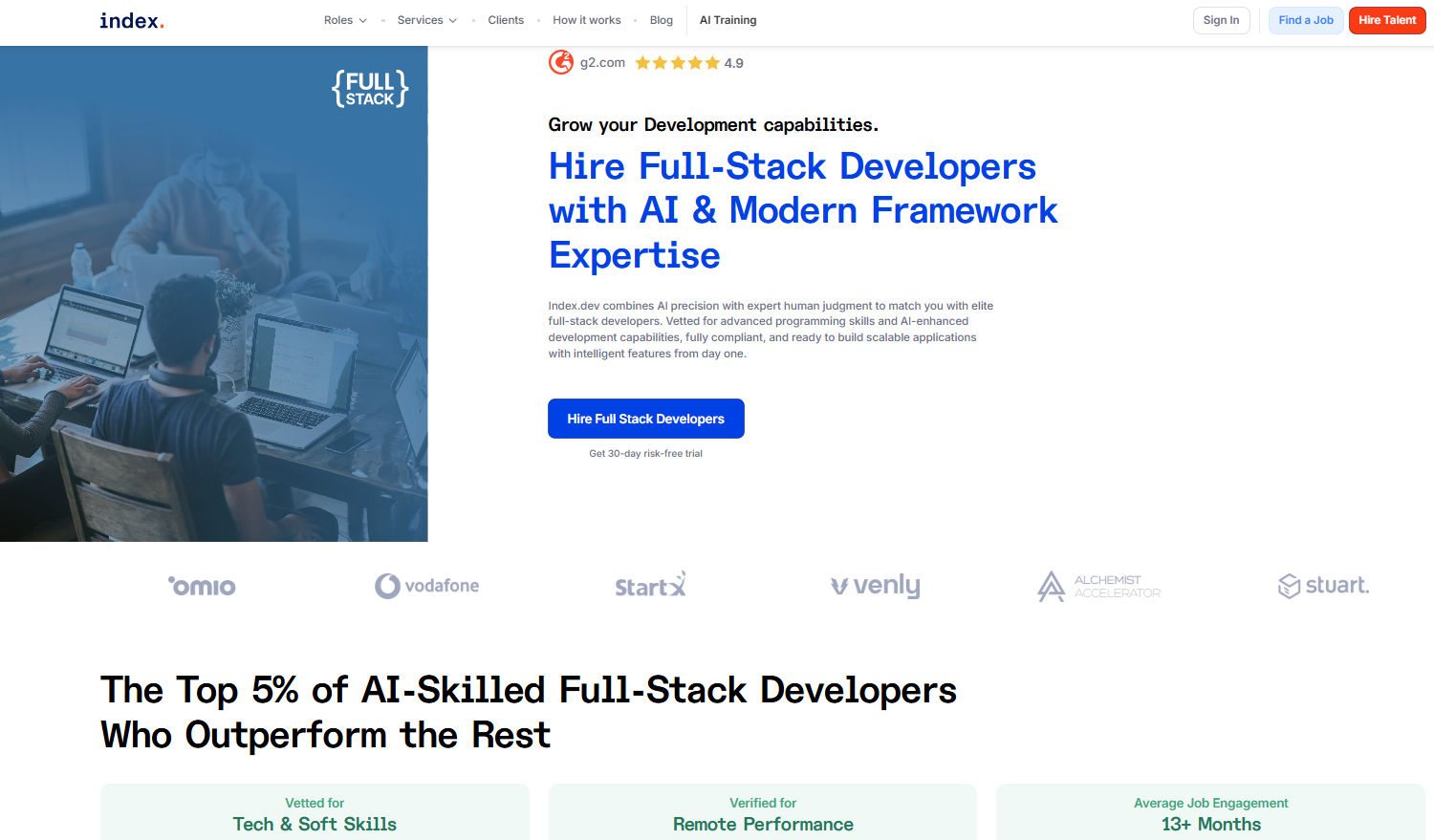
Index.dev bets everything on vetting. 5% pass their filter. 30 days risk-free to see if they ship, fit your team, and solve your problems. Still wrong? We replace them at no cost.
How This Changes the Game
You're not risking $500 on faith. You're risking 30 days of productivity. That's a different bet entirely, and it works. 97% of developers who trial convert to long-term placements. You can learn more about Index.dev's full-stack developer matching process here.
The Numbers That Matter
Developers cost $50-$80 per hour for senior roles. Matching happens within 48 hours, fast enough that your project keeps momentum.
Plus you have access to Index.dev's newly launched US Hub for teams needing timezone proximity—a growing priority as companies balance remote flexibility with timezone alignment.
Who We Built This For
Scale-ups moving fast. Mid-market teams that need speed without enterprise overhead. Companies that understand that the right developer in week two beats the perfect developer in month three.
Why It Works
Index.dev doesn't try to be everything. Our focus remains on remote-first senior developers with proven remote experience. The risk-free model incentivizes Index.dev to get vetting right. We only make money when you're happy enough to keep the developer. That's a powerful alignment.
2. Toptal: The Enterprise Default

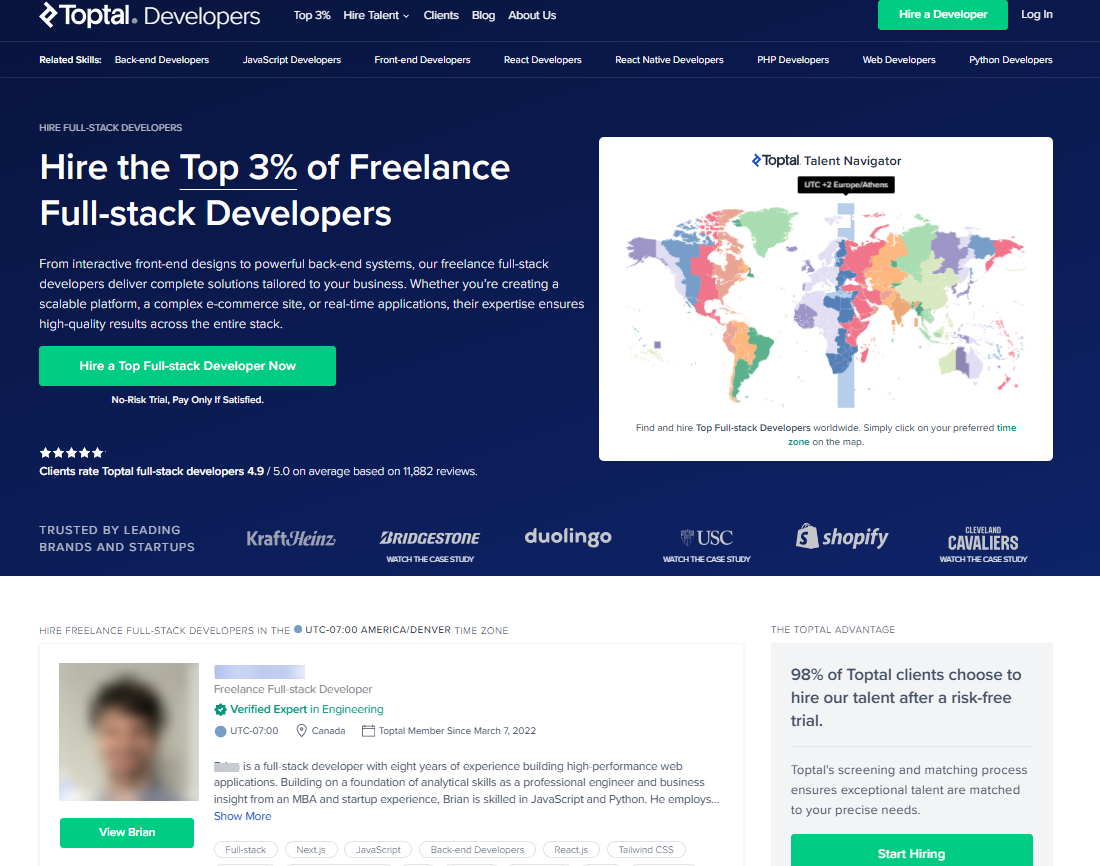
Toptal is where companies go when they've stopped shopping by price tag and started shopping by sleep-at-night. Expensive? Yes. Rigorous? Terrifyingly so. But they've built a machine that catches the edge cases before your roadmap suffers for it.
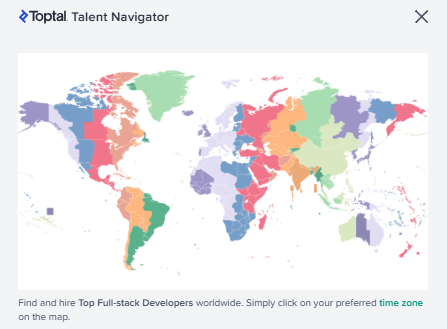
Only the top 3% make Toptal's network. Five to twelve interviews depending on specialization, English proficiency screens, technical assessments, live coding, and often a trial project.
When your project can't fail, you hire developers who function under that pressure. Toptal attracts them: people who understand complex requirements, communicate across time zones, respect deadlines like they're sacred. That maturity costs more. It's supposed to.
How This Beats Slow
Yes, 1-2 weeks is longer than Arc.dev's 48-hour matching. But that slowness is the feature, not the bug. Toptal's vetting doesn't optimize for speed—it optimizes for certainty. You wait longer because they're checking deeper.
The Numbers
Hourly rates run $60-$200+. A $500 upfront trial deposit gets refunded if you're unsatisfied. The process takes 1-2 weeks, slower than specialized platforms, but the result is a developer who doesn't break things under pressure.
Account managers come standard. For enterprises managing teams of ten remote developers, this coordination layer prevents common remote work failures—communication gaps, timezone confusion, project drift.
Who Needs Toptal
Mission-critical projects where a failed hire destroys your roadmap. Enterprise teams that need coordination. Companies betting on certainty over speed. You pay more because you sleep better.
3. Gun.io: The Specialist's Platform

No AI. No resume algorithms. Just senior engineers vetting other senior engineers.
Gun.io's bar is binary: 5+ years experience, US-based, proven technical depth. They're not hiring React developers. They're hiring people who can architect infrastructure from scratch, refactor legacy monoliths without breaking production, and think in system design patterns.
The Economics That Matter
Pricing runs $80-$150+/hour. Matching is fast—24-48 hours—because their team of senior engineers understand what they're matching you with. White-glove support is included. Gun.io handles contracts, negotiations, and relationship management.
The geographic focus is intentional. US-only talent means timezone overlap with East/Central time companies. It means fewer cultural adaptation requirements.
The Advantage Nobody Mentions
Gun.io takes a platform fee. Developers keep 100% of their negotiated rate. That's why senior talent shows up here instead of Toptal or Upwork. They're treated as partners, not supply.
Who Should Hire Gun.io
Companies with genuinely hard technical problems. Not "we need a React developer"—we need "someone who can architect our infrastructure from the ground up."
Teams that respect deep specialization. That respect shows in how they hire and how they pay.
4. Arc.dev: Culture-First Startup Hiring

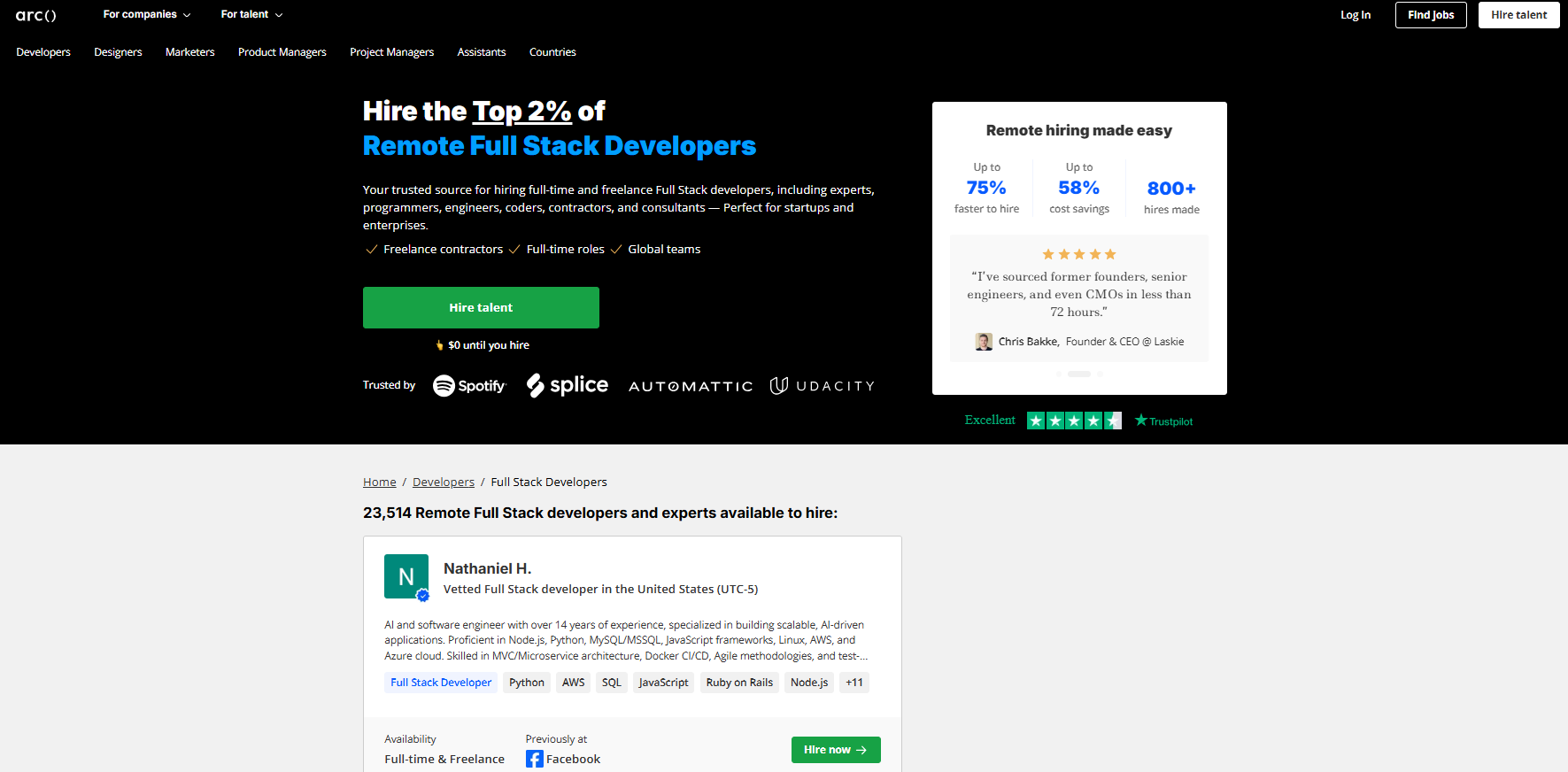
Arc.dev screens for one thing most platforms ignore: Is this person going to thrive in our chaos? 2.3% pass their filter. But vetting isn't just technical skill—they weigh cultural fit equally. Can you handle rapid pivots? Are you autonomous? Do you communicate in their timezone and work style?
Early-stage startups don't need developers who tolerate chaos. They need developers who thrive in it.
The Economics + Speed
Pricing is $60-$120/hour. Matching happens in 48-72 hours. They don't charge platform fees upfront; they take their cut from the developer rate later.
That creates alignment—Arc.dev wants long-term retention, not quick placements.
The Advantage
Most hiring consultants don't understand startup dynamics. A developer great at Google can be terrible at a ten-person startup. Arc specializes in that specific translation.
Your risk isn't finding someone technical. It's finding someone who ships and communicates clearly in a ten-person environment.
Who Should Choose Arc
Series A/B startups. Remote-first product companies. Teams where communication skills matter as much as code quality.
You're not hiring a developer. You're hiring someone who gets what you're building and can explain it back to your team.
5. Lemon.io: Speed Over Everything (For MVP Work)

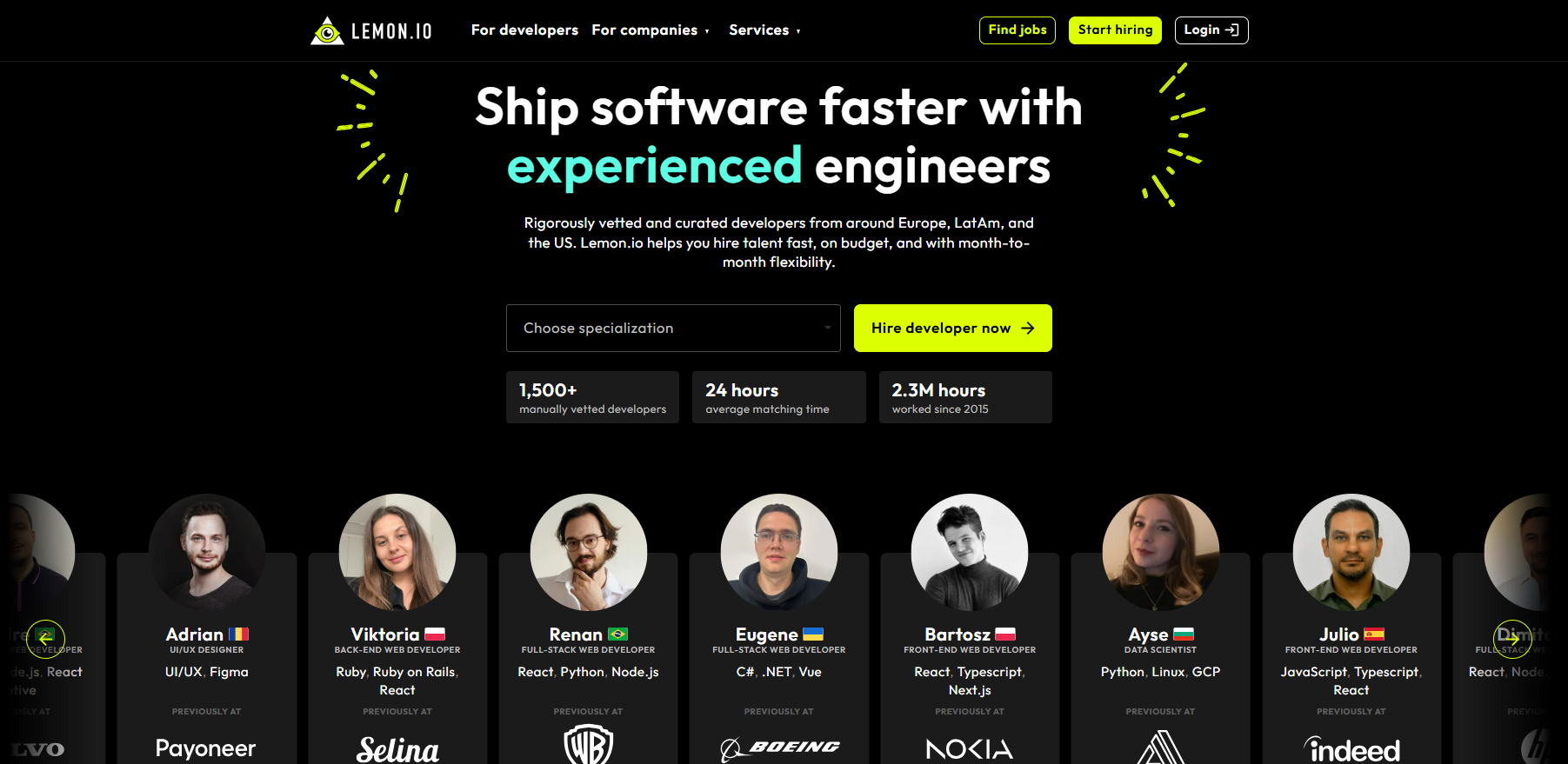
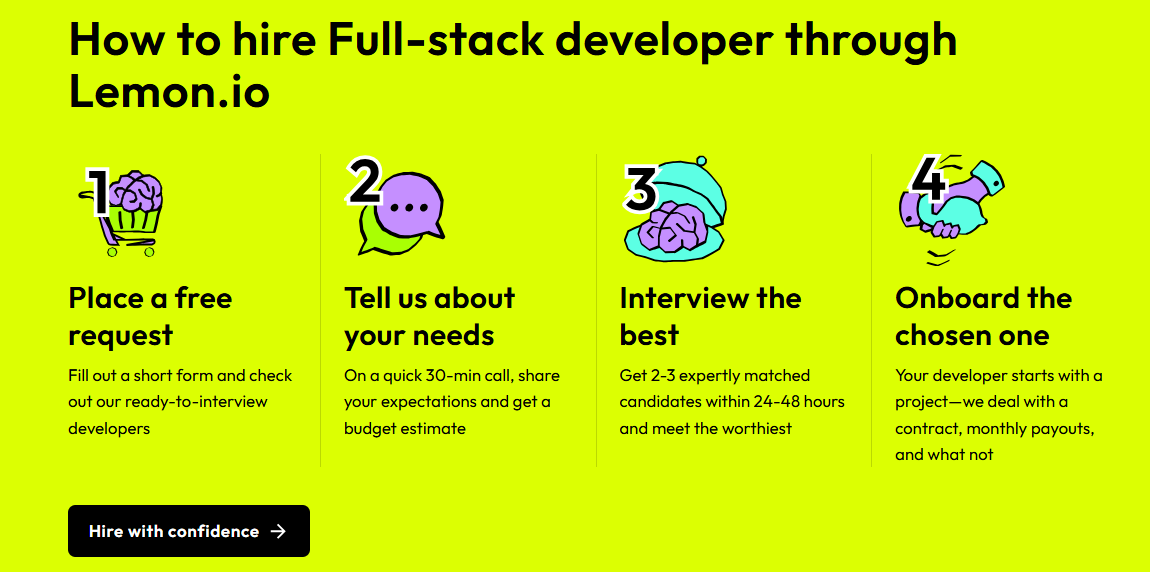
Lemon.io is built for one use case: you need a developer tomorrow. Not next month. Tomorrow. 1% acceptance rate. Matching in 24-48 hours. Meet 2-3 developers, pick, start the next day. That's the deal.
The Numbers
Pricing is $45-$120/hour, with month-to-month contracts and flexibility. That matters for teams with unpredictable needs. Scale up when a feature launches, scale down when it ships.
Developers are primarily from Eastern Europe and Latin America. 6-9 hour time differences are normal. That geographic distribution enables lower rates while maintaining quality—Lemon.io developers have 5+ years of experience minimum.
The Trade-Off (Be Honest With Yourself)
Yes, the timezone shift. Yes, they're cheaper. But vetting here specifically targets startup developers: people who understand MVP pressure, feature-driven shipping, and moving fast. That personality works perfectly for sprints. It can struggle in enterprise.
Who Should Hire Lemon.io
Teams building to a launch date. MVPs with tight timelines. Feature acceleration work. Companies that understand: speed and budget matter more than geographic convenience.
Speed is the feature. Pay accordingly.
6. X-Team: Stability Over Revolving Doors

X-Team doesn't sell individual developers. They sell dedicated teams. Hire a pod for months or years. Onboarding takes 2-3 days. Then your team stabilizes: code quality compounds, context builds, developers learn your product instead of treating it like a gig. That's the difference.
The Economics of Continuity
Pricing operates on project-based contracts rather than hourly rates. That means actual predictability—no surprises, no scope creep calculations. With team dynamic vetting they screen for fit, not just technical skills—critical for long-term partnerships.

The Advantage Nobody Mentions
Every other platform optimizes for speed: fast matching, fast interviews, fast onboarding. X-Team optimizes for depth and continuity.
Slower at the start. But six months in, your team knows your codebase better than you do. That knowledge compounds.
Who Should Choose X-Team
Companies with actual roadmaps. Sustained product building. Teams tired of constantly hiring and onboarding.
Slow start. Deep finish. That's the X-Team difference.
7. Stack Overflow Jobs: Reputation as Proxy

Stack Overflow's job board works on an unusual principle: let community participation speak for credentials.
Developers on Stack Overflow with high reputations, contributions, and Q&A activity have already demonstrated technical depth. They're engaged. They're learning. They're participating in community problem-solving.
Engineers checking Stack Overflow daily tend to be serious about their craft.
How This Actually Works (And What It Won't Do)
Job posting costs vary based on visibility tier. The real value: you're reaching actively engaged developers, not passive job board browsers.
Matching speed varies widely depending on role specificity. Pricing requires direct negotiation. Stack Overflow connects you to talent. They don't vet for you.
The Advantage
Community developers are proven communicators. They've explained technical concepts publicly for years. That translates to better documentation, remote work discipline, and clear thinking. But Stack Overflow isn't doing the vetting—you are.
Who Should Post Here
Technical companies with specialized requirements. Roles where the problem statement itself attracts the right people. Teams comfortable doing the hiring work themselves.
You're not buying vetting. You're buying visibility to developers who've already proved themselves in public.
8. Upwork: Talent Roulette (You Manage Everything)

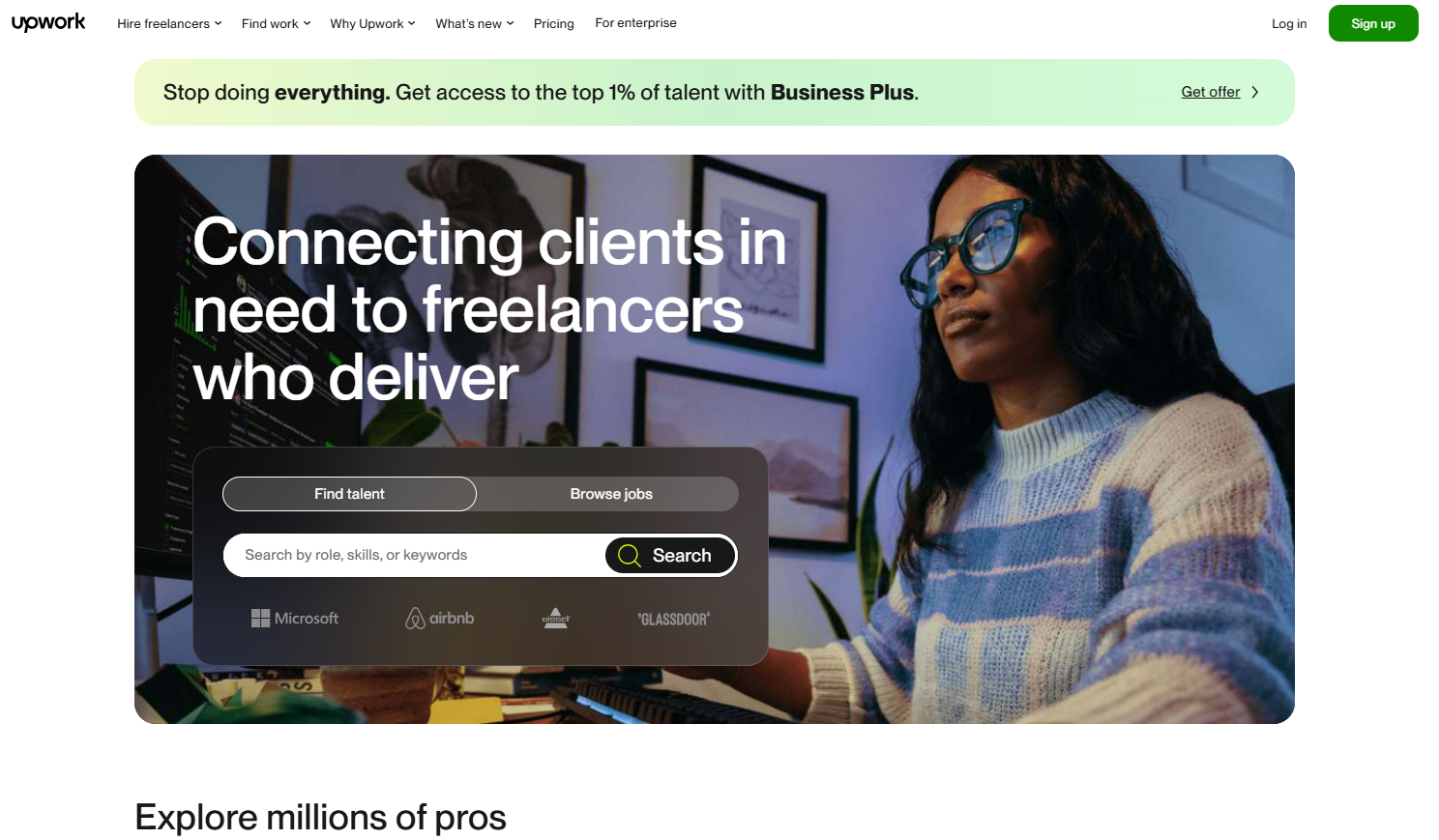
Upwork boasts 12+ million freelancers. $10-$150+/hour. You'll find someone for almost any skill. And you'll screen them all yourself. Upwork's vetting is minimal. You're reading portfolios and client scores. You're managing quality. That's the deal.
The Numbers (And The Catch)
Fees add up. Upwork takes 5-20% of freelancer rates. That incentivizes top talent to work elsewhere.Hiring models include hourly, project-based, and fixed-price. Integrated communication and payment tools reduce logistics friction.
But the platform doesn't manage project quality. That’s something your team needs to take care of.
Speed varies from same-day to multi-week depending on your screening diligence and role specificity.
The Honest Assessment
Top developers skip Upwork. The fees are too high and their reputation precedes them. Upwork becomes their secondary income source, not primary. So you're hiring from a network of good developers, not the best developers.
But for specific short-term work—a feature sprint, a module refactor, a proof-of-concept—that's fine. You need capacity for two weeks. You don't need long-term commitment. Upwork works perfectly for that.
Who Should Use Upwork
Teams with tight budgets. One-off projects or feature work. Companies comfortable doing the hiring and quality management themselves.
You're not buying vetting or continuity. You're renting capacity and keeping control.
Up next: Explore the top 5 platforms to hire back-end developers in the U.S.
The Bottom Line
Full-stack hiring doesn't have to be chaos—it just has to be intentional.
Pick the wrong platform, and you're three months into a disaster before admitting it won't work. Pick right, and your developer is productive in week two and still shipping with you 12 months later.
The metric that matters: not where you find developers, but whether they ship. Whether they stay. Whether they understand your problem deeply enough to propose solutions, not just code to spec.
That's what separates platforms that help you hire from platforms that let you hope.
➡︎Looking to hire full-stack developers without the 4-month wait? Index.dev matches you with pre-vetted senior developers in 48 hours, with a 30-day risk-free trial. Only pay when they ship. Start hiring smarter today.
➡︎Want to go deeper into full-stack hiring? Explore more guides on how to hire high-quality developers on a budget, assess full-stack skills effectively, compare full-stack vs. specialized developers, screen talent before interviews, craft strong job descriptions, and discover essential tools every full-stack engineer needs.