AI is racing ahead. HR should be racing to stay human.
Artificial intelligence is no longer an experimental sandbox for HR. It is the new operating system. According to SHRM’s 2026 data, a staggering 92% of CHROs have fully integrated AI into their HR processes. We are optimizing, automating, and scaling at speeds that would have seemed impossible just a few years ago.
While we are busy celebrating faster candidate screening and automated onboarding, the human experience at work is fracturing. A recent Deloitte Human Capital Trends report highlighted a stark reality: 59% of organizations take a strictly tech-focused approach to AI implementation, yet these exact companies are 1.6 times more likely to fail to meet their return-on-investment expectations than peers who prioritize a human-centric approach.
You do not need more automation for its own sake. You need judgment. You need clarity. You need human decisions in the moments that shape how people feel about work. This article looks at how HR can lead AI adoption without losing the human foundation work is built on.
The Real Risks of AI in HR
Bias and fairness get all the airtime in AI conversations. Fine. Those risks are real. But they're not the whole story, and if that's all HR is watching for, you're missing the bigger fire.
1. The engagement tax
Efficiency and meaning are not the same thing, and right now companies are optimizing for one while quietly draining the other. AI was cited in 87,714 planned layoffs in the first half of 2026 alone, already surpassing the entire total for 2025. Nearly one in six employers say they expect AI to shrink headcount this year. And the pain isn't evenly spread. Entry-level and junior roles are taking the hit first. The share of companies actively cutting junior positions jumped from 17% to 43% in a single year.
2. The regret spiral
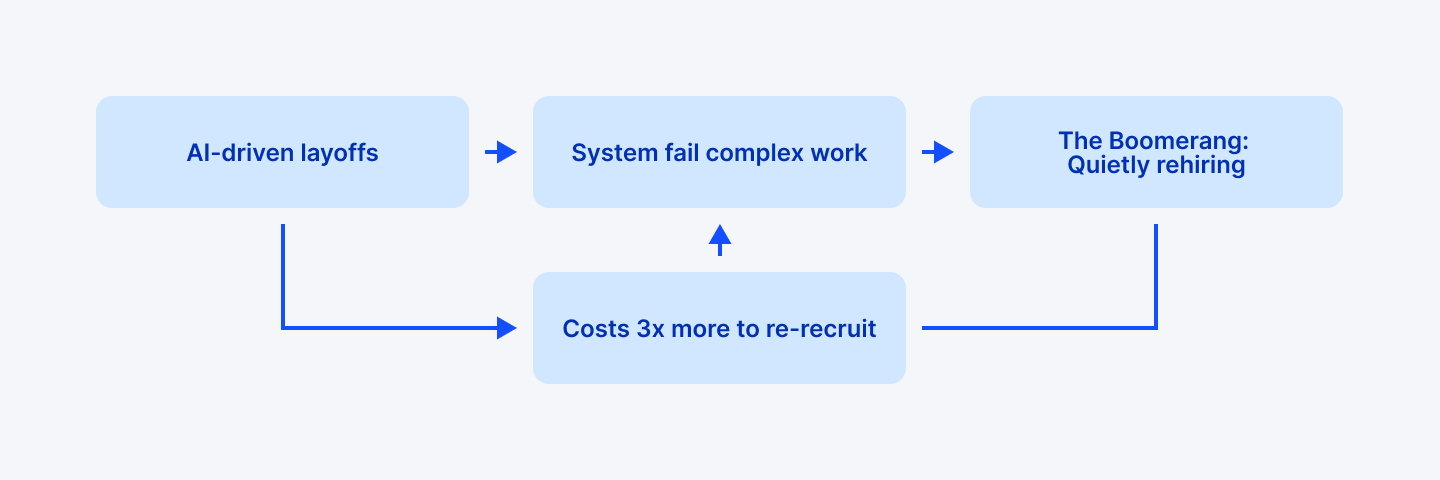
You'd think, given the stakes, companies would move carefully. Many didn't, and now they're paying for it twice. Orgvue's research found that 39% of business leaders made staff redundant because of AI. Of those, 55% now admit they got it wrong. Nearly a third have had to quietly rehire. Ford brought back hundreds of senior engineers to fix quality problems automation couldn't catch. IBM is tripling entry-level hiring after realizing AI can resolve routine queries but not the judgment calls that actually need a person. Even Commonwealth Bank reversed a round of AI-driven cuts.
3. The widening gap
AI does not hit everyone the same way. Younger workers, lower-income employees, and workers of color report the most anxiety about what's coming, and the data backs up the worry. In high-income countries, roughly 60% of jobs are considered automatable. In low-income economies, that figure drops to around 26%. The people with the least cushion are watching the most disruption headed their way, while the conversation at the top often stays abstract, all strategy, no faces.
→ Learn more about the key barriers slowing enterprise AI adoption and how leaders can overcome them.
Five Shifts to Human First HR
Every company is racing to be more AI native. Almost nobody is racing to be more human native. That is the gap HR should be fighting to close.
Call it Human Intelligence: the raw, messy, irreplaceable human traits that no algorithm can emulate. AI can analyze what is, but only humans can cultivate what could be.
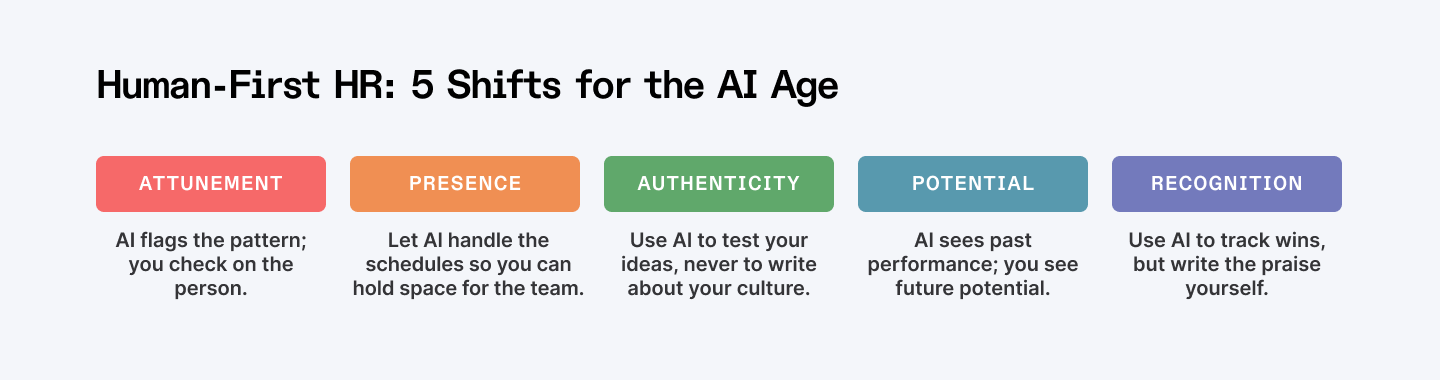
Here is a simple framework for staying human on purpose:
1. Attunement
Notice what people aren't saying. A flat tone on a call, a missed deadline that's out of character, a team that's gone quiet. AI can flag the pattern, a sentiment dip, a spike in after-hours messages, but it takes a human to walk over and ask what's going on.
Takeaways:
- Use AI to spot early warning signs. Ask your tools to highlight sudden drops in collaboration or sentiment dips by team. That's your cue to check in before it becomes an exit interview.
- Don't wait for the engagement survey to tell you what a good manager already suspects. If AI flags a shift in a team's mood, go talk to them. Today, not next quarter.
2. Presence
People are not always ‘optimized’ versions of themselves at work. They are stressed, uncertain, motivated, disengaged, sometimes all in the same week. When organizational change hits, people don't need a predictive analytics model; they need a safe space to vent, process, and feel heard. Make room for how people feel about AI, even when that feeling is fear, grief, or resentment. Don't rush to fix it or explain it away. Let AI draft the FAQ about the new tool rollout. Let a human sit in the room when people are angry about it.
Takeaways:
- Hand AI the scheduling, the note taking, the follow up emails nobody enjoys writing. Every hour it saves you is an hour you can sit with someone who's struggling.
- Have AI group anonymous comments from pulse surveys and give you themes. Then read a few raw comments yourself. It keeps you honest. It stops the anger and fear from getting cleaned up before it reaches you.
3. Authenticity
Think first. Use AI second. If your first instinct is to ask a chatbot what you believe about a hard people decision, you've already outsourced the part of your job that matters most. Use AI to stress test your thinking after you've formed it, not to form it for you. And never let a generative AI tool write your culture. When drafting a sensitive company announcement or a termination letter, champion your own voice first.
Takeaways:
- When you draft a layoff note, a restructure announcement, or a personal message to someone impacted, start with your own words. Then let AI help you tighten, check tone, and catch blind spots. The core needs to be you.
- Once you have a decision, ask AI to argue the opposite case so you can see what you might have missed. It keeps your thinking honest without handing over the steering wheel.
4. Potential
AI is inherently retrospective; it predicts future performance based on past behavior. But humans defy their data. True HR leadership looks at a worker and sees their hidden adaptability, their drive, and their capacity to reinvent themselves. See what someone could become, not just what their last performance review says they already are. Map adjacent skills, suggest learning paths, or identify hidden capability patterns across teams. A junior analyst is not just a data point. They might be your next product leader.
Takeaways:
- Ask your systems to map adjacent skills and project histories to suggest stretch roles or lateral moves. Then you decide which ones make sense, based on what you know about the person’s drive and context.
- Widen the pool for every opportunity. Let AI suggest people based on what they can do, not just what their last title says. You'd be surprised who's been ready for a stretch assignment and never asked.
5. Recognition
Recognition often fails because it becomes generic. Make praise specific enough that it couldn't have been written about anyone else. Let AI remember the details, the deadline someone quietly carried, the skill they just picked up, so you're not recognizing people with a template they've seen twenty times before. A message that says “you made the client rethink the entire approach with that one insight” hits differently than “great job on the project.”
Takeaways:
- Make recognition impossible to copy paste. Before you write a thank you or a shoutout, pull a quick snapshot of what the person has done: projects, deadlines, extra effort. Then mention one or two specifics so they know you saw them.
- Use tools to track work anniversaries, quiet wins, and small milestones. Have AI draft a rough message with those details, then you rewrite it in your own voice. Short, honest, specific. That is what people remember.
→ Up next, explore the biggest AI risks leaders need to understand and the practical steps to manage them.
A Final Thought
AI will not remove the human side of HR on its own. But careless AI adoption will. And once work stops feeling human, you do not fix it with better tooling. You fix it by reintroducing judgment, context, and conversation back into the system.
That is the real job of HR in this decade. Not to become more automated. But to make sure automation still feels human to the people living inside it.
➡︎ Whether you're building AI products, scaling engineering teams, or training frontier AI models, success still depends on the right people. Index.dev connects you with a vetted global network of senior engineers, AI specialists, and domain experts, and delivers complete software projects through experienced delivery teams. Explore how Index.dev can help you scale →