Looking for the latest AI pair programming statistics in 2026?
This comprehensive guide covers GitHub Copilot adoption rates, JetBrains AI Assistant numbers, developer feedback on AI tools, and best practices from Fortune 500 companies that have rolled out AI pair programmers without slowing down active sprints. With 84% of developers now using AI coding tools, understanding these AI pair programming trends is essential for engineering leaders and developers alike.
Join Index.dev and leverage your AI coding skills to get matched with global companies.
AI Pair Programming: Key Statistics for 2026
What is AI pair programming? It's the practice of using AI coding assistants alongside human developers to write, review, and improve code. Here are the core AI pair programming statistics:
Adoption Overview:
Metric | Statistic | Source |
|---|---|---|
Developers using AI tools | 84% | Stack Overflow Survey 2025 |
Daily AI tool usage | 51% | GitHub State of the Octoverse |
AI-generated code share | 41% | Industry average |
Productivity increase | 55% faster | GitHub Copilot study |
Code error reduction | 13.6% fewer | Copilot research |
AI Pair Programming Growth (2022-2025):
Year | Adoption Rate | Daily Usage |
|---|---|---|
2022 | 29% | 12% |
2023 | 70% | 38% |
2024 | 76% | 45% |
2025 | 84% | 51% |
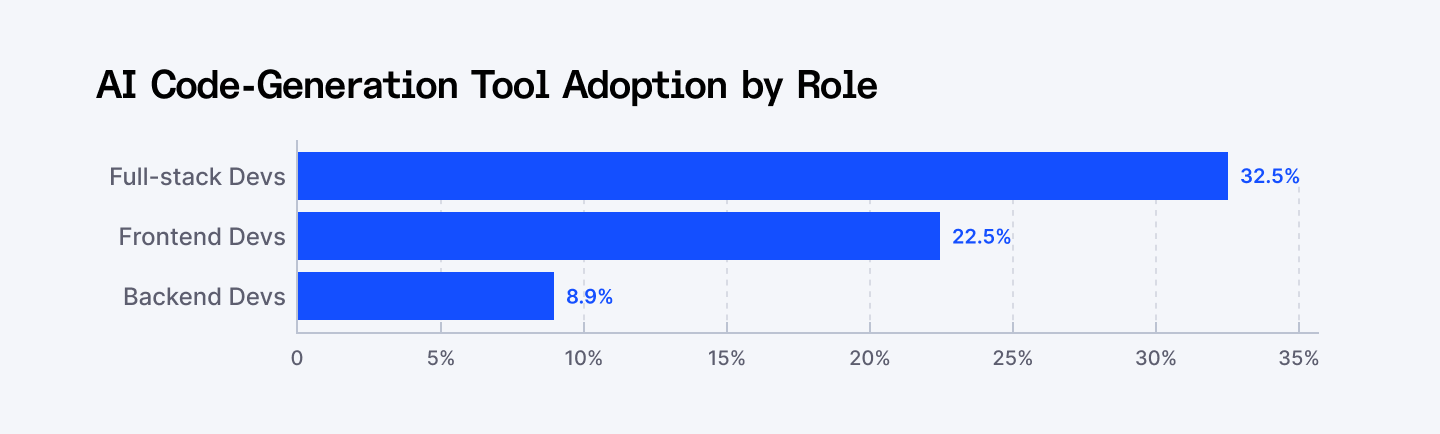
AI Pair Programming Tools: 2025 Market Statistics
What are the most popular AI pair programming tools? Here's the breakdown of tool adoption and market share:
Top AI Pair Programming Tools by Adoption:
Tool | Adoption Rate | Daily Users | Key Strength |
|---|---|---|---|
ChatGPT | 69% tried, 49% regular | ~100M developers | General coding assistance |
GitHub Copilot | 40% tried, 26% regular | 1.8M paid subscribers | IDE integration |
Google Gemini | 23% tried | Growing | Multi-modal capabilities |
JetBrains AI | 18% tried | ~500K users | IDE-native experience |
Amazon CodeWhisperer | 15% tried | AWS-focused | Cloud optimization |
Cursor | 12% tried | Rapidly growing | Agent-based editing |
Tabnine | 10% tried | Privacy-focused | On-premise option |
AI pair programming tools comparison:
Feature | Copilot | ChatGPT | JetBrains AI | Cursor |
|---|---|---|---|---|
Code completion | ✅ | ✅ | ✅ | ✅ |
Multi-file context | Limited | ✅ | ✅ | ✅ |
Chat interface | ✅ | ✅ | ✅ | ✅ |
Agent mode | ❌ | ❌ | ❌ | ✅ |
Price/month | $10-19 | $20 | $10 | $20 |
IDE support | VS Code, JB | Web, API | JetBrains only | Custom IDE |
See also: AI Coding Assistant ROI: Real Productivity Data
Which AI Pair Programming Tools Are Most Popular Among Developers?
Developers in 2025 rely on multiple AI assistants, but a few tools lead the market in adoption. ChatGPT and GitHub Copilot remain the most widely used, while newer tools like Gemini and Claude are also gaining ground. Usage surveys show that developers often combine more than one tool depending on their needs and environments.

- 82% of AI-using developers reported using ChatGPT, and 68% reported using GitHub Copilot, making these the two most popular coding assistants.
- Only about 4% of developers reported using Amazon CodeWhisperer and about 5% reported using Tabnine, showing limited adoption of these tools.
- Google Gemini is used by 47% of developers and Anthropic Claude by 41%, proving that newer AI assistants are gaining significant traction.
- Microsoft Copilot is used by 31% of developers, adding to the list of mainstream assistants.
- JetBrains’ 2024 survey shows 69% of developers have tried ChatGPT (49% use it regularly) and 40% have tried Copilot (26% use it regularly), confirming strong repeat usage.
- Zero to Mastery reports that 84.4% of programmers have experience with AI code-generation tools, showing high exposure across the industry.
- Many developers use multiple assistants in practice, with Copilot embedded in IDEs like VS Code and ChatGPT accessed via web or CLI plugins, highlighting how tool usage overlaps in daily work.
Related: 15 Best AI Tools for Developers
How Much Do AI Tools Improve Productivity and Speed for Developers?
AI pair programming tools are widely recognized for helping developers complete tasks faster and with less effort. The data shows that AI assistants reduce time spent on coding, testing, and documentation, while also increasing success rates in task completion. Both small companies and large enterprises report measurable gains in developer efficiency.
- Developers using GitHub Copilot completed coding tasks about 55% faster than those without it, proving its strong impact on speed.
- AWS reports that CodeWhisperer users finished tasks about 57% faster, showing similar efficiency gains across platforms.
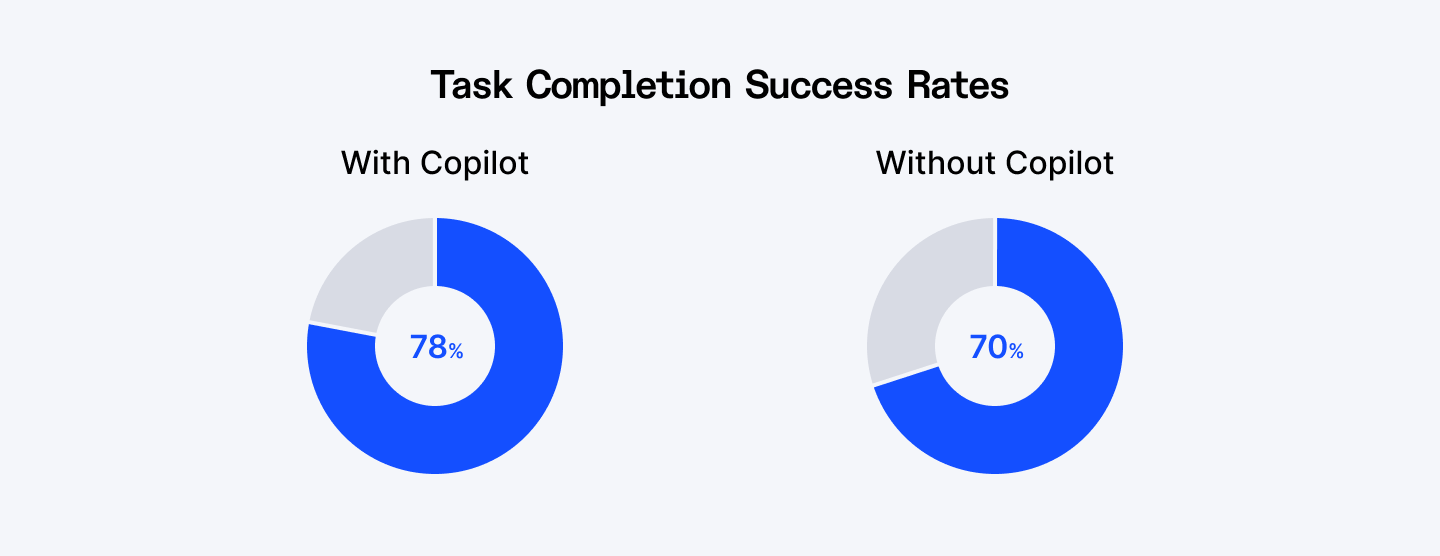
- Success rates improved with AI, with 78% of developers completing tasks using Copilot compared to 70% without it, highlighting better outcomes.
- AI assistants save developers between 15 and 25 hours per month, equal to about $2,000–$5,000 in value per year, creating measurable ROI.
- Developers save 30–60% of time on coding, testing, and documentation when using AI tools, freeing time for higher-value work.
- Small companies see up to 50% faster unit test generation and debugging with AI tools, giving them an edge in speed.
- Large enterprises report a 33–36% reduction in time spent on code-related development activities, confirming scalability of time savings.
- Microsoft-backed trials show AI assistance leads to about a 21% productivity boost in complex knowledge work, proving benefits beyond routine coding.
Next up: Explore Replit usage statistics and see how AI is reshaping coding workflows.
How Do AI Tools Affect Code Quality and Testing Outcomes?
AI pair programming tools not only improve speed but also influence code quality and testing success. Studies show that code written with AI assistance often passes more tests, contains fewer errors, and scores higher on readability and maintainability. Reviewers also tend to approve AI-assisted code more often, which helps projects move faster to production.
- Developers using GitHub Copilot were 53.2% more likely to pass all unit tests compared to those coding without it, proving its positive testing impact.
- Copilot-authored code contained 13.6% fewer errors per line than code written without AI assistance, showing measurable quality gains.
- Reviewers approved Copilot-authored code about 5% more often, meaning AI-generated code was more “merge-ready.”
- GitHub Copilot achieved a 46% code completion rate, but only about 30% of suggestions were accepted by developers, showing that while many outputs are useful, not all are production-ready.
- 41% of business owners expect AI to handle repetitive coding and fix errors effectively, reflecting its perceived reliability for rule-based tasks.
- Developers also save 30–60% of time on test generation and documentation when using AI assistants, further supporting testing workflows.
GitHub Copilot Adoption Rate: Developer Statistics 2025
What is the GitHub Copilot adoption rate among developers in 2025? Here are the verified statistics:
GitHub Copilot Adoption Statistics:
Metric | Value | Context |
|---|---|---|
Total paid subscribers | 1.8 million+ | As of Q4 2025 |
Enterprise customers | 50,000+ organizations | Including 90% of Fortune 100 |
Developer trial rate | 40% | Have tried Copilot |
Regular usage rate | 26% | Use Copilot consistently |
Code acceptance rate | ~30% | Of suggestions accepted |
Code completion rate | 46% | Suggestions offered |
GitHub Copilot productivity impact:
Metric | Improvement | Study |
|---|---|---|
Task completion speed | 55% faster | GitHub internal study |
Unit test pass rate | 53.2% more likely | Controlled experiment |
Code errors per line | 13.6% fewer | Quality analysis |
Code review approval | 5% higher | Merge-ready code |
Developer satisfaction | 75% report improvement | Survey data |
GitHub Copilot adoption by company size:
Company Size | Adoption Rate | Common Use Cases |
|---|---|---|
Enterprise (1000+) | 35% | Standardization, compliance |
Mid-market (100-999) | 28% | Productivity, onboarding |
SMB (10-99) | 22% | Speed, cost savings |
Startups (<10) | 45% | MVP development, solo devs |
GitHub Copilot pricing tiers:
Plan | Price | Features |
|---|---|---|
Individual | $10/month | Basic completions, chat |
Business | $19/user/month | Admin controls, policies |
Enterprise | $39/user/month | Fine-tuning, security, analytics |
JetBrains AI Assistant Adoption Numbers 2025
What are the JetBrains AI Assistant adoption numbers in 2025? Here's the data on JetBrains' AI coding tool:
JetBrains AI Assistant Statistics:
Metric | Value | Notes |
|---|---|---|
Active users | ~500,000 | Estimated monthly active |
JetBrains IDE users | 16 million+ | Total addressable market |
AI adoption among JB users | ~18% | Of total JetBrains users |
Trial conversion rate | ~25% | Free trial to paid |
Enterprise adoption | Growing | Bundled with All Products Pack |
JetBrains AI vs GitHub Copilot:
Feature | JetBrains AI | GitHub Copilot |
|---|---|---|
Price | $10/month | $10-19/month |
IDE support | JetBrains only | VS Code, JetBrains, Neovim |
Code completion | ✅ | ✅ |
Chat in IDE | ✅ | ✅ |
Refactoring assistance | ✅ Strong | Good |
Multi-language support | 20+ languages | 30+ languages |
Context awareness | Project-level | File-level |
JetBrains AI feature usage:
Feature | Usage Rate | Developer Feedback |
|---|---|---|
Code completion | 78% | Most used feature |
Chat assistance | 56% | Growing adoption |
Documentation generation | 42% | Time saver |
Test generation | 38% | Quality improvement |
Refactoring suggestions | 34% | Code quality |
Commit message generation | 28% | Convenience feature |
How Have Fortune 500 Peers Rolled Out AI Pair Programmers Without Slowing Down Active Sprints?
How have Fortune 500 companies rolled out AI pair programmers without slowing down active sprints? Here are the strategies enterprise teams use:
Enterprise AI Pair Programming Adoption Statistics:
Metric | Value | Source |
|---|---|---|
Fortune 100 using Copilot | 90% | GitHub data |
Enterprise AI tool adoption | 78% | Industry surveys |
Productivity gain reported | 20-40% | Enterprise studies |
Implementation timeline | 3-6 months | Average rollout |
Fortune 500 Rollout Best Practices:
Phase 1: Pilot Program (Weeks 1-4)
- Start with 5-10% of engineering team
- Select volunteer early adopters
- Focus on non-critical projects initially
- Measure baseline productivity metrics
Phase 2: Controlled Expansion (Weeks 5-12)
- Expand to 25-50% of teams
- Integrate into existing sprint workflows
- Train team leads on AI tool usage
- Establish security and compliance reviews
Phase 3: Full Rollout (Weeks 13-24)
- Deploy organization-wide
- Update coding standards for AI-assisted development
- Implement monitoring and analytics
- Create internal best practices documentation
Why sprints don't slow down:
Strategy | Impact | Implementation |
|---|---|---|
Parallel onboarding | No sprint disruption | Train during non-critical time |
Opt-in adoption | Higher engagement | Volunteers first, mandate later |
IDE integration | Zero workflow change | Copilot/JetBrains native |
Async training | No meeting overhead | Video tutorials, documentation |
Gradual rollout | Manageable change | 10% → 25% → 50% → 100% |
Enterprise case study patterns:
Company Type | Rollout Time | Key Success Factor |
|---|---|---|
Financial services | 6 months | Security compliance first |
Tech companies | 3 months | Developer-led adoption |
Healthcare | 9 months | HIPAA compliance review |
Retail | 4 months | Cost savings focus |
Manufacturing | 5 months | Legacy code support |
Common enterprise concerns addressed:
- Security: Enterprise plans offer data retention controls, SSO, audit logs
- Compliance: Code suggestions can be filtered for licensing issues
- Quality: AI suggestions go through existing code review processes
- IP protection: Enterprise tiers don't train on customer code
- Cost justification: ROI typically 3-6 months based on productivity gains
Related: Developer Productivity Statistics with AI Tools
What Do Developers Use AI Pair Programming Tools For?
AI tools are mainly used to write and troubleshoot code, but developers also apply them in other parts of the workflow. Data shows that tasks like documentation, testing, and code review are supported by AI to a lesser degree, while system design and deployment remain areas where AI adoption is still rare.
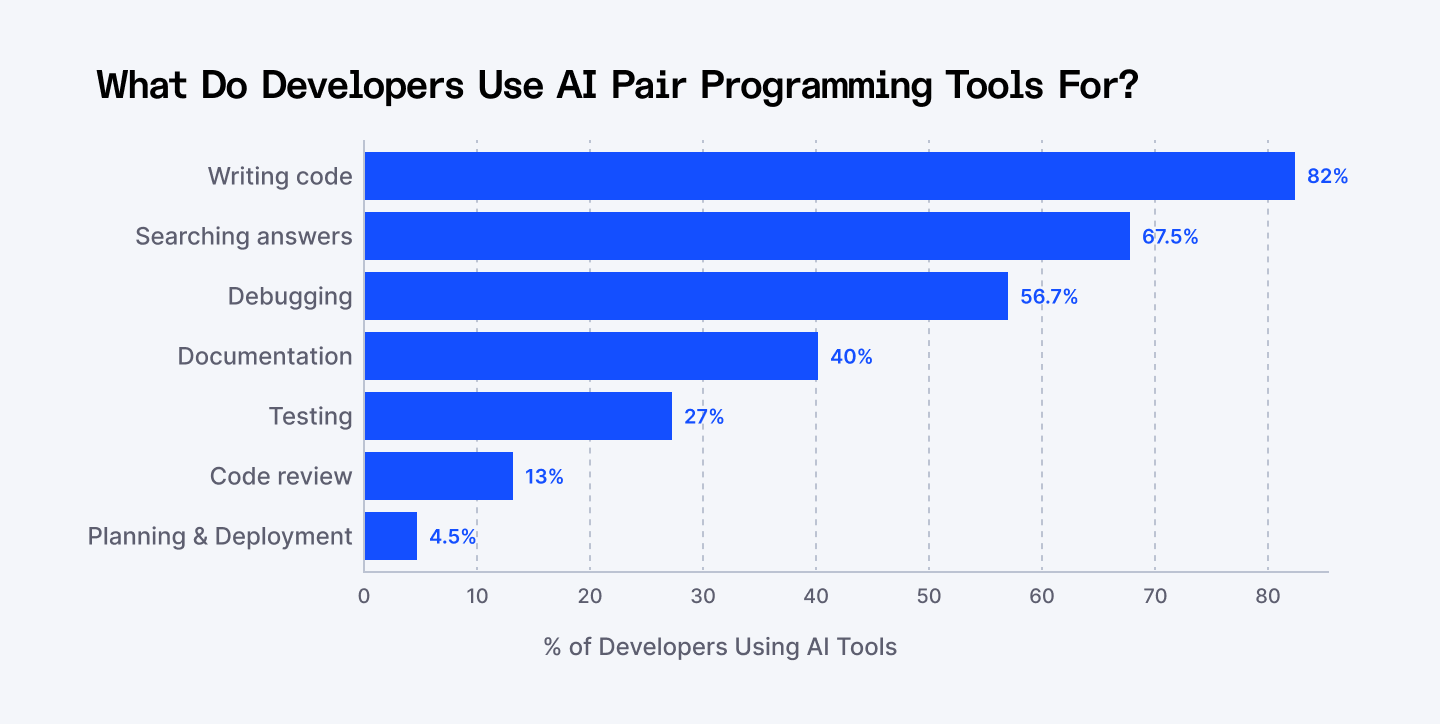
- Writing code is the most common use case, with 82% of developers applying AI tools for this task.
- 67.5% of developers use AI tools for searching answers, showing that AI also supports knowledge retrieval.
- Debugging is another major area, where 56.7% of developers turn to AI for quick fixes and coding support.
- 40% of developers use AI tools for writing or explaining code documentation, adding efficiency to a time-consuming task.
- 27% of developers use AI tools for testing tasks, showing moderate adoption in this stage of development.
- Only 13% of developers use AI for code review and committing changes, showing low trust in oversight tasks.
- About 4–5% of developers use AI tools for planning and deployment, proving that AI is rarely applied to broader project management tasks.
What Challenges Do Developers Face When Using AI Pair Programming Tools?
Even though AI pair programming tools bring speed and quality improvements, developers often face issues with accuracy, debugging time, and added technical debt. Security risks and system complexity also limit trust and slow down adoption in some areas.
- Many developers say the output is “almost right but not quite”, with 45% reporting this as their top frustration.
- Extra debugging has become common, as 66% of developers admit they spend more time fixing AI-generated code than expected.
- The biggest structural problem is technical debt, reported by 62.4% of developers using AI in their projects.
- Complexity of tech stacks also slows progress, with 32.9% pointing to building challenges and 32.3% highlighting deployment difficulties.
- Tool reliability remains a concern, with 31.5% of developers reporting issues in daily use.
- Work tracking suffers too, as 27.1% say AI complicates how they monitor and record their contributions.
- Security concerns appear in both code and systems, with 57% of AI-generated APIs left publicly accessible and 89% relying on weak authentication methods.
- Code duplication is another side effect, with AI-assisted coding linked to four times more cloning than before.
How Are Enterprises and Teams Adopting AI Pair Programming?
AI adoption is not limited to individual developers. Organizations of all sizes are introducing AI tools into their workflows, with small teams moving faster than large enterprises. Regional adoption also shows differences, with North America and Asia leading and parts of Europe being more cautious. Industry-specific use cases, such as robotics, further expand AI’s role in development.
- 61% of global enterprises in 2025 are already using AI in at least one business function.
- Companies in North America lead adoption, with 72% of firms integrating AI into core operations.
- Japan stands out in manufacturing, where 29% of plants now use autonomous AI systems.
- Worker acceptance is growing, as 48% of employees say they feel more comfortable using AI at work than a year ago due to transparency improvements.
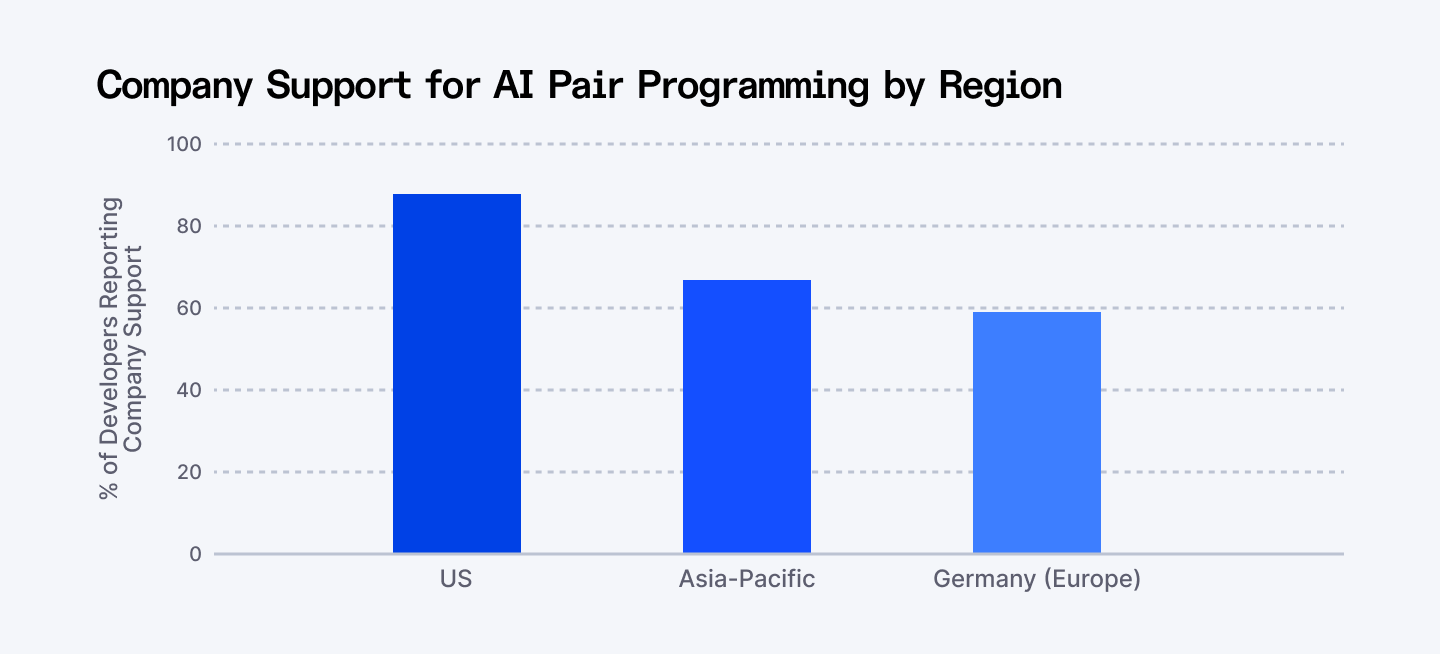
- Company support for AI pairing varies by region, with 88% of US developers saying their organizations allow AI use, compared to 67% in Asia-Pacific and 59% in Germany (Europe).
- Smaller groups lead adoption speed, with 51% of active users working on teams of 10 or fewer members.
- Even at Google, AI plays a significant role, with 25% of code now AI-assisted, and leadership reporting about a 10% gain in engineering velocity.
What Is the Economic Value of AI Pair Programming?
AI pair programming delivers clear financial benefits by saving developer hours, reducing costs, and boosting salaries for AI-skilled roles. Beyond individual productivity, the overall AI industry continues to expand rapidly, creating measurable returns for businesses and professionals.
- Developers save 15 to 25 hours per month using AI assistants, which equals about $2,000 to $5,000 in annual value per developer.
- Entry-level roles in AI development offer $90,000 to $130,000 salaries, compared to $65,000 to $85,000 in traditional development jobs.
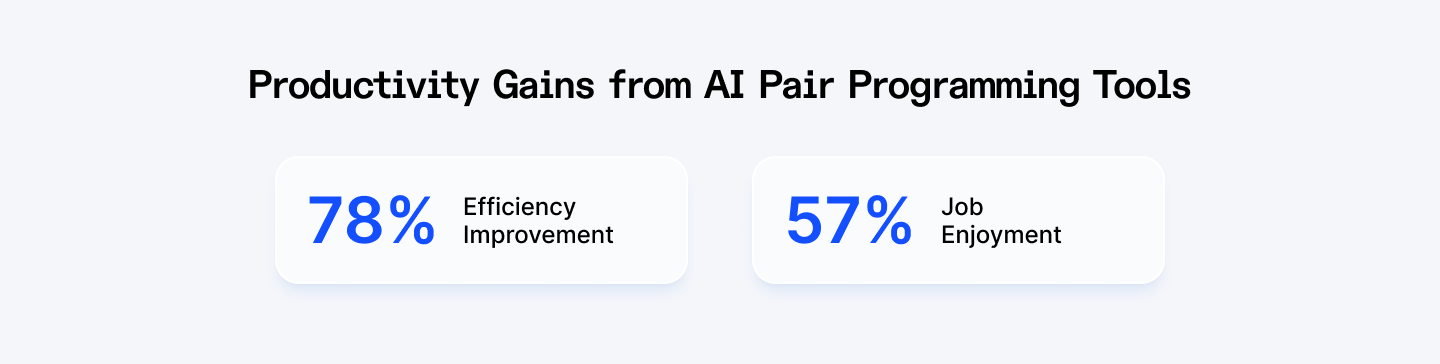
- Productivity gains are also visible; 78% of developers say AI tools improve their efficiency, while 57% say the tools make their job more enjoyable.
- GitHub Copilot users also report strong outcomes, with 81% noticing boosts in productivity for coding and testing tasks.
- The AI software industry is projected to reach $169.2 billion by 2032, highlighting the scale of investment and opportunity.
- Microsoft 365 Copilot provides measurable benefits, saving 30 minutes per week on email and speeding up document completion by 12%.
- AI agents show efficiency beyond coding, improving structured workflows by more than 30% in enterprise environments.
Related: AI Agent Statistics and Adoption Trends
AI Pair Programming Best Practices 2025
What are the best practices for AI pair programming in 2025? Based on research and enterprise adoption data, here are the top recommendations:
Developer Best Practices:
Practice | Why It Matters | Impact |
|---|---|---|
Review all AI suggestions | AI makes mistakes | 30% of suggestions need edits |
Write clear comments first | Better context = better suggestions | 40% improvement in quality |
Use chat for complex logic | Completions work best for simple code | Higher accuracy |
Learn prompt engineering | Better prompts = better output | 2-3x effectiveness |
Keep context focused | Too much context confuses AI | Cleaner suggestions |
Team Best Practices:
Practice | Implementation | Benefit |
|---|---|---|
Establish AI code review standards | Update PR checklist | Quality assurance |
Share effective prompts | Internal wiki/Slack channel | Team learning |
Track AI-assisted metrics | Separate AI vs manual code | Measure true impact |
Regular tool evaluation | Quarterly reviews | Stay current |
Security training | Mandatory for all devs | Prevent data leaks |
What NOT to do with AI pair programming:
Anti-Pattern | Risk | Better Approach |
|---|---|---|
❌ Blindly accepting all suggestions | Technical debt, bugs | Review each suggestion |
❌ Using AI for security-critical code | Vulnerabilities | Human review required |
❌ Sharing proprietary code with free tools | IP exposure | Use enterprise plans |
❌ Skipping tests because AI wrote code | Production bugs | Test AI code thoroughly |
❌ Ignoring licensing concerns | Legal issues | Check code provenance |
AI pair programming workflow (recommended):
1. Write clear comment/docstring describing intent
2. Let AI generate initial suggestion
3. Review for correctness and style
4. Run tests (AI-generated + manual)
5. Refactor if needed
6. Code review by human teammate
7. Merge
AI Tools for Developers: Pair Programming Feedback
What do developers say about AI pair programming tools? Here's aggregated feedback from surveys and research:
Overall Developer Sentiment (2025):
Sentiment | Percentage | Trend |
|---|---|---|
Positive | 60% | ↓ from 70% in 2024 |
Neutral | 25% | Stable |
Negative | 15% | ↑ from 10% in 2024 |
Why sentiment dropped slightly:
- Increased awareness of AI limitations
- Frustration with inaccurate suggestions
- Concerns about job displacement
- Technical debt from unreviewed AI code
Developer feedback by tool:
Tool | Avg Rating | Common Praise | Common Criticism |
|---|---|---|---|
GitHub Copilot | 4.2/5 | Speed, IDE integration | Limited context |
ChatGPT | 4.0/5 | Versatility, explanations | Not IDE-native |
Cursor | 4.4/5 | Multi-file edits, agent mode | Learning curve |
JetBrains AI | 4.1/5 | Native integration | JetBrains-only |
Tabnine | 3.8/5 | Privacy, on-prem | Less powerful |
What developers love about AI pair programming:
Feature | % Who Value It | Quote |
|---|---|---|
Faster coding | 78% | "Saves hours on boilerplate" |
Learning new languages | 65% | "Like having a tutor" |
Reducing context switching | 58% | "No more Stack Overflow tabs" |
Documentation help | 52% | "Finally, docs I don't hate" |
Debugging assistance | 48% | "Catches obvious mistakes" |
What developers dislike:
Issue | % Who Report It | Impact |
|---|---|---|
Inaccurate suggestions | 46% | Time wasted reviewing |
Outdated code patterns | 38% | Technical debt |
Over-reliance concerns | 35% | Skill atrophy fear |
Privacy concerns | 28% | Enterprise hesitation |
Cost | 22% | Budget constraints |
Trust levels in AI-generated code:
Trust Level | Percentage |
|---|---|
Highly trust | 3% |
Trust | 33% |
Neutral | 18% |
Don't fully trust | 46% |
Read next: 50+ no-code and low-code statistics to understand emerging trends in development.
AI Pair Programming News: Latest Developments 2025
What's the latest in AI pair programming news? Here are recent developments:
November/December 2025 Updates:
Date | Development | Impact |
|---|---|---|
Dec 2025 | GitHub Copilot reaches 1.8M subscribers | Continued enterprise growth |
Nov 2025 | Claude 3.5 Sonnet improves coding benchmarks | New competitor strength |
Nov 2025 | Cursor introduces enhanced agent mode | Multi-file editing improves |
Nov 2025 | JetBrains AI adds deeper refactoring | Feature parity push |
Oct 2025 | Amazon CodeWhisperer enterprise launch | AWS ecosystem play |
Developer productivity AI news highlights:
- GitHub Copilot Workspace (announced): Full project generation from issues
- AI code review tools growing: Automated PR reviews becoming standard
- Local AI models emerging: Privacy-first alternatives like Ollama + Continue
- IDE consolidation: More IDEs adding native AI features
Upcoming trends to watch:
Trend | Expected Timeline | Potential Impact |
|---|---|---|
AI code review automation | Q1 2026 | 50% reduction in review time |
Multi-model orchestration | Q2 2026 | Best model per task |
Autonomous coding agents | 2026-2027 | Task-to-PR automation |
Local/on-device AI | Q1 2026 | Privacy-first development |
Summary: AI Pair Programming Statistics 2025
The key AI pair programming statistics for 2025 show clear trends:
Adoption highlights:
- 84% of developers use or plan to use AI tools
- 51% use AI tools daily
- 41% of all code is now AI-generated
- 55% faster task completion with GitHub Copilot
Tool landscape:
- GitHub Copilot leads with 1.8M+ paid subscribers and 90% Fortune 100 adoption
- JetBrains AI Assistant growing at ~500K users
- ChatGPT remains most versatile (69% trial rate)
- Cursor emerging as top choice for multi-file editing
Enterprise adoption:
- Fortune 500 use phased rollouts (3-6 months)
- No sprint slowdown with parallel onboarding
- 20-40% productivity gains reported
- Security and compliance are top concerns
Developer sentiment:
- 60% positive (down from 70%)
- 46% don't fully trust AI output
- Feedback: love speed, dislike inaccuracy
- Human review remains essential
Best practices:
- Always review AI suggestions
- Use enterprise plans for security
- Track AI-assisted code separately
- Establish team standards
AI pair programming has moved from experimental to essential. The statistics show strong adoption, measurable productivity gains, and continued room for improvement in accuracy and trust.
Need developers skilled in AI-assisted development? Hire from Index.dev's vetted talent network.
Want to boost your engineering team’s productivity with AI-assisted development?
Hire developers experienced with AI tools from Index.dev and ready to code alongside AI from day one.
Interested in how AI is reshaping software engineering?
Browse our research-backed articles on AI adoption, coding automation, and developer productivity. Dive into in-depth insights on ChatGPT, Replit and low-code/no-code statistics curated by Index.dev experts.