
Hiring LLM engineers can feel like blind dating: lots of swiping, awkward intros, and the occasional disaster. This post gives you the short matchmaker’s answer up front — who to pick and when — plus a simple screening checklist so you don’t end up on a second date with a dud.
By the end, you'll know which platform fits your hiring timeline, budget, and technical requirements.
Hire pre-vetted LLM engineers through Index.dev: culture-fit checked and ready to deliver from day one.
1. Index.dev: Best For Fast, Risk-Free Senior Hires

Index.dev vets 20,000+ remote developers. Only the top 5% pass our rigorous screening.
You can get matched with top LLM developers in 48 hours and start a 30-day risk-free trial. Index.dev focuses exclusively on mid-to-senior engineers with 5+ years of experience who specialize in transformer architectures, fine-tuning, RAG pipelines, and production deployment.
The hiring process: Submit your LLM project requirements, whether you need conversational AI, model fine-tuning for domain-specific tasks, or retrieval-augmented generation systems, and Index.dev's talent matcher handpicks 2–3 candidates in 1–2 days. You interview only these hand-selected profiles, no sifting through hundreds of resumes. If you hire, the first 30 days come with a satisfaction guarantee. We have a 97% conversion from trial to placement record.
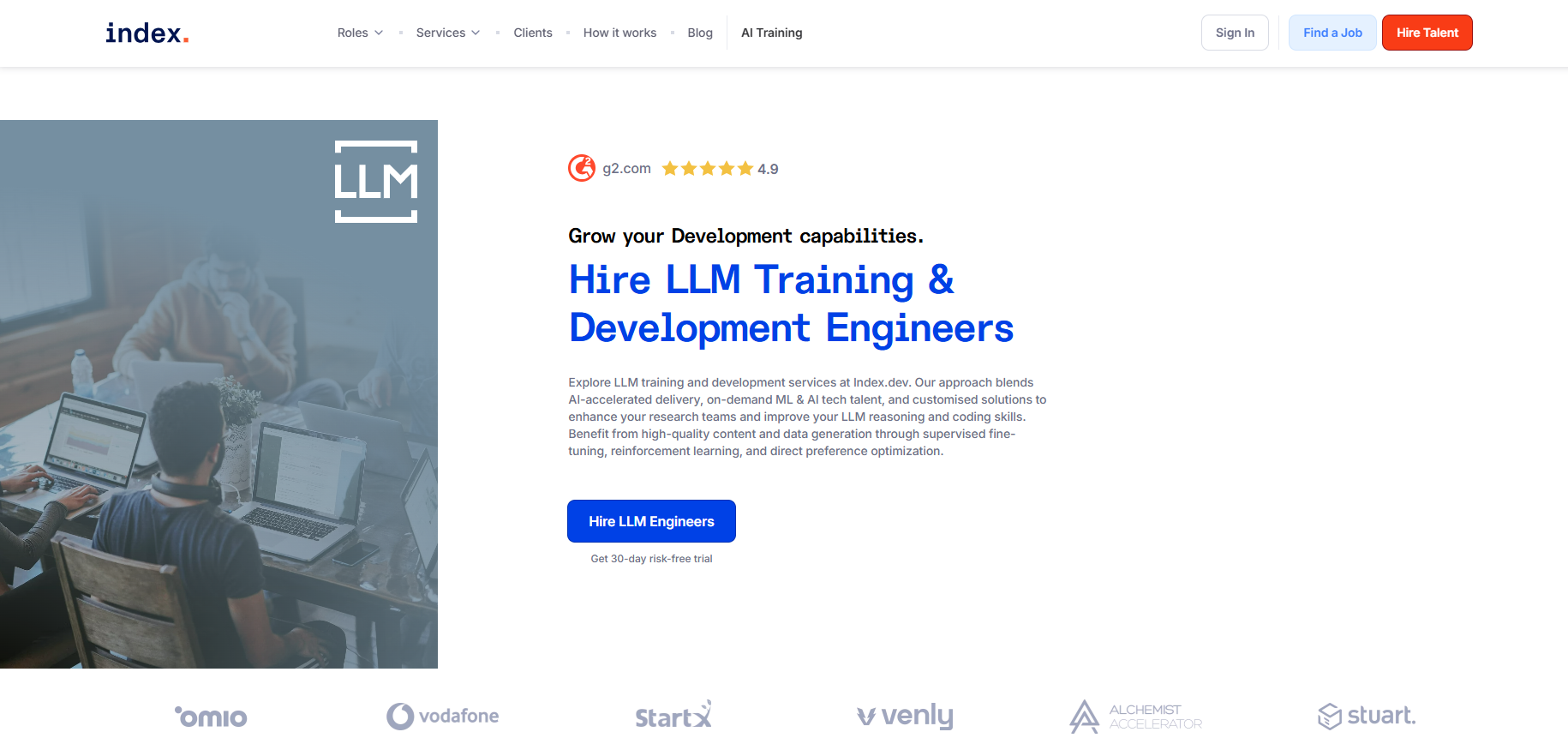
Key features: Senior U.S.-compatible developers, risk-free trial, dedicated account manager, direct hiring or contracting.
Vetting: All candidates pass technical tests covering LLM fundamentals (attention mechanisms, transformer architectures, prompt engineering), live coding interviews, and soft skills assessments. They must prove expertise in PyTorch or TensorFlow, Hugging Face Transformers, LangChain, vector databases, and excellent remote collaboration skills.
Curious how we vet for these skills? Read our full process.
Success metrics: Earlier this year, a fintech client filled three LLM roles in under a week — and they’re still building on our platform. In September 2025, we doubled down—launching our U.S. Hub with vetted American developers ready for quick deployment across the U.S. tech teams.
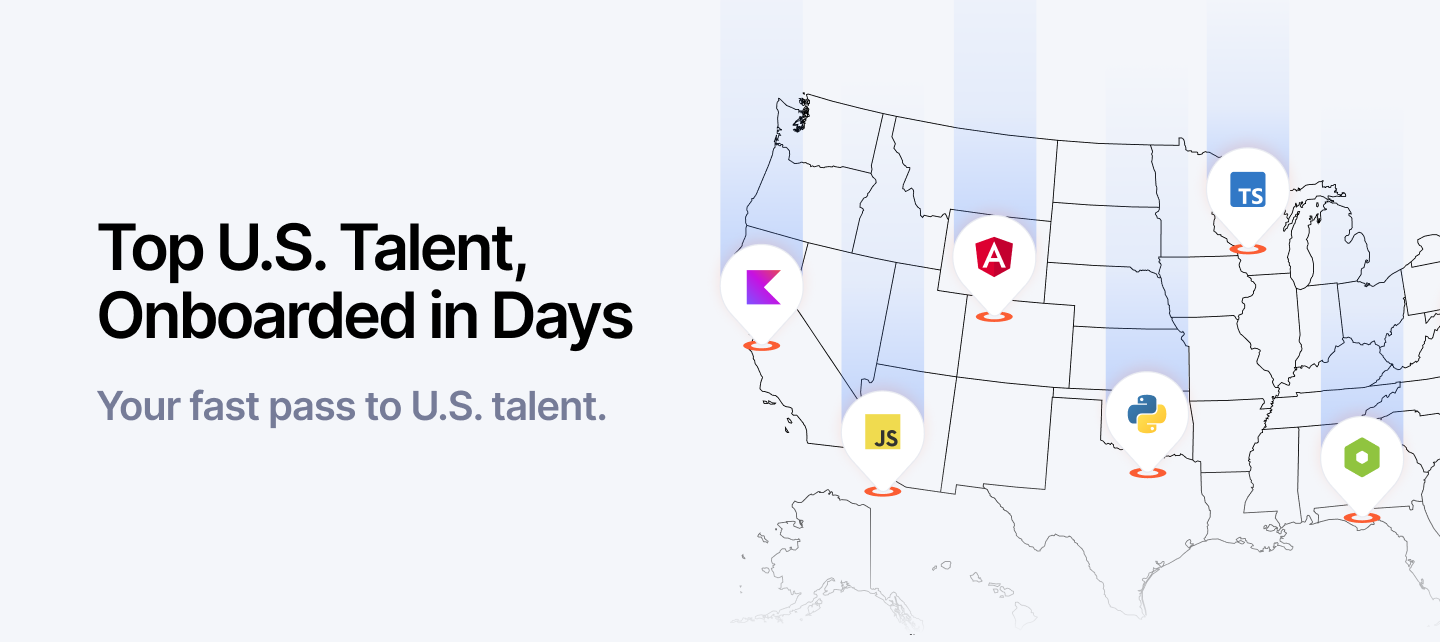
Pros: Speed (48-hour matching), high quality (only senior developers), risk-free trial, US-matched talent with timezone overlap, newly launched U.S. Hub for domestic hires.
Cons: Premium pricing versus generic boards, focus on mid-senior+ talent means fewer junior options.
Checklist: Before choosing Index.dev, confirm your scope and budget. Ensure you have specific LLM requirements: model types (GPT, Claude, Llama), frameworks (LangChain, LlamaIndex), deployment environments (AWS Bedrock, Azure OpenAI), and project duration. Understand the timezone overlap requirements and replacement guarantees.
Learn more about Index.dev’s newly launched U.S. Hub for remote tech talent.
2. Toptal: For Access to The Top 3% of Developers

Toptal accepts only the top 3% of applicants, after interviews, algorithm tests, and live coding challenges. These professionals include industry veterans with deep LLM expertise (transformer models, fine-tuning, prompt engineering). Result: a 98% trial-to-hire success rate.
Toptal pairs you with an engineering lead who matches you with candidates in 24–48 hours. Risk-free trial basis.
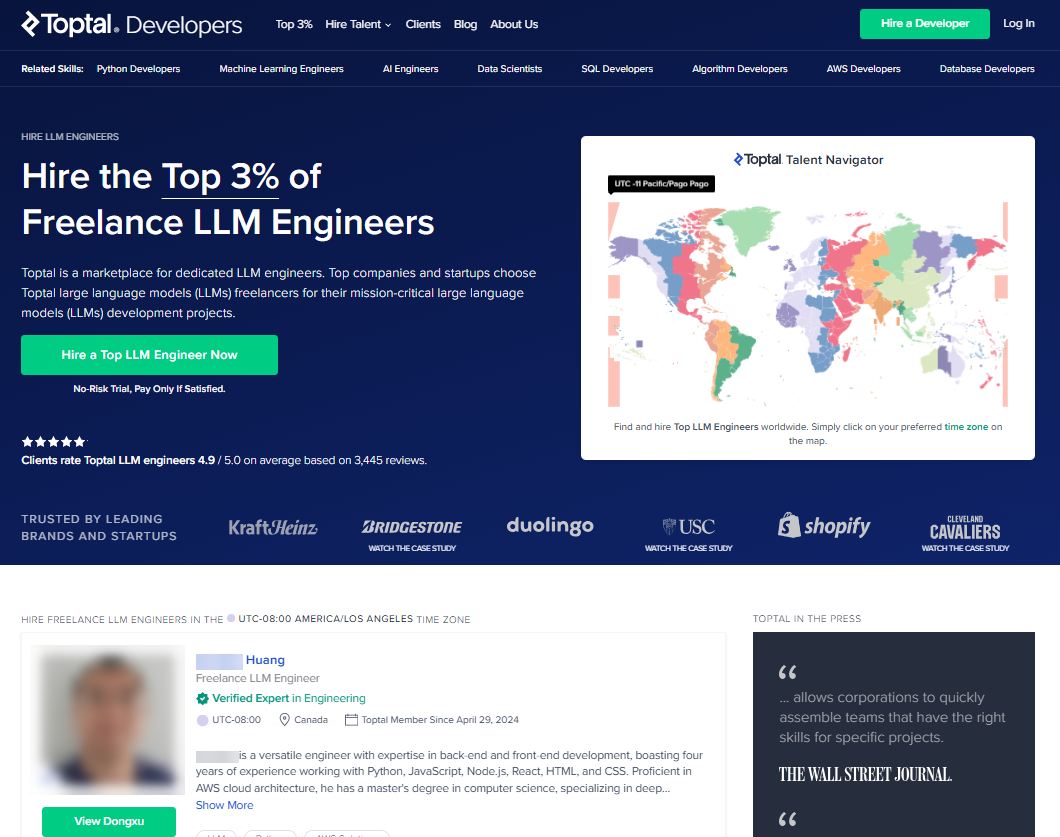
Pros: World-class talent, fast matching, risk-free trial, flexible scaling (hourly, part-time, full-time).
Cons: Very high cost—LLM engineers on Toptal often bill $100–$200+ per hour as per reports. Primarily remote talent requires timezone coordination.
Toptal works for firms that cannot sacrifice technical quality and have high budgets. If your project requires best-in-class LLM architects and you need nearly instant deliverables, Toptal justifies the premium.
3. Turing: For AI-Powered Matching at Scale

Need vetted LLM engineers in 4 days? Turing delivers. They use AI to scan 20,000+ candidate signals and match you with top 1% engineers fast.
Turing uses machine learning to test candidates on coding, algorithms, and LLM-specific skills like fine-tuning, prompt engineering, and vector databases. After you submit a job description, Turing presents qualified candidates in about 4 days. They require minimum 4-hour timezone overlap for real-time collaboration.
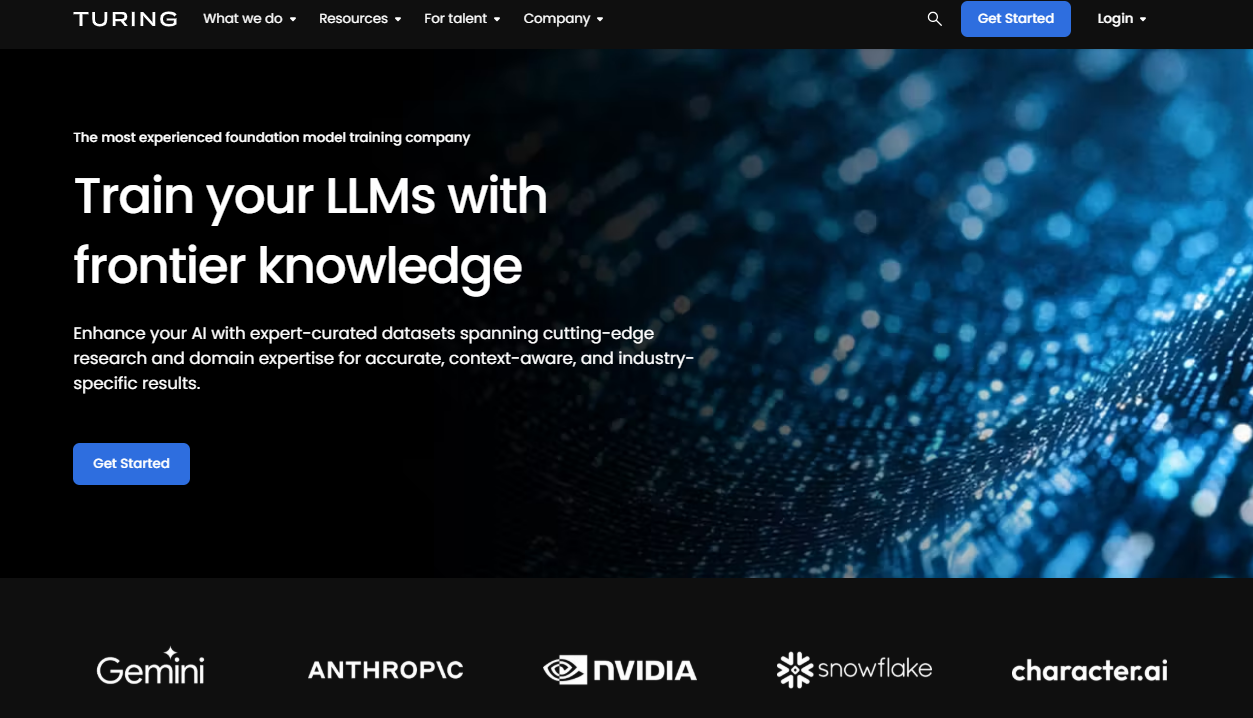
Pros: Rapid turnaround (4-day matching), global talent base, built-in remote work tools. Mid/senior developers at $100–$200/hour client-side rates.
Cons: Less direct control since Turing staff handle logistics. Pricing comparable to Toptal at high end. Primarily remote talent requires timezone management.
Turing shines when you need vetted LLM experts very fast and don't mind managing remote teams. Turing's technology "scans candidates with 20,000+ signals" to ensure fit.
4. Upwork: For Flexible Marketplace Hiring

Upwork has millions of freelancers ranging from developers of LLMs to machine learning engineers and NLP experts. The platform's strength is flexibility: post a job, review bids within hours, and hire for as little as 10 hours to validate fit.
Hourly rates span $30–$150 depending on experience and geography. Upwork works best for short experiments—baseline model prototyping, data preprocessing, prompt engineering research, or MVP chatbot builds. For production systems requiring architecture decisions and long-term maintenance, dedicated platforms like Index.dev offer more reliability.
Screen carefully: review portfolios showing past LLM work, check GitHub activity, and examine client ratings. Run a small paid spike (10–20 hours) mirroring your real problem—prompt optimization, RAG pipeline setup, or model evaluation—before scaling.
Pros: Low barrier to entry, huge candidate volume, flexible pricing, easy to test multiple contractors.
Cons: Little platform vetting—you do all screening. Quality ranges widely. Time-consuming to filter 100+ applicants per role.
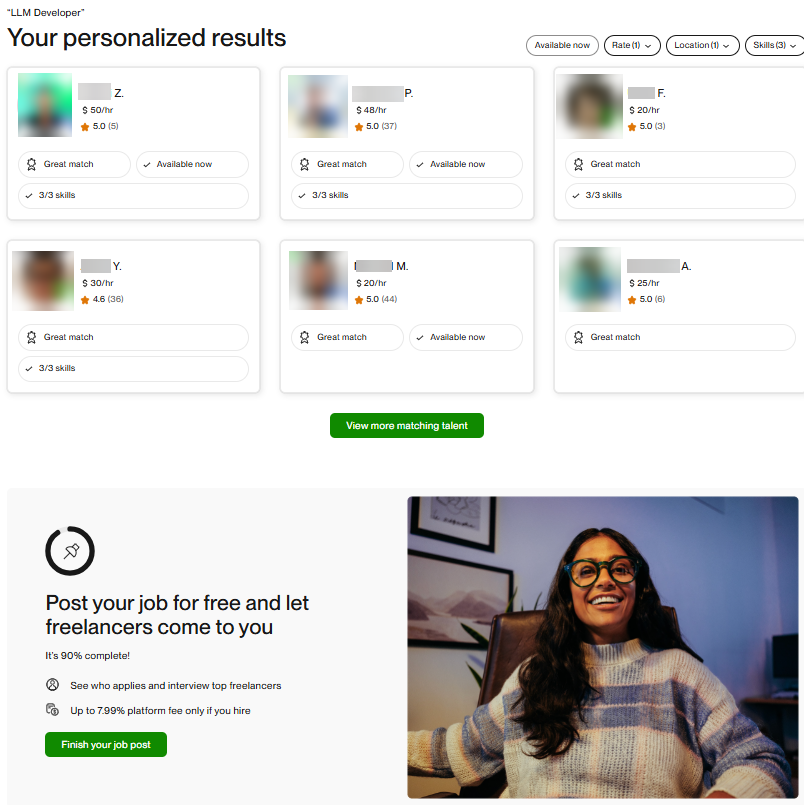
Upwork remains essential for teams testing multiple approaches in parallel or hiring at scale when internal bandwidth allows hands-on candidate management.
5. Dice: For Traditional Job Board Reach

Dice aggregates tech job postings across the U.S., including LLM developer, AI engineer, and machine learning roles. Companies post openings directly and candidates apply through standard workflows. Dice works best for full-time hires when you own the entire recruiting funnel.
Recent Dice listings emphasize hands-on experience with production LLM systems, agentic AI workflows, prompt engineering, LangChain or LlamaIndex frameworks, and cloud deployment. Salaries for mid-senior LLM engineers range $96,000–$223,000 annually depending on location and specialization.
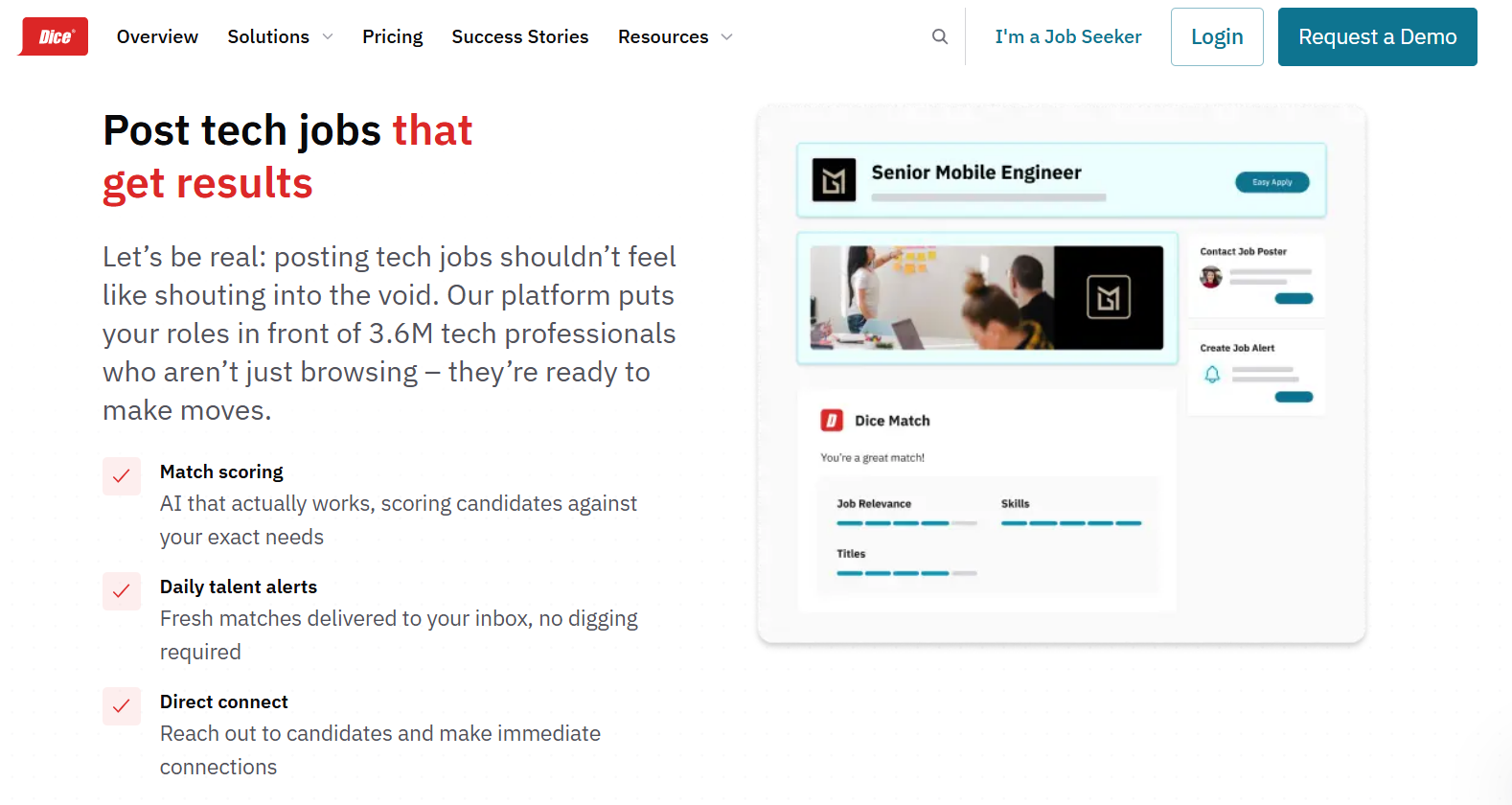
Dice doesn't vet candidates beyond basic profile verification, so expect significant filtering time. For companies with dedicated recruiters and defined hiring processes, Dice provides access to active job seekers at low cost. For startups without recruiting bandwidth, platforms like Index.dev that deliver pre-screened candidates in 48 hours save weeks.
Pros: Massive reach, low cost (job posting fees), useful for multiple simultaneous openings.
Cons: No vetting, high screening overhead, variable candidate quality.
Use Dice when you have internal recruiting capacity and need to fill multiple LLM roles over months.
6. Wellfound: For Startup-Focused Network

WellFound (previously AngelList Talent) connects startups to startup-minded engineers. Equity front and center, transparency built in, founders hiring founders. The jobs board has 150,000+ tech job postings and 10 million+ ready-to-work startup candidates.
Wellfound uses AI recruiting tools to automate sourcing, filtering, and outreach processes for candidates. The application allows access to salary information, equity, and company culture right from the start. For LLM hiring, Wellfound showcases roles at AI-first startups building foundation models or conversational AI products.
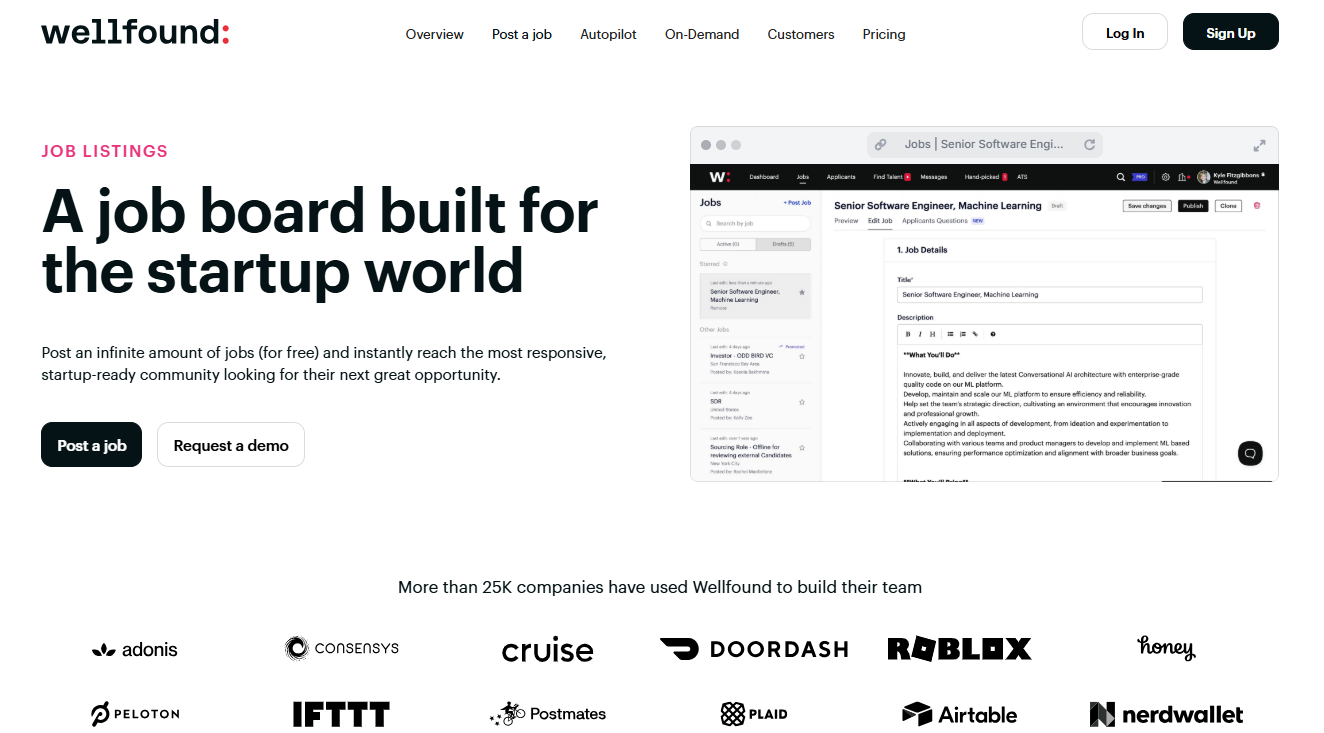
Wellfound works well for companies hiring junior-to-mid-level LLM developers or building founding engineering teams. The talent pool skews younger and startup-oriented compared to Toptal or Index.dev. For senior LLM architects or specialized roles, dedicated talent networks with deeper vetting deliver better matches.
Pros: Startup ecosystem access, transparent comp/equity info, free ATS, one-click applications, strong for early-career hires.
Cons: Less vetting than curated platforms, fewer senior specialists, longer time-to-hire for niche skills.
Use Wellfound when you're an early-stage startup hiring generalist engineers who can ramp on LLM work and want to showcase equity upside.
Compare Platforms at a Glance
Platform | Match time | Vetting | Pricing (USD) | Ideal use |
| Index.dev | 48 hrs | High, human-led | Premium | Fast, senior, risk-reduced hires. |
| Toptal | 24–48 hrs | Very high | High ($100+/hr) | Elite architects. |
| Turing | ~4 days | High (AI tests) | Mid–high | Scale remote hiring. |
| Upwork | immediate | Low (marketplace) | Low–mid | Prototyping/testing. |
| Dice | days–weeks | Low | Low | Full-time pipeline. |
| Wellfound | days–weeks | Low–mid | Low | Startup hires, equity roles. |
How to Screen LLM Developers Effectively
Don’t hire on credentials alone. Quiz candidates on shipped projects: “Which models have you fine-tuned? Show us your production code.” If they can’t walk you through a real-world launch, move on.
Request GitHub repositories or Jupyter notebooks demonstrating RAG pipelines, prompt engineering experiments, or model evaluation frameworks.
Live technical interviews should probe system design. Present a real business problem: "Build a customer support chatbot that routes complex queries to humans."
Evaluate how candidates architect solutions. Do they choose retrieval-augmented generation or fine-tuning? How do they handle context window limits? What guardrails prevent unsafe outputs? Strong candidates explain trade-offs clearly and propose concrete architectures.
Don’t fall for the “fullstack can do anything” fallacy. LLMs require a deep bench. Prioritize battle-tested candidates, not just impressive resumes. And don't neglect soft skills—remote LLM work requires clear communication and proactive problem-solving.
Pick wisely. Use Index.dev, and you’ll cut first-round screening by 95%. Go with a job board? Get ready to sift a mountain of resumes yourself.
Read next: Learn how to evaluate developers for AI and machine learning expertise.
Understanding LLM Developer Costs and Key Skills
LLM developer rates vary by experience, location, and engagement model. Hourly rates range $30–$200, with junior developers in offshore markets at the low end and senior U.S.-based specialists at the high end.
AI engineers in the U.S. average $245,000 annually in total compensation. Monthly costs for full-time LLM contractors span $5,000–$30,000.
Watch out for surprise costs. Data cleaning, cloud GPUs, and retraining eat up 20–30% more than you expected. Senior LLM engineers reduce long-term costs by architecting scalable systems upfront.
Key skills to prioritize
- Look for hands-on experience with transformer architectures, model fine-tuning via supervised learning or RLHF, and prompt engineering techniques.
- Prioritize candidates proficient in PyTorch or TensorFlow, Hugging Face Transformers, LangChain or LlamaIndex, and vector databases like Pinecone or Weaviate.
- Make sure your hires know their way around AWS Bedrock, Azure OpenAI, or Vertex AI. If they can’t build dashboards to flag latency spikes or runaway costs, keep looking.
- Ask for real deployment stories. “Show us your AWS or Vertex AI pipeline. Tell us how you fixed a hallucination bug.”
- For regulated fields, drill deep on compliance—this question alone trips up 80% of candidates.
Why LLM Developer Demand Keeps Rising
The talent gap is brutal: 4.2 million unfilled AI positions. Only 320,000 qualified developers worldwide. Cost per company? $2.8 million annually in delays.
Autodesk AI Jobs Report (2025) states that LLM-specific postings grew 114.8% in 2023, 120.6% in 2024, and 56.1% year-to-date in 2025. Yet, universities can't train talent fast enough.
Only 22% of computer science graduates have practical AI experience, while demand shows 89–96% shortage rates globally. FAANG companies absorb 70% of top AI graduates directly, leaving startups scrambling for remaining talent. This is why platforms like Index.dev that curate and vet senior talent become essential infrastructure.
Next up: Discover the top 5 platforms to hire back-end developers in the USA.
Conclusion
Speed or budget? That's your decision point.
Need someone this month? Start with Index.dev (48 hours, risk-free). Want elite architects? Toptal justifies the premium. Need scale and experimentation? Upwork or Turing work fast. Building a full pipeline? Dice and Wellfound let you cast wide nets and hire over time.
Move fast. Pick the platform matching your constraint. The right hire will deliver.
➡ ️Ready to hire LLM developers without the hiring risk? If you need a LLM developer, visit Index.dev or schedule a quick call. Our talent team will assess your needs and connect you with candidates on demand. Don’t waste another hiring cycle on generic job posts, let us match you with a high-performing backend developer today.
➡ Are you an LLM expert looking for remote or US-based opportunities? Join Index.dev to get matched with top companies and projects that value your skills.
➡ Want to dive deeper into developer hiring strategies? Explore more guides on Index.dev, including top platforms to hire web developers, tools for large-scale hiring, best freelance platforms, AI developer recruiting tips for early-stage startups, and top platforms for hiring European developers. Learn practical tips, compare platforms, and strengthen your hiring process.

