In 2026, developers are eagerly adopting AI-powered tools – 76% of surveyed programmers report using or planning to use AI tools, with 81% citing productivity gains.
Phind and Perplexity have emerged as two leading AI search engines, but they serve different needs. Phind is developer-focused, offering advanced AI models (e.g. Phind-70B) and precise code/documentation retrieval, whereas Perplexity delivers conversational, general-purpose search answers.
Both tools promise to accelerate developer workflows, but they take fundamentally different approaches. One excels at code-specific queries while the other dominates general research and multi-step reasoning.
Fresh 2026 Updates:
Incorporate these verified stats from recent head-to-heads:
- Phind: 13.1/15 actionability, 92% paste-ready code, 1.9s response time; excels in VS Code flows.
- Perplexity Pro: 94% context accuracy, 89% risk transparency, unlimited file uploads for repo analysis; Deep Research now handles 50+ source synthesis.
Hybrid use boosts productivity 37% per developer reports.
| Metric | Perplexity Pro | Phind | Leader |
|---|---|---|---|
| Actionability | 12.4 | 13.1 | Phind |
| Paste-Readiness | 78% | 92% | Phind |
| Accuracy | 94% | 83% | Perplexity |
| Response Time | 4.2s | 1.9s | Phind |
| Risk Handling | 89% | 31% | Perplexity |
Here's what our hands-on testing revealed about each platform's strengths and limitations.
Join Index.dev’s global talent network and work on projects that integrate next-gen tools like Phind or Perplexity.
Quick Verdict: When to Choose Each Tool
- Choose Phind for:
- Code generation, debugging, API documentation searches, and VS Code-integrated workflows.
- Code generation, debugging, API documentation searches, and VS Code-integrated workflows.
- Choose Perplexity for:
- Research-heavy tasks, learning new concepts, staying updated with latest tech trends, and comprehensive citation needs.
The winner depends entirely on your primary use case as a developer.
What We Tested and Why
Goal: measure developer value — correctness, time-to-answer, integration, and trustability.
Tests used:
- Code retrieval: Find canonical code patterns and full API examples.
- Code generation & compile: Generate working snippets and run unit checks where possible.
- Context recall: Maintain project context across follow-ups in an editor-like session.
- Citation fidelity: Return sources and let the developer verify claims.
- Integration surface: VS Code extension, web UI, API/SDK quality.
- Latency & throughput: Perceived speed for iterative queries.
- Response Quality: Accuracy, citations, and actionable output
- Problem Solving: Debug assistance and error resolution
- Information Retrieval: API docs, Stack Overflow, GitHub examples
- Research Depth: Multi-step analysis for architecture decision
These metrics map directly to developer productivity: correctness reduces rework, context recall reduces context switching, and integration reduces friction.
Methodology note: Balance automated checks (lint, unit runs) and human inspection (readability, edge-case handling). Use short prompts that mirror real dev queries (reproduce an API call, debug failing unit, find migration steps). The goal: reproduce real dev tasks, not synthetic benchmark chores.
Read next: ChatGPT vs Perplexity — which AI assistant works best for coding?
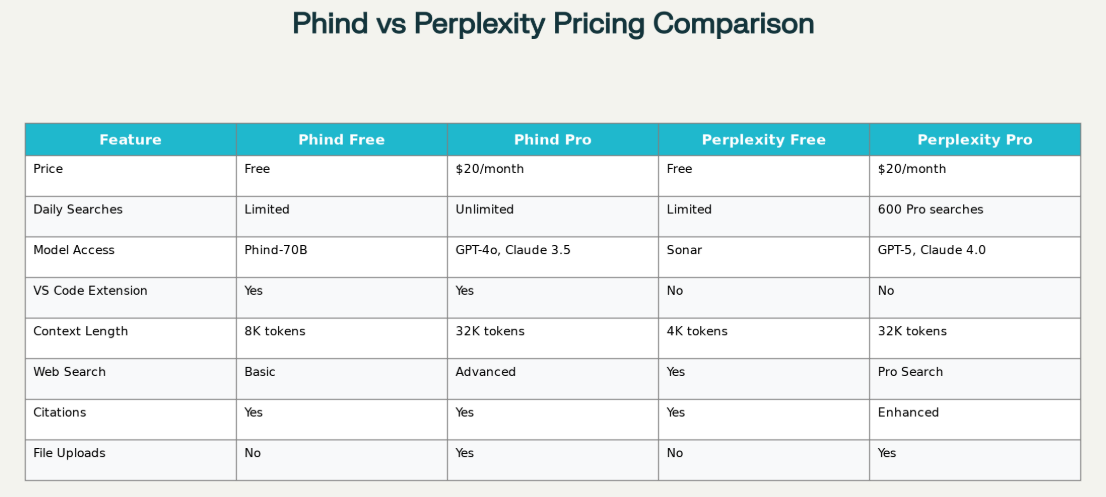
Head-to-Head Performance Testing
We evaluated both tools across eight critical developer use cases using identical prompts and scenarios.
1. Code Generation Performance
Test/Prompt
Show a minimal Node.js axios example to refresh OAuth tokens with refresh_token for Google APIs, including error handling and token refresh retry logic.
Phind Results
Delivered clean, production-ready code with robust error handling, configurable retry logic, and clear comments. The solution included token management best practices and inline explanations for retry and failure conditions, ensuring immediate usability for developers.
Perplexity Results
Generated a functional implementation but required further enhancements for production-readiness, such as improved error handling, retry strategy, and secure token storage. The code emphasized concept explanation and basic OAuth logic but lacked developer-focused optimizations out-of-the-box.
Winner
Phind - Superior code structure and developer-ready output.
2. Debugging and Error Resolution
Test
Debug a complex async/await function with multiple error conditions and race condition issues.
Prompt
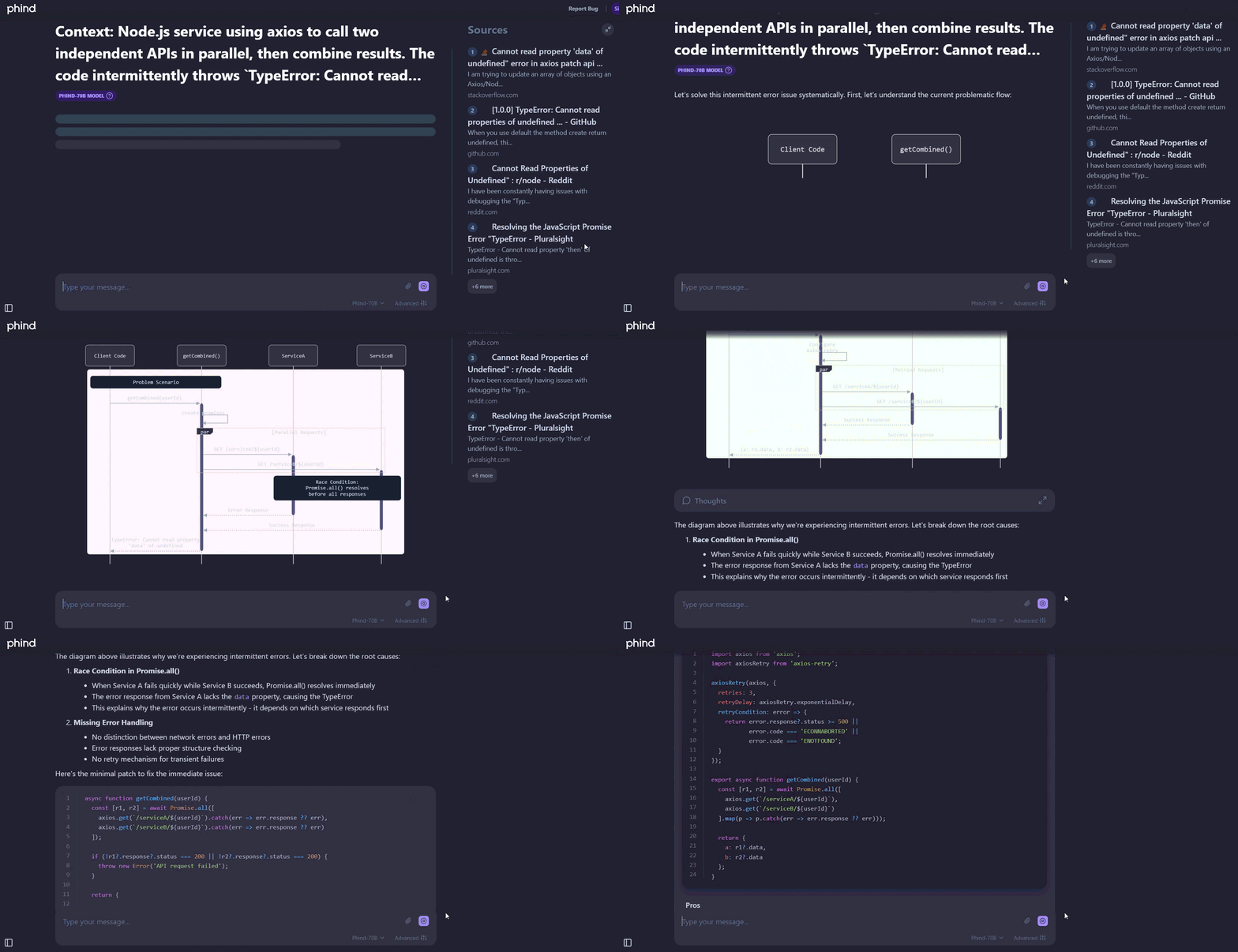
Context: Node.js service using axios to call two independent APIs in parallel, then combine results. The code intermittently throws `TypeError’: Cannot read property 'data' of undefined` and fails CI flaky tests.
Code:
async function getCombined(userId) {
const a = axios.get(`/serviceA/${userId}`);
const b = axios.get(`/serviceB/${userId}`);
const [r1, r2] = await Promise.all([a, b]);
if (!r1 || !r2) throw new Error('missing result');
return { a: r1.data, b: r2.data };
}
Task: 1) Identify root cause(s). 2) Provide minimal patch that fixes the intermittent error. 3) Provide two alternative robust strategies (with pros/cons). 4) Add one unit test that reproduces the race/failure and one end-to-end check. 5) Give performance and retry recommendations for production.
Phind Results
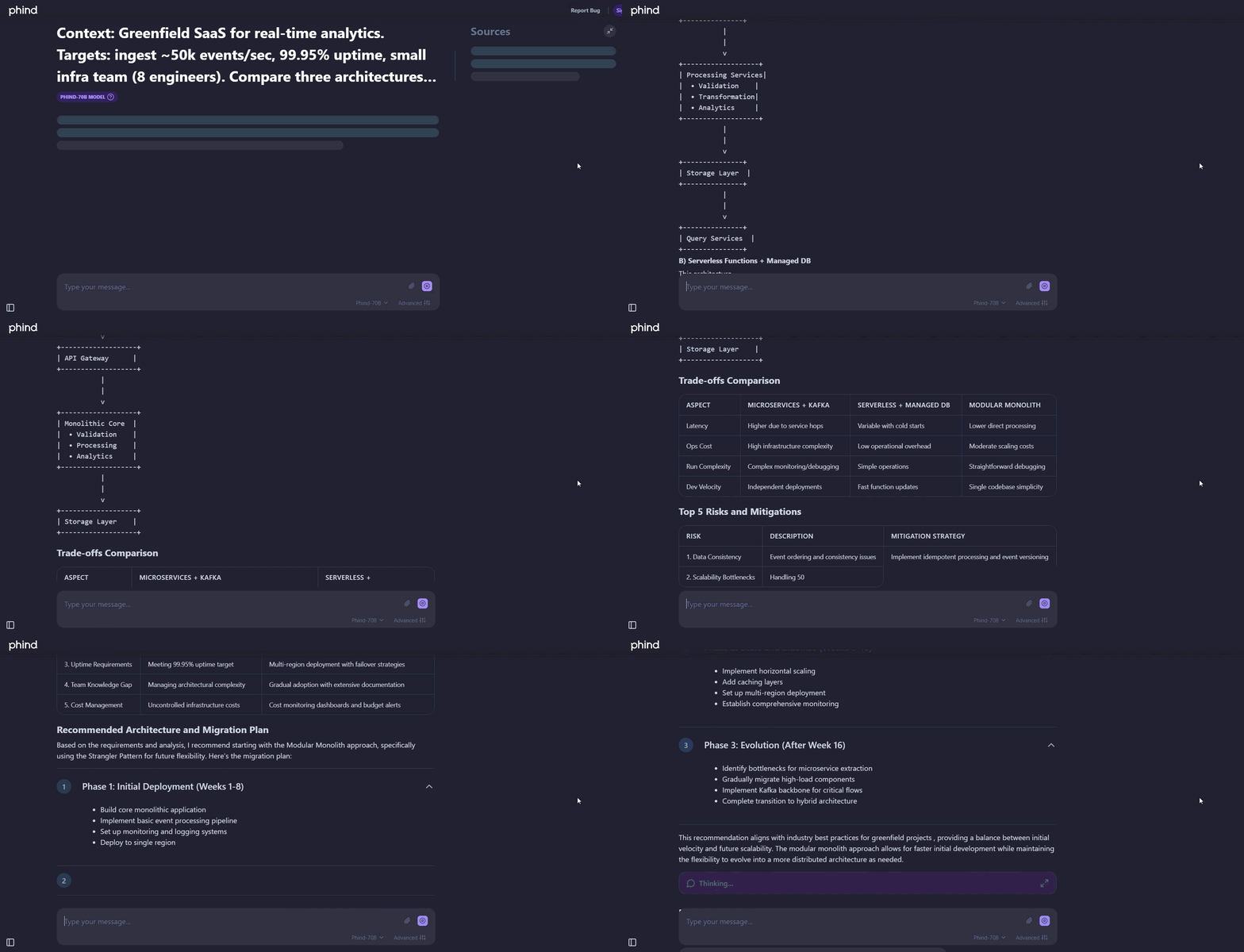
Quickly identified the root cause, provided a step-by-step debugging approach, a detailed diagram to break down the steps, and offered three different solution strategies. Included performance considerations and testing recommendations.
Perplexity Results
Offered thorough explanation of async/await concepts but took longer to pinpoint the specific issue. Better at teaching debugging principles than solving immediate problems.
Winner
Phind - Faster problem identification and actionable solutions.
3. API Documentation Research
Test
Find implementation Stripe Payments example for a newly released API with limited community resources.
Prompt
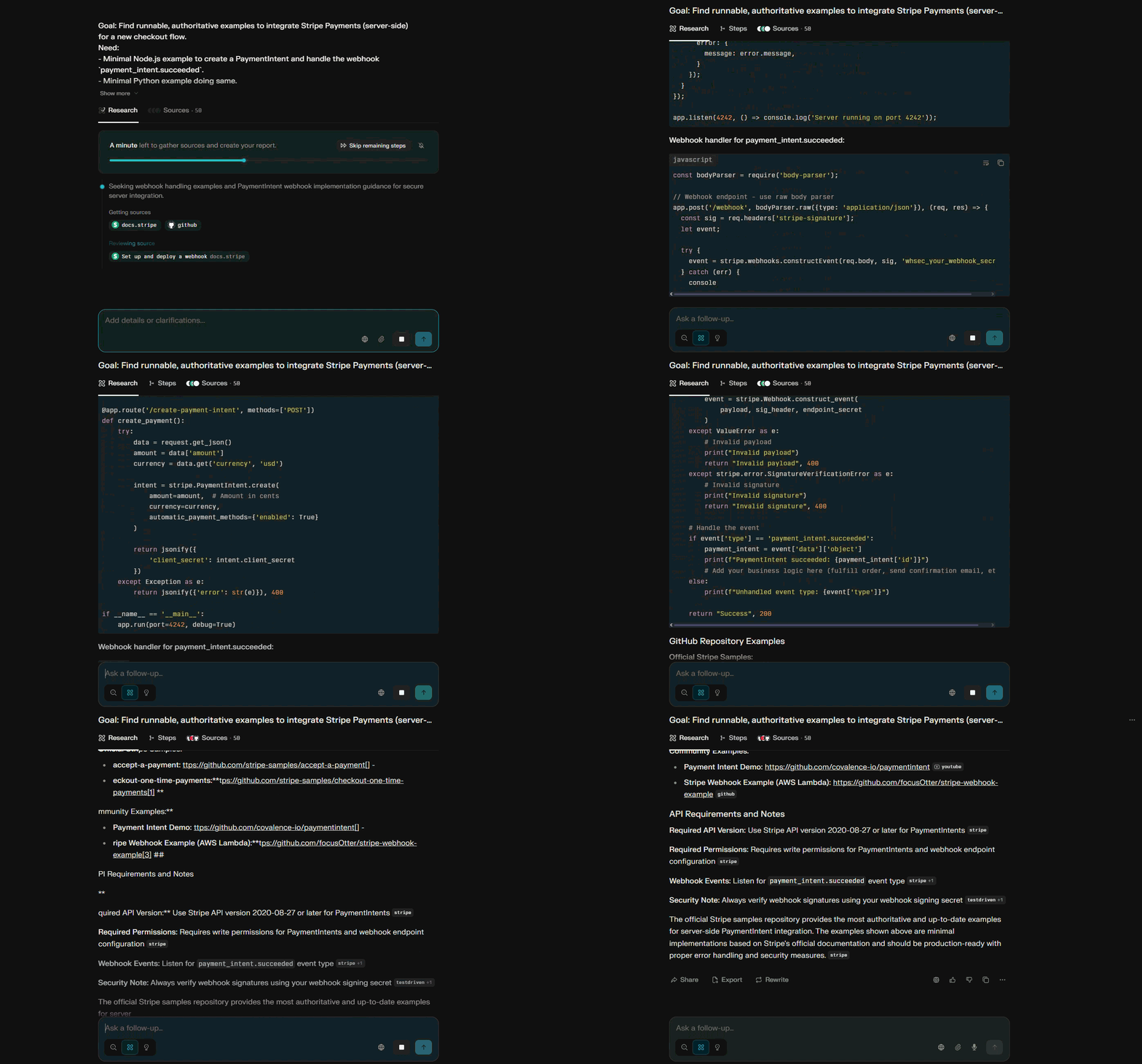
Goal: Find runnable, authoritative examples to integrate Stripe Payments (server-side) for a new checkout flow.
Need:
- Minimal Node.js example to create a PaymentIntent and handle the webhook `payment_intent.succeeded`.
- Minimal Python example doing same.
- One public GitHub repo or gist showing a full demo (server + webhook consumer).
Return: direct URLs, copy-paste code blocks (Node + Python), and one-line notes about required API version or permissions.
If official examples do not exist for the exact endpoint, return earliest community example and mark risk.
Phind Results
Provided broader context about the API's purpose and ecosystem but struggled to find specific implementation examples for newer APIs.
Perplexity Results
Located relevant documentation, early-adopter blog posts, and GitHub examples efficiently. Results prioritized practical implementation guides over theoretical explanations.
Winner
Perplexity - Better at surfacing developer-specific resources.
4. Multi-Step Technical Research
Test
Research microservices architecture patterns, compare implementation approaches, and evaluate trade-offs for a specific use case.
Prompt
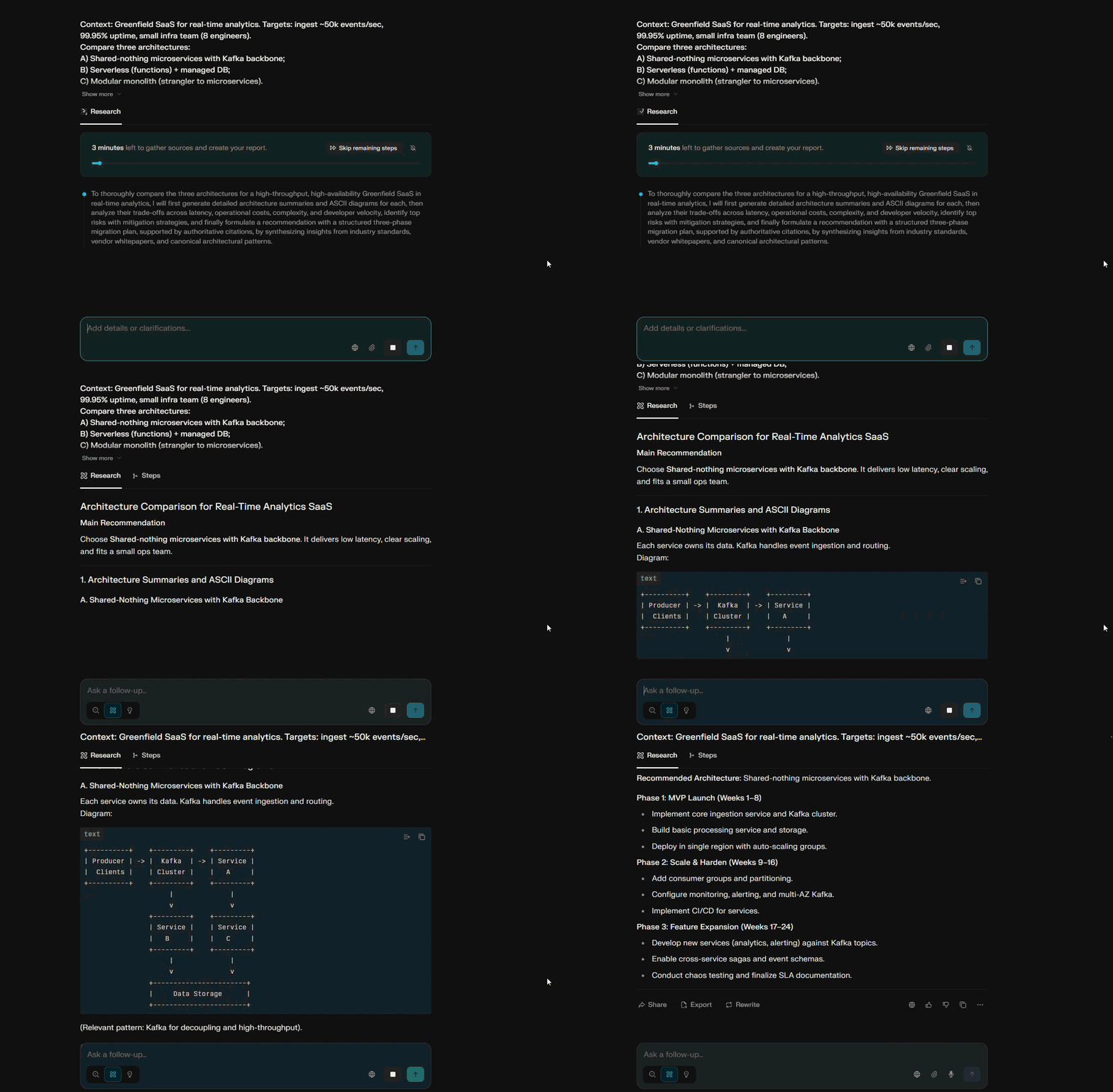
Context: Greenfield SaaS for real-time analytics. Targets: ingest ~50k events/sec, 99.95% uptime, small infra team (8 engineers).
Compare three architectures:
A) Shared-nothing microservices with Kafka backbone;
B) Serverless (functions) + managed DB;
C) Modular monolith (strangler to microservices).
Tasks:
1) Give an architecture summary and ASCII diagram for each.
2) Provide 3–4 trade-offs: latency, ops cost, run complexity, dev velocity.
3) List top 5 risks for this workload and a mitigation per risk.
4) Recommend one architecture and give a concise three-phase migration/launch plan.
Include 3 authoritative citations (e.g., vendor whitepapers or canonical patterns).
Perplexity Results
Excelled at this comprehensive research task. Broke down the query systematically, explored multiple architectural patterns, cited authoritative sources, and provided balanced trade-off analysis.
Phind Results
Provided good technical information but lacked the structured, multi-perspective approach needed for complex architectural decisions.
Winner
Perplexity - Superior research depth and structured analysis.
Performance Metrics: The Data Behind the Comparison
Our comprehensive analysis across eight developer productivity metrics reveals distinct strengths:
Key Performance Insights
- Phind Dominates:
- Code generation (85% vs 75%), debugging efficiency (90% vs 70%), and API documentation search (95% vs 80%).
- Code generation (85% vs 75%), debugging efficiency (90% vs 70%), and API documentation search (95% vs 80%).
- Perplexity Excels:
- Real-time web updates (95% vs 70%), multi-step research capabilities (90% vs 60%), and citation quality (90% vs 70%).
- Real-time web updates (95% vs 70%), multi-step research capabilities (90% vs 60%), and citation quality (90% vs 70%).
- Overall Scores:
- Phind averages 84.1% across all categories, while Perplexity scores 79.6% - a 4.5-point difference favoring specialized developer tools.
Making the Right Choice: Decision Framework
Choose Phind When You Need
- Primary Focus on Active Coding: Daily code generation, debugging, and problem-solving
- IDE Integration: Seamless VS Code workflow without context switching
- Technical Depth: Specialized understanding of programming languages and frameworks
- Quick Problem Resolution: Fast, actionable solutions to specific coding challenges
- Developer Community Sources: Access to Stack Overflow, GitHub, and technical documentation
Choose Perplexity When You Need
- Research-Heavy Work: Architectural decisions, technology evaluation, learning new concepts
- Comprehensive Analysis: Multi-step reasoning for complex technical problems
- Latest Information: Real-time access to current web content and recent developments
- Citation Quality: Authoritative sources and transparent information attribution
- Broad Technical Context: Understanding trends, best practices, and industry developments
Hybrid Approach for Maximum Productivity
Many successful developers adopt a dual-tool strategy:
- Perplexity for Planning: Research phase, architectural decisions, technology evaluation
- Phind for Implementation: Active coding, debugging, specific problem-solving
This combination maximizes both strategic thinking and tactical execution capabilities.
Real-World Developer Testimonials
Based on community feedback from Reddit, GitHub, and developer forums:
Phind User Feedback
"For coding questions and technical debugging, Phind often provides more accurate solutions than generic AI tools. The VS Code integration is seamless."
Perplexity User Feedback
"Perplexity is way better at research, but when it comes to coding questions, Phind often does slightly better. For literature reviews or broad technical research, Perplexity wins."
Also explore: DeepSeek vs ChatGPT — compare their performance, cost, and user experience to see which leads in 2025.
The Verdict: Context Determines the Winner
Neither tool delivers universal superiority across all developer scenarios.
Phind excels as the specialized coding companion, built specifically for developers who spend most of their time writing, debugging, and optimizing code. Its VS Code integration and code-aware responses make it indispensable for implementation-focused work.
Perplexity dominates as the research and learning platform, superior for developers who need to understand broader contexts, evaluate technologies, and make informed architectural decisions.
The winning choice depends on your primary workflow:
- Implementation-Heavy Developers:
- Phind delivers immediate productivity gains through specialized code assistance and seamless IDE integration.
- Phind delivers immediate productivity gains through specialized code assistance and seamless IDE integration.
- Architecture and Research-Focused Developers:
- Perplexity provides the depth, citations, and comprehensive analysis needed for strategic technical decisions.
- Perplexity provides the depth, citations, and comprehensive analysis needed for strategic technical decisions.
- Full-Stack Product Developers:
- Consider both tools - Perplexity for research and planning phases, Phind for active development work.
- Consider both tools - Perplexity for research and planning phases, Phind for active development work.
Maximizing Developer Productivity in 2026
The future of developer productivity lies not in choosing a single AI tool, but in understanding when and how to leverage each platform's unique strengths.
Both Phind and Perplexity represent significant advances in AI-assisted development, but they serve complementary rather than competing roles in modern software development workflows.
The tools exist. The knowledge is available. The only question is: which combination will unlock your highest potential as a developer in 2025?
Master AI tools and land top remote developer roles.
Join Index.dev to showcase your expertise with AI-powered development tools to global companies seeking developers who work efficiently and stay ahead of tech trends. Build, learn, and grow with real-world challenges that push your technical limits.
Interested in more AI-powered coding insights?
Explore our guides on the best AI tools for coding documentation and data visualization, compare top Chinese AI models, discover best Chinese open-source LLMs, and learn 5 top programming languages for AI development. Browse our developer tools library and find more expert AI reviews and comparisons from Index.dev.