AI is growing in every part of the world. Countries are using AI to improve their economy, speed up work, support schools, and build new technologies. Some nations lead in research and talent, while others lead in business adoption and government support.
This listicle roundup shares clear and complete statistics that show how AI is growing in each country and how these trends shape the global AI landscape. All data in this article comes from trusted and verified sources. We collected all the statistics from our online research, and you can find all the data sources at the end of the article.
Public Trust and Perception of AI Across Countries
Public trust plays a big role in how fast countries adopt AI. When people feel positive about AI, they accept new tools faster and support more innovation. This section shows how people in different countries feel about AI today and how their opinions have changed since 2022.
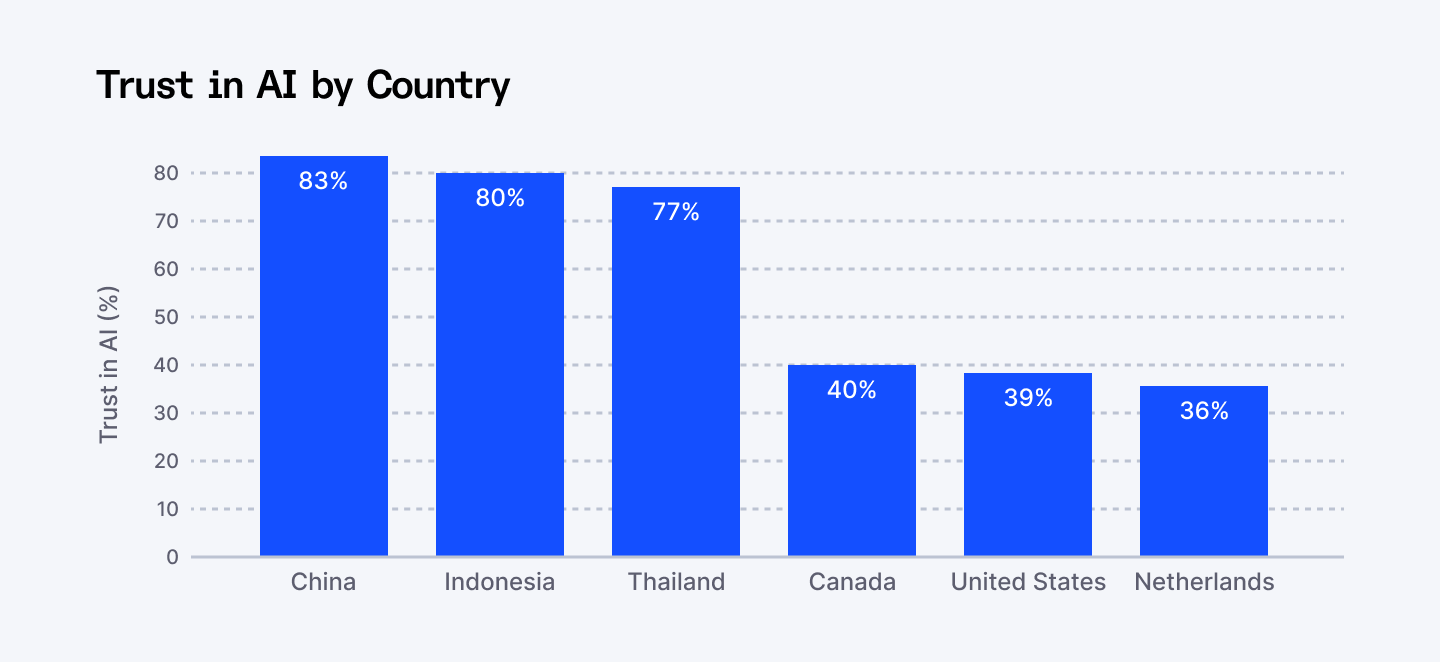
Levels of AI Optimism by Country
- China shows the highest trust in AI because 83% of people believe AI products and services bring more benefits than harm.
- Indonesia also shows strong confidence in AI because 80% of people say AI helps more than it harms.
- Thailand reports high support for AI because 77% of people see AI as more helpful than harmful.
- Canada has low trust in AI because only 40% of people believe AI offers more benefits than drawbacks.
- The United States shows similar low trust because 39% of people feel AI brings more benefits than harm.
- The Netherlands reports the lowest optimism because only 36% of people think AI is more helpful than harmful.
Change in AI Optimism Since 2022
- Public confidence in Germany increased by 10 points, showing a clear shift toward a more positive outlook.
- France also recorded a 10 point rise, reflecting growing acceptance of AI solutions.
- In Canada, optimism grew by 8 points as more people began recognizing AI’s benefits.
- Great Britain also saw an 8 point increase in positive sentiment since 2022.
- The United States recorded a 4 point rise, marking a smaller but steady improvement.
Belief That AI Will Influence Daily Life
- Two thirds of people worldwide now expect AI to shape everyday life within three to five years, which is a 6 point increase from 2022.
- In Canada, belief in AI’s impact grew sharply by 17 points, the largest rise among all countries measured.
- Next is Germany followed with a 15 point increase, showing strong awareness of AI’s future role.
Most countries reported growth in this belief, while Malaysia, Poland, and India did not show an increase.
Next up: Discover what works in AI recruitment and what’s just hype, so you can focus on strategies that deliver real results.
Government Regulations and AI Investments by Country
Government action plays a major role in AI growth. Some countries invest large amounts of money to build stronger AI systems, while others focus on new rules to guide safe use. This section explains how different countries support AI through laws, policies, and national funding programs.
Growth in AI Regulations Worldwide
- In 2024, federal agencies in the United States released 59 AI-related rules, which is more than double the count from 2023.
- Across 75 countries, AI mentions in legislative sessions grew by 21.3% in 2024, rising from 1,557 mentions to 1,889.
- Since 2016, the total number of AI-related mentions in global lawmaking has increased more than nine times.
Major National Investments in AI
- China introduced a 47.5 billion dollar semiconductor fund to strengthen AI hardware and development.
- France committed 109 billion euros to AI-related programs across multiple sectors.
- Saudi Arabia launched Project Transcendence, a 100 billion dollar initiative focused on large-scale AI development.
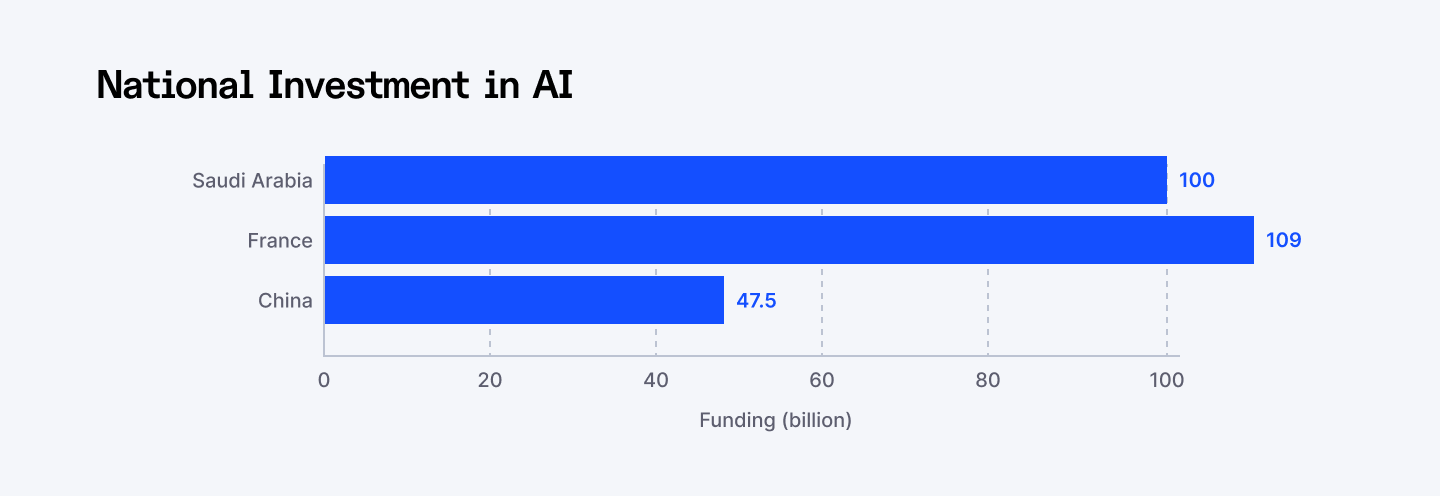
- Canada announced a 2.4 billion dollar plan to support AI growth and adoption and India pledged 1.25 billion dollars to expand the country’s AI capabilities.
Creation of New AI Safety Institutes
- The United States and the United Kingdom opened the first national AI safety institutes in November 2023.
- At the AI Seoul Summit in May 2024, new institutes were announced in Japan, France, Germany, Italy, Singapore, South Korea, Australia, Canada, and the European Union.
AI Education, Skills, and Workforce Readiness by Country
Strong education and a skilled workforce help countries grow faster in AI. Some regions have expanded computer science lessons in schools, while others struggle with basic access. This section highlights how different countries prepare students, teachers, and workers for an AI-driven future.
Progress in AI and Computer Science Education
- Two thirds of countries now offer or plan to offer computer science classes in K–12 schools, which is twice the number reported in 2019.
- African and Latin American regions have made the biggest progress in expanding computer science access for students.
- In the United States, the number of people earning bachelor’s degrees in computing increased by 22% over the past ten years.
Teacher Readiness for AI Topics
- In the United States, 81% of K–12 computer science teachers say AI should be part of basic computer science learning.
Less than half of these teachers feel ready to teach AI topics in the classroom, showing a clear skills gap. And many African nations still face limits in computer science education because some schools lack stable electricity and other basic infrastructure.
Read next: Learn how to integrate AI tools into your hiring workflow to save time and make smarter recruitment decisions.
AI Research Output and Innovation by Country
Research strength shows how much a country contributes to new AI ideas and scientific progress. Some nations lead in the number of papers published, while others stand out for influential work and patent activity. This section explains how different countries perform in AI research and innovation.
Global AI Research Publications and Influence
- China produces the largest share of AI research, with 23.2% of global publications and 22.6% of global citations in 2023.
- U.S. institutions lead in highly influential work because they contributed the most top 100 cited AI publications over the past three years.
- China published nearly 60,000 AI papers in 2023, which makes it the top contributor in volume.
- India produced around 17,000 AI papers in 2023, rising from fewer than 4,000 a decade ago and passing the United Kingdom in research output.
AI Patents and Intellectual Property
- Global AI patent filings increased from 3,833 in 2010 to 122,511 in 2023, showing strong long-term growth.
- In 2023 alone, AI patents grew by 29.6%, marking another major jump.
- China leads the world in AI patents and accounts for 69.7% of all patent grants.
- South Korea and Luxembourg stand out for having some of the highest AI patent counts per person.
Autonomous Vehicle Innovation
- China leads global autonomous vehicle testing and is also running autonomous vehicle trials across 16 cities, showing strong national support for large-scale mobility innovation.
AI Model Development by Country
AI model development shows how active a country is in building advanced systems. This includes large models used for research, industry, and national AI programs. Some countries produce a high number of important models, while others contribute at a smaller scale. This section highlights the countries leading these efforts.
- In 2024, U.S.-based institutions created 40 notable AI models, giving the country the highest output.
- China produced 15 notable AI models during the same year, placing it in the second position.
- Institutions across Europe created a total of 3 notable AI models in 2024.
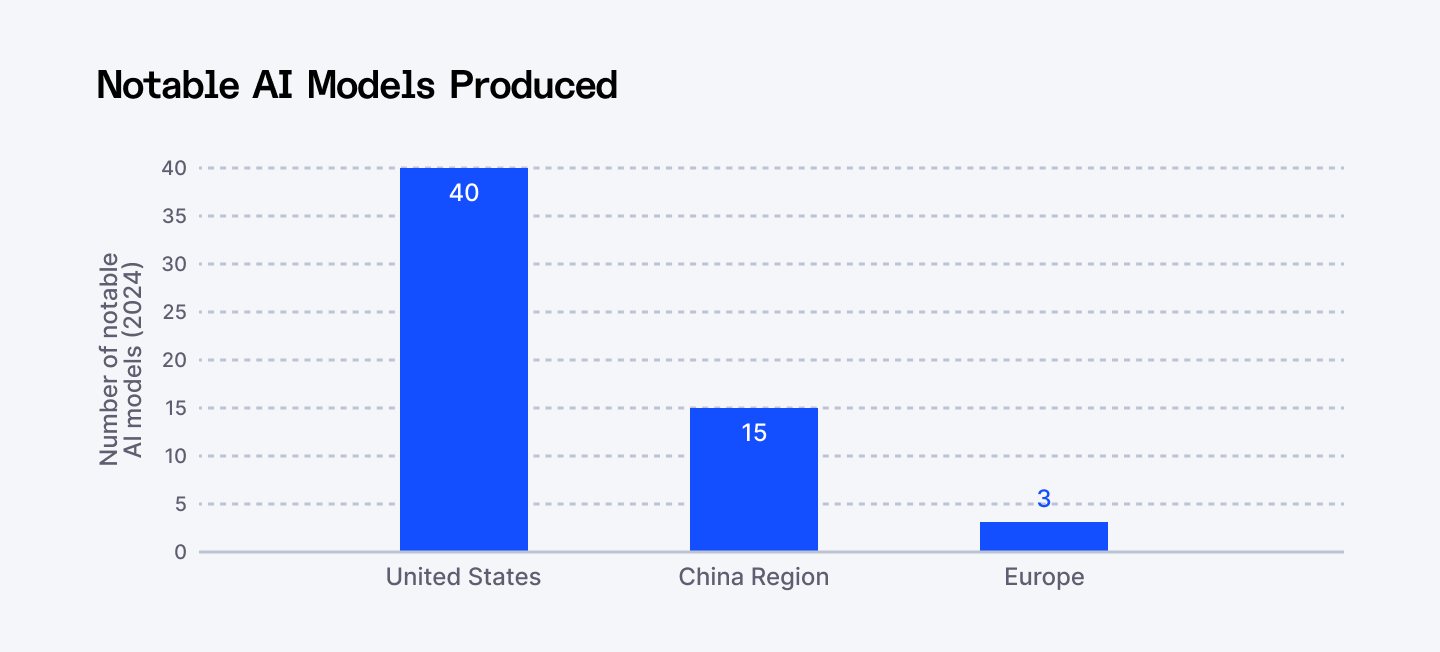
Over the past decade, the United States has produced more well-known machine learning models than any other country.
AI Private Investments by Country
Private investment shows how much financial support each country receives for AI development. Strong investment helps nations grow faster in research, innovation, and startup activity. This section highlights the top three countries with the highest AI private funding.
- The United States leads the world with 109.1 billion dollars in private AI investment.
- China ranks second with 9.3 billion dollars in private AI funding.
- The United Kingdom stands in third place with 4.5 billion dollars invested in AI.
The remaining countries, including Sweden, France, Canada, Germany, the United Arab Emirates, Austria, Israel, South Korea, India, the Netherlands, Japan, and Italy, are shown in the data chart.
AI Startup Growth by Country
Startup activity shows how quickly each country turns AI ideas into real companies. Nations with strong startup formation often lead in innovation and commercial AI solutions. This section highlights the top five countries that created the most newly funded AI startups.
- The United States created about 6,956 newly funded AI startups, giving it the strongest startup ecosystem in the world.
- China follows with around 1,605 funded AI startups.
- The United Kingdom ranks third with 885 funded AI startups.
- Israel recorded 492 funded AI startups during this period.
- Canada supported 481 AI startups that secured funding.
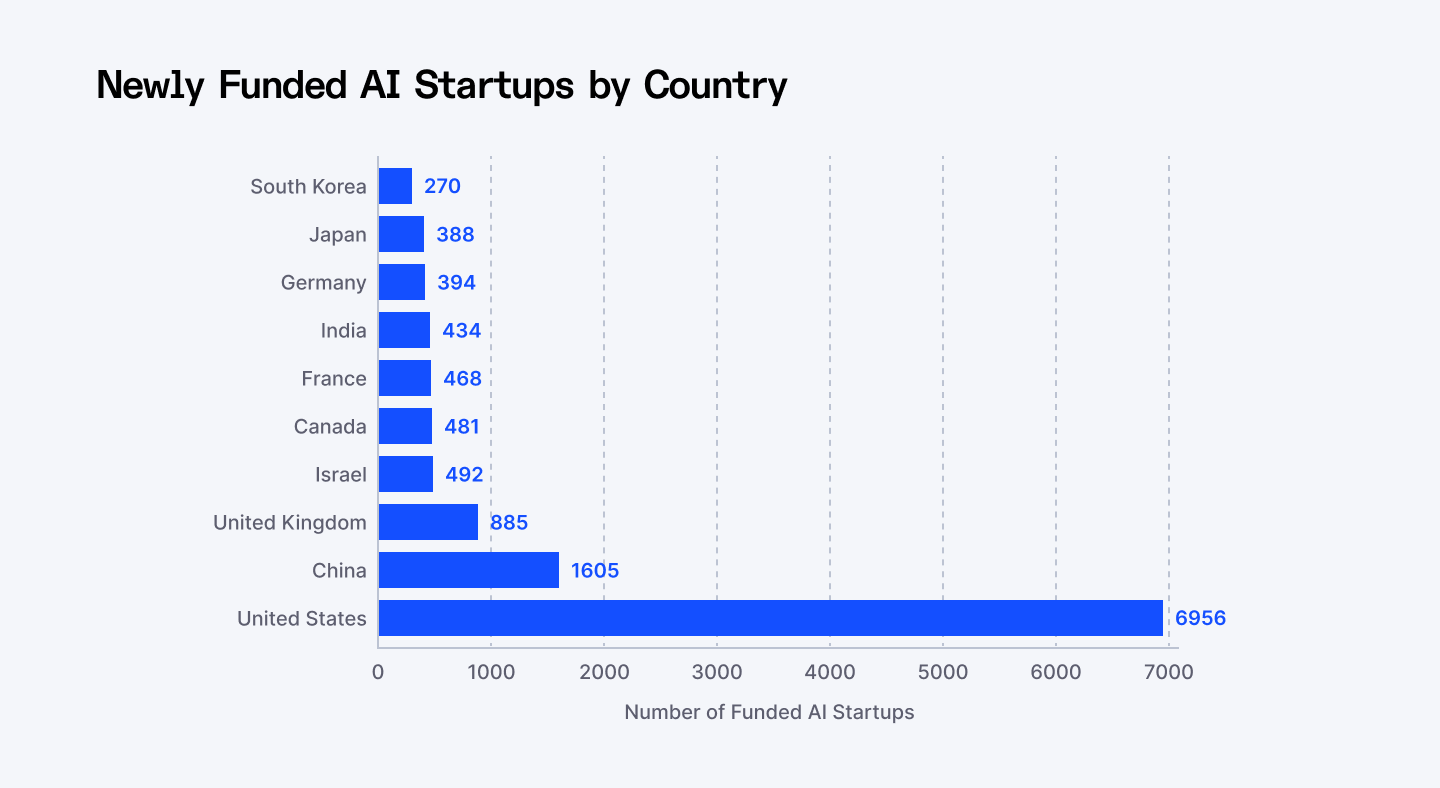
The remaining countries, including France, India, Germany, Japan, and South Korea, are shown in the data chart.
Continue reading: Follow our 10-point checklist to identify and reduce bias in AI hiring tools, creating a fairer recruitment process.
AI Hiring Growth and Skill Penetration by Country
Hiring trends and skill levels show how fast countries build AI teams and how deep their workforce knowledge runs. This section covers recent hiring rises, how common AI skills are across occupations, gender gaps in those skills, and where AI talent concentrates.
- India recorded the highest rise in AI hiring in 2024 with a 33.4% increase, showing strong demand for skilled workers followed by Brazil and Saudi Arabia with a 30.8% and 28.7% jump in AI hiring.
- The relative AI skill penetration rate reached 26% in the United States, 25% in India, 14% in the United Kingdom, 13% in Germany, and 13% in Brazil.
- The top five countries with the highest AI skill penetration by gender are India (2.38 male, 1.91 female), the United States (2.39 male, 1.71 female), Canada (1.30 male, 0.97 female), the United Kingdom (1.29 male, 0.90 female), and Germany (1.34 male, 0.89 female).
- The World Economic Forum expects AI to support about 170 million new jobs across the world by 2030.
Enterprise AI Adoption Rates by Country
Business adoption shows how widely companies use AI in daily operations. Some countries lead with strong deployment, while others remain in early testing. This section explains how different regions and countries use AI inside organizations.
- Survey data from 2024 shows that 78% of organizations worldwide use AI in some form.
- In the European Union, 13.5% of firms with at least ten employees used AI in 2024, which represents a 60% rise from the previous year.
- Denmark, Sweden, and Finland have the highest adoption levels in Europe with more than 25% of firms using AI.
- Turkey has one of the lowest adoption levels in Europe at around 4.4%.
- AI use is most common in the information technology and finance sectors, while smaller service firms report lower usage.
- In the Asia Pacific region, 92% of employees in India use generative and in Japan 51% of employees use generative AI tools weekly.
- Spain reports the highest AI exploration rate at 51%, followed by Australia at 50%, while South Korea and Canada each record 48%, compared with the global average of 40%.
- The top five countries in company-level AI deployment are India at 59%, the United Arab Emirates at 58%, Singapore at 53%, China at 50%, and the Latin America region at 47%.
Other countries such as South Korea (40), Canada (37), United Kingdom (37), Italy (36), Japan (34), United States (33), Germany (32), Australia (29), Spain (28), and France (26) are shown in the chart.
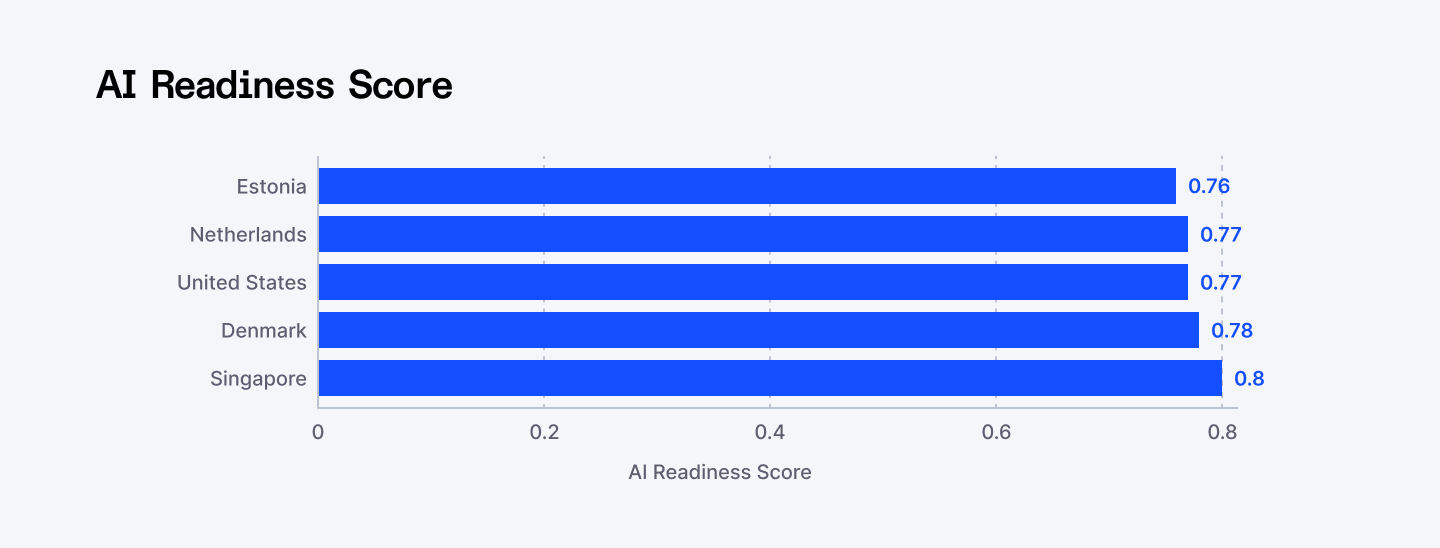
AI Readiness Index by Country
AI readiness shows how prepared a country is to support large-scale AI growth. It includes digital systems, government policy, and workforce skills. Countries with higher scores usually move faster in AI adoption and innovation. This section highlights the top nations with the strongest overall readiness.
- Singapore ranks first with an AI readiness score of 0.80, showing strong digital systems and clear national plans.
- Denmark follows with a score of 0.78, supported by strong public services and advanced digital tools.
- The United States records a readiness score of 0.77, showing strong innovation and workforce skills.
- The Netherlands also scores 0.77, supported by strong technology use and stable digital policy.
- Estonia reaches a score of 0.76, driven by advanced digital government services.
Final Words
AI is growing across the world, and each country is moving forward in its own way. Some nations advance through strong research and patents, while others grow through fast business adoption, large investments, and better workforce skills. These statistics give a clear picture of how countries are shaping the future of AI and where global progress is heading.
Countries that focus on education, policy, and talent will stay competitive as AI becomes part of daily work and life. This overview helps you understand these changes and the role each country plays in global AI growth.
➡︎ Stay ahead in AI innovation. Hire top AI developers worldwide with Index.dev — fast, reliable, and aligned with the latest global AI trends.
➡︎ Want to explore more insights on AI talent, strategy, and hiring? Dive into our related guides on global AI talent pools, building an AI-first tech stack, hiring developers faster with AI, emerging AI roles, and how top companies solved remote AI hiring challenges.
FAQs
1. Which country has the highest AI trust levels?
China has the highest trust in AI because 83 percent of people believe AI brings more benefits than harm. Indonesia and Thailand also show strong trust, while Canada, the United States, and the Netherlands report lower optimism.
2. Who leads in AI research and publications?
China leads global AI research with the most papers and citations. The United States leads in highly influential research and top-cited work. India is rising fast with strong growth in AI publications over the past decade.
3. Which countries show the highest AI adoption in companies?
India, the United Arab Emirates, Singapore, and China show the highest company-level AI use. Many firms in these countries use AI in daily operations. Europe shows steady growth, while some countries like Turkey still report low adoption.
4. Which countries receive the most private AI investment?
The United States receives the highest private AI investment, followed by China and the United Kingdom. Other countries like France, Canada, Germany, UAE, Israel, and India also attract funding but at smaller levels.
5. Which countries lead in AI startup growth?
The United States leads with nearly 7,000 newly funded AI startups. China, the United Kingdom, Israel, and Canada follow. These countries have strong ecosystems that support innovation, investment, and early-stage AI companies.
6. Which country leads in AI patent activity?
China leads the world in AI patents and holds nearly 70 percent of all patent grants. South Korea and Luxembourg also show strong patent activity per person, showing high innovation strength in smaller regions.
Data Sources
- https://hai.stanford.edu/ai-index/2025-ai-index-report
- https://hai.stanford.edu/assets/files/hai_ai_index_report_2025.pdf
- https://hai.stanford.edu/ai-index/2025-ai-index-report/research-and-development
- https://arxiv.org/pdf/2410.09985
- https://ascendixtech.com/how-many-ai-companies-are-there/
- https://www.digital-science.com/blog/2024/01/research-on-artificial-intelligence-the-global-divides/
- https://www.qureos.com/hiring-guide/impact-of-ai-on-job-creation-by-country
- https://oecdcogito.blog/2025/02/11/the-ai-race-is-on-businesses-and-regions-off-the-blocks/
- https://www.bcg.com/press/30october2025-asia-pacific-leads-ai-adoption
- https://www.ibm.com/watson/resources/ai-adoption
- https://www.statista.com/statistics/1462656/ai-adoption-rate-numerous-countries.
- https://www.salesforce.com/news/stories/global-ai-readiness-index-insights-2025/