Europe is the engine room of modern software delivery. For CTOs in 2025, the question isn't if you should extend your engineering team into Europe, but how to do it without wrecking your velocity or culture.
The US tech talent market is broken. Senior engineers in San Francisco start at $170k. You can hire the exact same architect in Warsaw for half that.
But here's the trick: you're not hiring "cheaper." You're hiring better at shipping. European developers ship faster, stay longer, and don't need constant therapy about equity upside.
The numbers aren't marketing. The average developer salary in Europe is $120,578 annually, yet productivity metrics show European teams hitting 4.2 focus hours per day against the 75th percentile benchmarks. Meanwhile, the European tech talent gap will be 1.4 to 3.9 million people short by 2027. Translation: the supply is tight, but the quality is insane—and time zone overlap means your engineers actually ship together, not asynchronously.
Here's what you need to know to pull this off in 2025.
The Executive Summary
Team extension in Europe is a mature, high-leverage strategy for 2025.
- Target: Senior talent in Poland, Romania, and the Balkans.
- Vet: For communication and debugging, not just syntax.
- Integrate: Radical inclusion. No second-class citizens.
- Comply: Use platforms to handle the legal mess.
The Math Works. Here's Why
Your burn rate doesn't care about feelings. Western Europe costs $25–$38/hour full-time for developers, with contractors running $64–$108/hour. Central and Eastern Europe sits at $20–$45/hour full-time and $45–$70 for contractors.
That spread buys runway. More importantly, engineering attrition across European tech sits at 12%, the lowest of any function. Your developers stay. Your code compounds.
Time zone overlap is real. A Berlin team gives the US East Coast 4–6 hours of crossover. Stand-ups, pair sessions, code reviews—they actually happen in real time. No "I'm blocked waiting for Manila" nonsense.
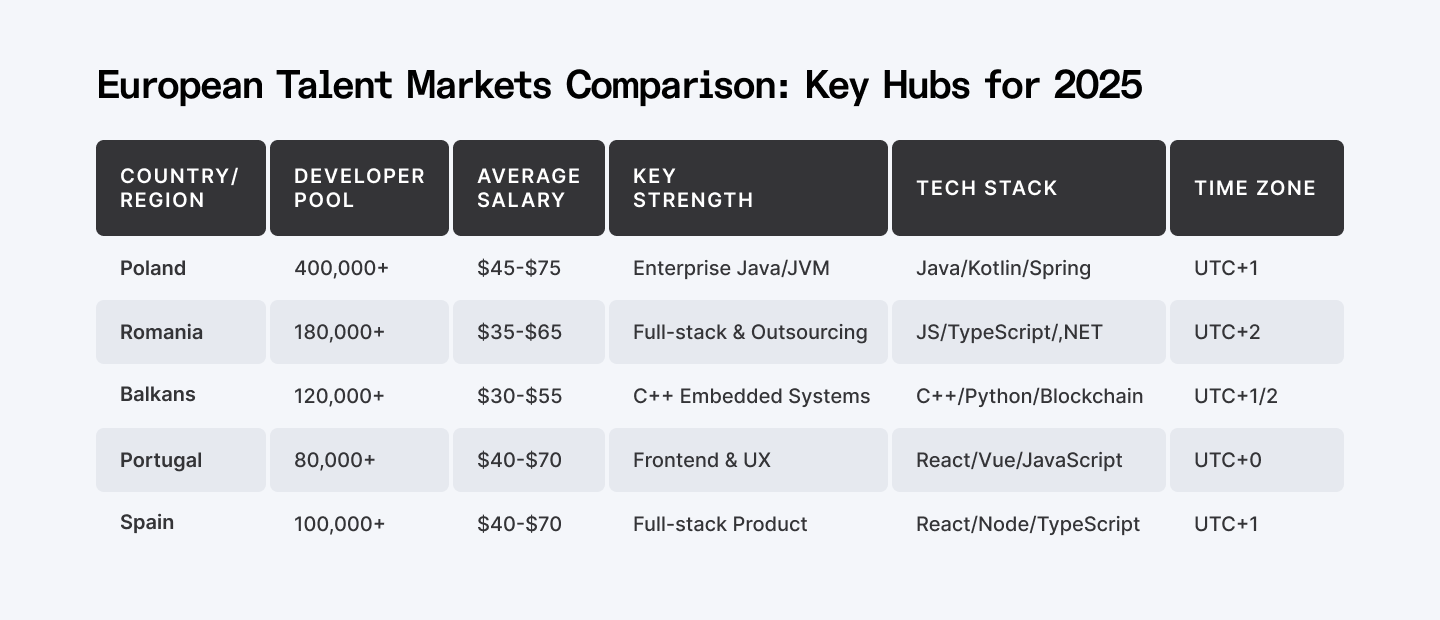
Poland alone has over 400,000 developers. Romania has deep outsourcing roots and near-native English proficiency. The Balkans punch above their weight in specialized talent—embedded systems, C++, blockchain chops. Portugal and Spain own frontend and full-stack JavaScript. You have options.
Why Europe Wins the Talent War in 2026
The market shifted. Post-2023 corrections normalized salaries, but the quality gap remains.
The Quality-to-Cost Ratio
You aren't looking for "cheap." You are looking for value. Senior developers in Western Europe and specialized hubs in CEE (Central and Eastern Europe) deliver code quality comparable to Silicon Valley at 40-60% of the cost. In 2025, the average annual cost for a Senior Backend Engineer in the US hovers around $170k. In Poland or Romania, you get equal architectural capability for significantly less. That is capital you reinvest in growth.
Time Zone Synchronization
Asynchronous work is great in theory. In practice, you need overlap. Europe gives US East Coast teams 4-6 hours of crossover. You can have stand-ups, design reviews, and pair programming sessions before your local team breaks for lunch. This kills the "24-hour blockage" cycle common with APAC expansions.
Retention is the Hidden Metric
Turnover kills momentum. European tech talent markets, particularly in the CEE region, show significantly higher retention rates than US hubs. Developers here value stability and long-term product ownership. You spend less time onboarding and more time shipping.
Wondering where to hire offshore AI talent? See how LATAM, CEE, and SE Asia stack up for cost-effective, high-performing teams.
Where to Look: The 2026 Talent Hotspots
Not all hubs are equal. Pick wrong and you're hiring academics. Pick right and you're hiring engineers who understand shipped code.
1. Poland: The Enterprise Java/JVM Powerhouse
Poland, with over 400,000 developers, is the default heavyweight. The education system here is mathematically brutal—rigorous fundamentals, algorithmic depth. If you need Java architects, Kotlin backends, or systems-level thinking, Poland delivers.
Job postings in Poland grew 68% in the first half of 2025, with 52% requiring senior expertise. Poland remains the most active development market in CEE. The talent density is absurd.
2. Romania: The Full-Stack & Outsourcing Veteran
Romania gets outsourcing. This isn't code tourism.
These developers have shipped 500 projects for Western clients. They understand requirements that don't make sense. They ask the right questions before coding. English proficiency is native-level. The cultural gap is invisible.
This is your hub for versatile full-stack JavaScript/TypeScript engineers and .NET ecosystems. They understand agile delivery implicitly.
3. The Balkans (Serbia, Croatia, Bulgaria): The Hidden Gems
Cost-efficiency meets raw talent here. These markets are smaller but denser in specialized talent. You find exceptional C++ wizards and embedded systems engineers here. The competition is lower than in Warsaw or Bucharest, meaning you can secure top-tier talent faster.
4. Portugal & Spain: The Frontend & UX Leaders
The Iberian peninsula has pivoted hard into product design and frontend frameworks. If you need React, Vue, or sophisticated UX implementation, Lisbon and Madrid offer a vibrant, creative talent pool that aligns perfectly with US work cultures.
With creative culture, strong JavaScript chops, and serious product thinking—you have it all.
How to Vet Software Engineers
Here's where most CTOs fumble.
Resumes are theatre. GitHub repos can be forked. You need a process that screens for debuggers, not algorithm wizards.
Stage One: Automate the Garbage Out
Use automated coding challenges. LeetCode. HackerRank. CodeSignal. Don't torture your engineering team with tier-1 screening. Filter for basic competency: Can they write clean code? Do tests pass? Move on.
Skip whiteboard algorithms. In production, nobody inverts trees by hand.
Stage Two: The "Live" Coding Session
This is the test that matters. Give them a broken API endpoint. A race condition. A messy database query. Watch them debug.
Do they read the logs? Do they ask clarifying questions? Do they Google the error? (Yes, you want them to Google it. That's real life) Can they explain their thought process? If they architect solutions before understanding the problem, that's your signal to pass.
Stage Three: Product Sense
Ask this question: "If you saw a requirement that didn't make sense for the end-user, what would you do?"
If the answer is "build it anyway," reject them. You need engineers who think about the why, not just the what. At Index.dev, the technical skills pass rate sits at 11.2% of applicants—that's because we screen for this.
Stage Four: Communication Over Syntax
A genius who can't explain their code is a liability. Ask them to explain a recent technical trade-off they made. Not the code. The reasoning. If they can't articulate why they chose one architecture over another, they won't function in a distributed team.
The Integration Trap (Where You'll Probably Fail)
Hiring is not the hard part. Integration is.
The biggest killer isn't lack of skill. It's treating the European team like a ticket factory.
Kill the "Us vs. Them" Mentality
There is no "offshore team." There is just "the team."
They are in your Slack. They are in your All-Hands. They have the same access to documentation. If you gatekeep information, you cripple their ability to make decisions. Velocity drops.
Synchronous Onboarding
If you can, fly them out for the first week. If you can't, dedicate the first five days to intense overlap. Assign a "deployment buddy"—someone from the core team whose only job is getting the new engineer to their first production merge by day five.
Research shows employees onboarded remotely during the pandemic were significantly more likely to resign within their first three years, even after returning to office. The lesson: physical integration for first hires pays dividends. Momentum builds trust.
Documentation is Your Async Lifeline
In distributed teams, undocumented decisions don't exist. You need to enforce a culture of "write it down." Notion. Confluence. GitHub Wiki.
If someone can't find the answer in 90 seconds of searching, your docs are broken.
63% of remote developers felt onboarding processes left much to be desired. The gap? Lack of written institutional knowledge. Fix this.
Compliance and Logistics: Stop DIYing This
Hiring in Europe looks simple until it isn't. Hiring involves a labyrinth of labor laws, taxes, and GDPR compliance.
The Contractor vs. EOR Dilemma
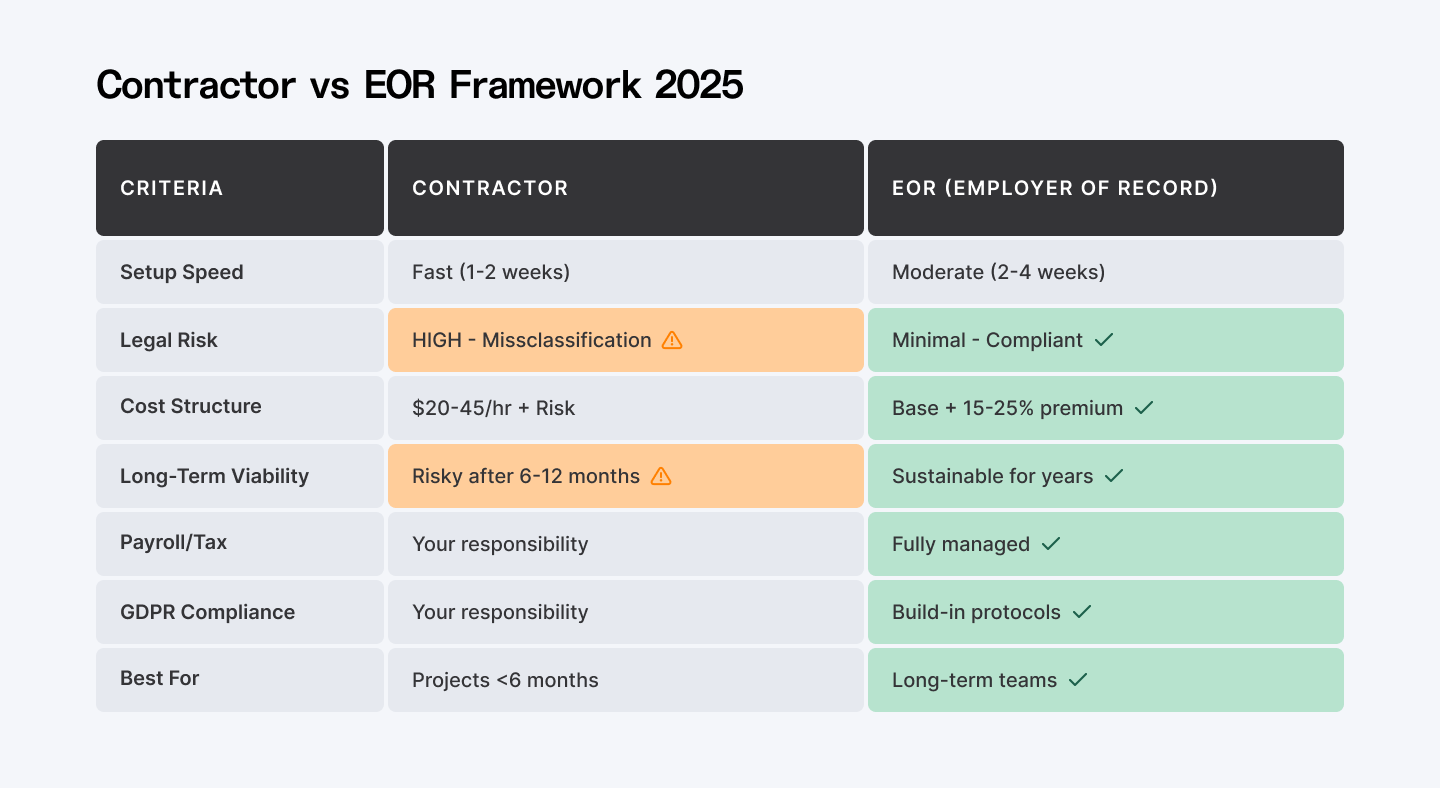
Direct contracting is fast. It's also legally risky in 2025. Labor law is tightening. Misclassification fines in Europe are brutal.
If a contractor looks like an employee and acts like an employee, local tax authorities will fine you like they are an employee.
Employer of Record (EOR): The Smart Path
For long-term teams, an EOR handles the headache. They are the legal employer. They handle payroll, taxes, and benefits. You handle the roadmap. It costs a premium, but it buys you legal safety.
Top providers like Rippling, Multiplier, and Deel operate in 25 to 40+ European countries. The best EOR providers offer multi-country employment without setting up separate legal entities, guaranteed compliance management, and audit-ready systems.
Yes, it costs. It costs less than hiring a compliance officer.
GDPR is Non-Negotiable
Data privacy isn't a checkbox. It's the law. Ensure your extended team understands PII (Personally Identifiable Information) handling.
GDPR compliance enforcement in 2025 has become more stringent, with regulators demanding higher transparency and accountability. Your legal framework must cover data access protocols.
Privacy by design means compliance is engineered in from day one, not bolted on later. Data access protocols. User consent mechanisms. Export-on-request functionality. These aren't "nice to have."
Developers often skip GDPR until audit season, but in 2025, the regulatory shift is clear: compliance needs to be engineered into software from day one.
Curious which EOR platform best supports your global AI team? Discover how Deel, Rippling, and Remote compare on cost, compliance, and speed.
Measuring Success: Metrics That Matter
Stop counting lines of code. Stop.
1. Cycle Time
How fast does a ticket go from "In Progress" to "Deployed"? This is your friction indicator. If your European team has a higher cycle time, check your blockers. Are they waiting on the core team for answers?
Median teams achieve 4.2 focus hours per day, with top-quartile teams reaching 5.8. If your new team is below median, something in your process is broken.
2. PR Pickup Time
How long does a Pull Request sit before review? This measures team integration health, not individual skill. If the core team ignores PRs from the extended team, you have a cultural problem, not a technical one.
3. Onboarding Velocity
Time to first commit. Time to first feature. If this creeps up, your documentation or your dev environment is broken.
4. Deployment Frequency
How often do they deploy to production? Velocity compounds here. Slower deployments signal bottlenecks, risk aversion, or poor testing infrastructure.
Want to track your developers’ impact more effectively? Explore the top 11 KPIs that reveal true performance, efficiency, and growth potential.
The 90-Day Win
- Week 1: Onboarding + first commit deployed.
- Week 4: Independent feature ownership.
- Week 12: Team recognizes them as equal, not "that overseas developer."
When companies invest in robust onboarding, new hire productivity nearly doubles. This isn't theoretical. It's your growth rate.
Why This Works in 2025
The old model was "we hire in-house, offshore backlog." That's dead.
The new model is "we hire distributed specialists who own outcomes."
Europe gives you:
- Time zone overlap that kills async delays.
- Retention rates that make sense financially (European engineering attrition at 12% vs. operational attrition at 21%).
- Talent density that punches above US regional hubs for equivalent cost.
- Cultural alignment that means fewer "why didn't you ask?" moments.
The catch is execution. Bad integration kills this. Treating people as ticket factories kills this. Skipping documentation kills this.
The CTO move is not "let's go cheaper." It's "let's scale faster without burning through cash.
The talent is there. The infrastructure is ready. The only variable left is execution.
➡︎ Looking to extend your engineering team? Index.dev connects you with pre-vetted senior developers ready to join your team in 48 hours, helping you scale faster, cut costs, and maintain culture without legal headaches.
➡︎ Want to explore more about hiring and scaling tech teams in Europe? Discover practical guides on sourcing top developers, understanding European developer rates, comparing outsourcing regions, and finding the best freelance talent. Explore top 6 websites to hire European developers, European developer hourly rates, key advantages of hiring developers from Eastern Europe, 10 best countries to hire quality freelance developers, freelance developer rates, and 9 hiring comparisons between Eastern Europe and LatAm. Browse our complete collection of EU talent articles and discover more insights from Index.dev experts on scaling teams cost-effectively.