According to the OECD Digital Economy Report 2024, there are now fewer than 300,000 trained AI developers around the globe, with millions of unfilled positions. We saw that issue personally when we attempted to expand our AI talent network last year.
That's when we began searching overseas. It was important to find true talent, engineers who could train models quickly, remain intrigued, and work across time zones. However, it wasn't all easy sailing. We encountered cultural incompatibilities, timezone issues, and some early recruiting errors that taught us a lot about what works and what does not.
This guide is our honest opinion, a breakdown of what we discovered while comparing Latin America (LATAM), Central and Eastern Europe (CEE), and Southeast Asia (SEA) for AI and ML development. We'll discuss pricing, quality, communication oddities, and even the surprising successes that forced us to reconsider how to develop global AI teams in 2025.
Looking to hire offshore AI developers? Index.dev connects you with pre-vetted AI engineers from LATAM, CEE, and SE Asia, offering speed, quality, and compliance in one global platform.
What Exactly Is the Offshore AI Talent Comparison?
When we initially began comparing offshore AI talent marketplaces, it felt like speed dating for engineers – LATAM, CEE, and SEA – all fantastic, but all distinct. On paper, it seems simple: discover the optimal balance of cost, talent, and communication. However, it took hundreds of interviews, a few recruiting misfires, and several Slack chats to determine what each location really adds to the table.
What did we learn?
It is never simply about the expense. An AI project may succeed or fail based on skill maturity, communication style, and cultural fit. For example, LATAM teams worked well with US time zones and work cultures, which is ideal for agile cycles. CEE engineers astounded us with their extensive academic backgrounds; we met several who had even written AI papers before joining production teams. And Southeast Asia? They're lightning-fast at scaling; we once filled five ML posts in under three weeks.
We also tried personnel augmentation and outsourcing. Augmentation provided us with long-term alignment, making our "extended team" seem like a part of the organization. Outsourcing was more suited for fast experimentation. After analyzing factors like typical pay ranges, time-to-hire, and project velocity, we created a comparison model that allowed us to make evidence-based judgments rather than gut instincts.
If you're planning to extend your AI initiatives internationally, consider this the advice we wish we had before digging in.
Regional Overview Framework
When we originally began researching offshore AI centers, three locations kept coming up in every conversation: Latin America, Central and Eastern Europe, and Southeast Asia. On paper, they all seemed good. However, after working with teams from each, we discovered that each location has its own rhythm, strengths, and subtle surprises that no market study will reveal.
- Our first spot was Latin America, which included Brazil, Mexico, Colombia, and Argentina. The time zone encounter with the United States was a complete success; standups finally made sense for once. Most developers we talked with were proficient in English and surprisingly knowledgeable about frameworks such as TensorFlow and PyTorch. What surprised us was how collaborative they were – it seemed like we were expanding our in-house team rather than outsourcing it. Was it the only hiccup? Talent demand has skyrocketed, thus skilled engineers don't last long on the market.
- Then came CEE – Poland, Romania, Ukraine, and Hungary. If you're seeking sheer technical depth, this area is fantastic. We spoke with engineers who had participated in worldwide coding competitions and written academic papers for pleasure. Their degree of discipline and organization inspired our internal teams to raise their game. What about the trade-off? Costs have risen slightly—not to Silicon Valley levels, but certainly more than a few years ago.
- Finally, Southeast Asia includes Vietnam, the Philippines, Malaysia, and Indonesia. If your aim is to scale, here is where things get fun. The recruiting pace was unparalleled; we once assembled a five-person ML operations team in less than a month. The costs were also reasonable. What's the challenge? Time zone overlap may be difficult if you're headquartered in the United States, and English proficiency varies, so we had to fine-tune communication procedures and documentation from the start.
Each area contributed something significant, including LATAM's agility, CEE's brainpower, and SEA's scalability. The difficulty is determining which of those qualities is most suited to your developmental stage and project objectives.
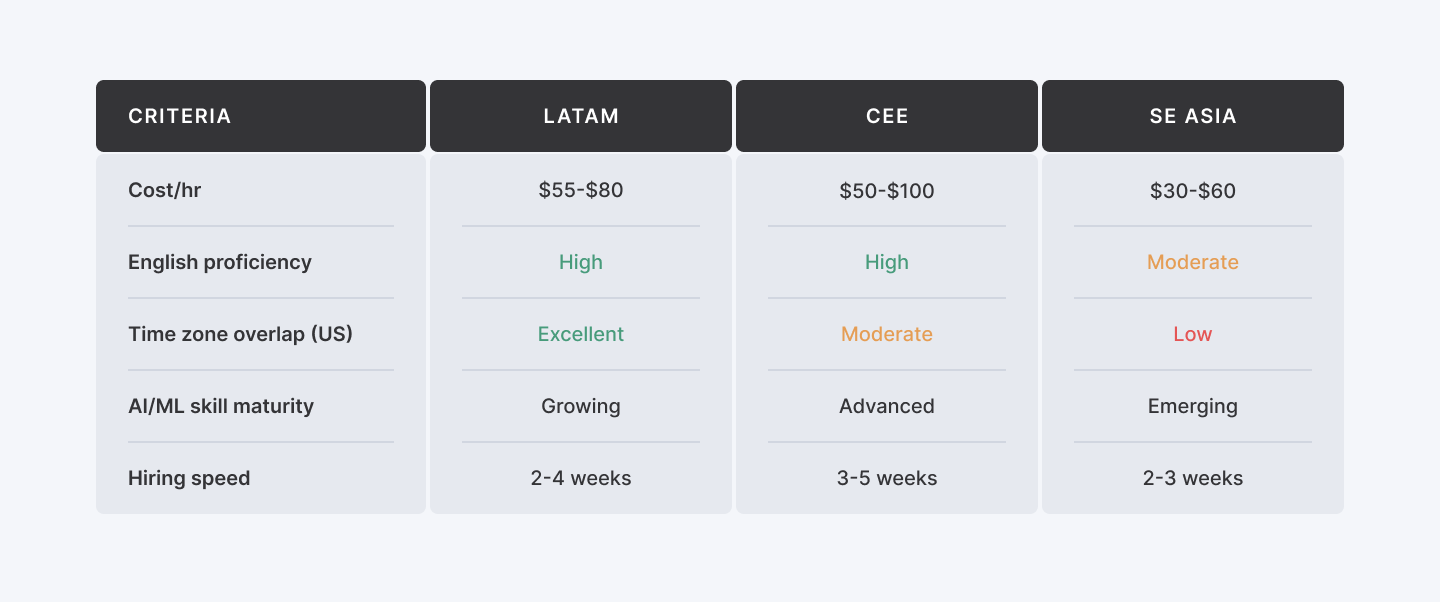
Criteria | LATAM | CEE | SE Asia |
Cost/hr | $55–$80 | $50–$100 | $30–$60 |
English proficiency | High | High | Moderate |
Time zone overlap (US) | Excellent | Moderate | Low |
AI/ML skill maturity | Growing | Advanced | Emerging |
Hiring speed | 2–4 weeks | 3–5 weeks | 2–3 weeks |
For a detailed breakdown of time zone benefits, see LatAm vs Eastern Europe time zone overlap.
Cost Comparison
When we first began budgeting for offshore AI engineers, we assumed it would be as straightforward as comparing hourly rates on a spreadsheet. It turns out that's the simplest part, the major shocks come later. After many rounds of recruiting in LATAM, CEE, and Southeast Asia, we discovered some distinct trends (and made some costly blunders along the way).
- In Latin America, we discovered AI and ML developers charging between $55 and $80 per hour. We first concluded that "lower cost = lower quality," however, this was far from true. Engineers from Brazil and Mexico were not just proficient in TensorFlow and PyTorch, but also excellent communicators - they'd join Slack conversations in real time, and deadlines genuinely meant something. The ideal combination was value and teamwork.
- Central and Eastern Europe (including Poland, Romania, and Ukraine) followed next. The rates were higher, between $50 and $100 per hour, but so was the degree of detail. We once spoke with a Romanian engineer who had done AI modeling for an autonomous driving business and had a PhD in applied mathematics. You pay more here, but it's for experience and intellectual quality.
- Then we tested Southeast Asia, namely Vietnam and the Philippines. Costs appeared appealing at $30 to $60 per hour with platform like Asiatal, and recruiting was really quick. However, the learning curve revolved on communication and time zones. We discovered the hard way that not everyone is used to async communication, so we had to establish tighter documentation practices and overlap hours. Still, once it was addressed, productivity skyrocketed.
One thing no one informed us right away was that there might be hidden fees. Onboarding, timezone sync, rework due to misunderstanding, all of these little details easily contributed an additional 10-15% to the overall price. When we began accounting for them, our projections stopped blowing up.
If you're wondering about how long it takes to actually recruit, here's how our process usually looked:
- Week 1: Candidate sourcing and screening.
- Week 2: Includes technical interviews and coding exams.
- Week 3: Offer, negotiation, onboarding, and first sprint preparation.
If you're planning your own offshore development, certainly look at LinkedIn Workforce Insights or comparable datasets; they're the most up-to-date on developer salaries per country, and they spared us a lot of guessing.
Understanding offshore AI developer expenses is critical for accurate budgeting and planning. While earnings vary by nation, area, and amount of expertise, there are definite patterns for 2025.
Hiring Speed and Availability
When we first began sourcing offshore AI developers, we understood that "speed" meant how quickly we could post a position and get applications. However, after doing this throughout LATAM, CEE, and Southeast Asia, we discovered that speed is determined by much more than just time zones; it is determined by market competitiveness, communication flow, and how quickly teams click.
- LATAM shocked us initially. The IT landscape in Brazil, Mexico, and Colombia is thriving, with new AI businesses, a large number of bilingual developers, and a strong familiarity with the American work ethic. We were able to get strong AI developers on board in 2-4 weeks, and the integration went well since they "got" the agile methodology we adopted. One unexpected benefit: we didn't need to explain the business context; their communication style simply suited.
- Then came CEE – Poland, Romania, and Ukraine, where the talent pool is enormous. We encountered engineers who could examine machine learning models more thoroughly than some of our in-house PhDs. But there's a catch: everyone wants them. The market is hot, and we've seen that recruiting might take up to 3-5 weeks since large EU firms and US startups are all competing for the same talent. However, the wait is worthwhile since these people provide significant value.
- Southeast Asia, particularly Vietnam and the Philippines, proved to be a game-changer for rapid growth. In approximately 2-3 weeks, we had established an ML operations support staff there. The talent pool is massive, and the excitement is incredible. However, we had to put in additional effort with cultural onboarding and skill validation since we misjudged how diverse English fluency and work styles may be. Things fell into place perfectly when we implemented a structured onboarding document and frequent syncs.
If near-real-time cooperation is important to you, LATAM is definitely your best option; the time zone overlap alone saves hours of back-and-forth. However, each location flourishes for unique reasons. The challenge is to match your urgency and work culture to the region's assets - something we learnt the hard way.
Talent Quality and Education
When we initially began evaluating talent quality among AI hubs, we believed that degrees and portfolios would tell us everything. However, after interviewing hundreds of developers from LATAM, CEE, and Southeast Asia, we discovered that the true narrative is revealed in how individuals think, interact, and solve issues, rather than what is listed on their resumes.
- Consider LATAM, for example. We met engineers from Brazil and Mexico who had trained TensorFlow and PyTorch at prestigious colleges such as ITA and UNAM before honing their talents at scrappy companies where they had to construct real-world AI models under tight deadlines. That combination of academic profundity and entrepreneurial drive jumped out. The majority of them spoke English well, were at ease taking calls, and were really interested in the product rather than the code itself. Within the first week, one of our new staff members from São Paulo began recommending model optimization improvements.
- Then there's Central and Eastern Europe (CEE), which is really exceptional in terms of AI research and theory. Our interviews in Poland and Romania seemed like mini-university lectures. Candidates quietly mentioned research papers or Kaggle competition techniques in the middle of a chat. Much of this stems from the region's strong STEM background; they not only know how to code, but also understand why algorithms act the way they do. What about the trade-off? They favor well-defined initiatives – structure over chaos.
- Southeast Asia, particularly Vietnam and Malaysia, has been interesting to watch develop. When we initially looked at the area, the AI education landscape was in its early stages. Fast forward a few years, and we have government-backed AI initiatives, new university courses, and a younger population that is ready to learn. The talent here may require more early mentoring, but the development trajectory is impressive. We've seen juniors from Ho Chi Minh City develop into strong mid-levels in just a year.
One thing we learnt the hard way: do not neglect systematic screening. We now have coding competitions and live problem-solving sessions for each senior AI or React developer we interview. It's the only way to sift through flashy resumes and locate those who can genuinely deliver.
Structured vetting is crucial for companies evaluating the technical depth of candidates. Learn how to vet effectively senior engineers.
Risks and Mitigation
While offshore recruiting provides access to global AI talent, it also poses operational and regulatory issues. Understanding these issues early on and using organized mitigation techniques leads to an effective long-term partnership.
- Compliance gaps are one of the most significant dangers in offshore AI recruiting. Data privacy and intellectual property regulations vary among areas, particularly between the United States, the European Union, and Asia. To avoid exposure, only work with vetted offshore providers like Index.dev who follow GDPR, CCPA, and local labor regulations. Standardize NDAs and access restrictions for sensitive datasets.
- Turnover is another issue. In competitive AI markets like CEE and LATAM, engineers often change positions for higher compensation or projects. Mitigation entails forming long-term dedicated teams rather than short-term contractors. Offering established career pathways, incentives, and mentoring programs all assist in retaining talent.
- Communication barriers can make collaboration difficult, especially when teams are separated by time zones or do not speak English fluently. The ideal method is to set daily overlap hours, utilize asynchronous communication technologies like Slack or Jira, and keep documentation clear.
When managed correctly, offshore AI teams can operate at the same speed and reliability as in-house staff, often at a lower cost.
Read next: Proven ways how to mitigate risks of hiring offshore talent.
Tools and Hiring Checklist
A high-performing offshore AI team needs the correct combination of data-driven recruiting tools and disciplined assessment methods. These tools help CTOs and talent acquisition executives make better decisions by allowing them to compare salaries, evaluate abilities, and analyze market depth.
Recommended tools:
- LinkedIn Talent Insights - It is ideal for market mapping since it shows the distribution of regional AI developers, the top employers, and hiring patterns.
- Glassdoor - Useful for validating salaries and understanding wage expectations in Latin America, Eastern Europe, and Southeast Asia.
- Index.dev - A worldwide tech remote work platform that connects organizations with pre-screened AI and ML developers based on competence, timezone, and cultural fit.
Hiring Checklist:
- Define the job scope (AI/ML specialism, experience level).
- Make a short list of suitable offshore areas.
- Validate wage ranges using public data and recruiting tools.
- Conduct technical vetting via coding tests or case studies.
- Align on compliance, intellectual property rights, and onboarding timelines.
- Establish performance KPIs during the first 90 days.
Finally, implement data openness in your employment process. Read the "Global AI Developer Cost Checklist", a resource for comparing salaries and recruiting schedules across regions.
Conclusion and Next Steps
Offshore AI hiring is never a one-size-fits-all approach; it is about matching your goals to the correct area. LATAM excels at seamless cooperation and time zone alignment with US teams, making it perfect for agile product development. Central and Eastern Europe (CEE) has great technical rigor and depth in AI research, making it ideal for complicated ML and data science programs. Meanwhile, Southeast Asia (SE Asia) remains the preferred location for cost-effective scalability and quick recruiting cycles.
Choosing an appropriate offshore region enables organizations to strike a balance between cost, quality, and speed while preserving innovation. As the global AI talent market evolves, working with a reputable recruiting platform assures consistent access to top developers.
➡︎ Looking to hire AI developers from the best global hubs? Index.dev connects you with pre-vetted AI talent from LATAM, CEE, and SE Asia—offering the perfect balance of cost, quality, and speed for your next AI project.
➡︎Want to learn more about global AI hiring and offshore developer markets? Explore these quick reads from Index.dev experts: Setting up an offshore team in Eastern Europe, safely hiring offshore developers, top AI talent countries, LATAM vs Eastern Europe comparisons, and LLM developer costs. Discover how to find, hire, and manage AI talent globally, and make smarter, data-driven hiring decisions.
FAQs
1. How much does it cost to hire AI developers in LATAM, CEE, and SE Asia in 2025?
In 2025, the cost of an offshore AI developer varies greatly by area. LATAM AI developers generally charge between $55 and $80 per hour, providing nearshore convenience for US enterprises. AI and machine learning engineers in Central and Eastern Europe (CEE) earn between $50 and $100 per hour, indicating their great technical skills. Meanwhile, Southeast Asia (SE Asia) offers affordable choices ranging from $30 to $60 per hour, making it excellent for startups and large-scale AI initiatives. These prices do not include hidden expenses like onboarding or time zone inefficiencies. Index.dev offers clear pay benchmarking and approved employment possibilities.
2. Which region offers the best value for offshore AI hiring?
The greatest value is determined by priorities—LATAM offers good cooperation and cultural alignment, CEE specializes in sophisticated AI/ML engineering, and SE Asia offers unparalleled pricing. CEE provides higher value to businesses that prioritize technological depth and dependability. SE Asia is frequently the most cost-effective location for startups looking to scale quickly within a budget. LATAM, with its multilingual talent and overlap with the United States time zone, achieves a balance between expertise and communication ease. Prior to recruiting, assess business requirements utilizing an offshore AI talent comparison methodology.
3. How long does it take to hire offshore AI engineers?
The typical offshore AI recruiting schedule is 2 to 5 weeks, depending on area and position complexity. LATAM has the quickest onboarding (2-4 weeks) owing to its massive multilingual talent pools and nearshore access. CEE normally takes 3-5 weeks since competition for top AI developers is fierce. SE Asia has the fastest recruiting cycles (typically 2-3 weeks), but further screening assures quality consistency. Working with trusted talent partners, such as Index.dev, reduces sourcing time and provides compliance-ready AI engineers.
4. What are the risks of offshore AI development and how can they be reduced?
Data compliance issues, frequent developer turnover, and communication obstacles are all common dangers associated with offshore AI development. Each may be avoided by taking proactive steps such as working with GDPR-compliant partners like Index.dev, forming long-term committed teams to prevent turnover, and aligning daily overlap hours for better cooperation. In addition, develop robust intellectual property protection procedures and leverage async communication technologies like Slack or Jira. By efficiently addressing these risks, offshore AI hiring may become a competitive benefit in terms of global innovation scaling.
5. Which offshore region offers the best time zone overlap for US companies?
Latin America (LATAM) offers the finest time zone alignment for US businesses, with less communication delays and overlapping work hours. Teams in Mexico, Colombia, and Brazil may interact in real time with their North American colleagues, assuring smooth stand-ups and project synchronization. CEE provides modest overlap, often 4-6 hours, which is ideal for mixed schedules. SE Asia compensates for minimal overlap by providing flexible working conditions.
6. What are the main compliance challenges when hiring offshore AI talent?
Data protection, tax, and labor regulations differ by country, creating compliance issues. CEE developers often operate under GDPR, although LATAM and SE Asia use local frameworks that may vary from Western norms. Companies must comply with IP ownership, NDAs, and cross-border data rules. Working with trusted partners, such as Index.dev, assures compliance with EU and US data legislation, reducing risk exposure. Using uniform contracts and regional audits improves compliance integrity.
7. How do AI developer salaries compare globally?
Globally, AI developer wages are determined by geographical skill maturation and market demand. The United States leads with average hourly wages of more than $120, followed by Central and Eastern Europe ($50-$100), Latin America ($45-$80), and Southeast Asia ($30-$60). These discrepancies are consistent with the cost of living and technological competence levels. Emerging nations such as Vietnam and Brazil are rapidly bridging the gap as AI education develops. For extensive benchmarking, go to developer salaries by nation.
8. Which countries have the most skilled AI engineers offshore?
Poland, Romania, and Ukraine are top offshore destinations for competent AI engineers in Central and Eastern Europe; Brazil and Mexico in Latin America; and Vietnam and Malaysia in Southeast Asia. These nations have robust AI education programs, international project exposure, and thriving startup ecosystems. CEE leads in deep technical competence, but LATAM excels in communication and cultural alignment. Southeast Asia provides quick scalability for data-driven organizations. Each area brings something unique to the global AI talent ecosystem.