
Most companies don't need platform recommendations. They need developers. Hiring one takes three to six months. Add vetting, interviews, culture assessment: you're burning time that could ship products.
There are 70,000+ Python positions open right now on Indeed. Sounds abundant. Abundance doesn't equal availability.
"This platform has 50,000 developers" means nothing if 49,500 are pretenders and the other 500 are booked out. The crisis isn't finding bodies. It's finding people who don't submit code that makes your codebase weep.
Your choice isn't between platforms—it's between hiring fast and hiring right. Sometimes you get both. Usually you don't.
This guide explores 8 best platforms for hiring Python developers in the U.S. With real scenarios that either succeeded or became expensive cautionary tales.
Looking to hire Python developers in the USA? Index.dev offers pre-vetted talent, 48-hour matches, and a 30-day risk-free trial to scale your team fast and right.
The Shortlist: What We Actually Researched
We excluded platforms based on current market reality. Turing, for instance, shifted toward AI augmentation and training pipelines, not traditional developer hiring.
General marketplaces like Fiverr and Freelancer appeared in search results but with significant caveats: quality ranges wildly, you do most of the vetting yourself, and you're competing with people bidding $5/hour.
What stayed in: platforms where someone cared about developer quality before your money left their wallet.
Read next: Discover the top platforms to hire back-end developers in the U.S.
Platform Comparison: What Actually Matters
| Platform | Vetting | Python Specialization | Timeline | Best For | Cost |
| Index.dev | High (5%) | Specialized screening | 48 hrs | Team scaling, managed | $50-$100/hr |
| Toptal | Extreme (3%) | Senior-heavy | 48 hrs* | Business-critical | $80-$150+/hr |
| Gun.io | High (10%) | Senior US-based | 13 days | Boutique approach | $100-$200/hr |
| Arc.dev | High (2%) | Global diverse | 14 days | Speed + quality | $40-$75/hr |
| Wellfound | None | Startup-minded | 7-14+ days | Equity plays | $40-$120/hr |
| Revelo | High (2%) | LATAM/AI focus | 14 days | Managed scale | $1,999/mo |
| Lemon.io | Very high (100% manual) | Communication-first | 7 days | Direct matching | $30-$54/hr |
| Upwork | Low (reputation) | Massive range | <24 hrs | Small projects | $10-$150+/hr |
1. Index.dev: The Gatekeepers' Gatekeepers

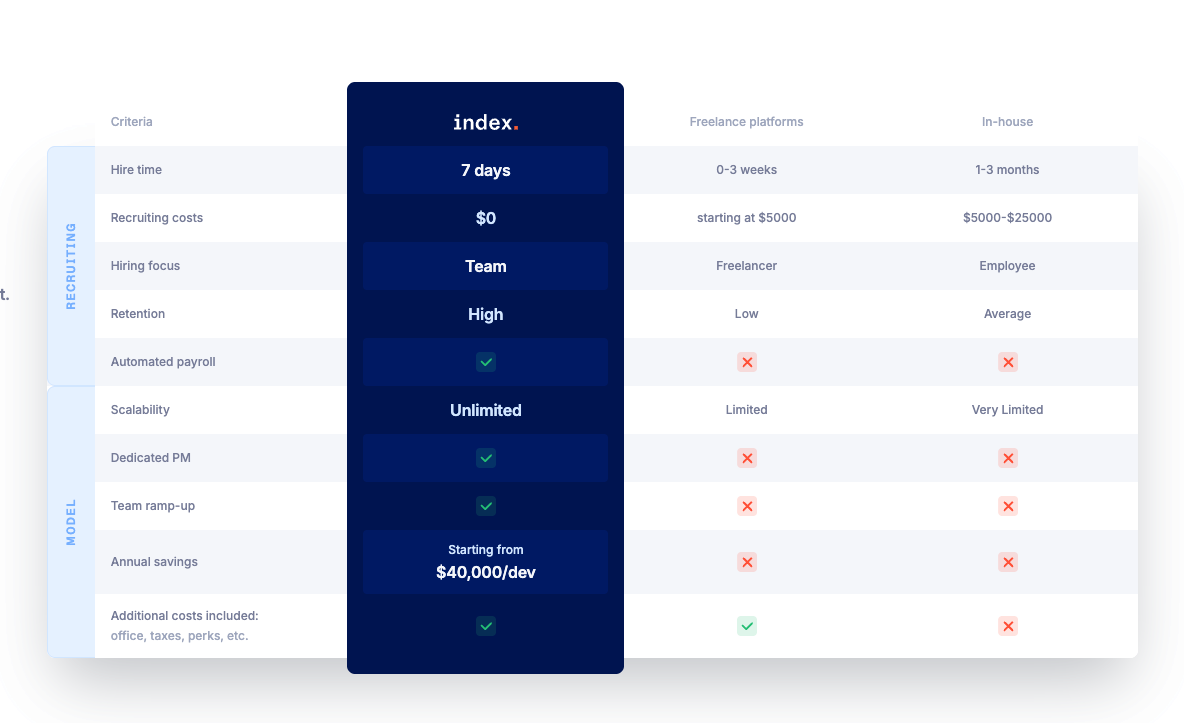
Model: Curated talent network of pre-vetted developers
The pool: Index.dev doesn't have 100,000 developers. They have 5% of what they receive, and that's the point. 20,000+ vetted developers with strong Python specialization screening, that's what it offers.
What we actually have:
- Backend engineers (Django, FastAPI, Flask)
- Full-stack Python + React/Vue
- AI/ML specialists (TensorFlow, PyTorch, LLM training)
- Data engineers (Python, SQL, pipeline design)
- DevOps engineers (Python automation, Kubernetes, CI/CD)
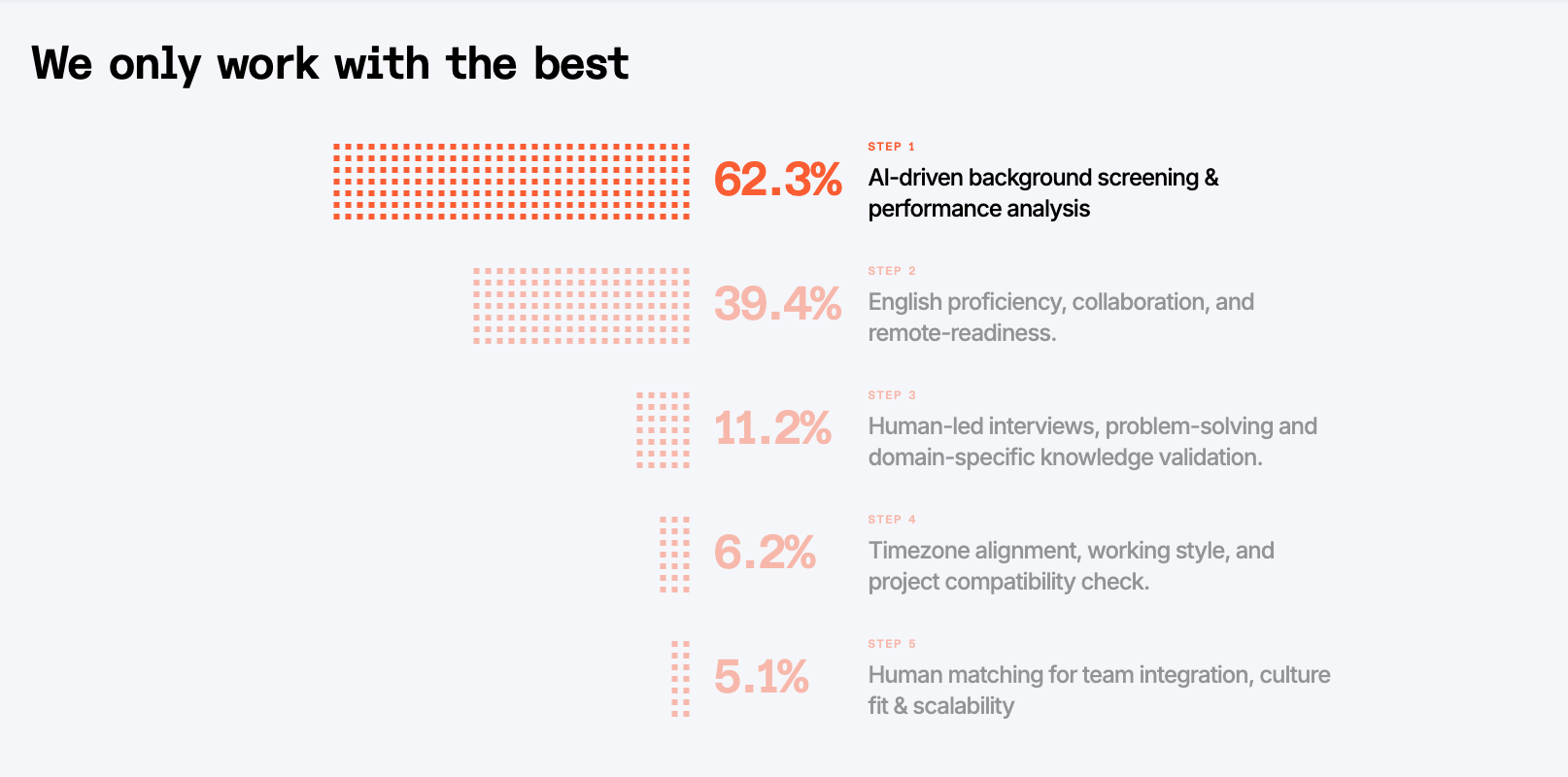
The vetting: The vetting process reads like an obstacle course designed by someone who's been burned before. Five sequential gates, each eliminating the majority:
- Background & remote performance (62.3% pass)
- Soft skills & English (39.4% pass)
- Technical skills & problem-solving (11.2% pass)
- Live interviews & coding tests (6.2% pass)
- Culture fit, timezone, availability (5.1% pass)
Real data: 13+ months average engagement. 3x longer than typical freelance platform churn. 97% successfully pass trial period.
Why It Matters: By the time a developer lands on Index.dev, they've survived five increasingly brutal filters. In 2024, one hiring manager told us: "I posted on three platforms. Index.dev gave me interview-ready candidates in 48 hours. The other two were still sending me juniors after three weeks." That's not luck. That's systematic vetting working.
Python pool reality: The platform screens specifically for Python specialization. You're not hiring "a developer who codes Python." You're hiring a backend engineer who's shipped Django APIs at scale, or an ML specialist who's trained LLM models, or a data engineer who built production pipelines.
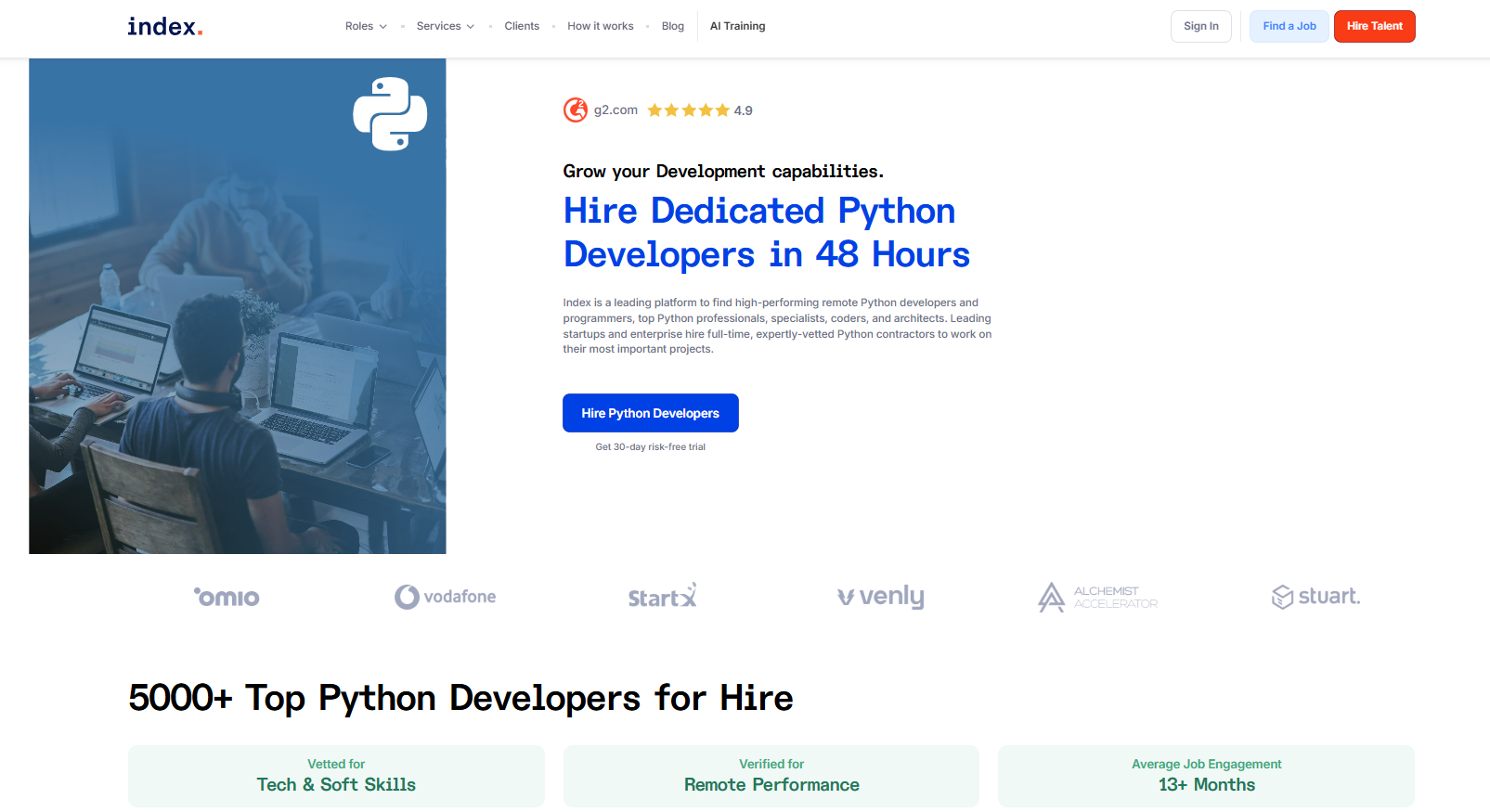
Pricing: No upfront fees. You pay only for successful placements. 30-day risk-free trial.
Time: 48 hours to match.
Who Should Use This: Mission-critical projects where bad hire cost exceeds good hire cost. Scaling startups that need to move fast but can't afford team cancer. Companies that value integration over speed-at-any-cost.
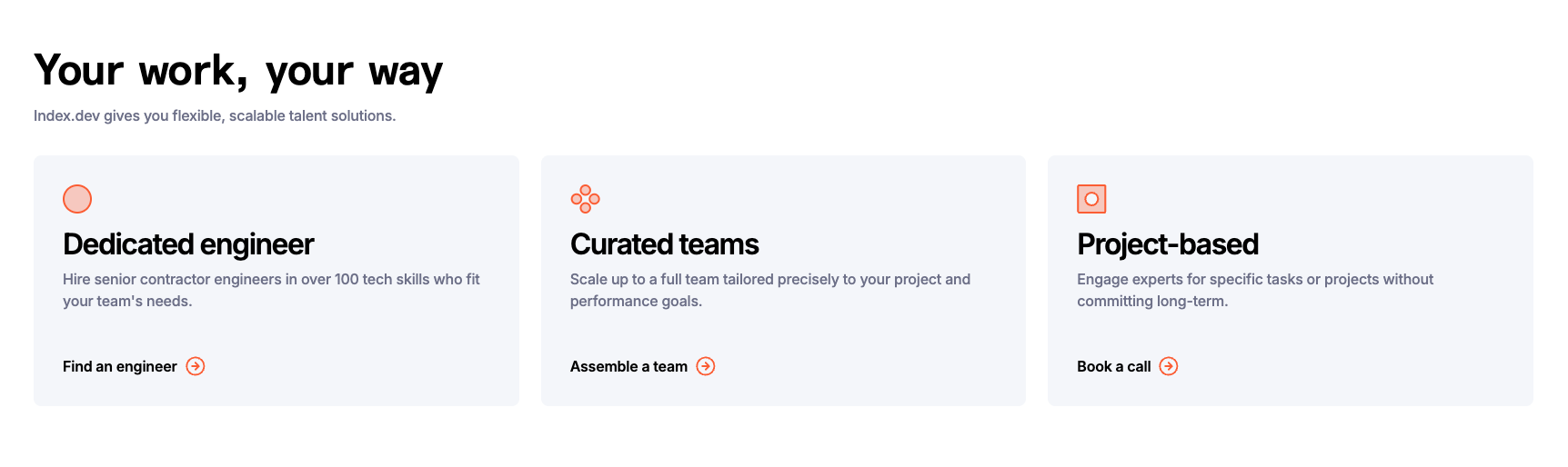
The Trade: Rigorous vetting means fewer developers available simultaneously. But Index.dev explicitly supports team hiring—requesting "3 senior backend engineers, 2 mid-level" happens within the same 48-hour window, not sequentially. See how the matching algorithm works in the newly expanded US Hub.
2. Toptal: When Quality Is Non-Negotiable

Model: Highly selective freelance network
The Pool: Toptal screens so aggressively that only 3% of applicants get approved. Clients include Fortune 500 companies, Airbnb, Shopify.
What they actually have:
- Senior backend engineers (8+ years)
- System design specialists
- Production-proven Python engineers
- DevOps and infrastructure experts
Vetting Depth: Five sequential gates across 3-8 weeks:
- Language and personality assessment (26.4% pass rate)
- In-depth skill review via assessments (7.4% pass rate)
- Live screening with domain experts (3.6% pass rate)
- Real-world test projects lasting 1-3 weeks (3.2% pass rate)
- Continued excellence monitoring post-onboarding (3% final acceptance)
Real Data: Developers report that passing Toptal's technical interview requires preparation—they test real systems design, not coding trivia. Index.dev uses a similar five-stage approach but reaches acceptance differently—understand the baseline vetting standard here.
Why It Matters: By the time someone lands on Toptal, they've proven they can think critically under pressure. The screening isn't marketing—it's how they operate.
Python Pool Reality: If a Toptal developer lists Python, they've shipped Python projects at scale. No resume-polishing. You're hiring someone who's debugged production systems at 3 a.m.
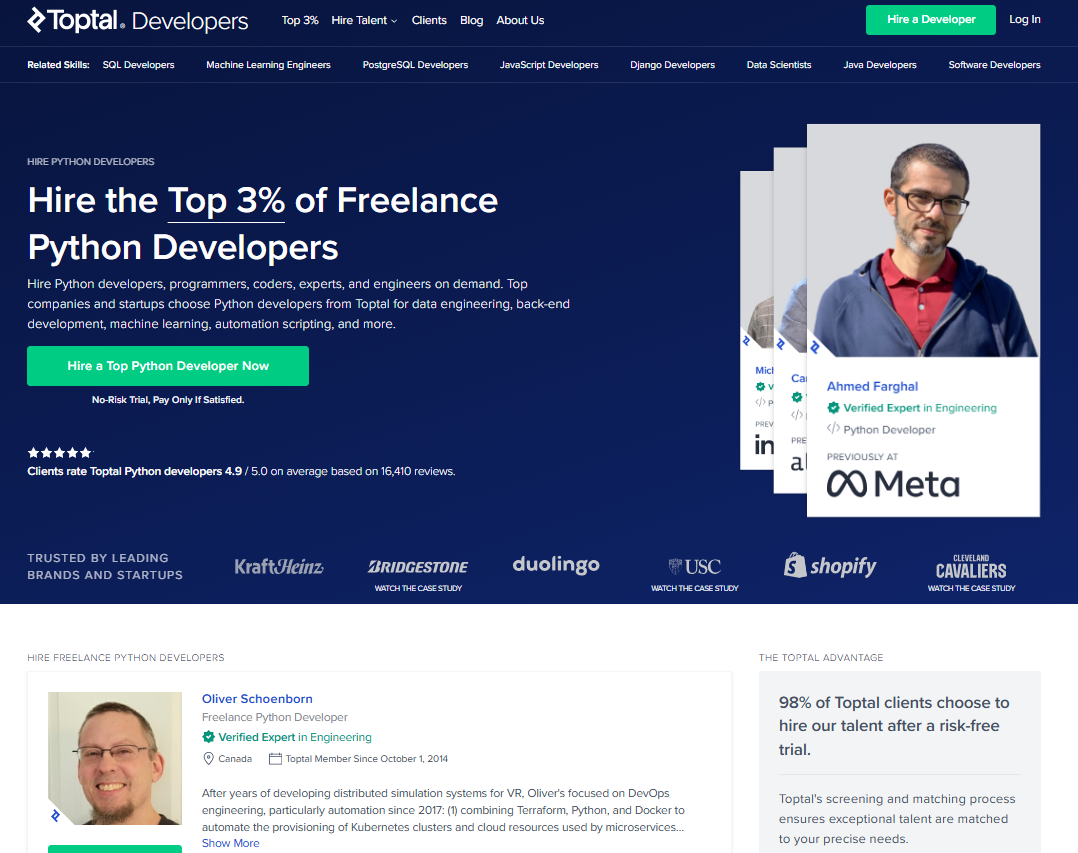
Pricing: Developers set hourly rates, typically $80-150+/hour. No platform fee cuts into developer pay—what you negotiate is what they receive.
Time-to-Hire: 48 hours to match; typical project starts within days.
Who Should Use This: Business-critical systems where you cannot afford mistakes. Complex architecture requiring someone who's already seen every failure mode.
The Trade: Budget constraints kill consideration immediately. Limited Python-specific inventory at any given moment—if you need two senior Python backend engineers simultaneously, you wait.
3. Gun.io: Experienced US-Focused Developers

Model: Vetted US developer marketplace with end-to-end service
The Pool: Gun.io handles hiring like a recruitment agency, not a marketplace. You submit requirements; their team screens, interviews, and presents qualified candidates. They're selective—only 10% of applicants pass screening. Approximately 70% have 10+ years shipped experience.
What they actually have:
- Production-proven engineers (not career employees)
- People who've built actual products
- Senior-level autonomous workers
- US-based or US-timezone flexible
The Vetting: Practical, not theoretical. "Have you shipped this? What broke? How'd you fix it?" Their screening asks for proof, not credentials. The platform isn't chasing junior talent or building volume—it's matching proven engineers.
Real Data: Gun.io places developers with a 13-day average hiring cycle. When matches work, developers stay—the platform's reputation depends on placements succeeding, not speed-closing.
Why It Matters: Gun.io doesn't chase volume. They mastered one niche—experienced, US-focused, production-proven. This specificity matters for hiring teams that value judgment over speed.
Python Pool Reality: Gun.io filters specifically for senior Python engineers comfortable with autonomy. You're not hiring someone who needs direction—you're hiring someone who'll architect solutions independently.
Pricing: Freelancers set hourly rates ($100-$200/hour typical). Gun.io charges a 20% one-time placement fee for full-time hires. No hidden costs.
Time-to-Hire: Average 13 days from job request to hire start.
Who Should Use This: Startups wanting senior-level judgment without full-time overhead. Founders preferring US-based developers for timezone or working-style reasons. Projects where you need someone who've shipped multiple products..
The Constraint: Smaller pool than generalist platforms. If you need 10 people simultaneously, inventory becomes a constraint. Niche skills extend the timeline.
Unique Value: Gun.io filters for developer reliability. If a developer gets overbooked (not uncommon on other platforms), Gun.io coordinates reschedules. The platform's reputation depends on placements working, not just speed.
4. Arc.dev: Speed Meets Vetting

Model: Vetted global marketplace with AI-powered matching
The Pool: 450,000 developers across 190 countries. Top 2% pass four-stage vetting.
What they actually have:
- Eastern European specialists (strong representation)
- LATAM developers
- Global remote workers
- AI-native workflow capable developers
The Vetting: Arc.dev uses HireAI, a GPT-4-powered recruiter that screens profiles and generates instant candidate matches.The human recruiters then conduct:
- Profile screening (AI-powered)
- Behavioral interview
- Technical interview or pair programming
- Ongoing performance monitoring
Real Data: Full-time hiring available through partner EOR platforms. The platform manages quality variance through AI-assisted filtering.
Why It Matters: Arc.dev attempts something difficult—speed without abandoning quality. Their filter is different from Toptal, not necessarily less rigorous. They've automated the boring parts and let humans handle culture fit.
Python Pool Reality: Arc attracts developers comfortable with remote work. Fewer US-based profiles, stronger Eastern European and LATAM representation. If you're comfortable with global timezones, you unlock larger Python talent pools.
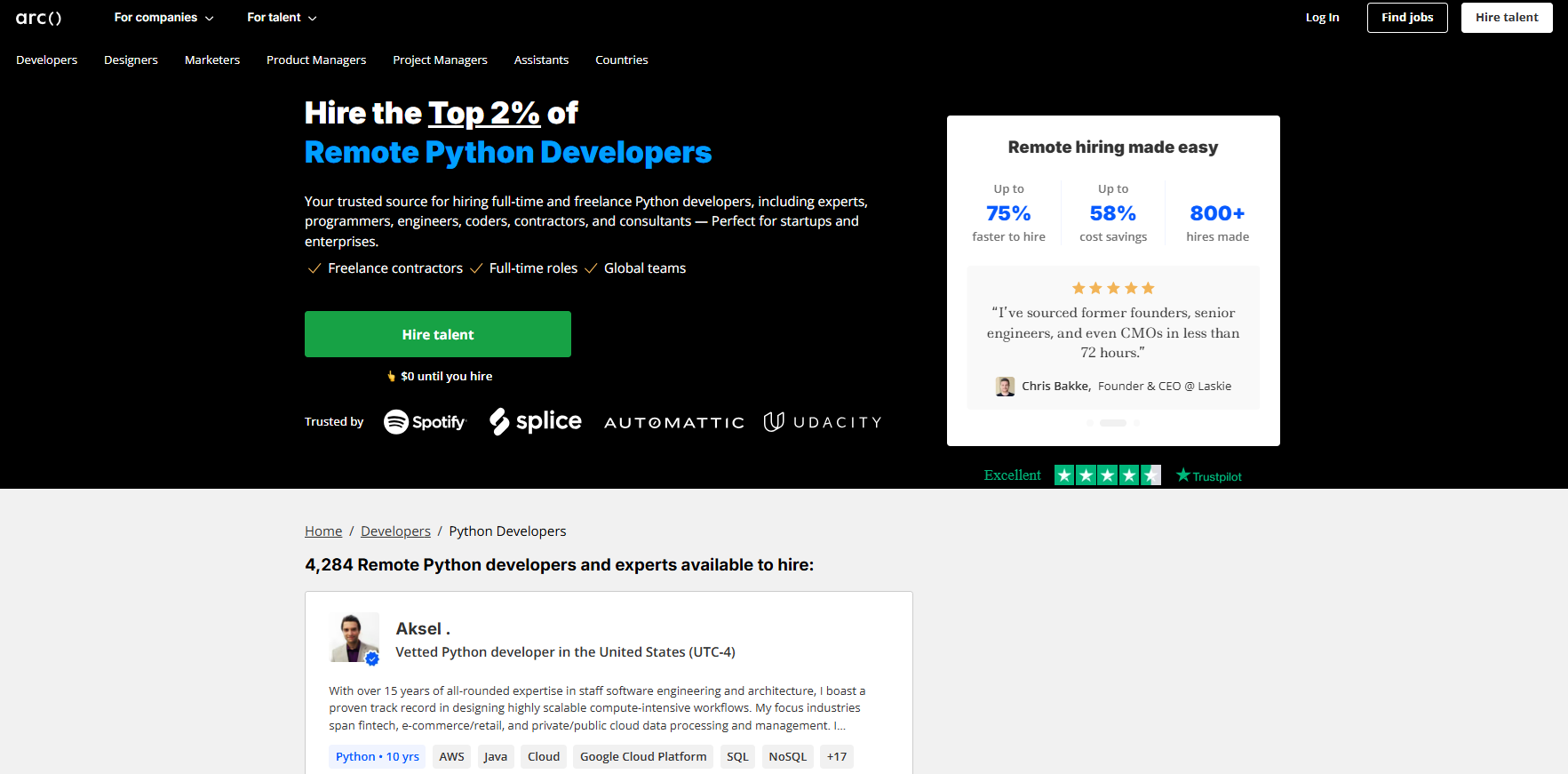
Pricing: Freelance developers typically charge $40-$75/hour depending on specialization. Full-time hiring available through partner EOR platforms.
Time-to-Hire: 72 hours for freelance developers; 14 days for full-time.
Who Should Use This: Companies wanting global reach without vetting headaches. Startups needing flexible scaling. Tech leaders who value AI-powered matching as actual filtering, not decoration.
The Trade: Quality variance exists at lower price points, but it's managed. If you need one exceptional senior engineer willing to mentor and want them in PST, other platforms might be safer.
5. Wellfound (AngelList Talent): Startup Ecosystem Play

Model: Free job board with optional paid sourcing
The Pool: Developers self-selected for early-stage environments, equity opportunities, etc. They're not looking for stability—they want impact and growth velocity.
What they actually have:
- Founders' developers
- People motivated by impact, not stability
- Early-stage experienced engineers
- Cross-functional thinkers
The Vetting: None. It's a job board. Quality filtering is entirely your responsibility.
Real Data: Developers on Wellfound report they're searching specifically for startup environments. Self-selection is your vetting advantage. The platform skews toward founders and engineers interested in early-stage work, equity opportunities, and rapid growth environments.
Why It Matters: Wellfound's network self-selects for startup-specific skills—ability to pivot, comfort with uncertainty, cross-functional thinking. This alignment matters more than vetting depth if you're actually a startup.
Python Pool Reality: Wellfound developers aren't looking for "senior backend engineer" roles. They're looking for "build the data pipeline and help with DevOps" roles. They see Python as a tool, not an identity.
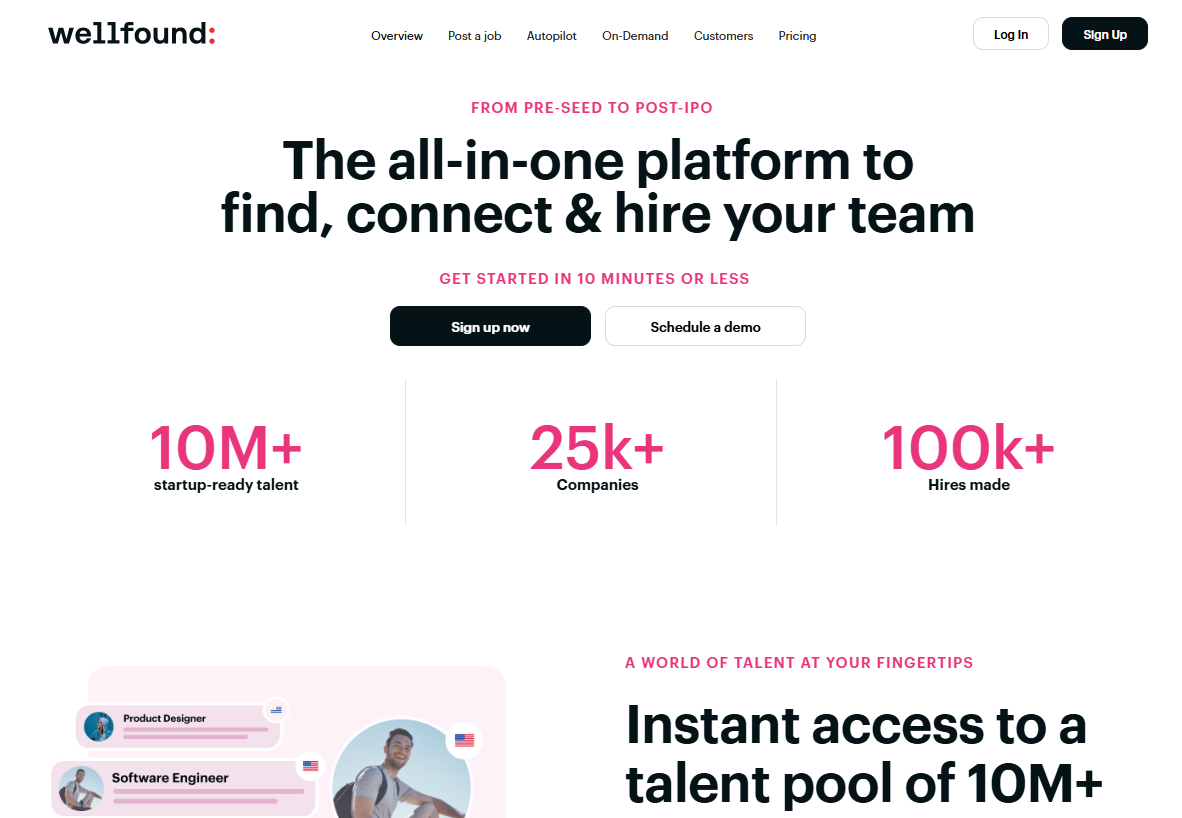
Pricing: Free job posting (unlimited). Optional upgrades—Essentials ($149/month) adds screening tools and applicant filters. Promoted jobs add $200+ for visibility.
Developer Quality: Depends on your filtering. Free tier means open bidding; quality varies. Essentials plan adds custom screening questions and templates.
Time-to-Hire: Depends heavily on how well you write the job description and screen applicants. Could be days or weeks.
Who Should Use This: Seed-stage to Series A startups. Companies offering equity or mission-driven roles. Organizations with internal HR capacity to source and screen manually.
The Trade: You're doing recruiting work, not outsourcing it. But if you're a startup founder, this might be your actual advantage—you can identify culture fit better than platform algorithms.
6. Revelo: Nearshore Specialist with AI Momentum

Model: Nearshore staffing platform specializing in Latin American developers
The Pool: 400,000+ vetted developers across LATAM. Only the top 2% pass vetting.
Unique Services: Beyond individual developers, Revelo offers full teams and human data collection for LLM training.
What they actually have:
- LATAM-based developers
- LLM training specialists (22% of placements now)
- AI pipeline engineers
- Managed team structures
The Vetting: Rigorous, LATAM-specific. Revelo consolidated the nearshore market—acquiring five competitors over 30 months—which means consistent vetting standards.
Real Data: Revelo hit unprecedented demand surge. According to TechCrunch, companies hiring for LLM post-training and AI model optimization now account for 22% of Revelo's revenue, up from near-zero in 2023. This reveals market direction.
Why It Matters: Revelo's revenue shift to AI/LLM work suggests the platform actively vets for emerging skill sets. If you're building ML infrastructure in 2025, Revelo's developer profiles might reflect current AI expertise better than platforms optimized for web development.
Python Pool Reality: Revelo developers aren't just "Python engineers"—they're specialists in LLM model training, data annotation, pipeline optimization. The platform pivoted toward AI/ML hiring specifically because demand surged there.
Pricing: $1,999/month per developer all-in (salary, benefits, taxes, compliance, hardware). No variable fees.
Time-to-Hire: 14-day average, though expedited options available.
Who Should Use This: Companies needing cost-effective scaling without compliance overhead. Organizations building LLM training teams. Tech leaders wanting fully managed payroll across borders.
The Trade: Regional focus means fewer US-based options. Best fit for companies comfortable with LATAM timezone and needing managed delivery.
7. Lemon.io: Direct Client Matching Without Bidding

Model: Vetted freelancer network with direct placement
The Pool: 100% manual vetting. Every developer passes technical and soft skills assessment. Lemon.io emphasizes developers with 5+ years experience, strong English, and remote work discipline.
What they actually have:
- 5+ years experience baseline
- Strong English communicators
- Remote work discipline proven
- Communication-first engineers
The Vetting: 100% manual vetting ensures every developer passes technical and soft skills assessments. No automated tests replacing human judgment.
Real Data: Lemon.io reports 98% rejection during screening. Available developers are genuinely vetted, not just self-selected.
Why It Matters: Lemon.io skips the bidding war. You don't shop through 200 profiles. Developers and clients connect via pre-vetted matches. You see developers who fit your needs; they see companies offering projects they care about.
Python Pool Reality: Lemon.io emphasizes communication clarity as explicit hiring criteria—exactly what distributed teams need. Python specialization is secondary to communication discipline.
Pricing: Typical range $60K-$108K annually for full-time equivalents, translating to $30-$54/hour effective rates. Specialists higher.
Time-to-Hire: Fast, typically 1-2 days to placement.
Who Should Use This: Teams wanting to skip marketplace friction. Companies valuing direct developer-client relationships. Projects requiring strong communication discipline.
The Trade: Smaller talent pool than peers. EU-focused means fewer US-timezone options. Niche tech stacks take longer to match.
8. Upwork: Flexibility Across Every Budget

Model: General freelance marketplace with open bidding
The Pool: Massive. Quality varies wildly.
Why It Still Works: For certain projects, Upwork's breadth overcomes its vetting limitations. You can post a job at 9 a.m., get proposals by lunch, and start work within hours.
What they actually have:
- Junior to senior range
- Resume-polishers mixed with shipped work
- Well-scoped project specialists
- Fixed-bid workers
The Vetting: Reputation-based. Aggregate ratings help. Your technical evaluation remains essential.
Real Data: Developers report saturation and race-to-bottom pricing. For hiring managers with technical rigor, this means extra screening work but access to developers you'd miss elsewhere.
Why It Matters: Upwork solved a real problem—connecting client to coder instantly. But it created new problems: vetting becomes your job, bidding becomes a circus. This works if you know what to look for.
Python Pool Reality: Upwork developers range from junior bootcamp grads at $10/hour to experienced specialists at $100+/hour. The variance is extreme. Your filtering determines the outcome.
Pricing: 5% client fee on projects. $10-$150+/hour depending on profile, reviews, and specialization. Wide variance means manual vetting becomes your job. The escrow system holds payment until milestone completion. Refunds work if projects go sideways.
Time-to-Hire: Fastest possible—sometimes hours.
Who Should Use This: Well-defined, small-to-medium projects. Bug fixes, script automation, testing, small features. Projects where you have technical capacity to evaluate code quality yourself.
The Trade: Upwork works when scope is tight but you're doing vetting work that paid platforms handle. It breaks down when requirements are vague or you lack the chops to spot bad code.
Next up: Find out which websites give you access to skilled web developers in 2025.
What Actually Goes Wrong
- Architectural Overengineering:
- Contractors solving imaginary problems instead of shipping.
- Communication Collapse:
- Developers who ghost for 12 hours, derailing timezone workflows.
- Credential Theater:
- Strong portfolios hiding weak fundamentals.
- Day-One Mismatches:
- Claiming "5 years Python" while not understanding async patterns.
Every platform addresses different aspects. Toptal prevents skill mismatch through brutal testing. Index.dev catches communication issues and culture misalignment—its vetting process specifically flags developers who work solo vs. collaboratively.
Gun.io filters for maturity. Arc.dev uses AI matching to surface cultural alignment. Revelo manages timezone and communication through structure. Lemon.io prioritizes communication explicitly. Wellfound self-selects mission-aligned developers while Upwork makes you do vetting yourself.
Every hire is a bet. You're just choosing which dice to roll.
Keep learning: The best tools to recruit AI developers and scale your early-stage startup.
Final Thoughts
The best Python developer hire doesn't come from the 'best' platform. It comes from matching your hiring reality to the platform's actual design.
Toptal wins when you can't afford mistakes. Index.dev wins when you need speed without sacrificing screening. Gun.io wins if you want senior experience plus US timezone alignment. Others win for different reasons—but they all win specifically, not generally.
Platforms that fail try to serve everyone equally.
Your choice isn't between platforms. It's between: How much vetting do you need? How fast do you need it? What timezone? What budget? Answer those three questions honestly, and the platform chooses itself.
➡︎ Done hiring Python developers who make your codebase weep? Index.dev matches you with the top 5% in 48 hours—Django, FastAPI, and ML specialists who've shipped production code, survived five brutal vetting stages, and come with 30-day risk-free trials. No resume theater. Just developers who deliver.
➡︎ Want to sharpen your Python hiring and technical evaluation skills? Dive deeper into practical guides that help you assess candidates effectively and build stronger teams. Explore our collection covering the cost of hiring Python developers across CEE, LatAm & Asia, 13 essential Python algorithms every developer should master, how to evaluate AI/ML developers for production-grade work, mastering Python data types for better code quality, comprehensive Python developer hiring frameworks, and useful Python scripts to automate your daily workflow. Browse our complete library of hiring insights and technical guides from Index.dev experts.


