
AI agents are no longer experimental tools used only in research labs or pilot programs. They are now being deployed across enterprises to handle customer support, software development, financial operations, cybersecurity, and internal workflows. This shift has turned AI agents into a measurable driver of productivity, cost reduction, and revenue growth across multiple industries.
This report compiles AI agent market size and growth statistics sourced from industry research firms, enterprise surveys, and global economic studies. Each statistic reflects real adoption, investment trends, and financial impact across regions and sectors.
For full transparency, all data sources are listed at the end of this article so readers can verify the research behind every figure.
Hire senior AI engineers who build and deploy agentic systems at scale.
Key AI Agent Market Statistics
- The global AI agent market was valued at USD 5.26 billion in 2024 and is projected to reach USD 52.62 billion by 2030, representing a 6.7× market expansion in five years.
- The AI agent market is expected to grow at a 46.3% compound annual growth rate from 2025 to 2030.
- North America currently holds the largest share of the AI agent market due to the presence of major AI vendors and enterprise adoption.
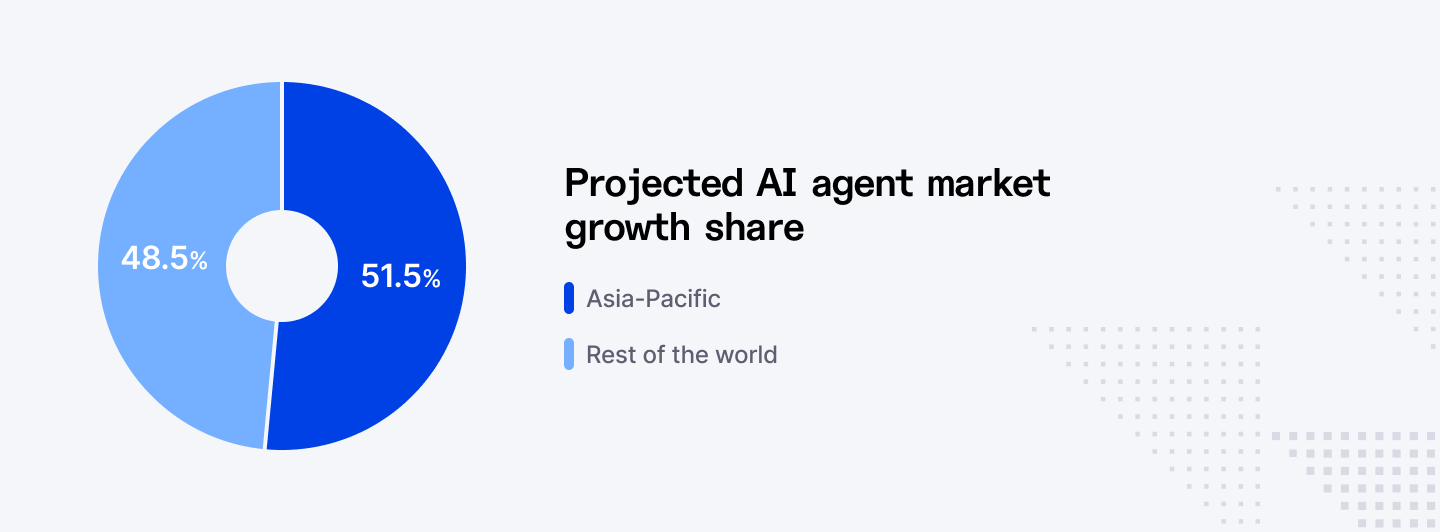
- Asia-Pacific is the fastest-growing region with a projected 48.5% CAGR driven by enterprise digitalization and government AI programs.
- Vertical AI agents built for specific industries such as banking, healthcare, and retail represent the largest share of the AI agent market.
- Multi-agent systems are the fastest-growing AI agent architecture, supporting collaborative and autonomous workflow execution.
- Banking, Financial Services, and Insurance is the largest end-user segment for AI agents globally.
- Professional services firms are the fastest-growing adopters of AI agents, particularly in Asia-Pacific markets.
- 88% of organizations use AI in at least one business function, but only 23% have scaled AI agent systems into production.
- 39% of organizations report EBIT impact from AI deployments, while 64% say AI is driving innovation.
Regional Growth of the AI Agent Market
The global AI agent market is expanding at different speeds across regions based on enterprise digitization, cloud infrastructure maturity, and government investment in artificial intelligence. Markets with advanced enterprise software ecosystems and strong AI vendor presence are seeing faster commercialization of AI agents, while emerging economies are rapidly closing the gap through large-scale digital transformation programs.
North America continues to generate the largest share of revenue due to its concentration of cloud providers, foundation model developers, and enterprise software companies, while Europe’s growth is being shaped by regulatory compliance and governance-driven deployments.
- Asia-Pacific is projected to grow at a 48.5% compound annual growth rate, making it the fastest-growing AI agent market globally.
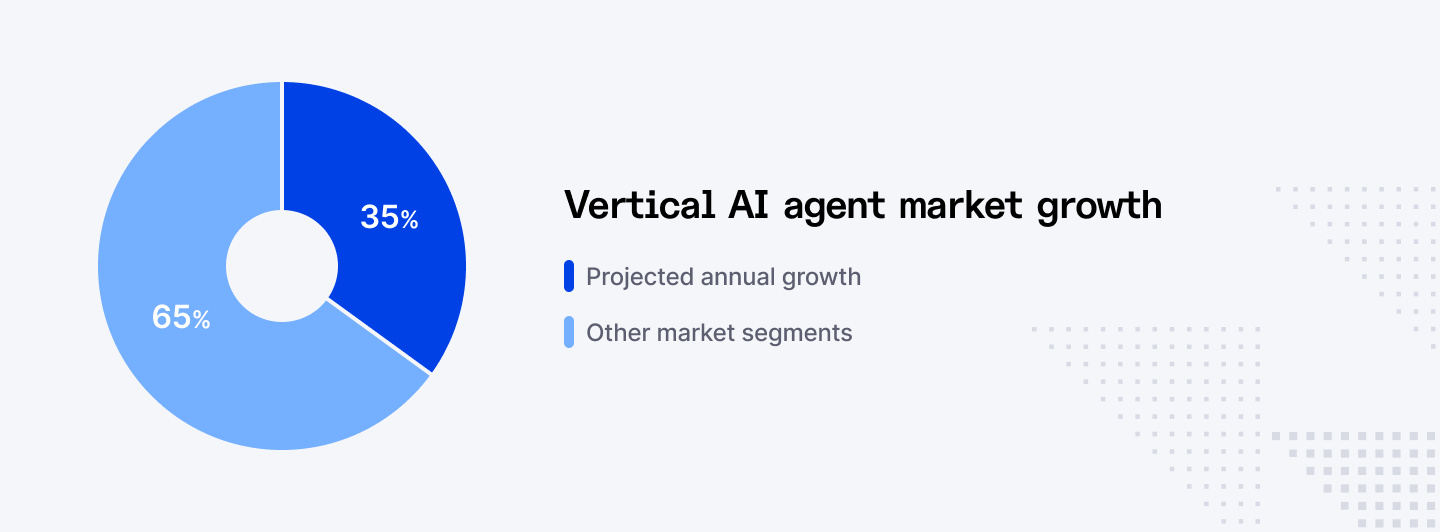
- Vertical AI agents across industries are expected to grow at approximately 35% annually as regional enterprises demand industry-specific automation.
- 88% of organizations worldwide report using AI in at least one business function, but only 23% have scaled AI agents into production.
- 39% of organizations report EBIT impact from AI adoption, showing that financial benefits are emerging as deployments increase.
Adoption of AI Agents in Enterprises
Enterprise adoption of AI agents is being driven by a rapid rise in AI usage, but most organizations are still transitioning from basic AI tools to autonomous systems. While interest in agentic AI is high, only a small share of companies have reached meaningful scale. This creates a large growth runway as businesses upgrade their infrastructure and governance to support autonomous workflows.
- 39% of organizations are currently experimenting with AI agents in at least one business function.
- 23% of organizations are actively scaling AI agent systems into production environments.
- 14% of organizations have already implemented AI agents at partial or full scale.
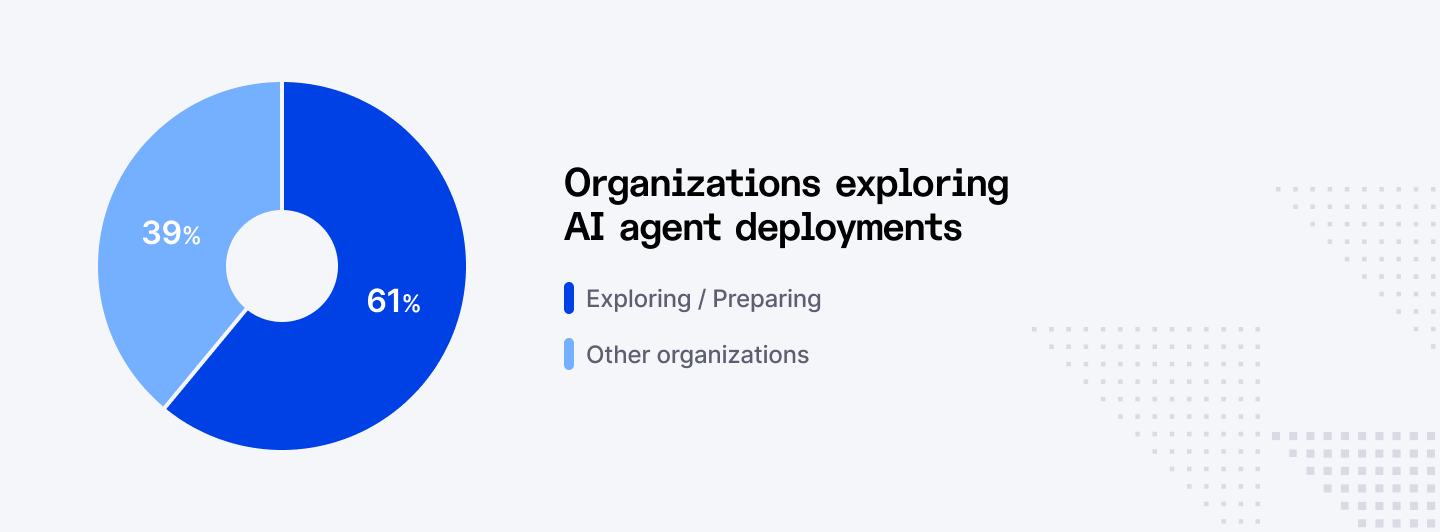
- 61% of organizations are preparing for or exploring the deployment of AI agents in the near term.
- 93% of business leaders believe companies that successfully scale AI agents within the next 12 months will gain a competitive advantage over peers.
Explore the key numbers showing how fast enterprises are adopting AI agents.
Market Segmentation of AI Agents
The AI agent market is being segmented by how agents are built, which industries they serve, and how deeply they are deployed inside enterprises. Vertical agents are gaining traction because companies want tools that understand industry-specific data, compliance, and workflows. At the same time, organizations are shifting from single bots to coordinated multi-agent systems that can execute complex processes. Adoption levels show that while AI is widespread, fully autonomous agent systems are still early.
- Vertical AI agents designed for industries such as banking, healthcare, and retail are projected to grow at approximately 35% per year as enterprises demand more specialized automation.
- The overall AI agent market is forecast to grow at a 46.3% compound annual growth rate between 2025 and 2030, reflecting how fast these segmented use cases are expanding.
- Asia-Pacific, where many industry-specific agents are being deployed first, is projected to grow at a 48.5% CAGR, the fastest of any region.
Business Impact of AI Agents
AI agents are beginning to reshape how organizations operate, hire, and allocate capital. Beyond automation, companies are seeing structural changes in how work is performed and how teams are organized. As agentic systems take on more tasks, enterprises are adjusting workforce plans and redefining which roles create the most value.
- 32% of organizations expect workforce reductions of at least 3% over the next year due to the impact of AI agents on task automation and productivity.
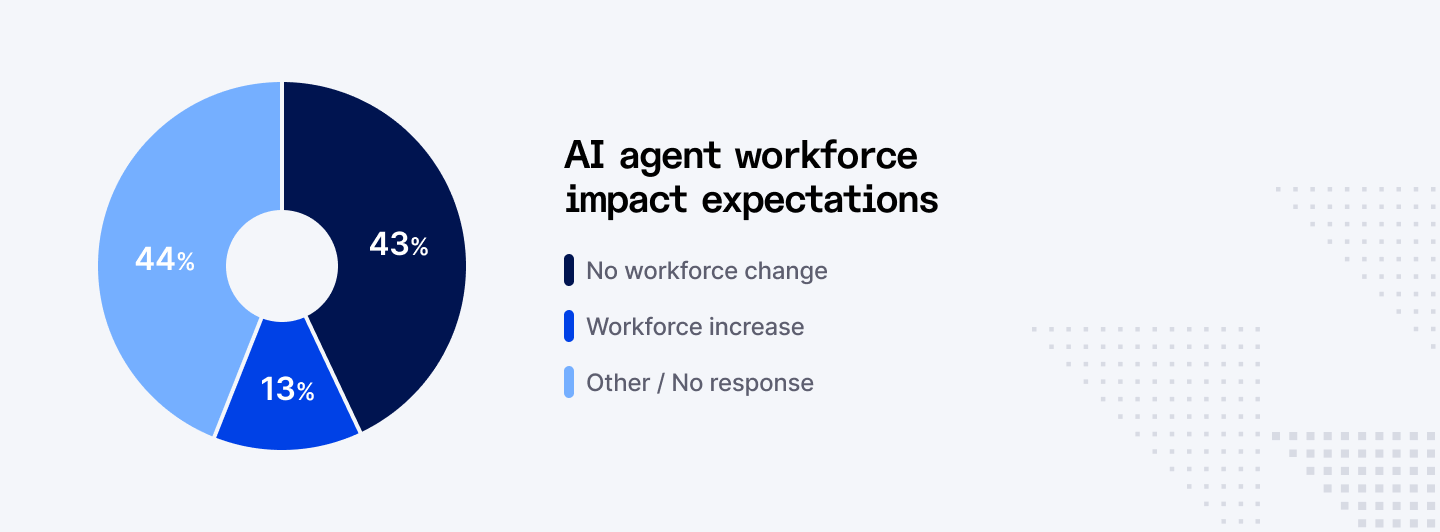
- 43% of organizations expect no workforce change from AI agents, while 13% expect workforce increases driven by new AI-related roles.
- Only 6% of organizations are classified as AI high performers, defined as companies generating more than 5% EBIT impact from AI deployments.
- AI high performers are 3 times more likely to redesign workflows fundamentally rather than optimize existing processes when deploying AI agents.
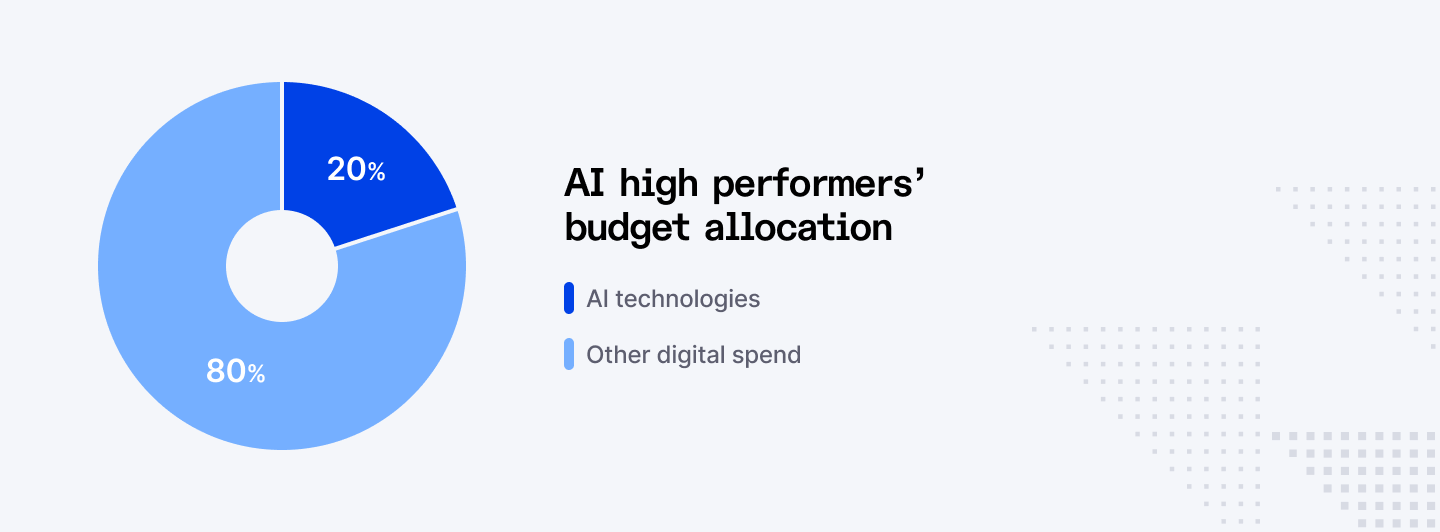
- AI high performers allocate more than 20% of their total digital budgets to AI technologies, compared with significantly lower investment levels among average adopters.
Learn how companies are using AI agents today—and what ROI they’re actually seeing.
Workforce and Organizational Impact of AI Agents
As AI agents take on more operational and analytical work, organizations are being forced to rethink how teams are structured and how skills are allocated. The impact is not limited to job reductions, but also includes the creation of new roles focused on supervising and governing autonomous systems. Companies that scale AI agents are changing their hiring priorities and budget allocations to support this shift.
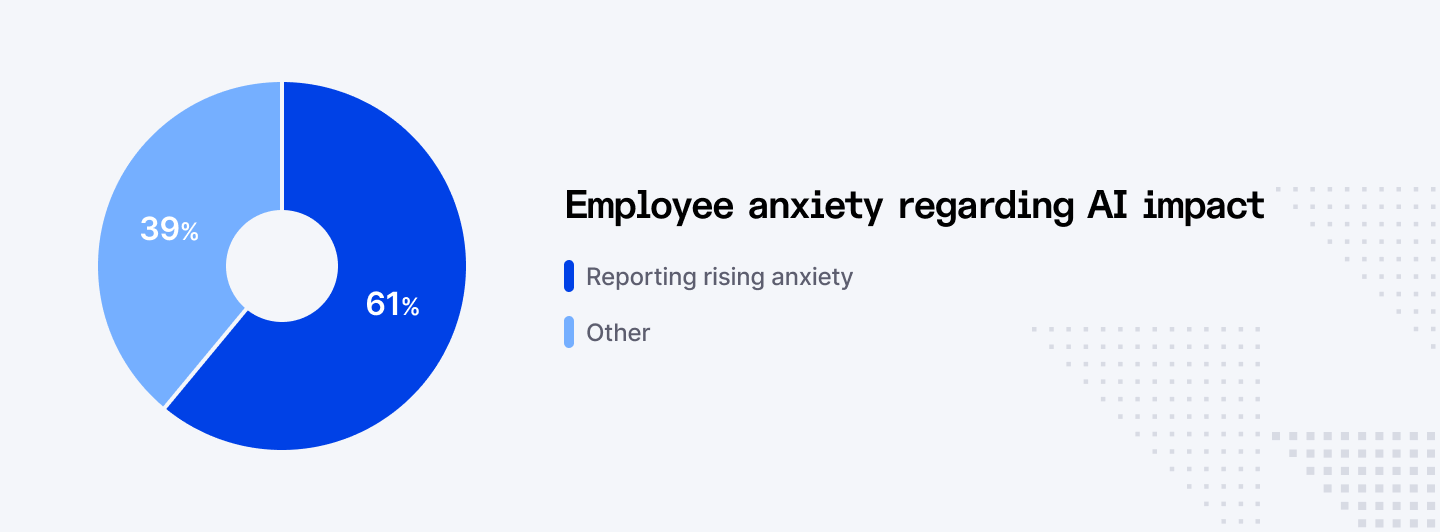
- 61% of organizations report rising employee anxiety about the impact of AI agents on their employment prospects.
- Only 50% of organizations say they have sufficient knowledge of AI agent capabilities, limiting their ability to deploy these systems effectively.
- Fewer than 20% of organizations report having high levels of data readiness required to scale AI agents across the enterprise.
- Over 80% of organizations lack mature AI infrastructure, which restricts large-scale deployment of autonomous agents.
Up next: See which skills will matter most as agentic AI reshapes software roles.
Operational Efficiency Gains from AI Agents
AI agents are already producing measurable performance improvements in customer service, marketing, and internal operations. These gains are driven by the ability of agents to handle large volumes of interactions, make real-time decisions, and operate continuously without fatigue. Companies deploying AI agents are seeing improvements in accuracy, response times, and conversion rates even at early stages of adoption.
- Telefónica handles approximately 4.5 million customer service calls per month using AI agents to automate and manage high-volume customer interactions.
- Telefónica’s AI agents achieve about 90% intent recognition accuracy, allowing them to correctly identify customer needs and route or resolve requests with minimal human involvement.
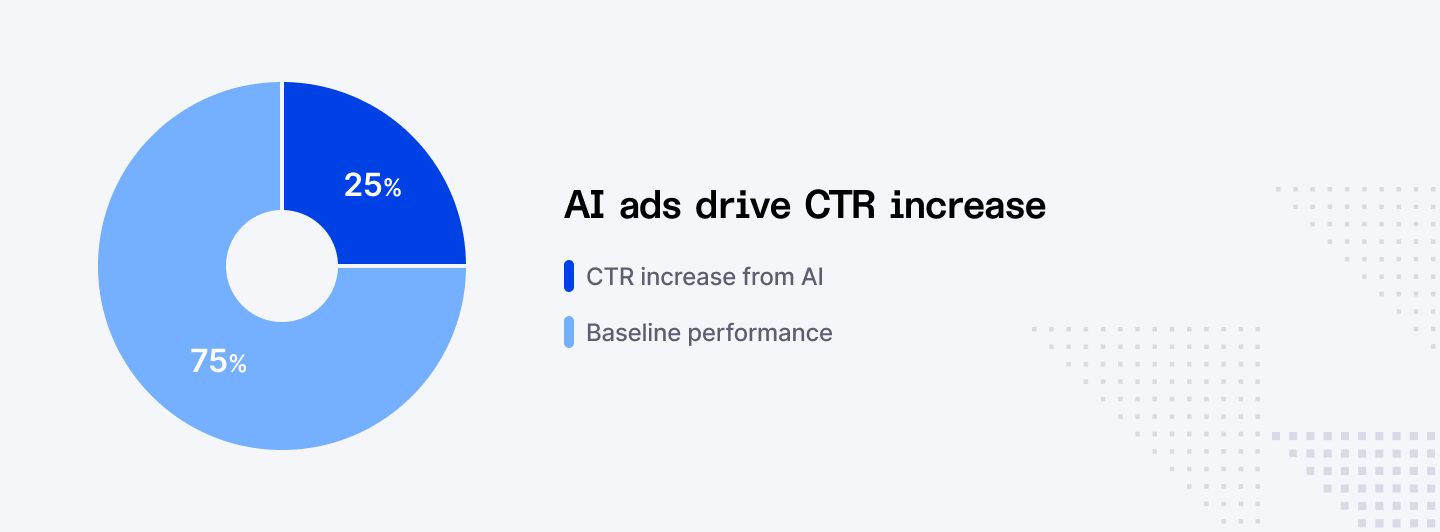
- Mercado Libre recorded a 25% increase in advertising click-through rates after deploying AI-generated ads powered by autonomous AI systems.
- 64% of organizations report that AI is enabling innovation across their business, showing that AI agents are being used for growth and new capabilities rather than only for cost reduction.
Governance and Deployment Barriers
While interest in AI agents is high, many organizations face significant barriers when trying to deploy these systems at scale. These challenges include compliance risks, data governance issues, and a lack of mature infrastructure to support autonomous decision-making. As AI agents become more deeply embedded into core workflows, organizations must address these risks before they can be trusted with critical business processes.
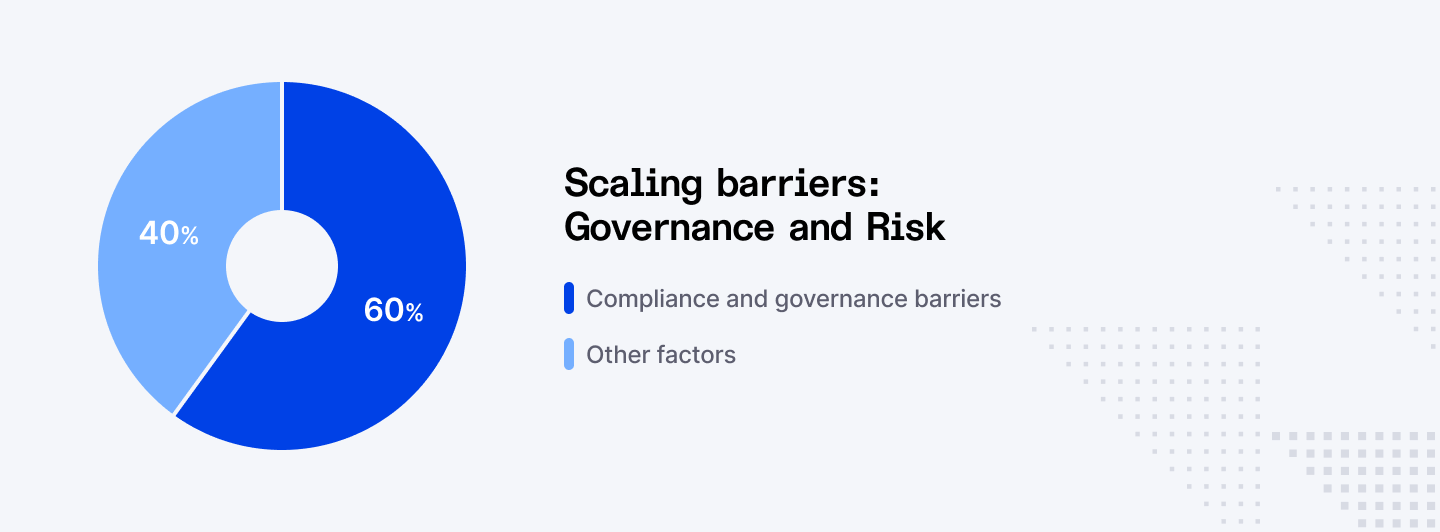
- 60% of enterprises cite non-compliance risks and data governance concerns as major barriers preventing them from scaling AI agent deployments.
- Only 50% of organizations say they have sufficient knowledge of AI agent capabilities, which limits their ability to design and deploy effective agentic systems.
- Fewer than 20% of organizations report having high levels of data readiness, a requirement for training, deploying, and monitoring AI agents at scale.
- More than 80% of organizations lack mature AI infrastructure, significantly restricting their ability to support large-scale autonomous agent deployments.
What High-Performing AI Agent Users Do Differently
A small group of organizations is capturing a disproportionate share of the value created by AI agents. These high-performing companies are not only adopting AI faster but are also redesigning workflows, allocating more capital, and deploying agents across multiple functions. Their approach contrasts sharply with companies that are still running isolated pilots.
- AI high-performing organizations are 3 times more likely to use AI agents for transformative change rather than incremental process improvements.
- These high-performing organizations are also 3 times more likely to redesign core workflows when implementing AI agents, enabling deeper automation and efficiency gains.
- AI high performers allocate more than 20% of their total digital budgets to AI technologies, compared with much lower investment levels among average adopters.
- Organizations that capture the most value from AI agents typically deploy them across at least 5 business functions, compared with far fewer functions among low performers.
- Leading organizations invest more than 40% of their digital budgets into AI capabilities to support large-scale agent deployments.
Future Outlook for the AI Agent Market
The next phase of the AI agent market is expected to be driven by the transition from small-scale pilots to large-scale enterprise deployments. As organizations improve their data readiness, governance, and infrastructure, more autonomous agents will be embedded into everyday business processes. This shift is expected to accelerate adoption in industries such as professional services, healthcare, and financial services.
- By 2028, AI agents are expected to generate up to USD 450 billion in economic value through revenue growth and cost savings across surveyed countries.
- 15% of all business processes are expected to operate at semi-autonomous or fully autonomous levels within the next 12 months.
- This share is projected to increase to 25% of business processes by 2028 as AI agent capabilities mature.
- 61% of organizations report that they are preparing for or actively exploring AI agent deployments as part of their near-term digital strategy.
- 93% of business leaders believe that scaling AI agents in the next 12 months will provide a competitive advantage over peers.
Final Words
AI agents are no longer experimental technology or optional add-ons. The data shows that autonomous systems are already influencing productivity, cost structures, and how work gets done across enterprises.
Across industries, organizations are beginning to evaluate AI agents not just by technical capability, but by how reliably they improve real business outcomes.
While a majority of organizations are experimenting with AI agents, far fewer have successfully scaled them into core workflows or redesigned processes around autonomous systems. At the same time, organizations that do invest in data readiness, infrastructure, and workflow redesign are seeing measurable advantages.
➡︎ Building AI agent systems that scale? Index.dev connects you with developers experienced in AI integration, multi-agent architectures, workflow automation, and enterprise AI deployment. With 93% of leaders saying AI agents create competitive advantage, hire the engineers who can help you capture it.
➡︎ Want to explore more real-world AI performance insights and tools? Dive into our expert reviews — from Kombai for frontend development and ChatGPT vs Claude comparison, to top Chinese LLMs, vibe coding tools, and AI tools that strengthen developer workflow like deep research, and code documentation. Stay ahead of what’s shaping developer productivity in 2026.
Data Sources
- https://www.marketsandmarkets.com/Market-Reports/ai-agents-market-157530160.html
- https://www.capgemini.com/insights/research-library/rise-of-agentic-ai/
- https://www.mckinsey.com/capabilities/mckinsey-digital/our-insights/the-economic-potential-of-generative-ai-the-next-productivity-frontier
- https://openai.com/enterprise-ai
- https://www.weforum.org/publications/navigating-the-ai-frontier-a-primer-on-the-evolution-and-impact-of-ai-agents
- https://www.cci.gov.in/sites/default/files/whats_newdocument/Market-Study-on-Artificial-Intelligence-and-Competition.pdf
- https://www.bondcap.com/research/trends-artificial-intelligence/


