The corporate world is witnessing a fundamental operational transformation as agentic AI, autonomous artificial intelligence agents capable of planning, acting, and executing multi-step tasks, transitions from experimental initiatives to strategic organizational infrastructure.
What was previously considered niche technology is now altering how businesses give value, make choices, and automate activities at scale. In fact, top consultants such as McKinsey are now reconsidering their workforce makeup to incorporate tens of thousands of AI agents working alongside human talent, demonstrating how seriously businesses are taking this change.
This progress is more than simply sparkling new technologies; it is based on measurable business consequences. Across sectors, organizations are progressively investing in agentic systems to improve efficiency, speed operations, and gain a competitive advantage. With corporate AI agent deployment quickly increasing through 2026, executives are focusing on AI agent enterprise adoption numbers and what they signify for competitive positioning, as well as AI agent ROI 2026, as automated processes begin to exhibit actual value. Globally, the influence of agentic AI is reverberating across operations, customer experience, and productivity, pointing to a future in which autonomous systems are critical to business success.
Looking to deploy AI agents in your business? Index.dev connects you with pre-vetted engineers to build, manage, and scale autonomous systems.
What Are AI Agents and Agentic AI?
AI agents are fundamentally autonomous software systems that can act, plan, and execute tasks autonomously, frequently over several phases, and communicate with tools or data sources without constant human interaction. Unlike traditional AI tools, such as chatbots or simple automation scripts, which require predetermined rules or direct input, AI agents dynamically assess goals, adapt to situations, and make decisions to accomplish outcomes, similar to having digital coworkers that can execute complicated jobs on demand.
This next generation of AI, known as agentic AI, extends beyond typical generative models. Traditional AI may create replies or analyses based on prompts, but agentic AI integrates reasoning, action planning, and execution into a single system.
These systems can autonomously organize processes across various platforms, assess progress toward targets, and alter methods in response to real-world data, blurring the line between automation and independent decision-making.
To operationalize these capabilities at scale, many enterprises rely on an AI agent builder to design, test, and deploy autonomous workflows across their existing systems.
Emerging frameworks, such as Outcome as Agentic Solutions (OaAS), reflect this shift in corporate thinking, emphasizing systems that give outcomes above tools for task performance. In this context, agentic AI is fundamental to AI agent enterprise adoption initiatives worldwide, allowing organizations to expand processes and unleash new efficiencies with minimum manual intervention.
See how AI agents are changing the way software is built, tested, and shipped by engineering teams.
Current State of Enterprise Adoption
Enterprise use of AI agents has expanded dramatically between 2025 and 2026, indicating a transition from experimental to widespread implementation. According to recent polls, between 79% and 96% of organizations are either actively deploying AI agents or increasing current deployments, demonstrating how rapidly agentic systems are being integrated into core operations rather than standalone pilots. At the same time, 52-79% of firms have already implemented AI agents or are in advanced planning phases, indicating increased confidence in enterprise readiness and business benefit.
Adoption is highest in data-intensive tasks. Approximately 47% of organizations now employ AI agents for data management tasks, such as pipeline monitoring, data quality checks, and workflow automation, with 84% expecting to increase their investment in AI agents in the coming year. Notably, virtually all global IT leaders want to increase AI agent adoption in the next 12 months, indicating strong top-down support and budget alignment.
Regional Highlights
India stands out as a fast-paced market. According to a Microsoft-sponsored study, 93% of Indian company executives intend to implement AI agents within the next 12-18 months, motivated by cost savings, scale, and digital-first business models.
Growth Trajectory
Looking ahead, usage is likely to increase further in 2027 and 2028 when agentic capabilities are integrated directly into corporate applications. Gartner projects that by 2026, 40% of enterprise applications will integrate task-specific AI agents, adding to the momentum of AI agent enterprise adoption statistics and boosting enterprise AI agent use cases.
Enterprise Use Cases and Impact on Business Functions
As usage grows, AI agents are having a concrete influence on key business activities. Customer support and experience (CX) are among the most mature domains. A customer service chatbot like Chatbase takes this further training AI on your own business data to deliver accurate, 24/7 responses without any human intervention required. Autonomous agents may manage FAQs, route tickets, and address typical issues from beginning to end, drastically lowering response and resolution times while enhancing customer satisfaction.
AI agents are increasingly being utilized in security and IT operations to monitor systems in real time, detect anomalies, and respond to incidents. These agents may autonomously assess alarms, conduct repair actions, and escalate only significant issues to human teams, allowing organizations to manage increasing infrastructure complexity with fewer teams
Another area of significant effect is the supply chain and operations. Agentic systems improve inventory planning, demand forecasting, and logistics orchestration by constantly modifying decisions based on real-time data. This allows for speedier responses to interruptions and enhances overall operational resilience.
Meanwhile, data management and analytics remain core use cases. Artificial intelligence agents automate data workflows, governance checks, and reporting duties, allowing data teams to focus on strategic analysis rather than manual upkeep.
Cross-Industry Impacts
From healthcare appointment scheduling and care coordination to financial fraud detection and compliance monitoring, agentic AI is making inroads into mission-critical sectors where speed, accuracy, and scale are crucial. As a result, AI agent enterprise adoption is becoming more linked not just to efficiency improvements, but also to the wider agentic AI business effect in sectors.
Up next: See which industries AI will disrupt next—and what to expect.
Measuring ROI: What Enterprises Are Seeing
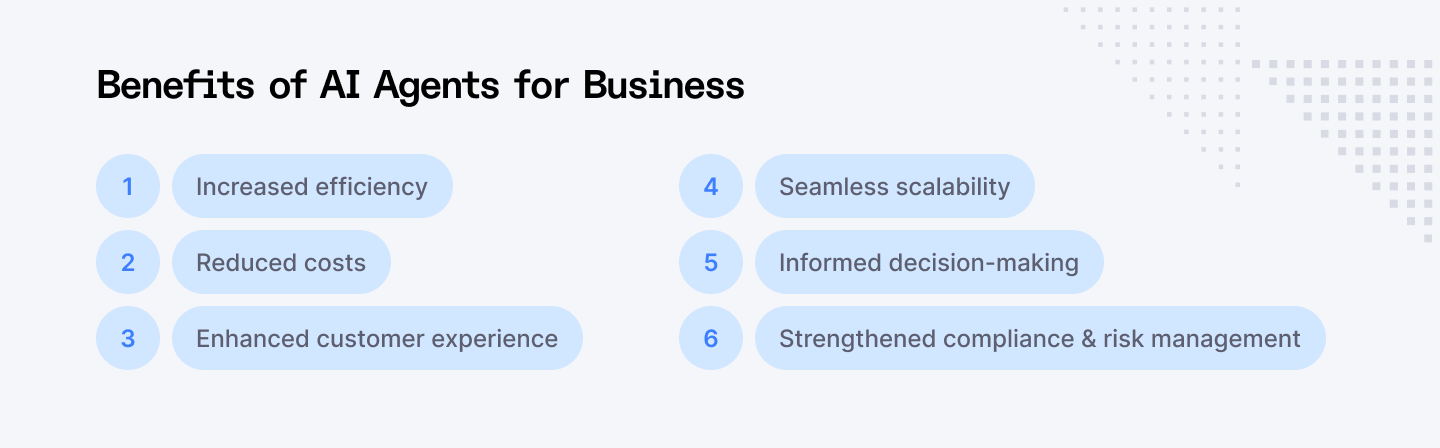
As AI agents reach production environments, businesses are increasingly able to quantify returns rather than relying just on theoretical value. The early findings are impressive. Approximately 88% of organizations that use AI agents report a favorable ROI, especially in functions with a high number of repeated, decision-driven activities.
In advanced deployments, some organizations predict up to 4.3x ROI, with payback times of less than 12 months, demonstrating that agentic systems may generate value more quickly than standard enterprise software expenditures.
Cost effectiveness is a big motivator. By 2026, the majority of organizations expect to reduce operational costs by 40% or more as AI agents take over monitoring, orchestration, and decision-heavy processes across IT, operations, and support services.
Business Value Breakdown
Beyond cost reductions, organizations are reporting direct revenue increases of 6-10% or more, particularly if AI agents affect sales operations, client retention, or personalization initiatives. Another significant benefit is increased productivity: autonomous agents decrease manual labor, cut cycle times, and allow teams to focus on higher-value tasks. In many situations, demonstrable ROI is reached within the first year of deployment, bolstering confidence in AI agent ROI 2026 estimates and improving total enterprise AI ROI data.
ROI Challenges
However, refunds are not guaranteed. Gartner predicts that more than 40% of agentic AI initiatives will be abandoned by 2027 owing to uncertain value, insufficient alignment with business goals, or poor execution. The outcomes vary greatly depending on organizational maturity, data quality, and governance preparedness.
Challenges and Risks
Despite tremendous progress, organizations confront a number of challenges as they expand AI agent installations. Integration with old systems is still one of the most typical challenges. Many organizations employ fragmented technology stacks, making it challenging for AI agents to consistently manage operations across older platforms.
Conducting thorough root cause analysis helps organizations identify whether failures stem from legacy infrastructure, integration issues, or AI agent behavior before scaling deployments.
Concerns about data governance and security are another important danger. Because AI agents may access, transfer, and act on data independently, organizations must maintain strict controls over permissions, auditability, and compliance, particularly in regulated sectors. Without strong governance frameworks, agentic systems might exacerbate current data quality or security problems.
A third barrier is the skills gap and change management needed to enable agentic AI. Teams must adjust to new tasks such as AI orchestration, oversight, and exception management, while executives deal with cultural opposition to autonomous systems making choices.
For early-stage businesses navigating these shifts without in-house expertise, startup consulting can provide the strategic guidance needed to bridge skill gaps and build the right internal capabilities from the ground up.
Project Failure Risk
High implementation costs, imprecise KPIs, and insufficient business alignment all contribute to project cancellations, underscoring Gartner's prediction that a large portion of agentic AI ventures may fail.
Governance & Trust
Finally, trust is limited. Only a tiny percentage of organizations are now comfortable with fully autonomous agents, necessitating the use of human-in-the-loop models to manage AI agent enterprise adoption problems and mitigate larger AI dangers.
Future Outlook: Trends Through 2028
The future of agentic AI predicts fast expansion and stronger corporate integration. Market researchers expect the agentic AI market to develop at a compound annual growth rate (CAGR) of 35-46% or higher, with overall market value increasing dramatically by 2030 as autonomous systems take on mission-critical responsibilities. This expansion demonstrates growing trust in AI agents as scalable, ROI-driven infrastructure rather than experimental technologies.
Agentic capabilities are likely to become mainstream software features rather than optional add-ons. This evolution is also creating demand for LLMO agencies that help businesses improve how their brands and content are represented across large language model ecosystems.
According to Gartner, by 2028, approximately one-third of corporate apps will feature built-in AI agent capabilities, integrating autonomous task execution directly into business platforms.
A major transition is the rise of Outcome as Agentic Solution (OaAS) models, in which suppliers are paid to produce quantifiable results rather than licenses or tools. This method better connects AI investment with business objectives.
As organizations adopt these models, a strong thought leadership strategy becomes essential to communicate value, influence market perception, and guide stakeholders through AI-driven transformation.
Finally, organizations will see faster workforce change. New professions such as AI orchestrators, agent supervisors, and automation strategists are developing to manage, control, and optimize agentic systems, supporting long-term agentic AI trends throughout the world and determining future corporate AI trends.
Want the hard numbers behind AI agent adoption? Explore the stats shaping enterprise decisions in 2026.
Conclusion
AI agents are no longer fringe inventions limited to pilots or R&D laboratories; they are quickly becoming fundamental to company operations and strategic planning. Adoption is rising across sectors as enterprises see agentic AI's ability to automate complicated procedures, improve decision-making, and create measurable commercial value. With AI agent ROI forecasts for 2026 indicating significant cost savings, productivity benefits, and revenue growth, businesses are increasingly considering autonomous agents as long-term investments rather than short-term trials.
Looking ahead, rapid industry expansion and tighter software integration will consolidate AI agents' prominence in the business stack. Organizations that proactively link people, processes, and AI agents, while also combining strong governance with defined business objectives, will prosper. In doing so, they will realize the full potential of agentic AI and position themselves for the next wave of industrial change.
➡︎ Building autonomous AI agents at scale? Index.dev connects you with engineers who've deployed production agentic systems—from multi-step workflows to OaAS platforms. Get the talent to turn 4.3x ROI projections into reality.
➡︎ Want to explore more real-world AI performance insights and tools? Dive into our expert reviews — from Kombai for frontend development and ChatGPT vs Claude comparison, to top Chinese LLMs, vibe coding tools, and AI tools that strengthen developer workflow like deep research, and code documentation. Stay ahead of what’s shaping developer productivity in 2026.