AI is changing how companies conduct job interviews and make hiring decisions. For founders, recruiters, and HR managers, this data shows how automation improves efficiency, reduces hiring costs, and enhances candidate screening.
In this guide, you will learn the latest AI job interview stats, hiring trends, trust issues, and recruiter insights shaping the future of recruitment. Understanding these trends helps leaders balance technology with human judgment in recruitment.
All data sources for the statistics mentioned in this guide are curated from trusted sources. You will find the source URLs listed at the end for reference.
Key Takeaways
- 51% of companies now use AI in recruitment, making automation a mainstream hiring tool.
- 70% of recruiters say AI boosts efficiency by cutting manual screening time.
- 59% of employers already use AI tools to scan and evaluate resumes during the recruitment process automatically
- AI helps reduce cost per hire by up to 35%, improving hiring ROI.
- The AI recruitment market will hit USD 1.29 billion by 2035.
- 39% of candidates use AI tools to craft resumes and cover letters.
- Only 26% of applicants trust AI to evaluate them fairly.
- 85% of recruiters believe AI will automate tasks but not replace human judgment.
- 37% of HR leaders cite data privacy as their biggest AI concern.
- Recruiters using AI-assisted outreach are 9% more likely to make quality hires.
1. Global AI Adoption in Recruitment
This part gives you a clear view of how widely companies use AI in hiring today. It explains which stages of recruitment depend on automation and how fast adoption is growing. You will understand how normal AI has become in modern HR and why it now shapes most hiring decisions.
- 51% of organizations use AI in recruitment, showing that automation has become a normal part of modern hiring.
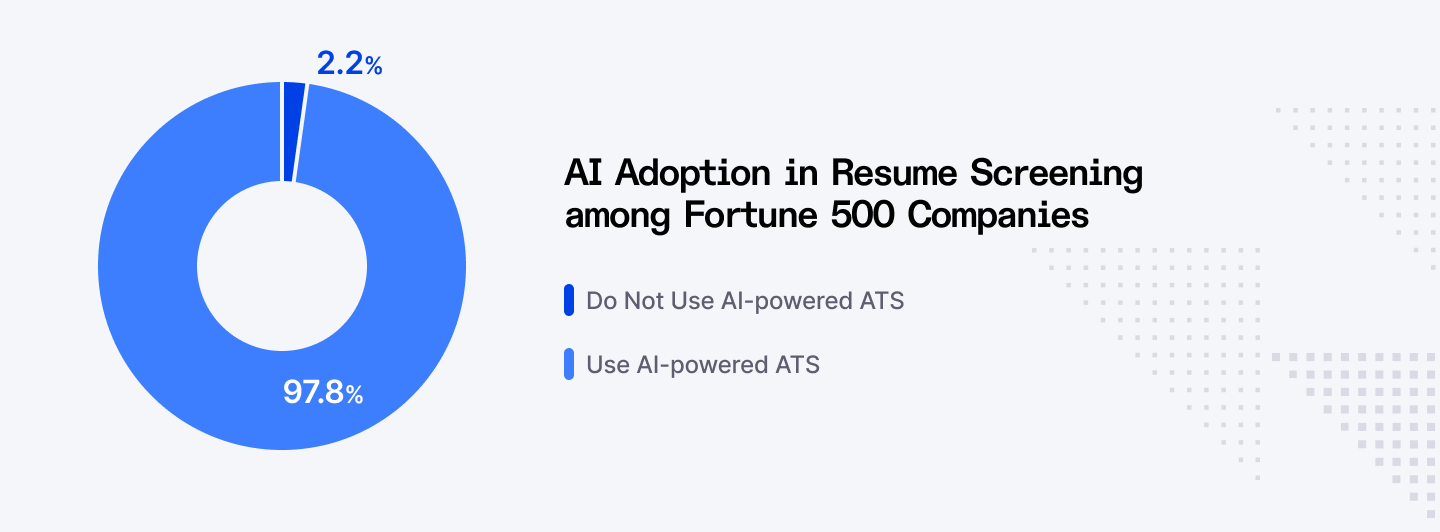
- 97.8% of Fortune 500 companies depend on AI-powered Applicant Tracking Systems to screen resumes before a person reviews them.
- 62.5% of HR teams used AI in their hiring processes in 2023, demonstrating that AI tools are widely accepted across HR functions.
- 35% of companies in 2025 use AI-driven talent marketplaces, up from 25% in 2024, showing how fast internal talent systems are growing.
2. AI Market Growth and Industry Expansion
Here you will see how fast the AI recruitment market is expanding. The data shows how much companies invest in AI tools, how large enterprises scale analytics teams, and why automation is now part of long term talent planning. This helps you see where the industry is moving and why AI is viewed as a strategic asset.
- The AI recruitment market was valued at USD 617.50 million in 2024 and may reach USD 1.28 billion by 2035, reflecting strong demand for smarter hiring tools.
- 79% of large companies with over 10,000 employees now include data analytics roles in HR to make better workforce decisions.
- 91% of HR leaders believe automating the hiring process is essential for long-term success, confirming that AI is a strategic business need, not just a tech upgrade.
3. Key Use Cases and AI Applications in Hiring
This section breaks down the main tasks AI handles in recruitment. It covers job descriptions, resume screening, candidate searches, assessments, scheduling, interviews, and support tools like chatbots and background checks. You will learn which parts of hiring AI improves the most and where teams can automate work right now.
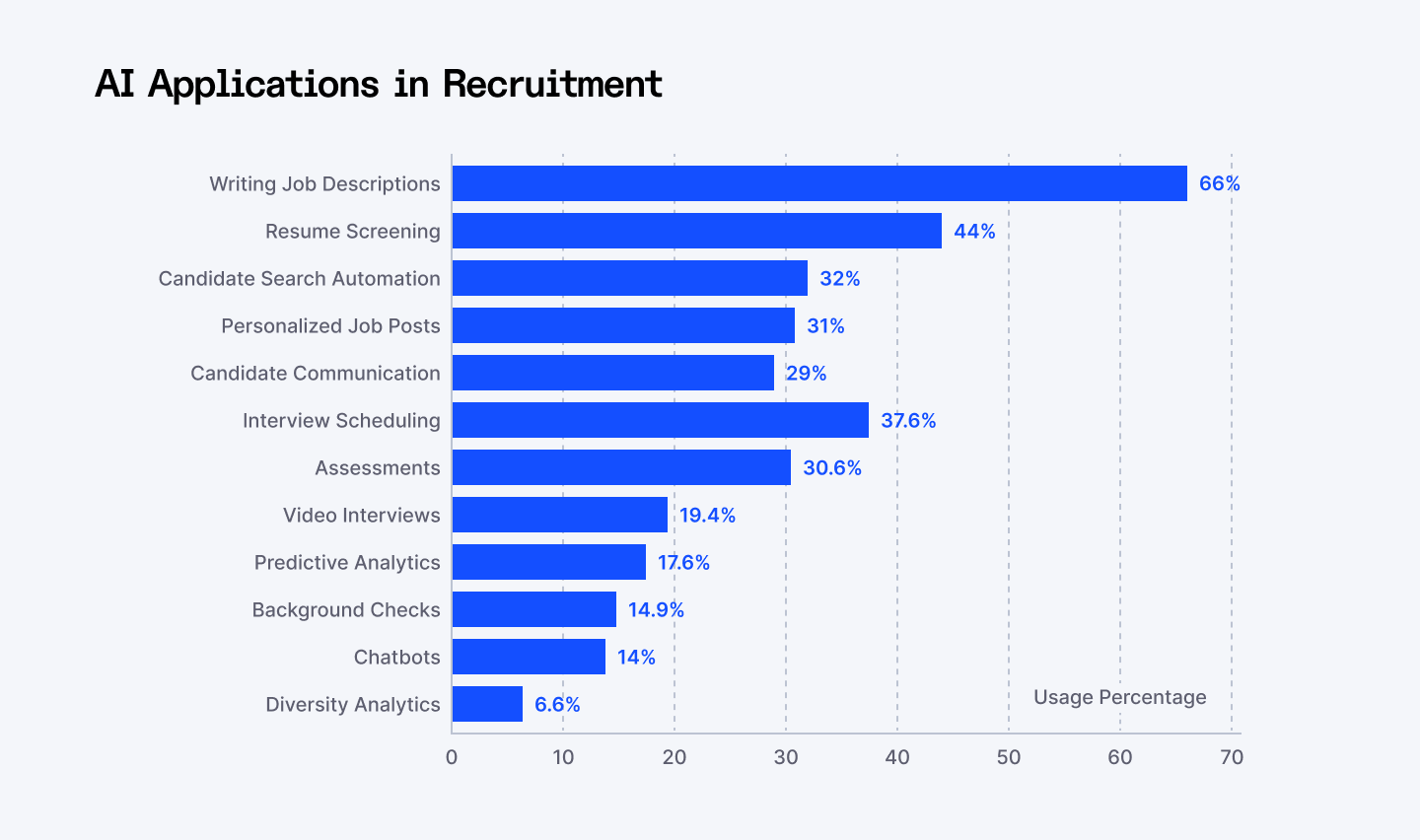
- 66% of recruiters use AI to write job descriptions, and 44% rely on it to screen resumes and shortlist applicants with more speed and accuracy.
- Candidate outreach is also changing because 32% of companies automate candidate searches, and 31% use AI to personalize job postings for stronger reach.
- AI now supports key steps in the hiring flow, with 29% using it to communicate with applicants, 37.6% to schedule interviews, and 30.6% to run assessments that reduce delays and improve engagement.
- More advanced tasks are also growing, as 19.4% use AI for video interviews and 17.6% rely on predictive analytics to judge future job performance.
- AI adoption extends to support functions too, with 14.9% using it for background checks, 14% using chatbots for common questions, and 6.6% using diversity analytics to guide inclusive hiring.
Find the top tools that can streamline your recruitment process and improve outcomes.
4. AI-Driven Hiring Efficiency and Performance
Here you get insights on how AI boosts productivity and hiring results. The statistics show how much time recruiters save, how cost per hire drops, and how automation improves candidate quality. These insights help HR teams understand the real performance impact of using AI in daily workflows.
- Companies using AI recruiter messaging are 9% more likely to make quality hires because automation helps keep candidates engaged.
- 89% of HR professionals say AI saves time and boosts productivity by reducing manual screening.
- 36% report lower hiring costs, and 24% say AI helps identify better-qualified candidates for open roles.
- Businesses using AI have cut cost per hire by 35%, proving the financial benefits of automation.
- 98% of HR leaders noticed improvements in scheduling and screening accuracy, showing that AI improves both speed and precision.
5. Candidate Experience and Behavior
This part explains how applicants use AI during job searches. It includes data on resume tools, cover letter generators, AI assisted writing, and unethical use during interviews. You will see how AI shapes applicant behavior and why recruiters need new ways to detect authenticity and maintain fairness.
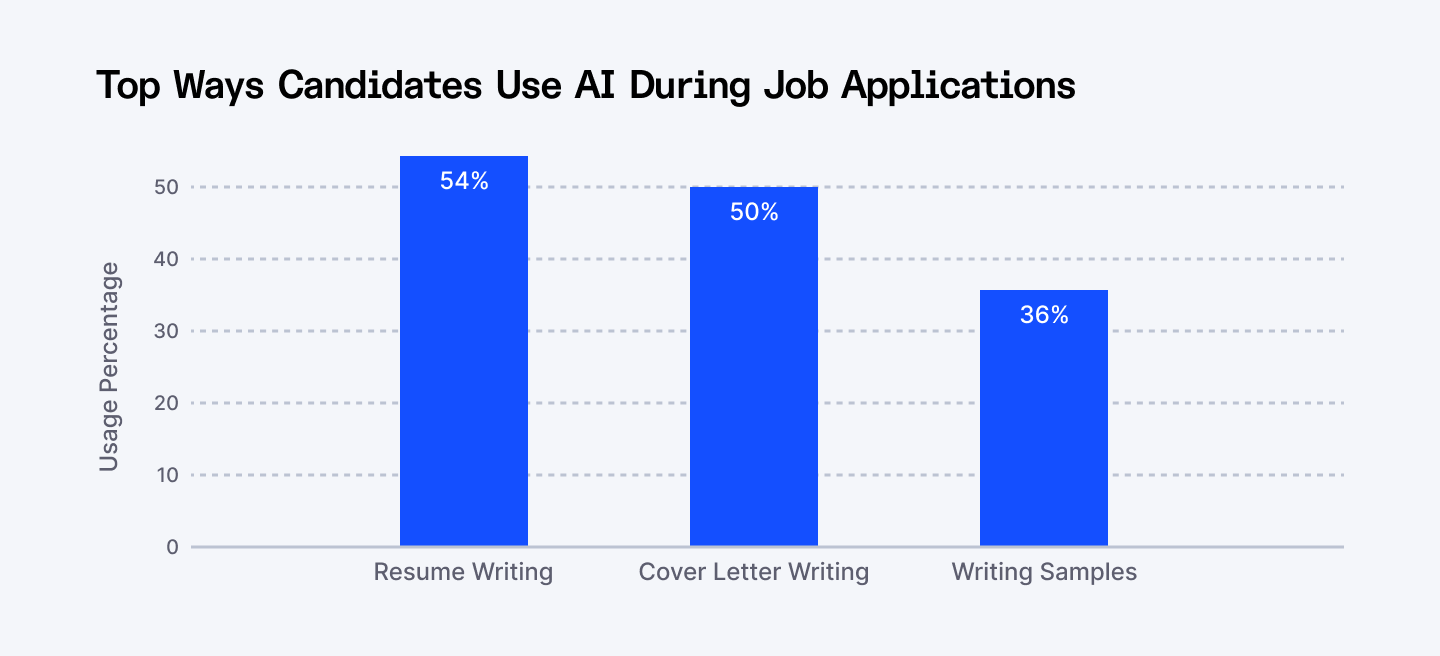
- 39% of job seekers use AI to write resumes (54%), cover letters (50%), or writing samples (36%), showing how AI is shaping candidate communication.
- 6% of applicants admit to interview fraud by using AI-generated answers or other people to represent them.
- 52% of candidates believe AI systems screen their applications before they reach human recruiters, showing awareness of automation in hiring.
6. Perception and Trust in AI Hiring
This section focuses on how candidates feel about being evaluated by AI. The data highlights trust levels, fairness concerns, bias worries, and resistance to fully automated decisions. Understanding these insights helps companies improve transparency and build trust in AI powered hiring.
- Only 26% of candidates trust AI to evaluate them fairly, showing a major gap in confidence.
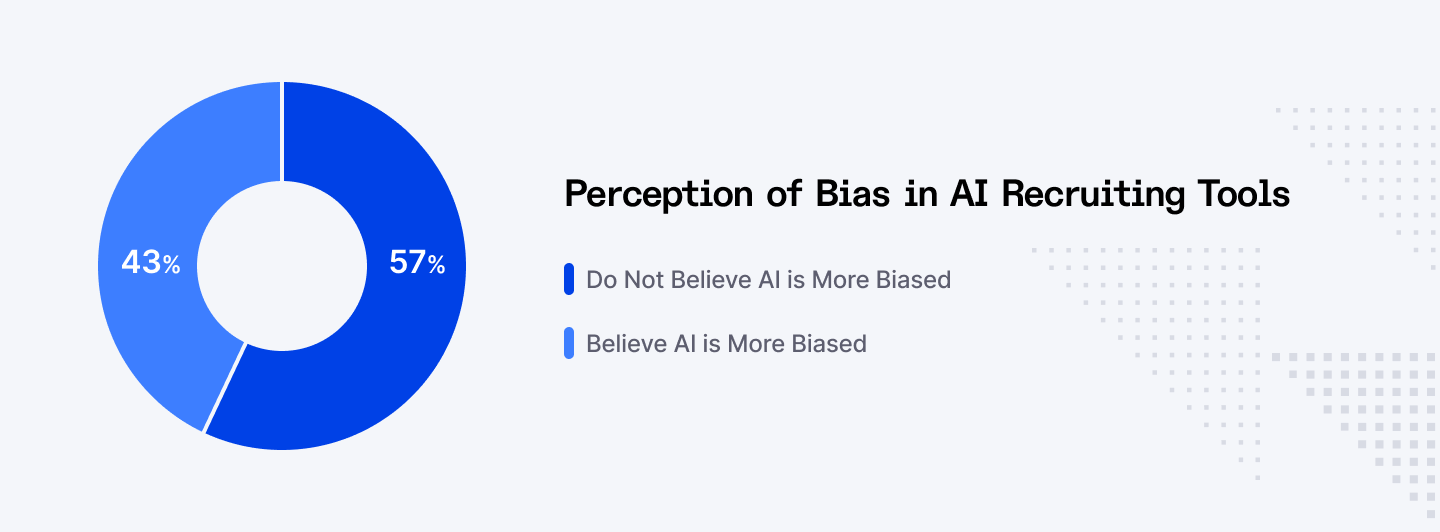
- 43% think AI recruiting tools are more biased than humans, raising ethical concerns.
- 66% of candidates say they would not apply to companies that use AI in their hiring process, reflecting ongoing skepticism.
- 71% of Americans oppose AI making final hiring decisions, and only 7% support full automation, showing a strong preference for human judgment.
Learn how to make your AI-driven hiring fair and unbiased.
7. HR Leaders’ View on AI in the Workplace
Here you will learn how HR leaders view the role of AI in their teams. The insights show how they expect AI to reduce repetitive work, support better decisions, and free time for interviews and culture building. This helps you see how leadership plans to balance technology with human involvement.
- 75% of HR professionals report that AI increases the value of human judgment because it gives recruiters more time to focus on interviews and strategy.
- 85% believe AI will replace repetitive parts of hiring, such as screening and scheduling.
- Hiring decisions may shift further toward automation, with 79% expecting AI to make hiring and firing recommendations while still wanting humans to approve final choices.
- Talent shortages remain a key issue, as 51% of HR leaders say that finding qualified candidates is still their biggest challenge even with advanced hiring tools.
8. Limitations and Ethical Challenges
This part highlights what AI still cannot solve in recruitment. It covers bias risks, privacy issues, accuracy gaps, candidate ghosting, and ongoing skill shortages. These insights show why companies must keep humans involved to ensure ethical and reliable hiring decisions.
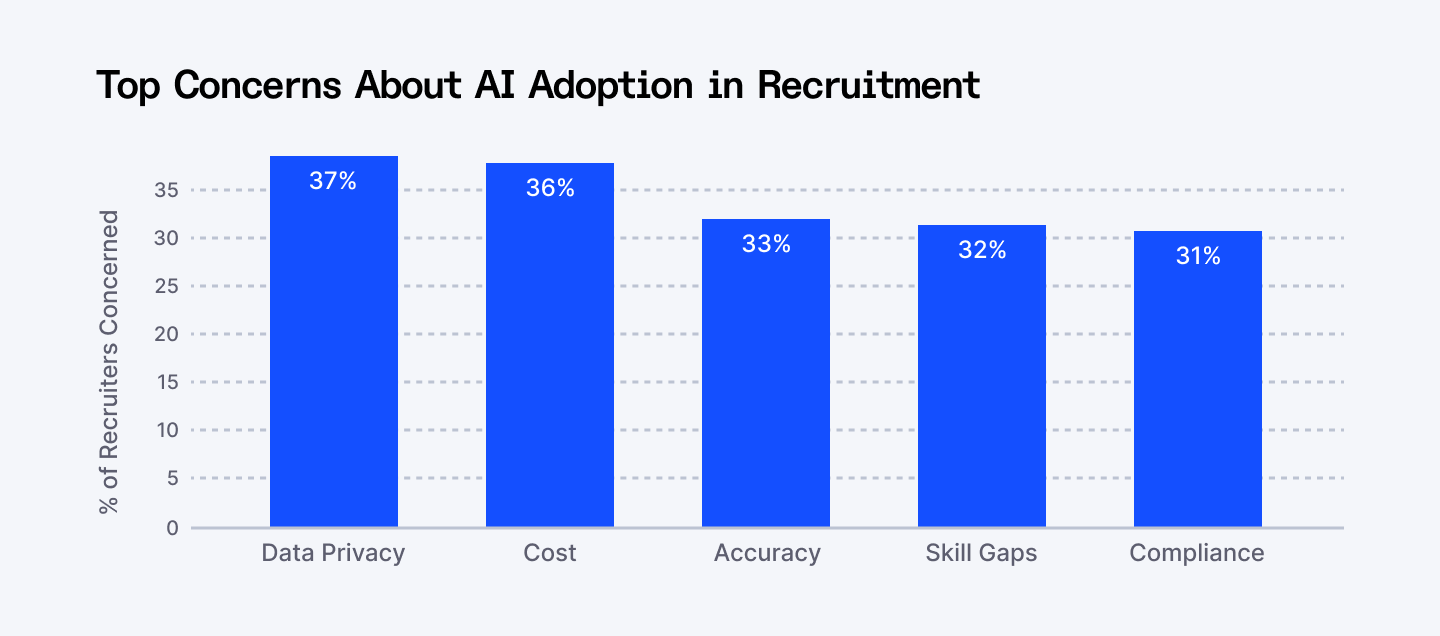
- 37% of recruiters are concerned about data privacy, 36% about cost, 33% about accuracy, 32% about skill gaps, and 31% about compliance, proving that adoption comes with challenges.
- AI bias remains a major concern, and 40% of recruiters say it creates a clear ethical risk that affects fair hiring.
- Even with AI tools in place, 69% of companies still struggle to find qualified candidates, which shows that automation has clear limits.
- Candidate engagement remains a challenge because 41% of companies experience higher ghosting rates despite using AI.
- Skill gaps persist in most roles, and 75% of hiring teams agree that AI cannot replace the need for strong human skills.
9. Economic and Global Impact of AI in Recruitment
This section shows how AI changes hiring results at a national and global level. The data explains how automation boosts productivity, supports economic growth, and increases competition for talent. You will understand why AI is now an advantage for both employers and countries.
- 66% of HR professionals say AI-driven hiring makes their country more globally competitive by improving productivity and efficiency.
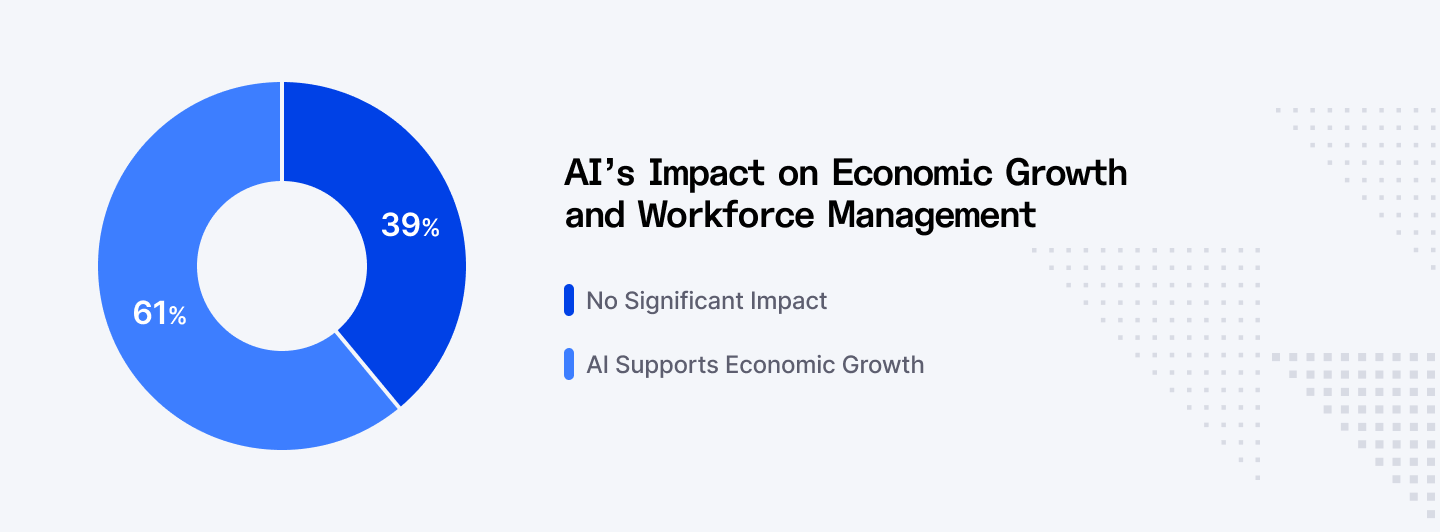
- 61% say AI-supported workforce analytics help with economic growth and better labor management.
- 50% say competition from other AI-using employers makes it harder to hire top talent, proving that automation also raises hiring pressure.
10. Future of AI and Workforce Trends
This part explores how AI will shape jobs, skills, and hiring in the coming years. As AI matures, it will become more deeply embedded in human resource management software, shaping how companies recruit, assess, and retain talent at scale. The insights show how workers expect automation to change wages, roles, and decision-making.
You will see where AI improves fairness, where risks remain, and why human judgment will stay essential in final hiring choices. This helps leaders prepare for a workforce that blends automation with human skills.
- 3 in 5 workers fear losing their jobs to AI in the next 10 years because they believe automation will replace many tasks.
- 2 in 5 employees expect AI to reduce wages in their field because they worry that automation will lower the value of human work.
- 73% of hiring experts say AI will change how companies recruit and manage talent by speeding up screening and reducing manual tasks.
- 74% of hiring experts state that AI improves the match between candidate skills and job needs, which leads to better hiring decisions and stronger performance.
- 2 in 3 professionals believe AI can reduce cultural bias when used correctly, which helps companies build more fair and diverse teams.
- 56.8% of companies use AI as a support tool, while 15.3% rely only on human judgment, showing that hybrid systems are now the standard in hiring.
Discover practical ways to assess AI and machine learning talent effectively.
Final Words
For organizations, the key takeaway is balance. They should use AI to improve efficiency while keeping fairness and human judgment at the center of hiring. Companies that use AI responsibly will build stronger, more adaptive, and transparent recruitment practices for the future.
➡︎ Hiring developers and want an platform that speeds up results? Index.dev delivers pre-vetted engineers ready for remote, global, AI-first teams. Build your engineering team faster with vetted talent, structured interviews, and data-driven hiring support.
➡︎ Want to explore more insights on ATS tools, AI hiring, and global tech recruitment? Check out related articles such as the Paradox AI recruitment chatbot review, AI startup tech stack for 2026, remote AI hiring challenges, mitigating risks when hiring offshore talent, top countries for AI developer ROI, choosing the right AI transformation partners, and evaluating developers for AI/ML expertise. These guides offer deeper frameworks, tool comparisons, and data-driven insights to help you hire smarter and scale engineering teams globally.
Data Sources
- https://business.linkedin.com/talent-solutions/resources/future-of-recruiting
- https://www.gartner.com/en/newsroom/press-releases/2025-07-31-gartner-survey-shows-just-26-percent-of-job-applicants-trust-ai-will-fairly-evaluate-them
- https://www.shrm.org/in/topics-tools/research/2025-talent-trends/ai-in-hr
- https://www.morganmckinley.com/article/how-stand-out-in-ai-job-interviews-human-skills-still-matter
- https://www.marketresearchfuture.com/reports/ai-recruitment-market-8289
- https://www.jobscan.co/blog/fortune-500-use-applicant-tracking-systems/
- https://americanstaffing.net/posts/2023/09/07/ai-recruiting-tools/
- https://www.prnewswire.com/news-releases/harvard-business-review-research-reveals-how-ai-is-making-the-recruiting-process-more-effective--and-positively-impacting-business-success-301900660.html
- https://www.oecd.org/content/dam/oecd/en/publications/reports/2024/03/using-ai-in-the-workplace_02d6890a/73d417f9-en.pdf
- https://www.irejournals.com/formatedpaper/1707517.pdf
- https://insightglobal.com/2025-ai-in-hiring-report/
- https://tengai.io/resources/ai-recruitment/
- https://hr.workable.com/hubfs/Ebooks%20(2023-2024)/AI%20in%20Hiring%20and%20Work%20-%202024%20Survey%20Report%20-%20Workable.pdf?utm_campaign=%5BEBOOK%5D%20Hiring%20With%20AI%20Survey&utm_medium=email&_hsenc=p2ANqtz-9o1xTMjFQgWSpAECNrzxLkiVlpJSm3_tDs_DWQGYNx7bxYIPDgwXHkDn3qxf-DG6eftUijWvehSIw4Hs-05BTIBB_q-g&_hsmi=286951909&utm_content=286951909&utm_source=hs_automation
- https://www.pewresearch.org/internet/2023/04/20/americans-views-on-use-of-ai-in-hiring/
FAQs
How many companies use AI in recruitment today?
About 51% of organizations now use AI in recruitment, making automation a mainstream part of the hiring process. Nearly 98% of Fortune 500 companies rely on AI-powered systems to scan resumes, rank applicants, and shortlist candidates before interviews. By 2025, 35% of employers are expected to use AI-driven talent platforms for internal mobility.
How does AI improve hiring efficiency?
AI improves hiring efficiency for 70% of recruiters by automating repetitive screening and communication tasks. It reduces manual work, shortens time-to-hire, and increases recruiter productivity. Studies show that AI tool adoption has strong correlations with recruiter efficiency (r = 0.689) and improved candidate experience (r = 0.712).
How much can AI reduce recruitment costs?
AI can reduce cost per hire by up to 35% by speeding up screening, automating workflows, and lowering administrative expenses. Research by IT firms in Bangalore found that AI adoption accounted for 80% of hiring success, mainly due to faster decision-making and fewer manual interventions.
How many job seekers use AI tools for interviews and applications?
Around 39% of candidates use AI to prepare resumes, cover letters, or writing samples before interviews. Specifically, 54% use AI for resumes, 50% for cover letters, and 36% for writing samples, indicating that applicants now rely on automation to improve their presentations and interview readiness.
How much do candidates trust AI during hiring and interviews?
Only 26% of job seekers trust AI to evaluate them fairly in interviews and assessments. Meanwhile, 43% believe AI is more biased than human recruiters, and 66% would avoid companies that depend heavily on AI for hiring decisions. This shows a major trust gap in AI-driven evaluation.
What impact does AI have on recruiter performance and hiring outcomes?
AI improves recruiter performance and hiring success by up to 80%, according to regression data from the JIER 2025 study. Quality of hire (β = 0.527) and candidate experience (β = 0.436) were the most influential factors, while shorter time-to-hire (β = –0.215) significantly improved overall recruitment results.