Artificial intelligence (AI) continues to dominate technology and business strategy as firms seek a competitive advantage through automation, data-driven insights, and informed decision-making. As businesses and big tech invest in next-generation systems and models, the global AI landscape shifts from experimental pilots to strategic core investments. According to industry research, the AI market is now worth over $391 billion in 2025 and is predicted to grow significantly over the next decade, driven by rapid adoption across sectors and use cases.
With forecasts indicating continuous growth through 2030, this article delves into important AI market value projections 2025-2030, developing AI expenditure trends among companies and Big Tech, and how tech budget allocation to AI in 2026 is redefining organizational goals and investment plans.
Hire AI-ready engineers and specialists who can turn AI spend into real outcomes.
Global AI Market Size Forecast: 2025–2030
Overall Market Growth
The worldwide AI industry is accelerating its growth, fueled by enterprise adoption, cloud-scale infrastructure investment, and significant developments in generative and applied AI. According to multiple analyst projections, the AI market will be worth hundreds of billions of dollars by the middle of the decade, with trillion-dollar valuations expected by 2030, depending on how the market is characterized.
According to Grand View Research, the worldwide AI industry will be worth around $390 billion in 2025, with a compound annual growth rate (CAGR) of more than 35% until the late 2020s, thanks to widespread use of software, platforms, and AI-enabled services across industries.
Other expectations for 2026 vary, with estimates ranging from $375 billion to more than $540 billion, reflecting variances in scope, whether infrastructure, software, services, or embedded AI capabilities are considered. Despite this heterogeneity, the directional trend is consistent: AI spending trends imply long-term growth far exceeding traditional IT markets.
Time-Series Forecast (2025–2030)
The following table includes frequently mentioned market milestones based on aggregated analyst projections:
- 2025: ~$390B–$400B
- 2026: ~$375B–$540B
- 2030: ~$800B–$2.4T+
By 2030, projections diverge significantly. Some analysts predict the AI market will approach $800 billion, while broader definitions, including AI infrastructure, cloud platforms, and enterprise services, project totals of more than $2 trillion.
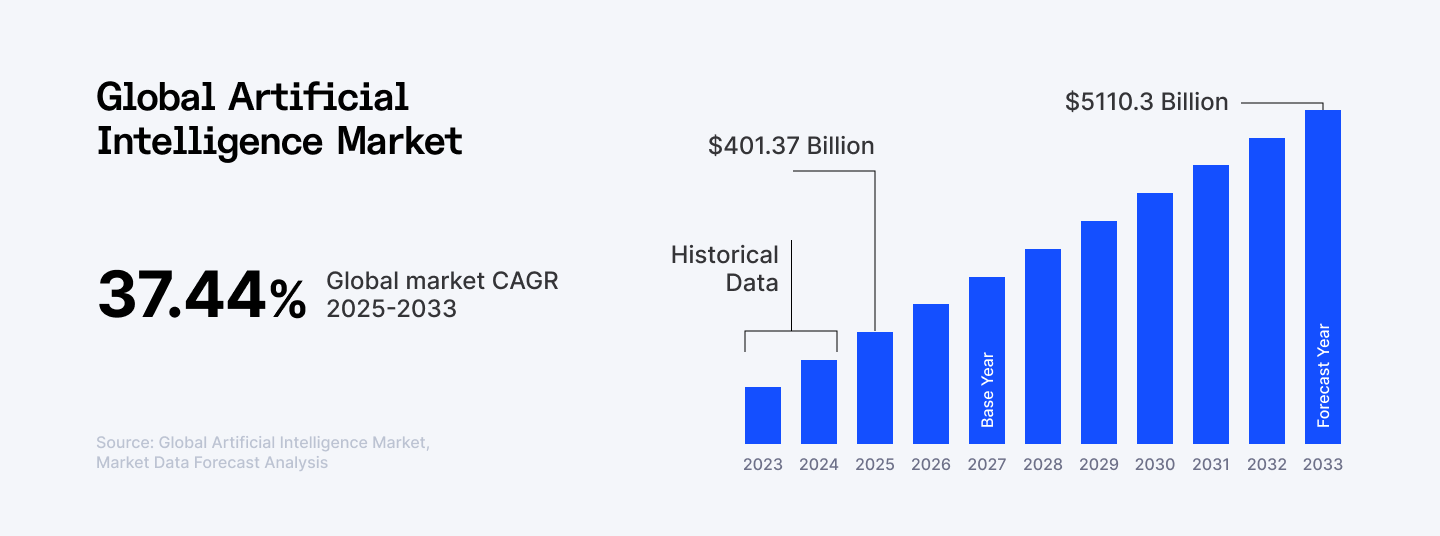
Source: Global Artificial Intelligence Market | Market Data Forecast Analysis
Segmented Market Views
Within the broader ecosystem, Generative AI is developing as one of the most rapidly rising segments. Precedence Research believes that generative AI would rise from $38 billion in 2025 to $55 billion in 2026, with exponential growth projected after that.
Meanwhile, as businesses transition from testing to production-scale deployment, AI platforms and enterprise services, such as model development tools, MLOps, and AI-driven SaaS, are expected to have significant, ongoing demand.
Insight: AI industry projections vary greatly due to different definitions; some focus primarily on AI software, while others consider infrastructure, chips, cloud services, and embedded intelligence. Understanding this distinction is crucial for assessing long-term AI market size projections from 2025 to 2030.
Big Tech AI Spending Trends
Capital Expenditures on AI Infrastructure
Big tech corporations are driving the current AI investment cycle with enormous capital expenditures (Capex) on AI infrastructure. Hyperscalers are investing billions in AI data centers, high-performance compute clusters, networking, and proprietary AI chips, establishing AI as the foundation of future digital services. In 2025 alone, Big Tech businesses will spend more than $300 billion on AI-related infrastructure, representing one of the greatest coordinated technology investment surges in history.
To fund this scale, numerous companies have obtained record levels of corporate debt, indicating strong long-term confidence in AI-driven profits, despite near-term profitability pressures.
Forecasts for the Late Decade
Analyst forecasts show that Big Tech AI investment trends will continue to accelerate through the late 2020s. According to Reuters, total AI infrastructure investments by major technology businesses might exceed $1 trillion by 2029, driven by rising cloud demand, generative AI workloads, and enterprise adoption.
Notably, hyperscaler capital expenditure predictions for 2026 remain historically high, outpacing previous cloud expansion cycles. According to Goldman Sachs analysts, AI-related investments might top $500 billion per year by 2026, highlighting AI's strategic importance across Big Tech balance sheets.
Strategic Decisions Behind the Numbers
These figures reflect fierce competition for AI expertise, proprietary foundation models, specialized chips, and edge infrastructure. Owning the entire AI stack, from silicon to software, has become a key differentiation. However, this technique carries risks such as high leverage, prolonged ROI timelines, and increased operational costs, particularly as energy and regulatory constraints rise.
Outcomes to Watch
Big Tech's aggressive AI investments are expected to increase AI service availability while influencing pricing dynamics in the cloud and corporate sectors. While this may hasten adoption, it also creates barriers for smaller firms, potentially changing the enterprise AI adoption curve and causing long-term industry concentration.
Enterprise AI Spending and Tech Budget Allocation in 2026
Enterprise Spend Patterns
Enterprise AI usage is progressing decisively beyond experimental. Following years of pilot initiatives and proofs-of-concept, corporations are now expanding AI into key business activities, including operations, customer experience, finance, and cybersecurity. According to Deloitte's State of AI research, an increasing number of businesses say AI programs are now mission-critical rather than exploratory, indicating a structural shift in enterprise technology strategy.
As a result, AI spending trends in 2026 are shifting toward production-level investments such as strong data foundations, model optimization, AI lifecycle management (MLOps), and integration with legacy systems, areas that require long-term budget commitment rather than one-time experimentation.
“AI is a driver for revenue growth rather than just a method of cutting costs.”
— Julie Sweet, CEO of Accenture
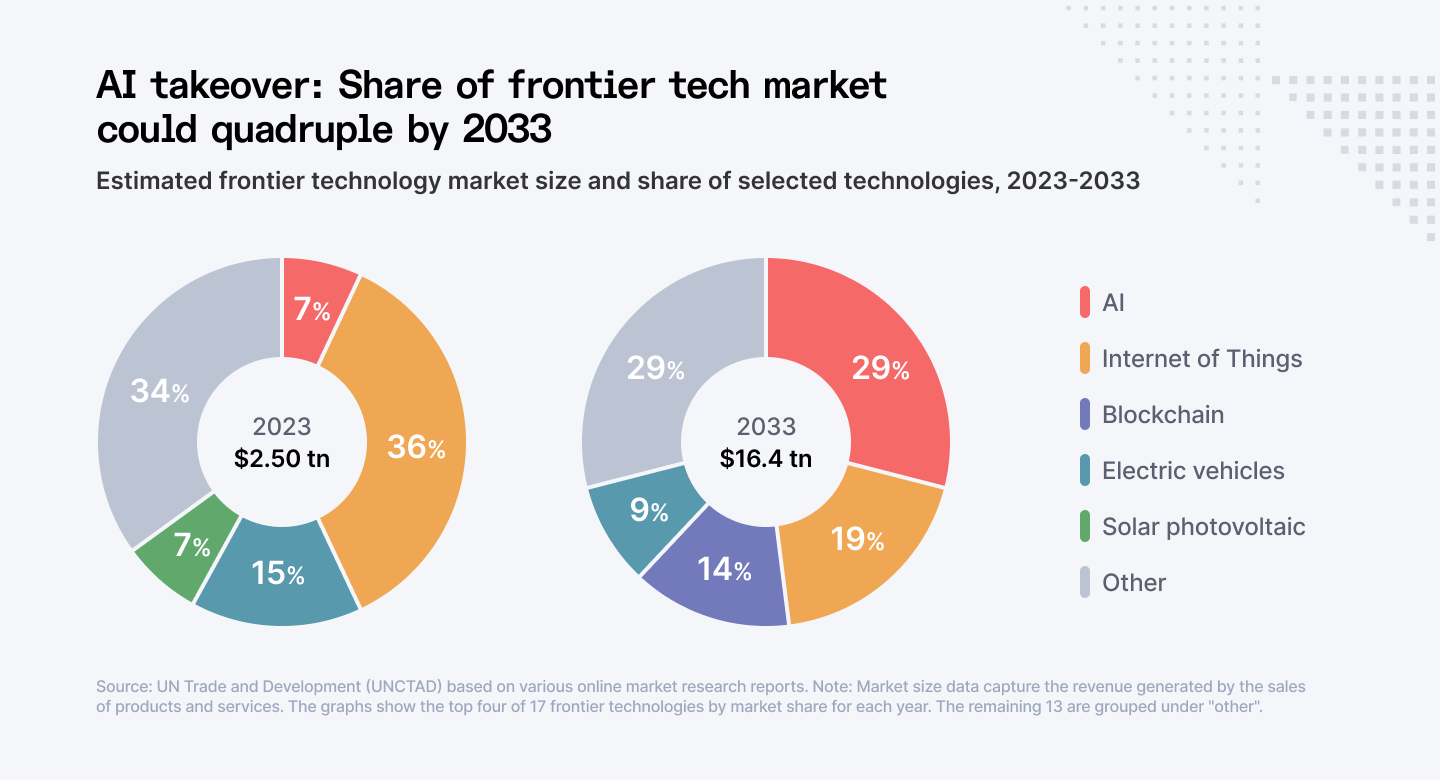
Source: AI Takeover | UN Trade & Development
Overall AI Spending Increase
Global enterprise AI spending is predicted to increase dramatically by 2026. Gartner predicts that global AI spending will reach $2.5 trillion in 2026, representing a roughly 44% year-on-year increase as AI gets integrated into enterprise software, infrastructure, and services.
Other industry analysts predict similar growth paths over the next decade, supporting the assumption that AI market size growth is driven equally by enterprise demand and Big Tech investment.
“68% of CEOs plan to increase AI spending in 2026 even though fewer than half of all AI projects have paid for themselves.”
Technical Budget Allocation Trends
In 2026, the tech budget allocation to AI will expand across various categories:
- Infrastructure and AI platforms (cloud computing, accelerators, and data platforms).
- AI Software and Foundation Models
- AI-powered services and cybersecurity
- Data Engineering, Governance, and Compliance
These categories are absorbing a growing share of overall IT budgets, which are frequently transferred from traditional application development and legacy upgrade projects.
Use of AI Agents is most often reported by respondents working in technology, media and telecommunications, and healthcare.
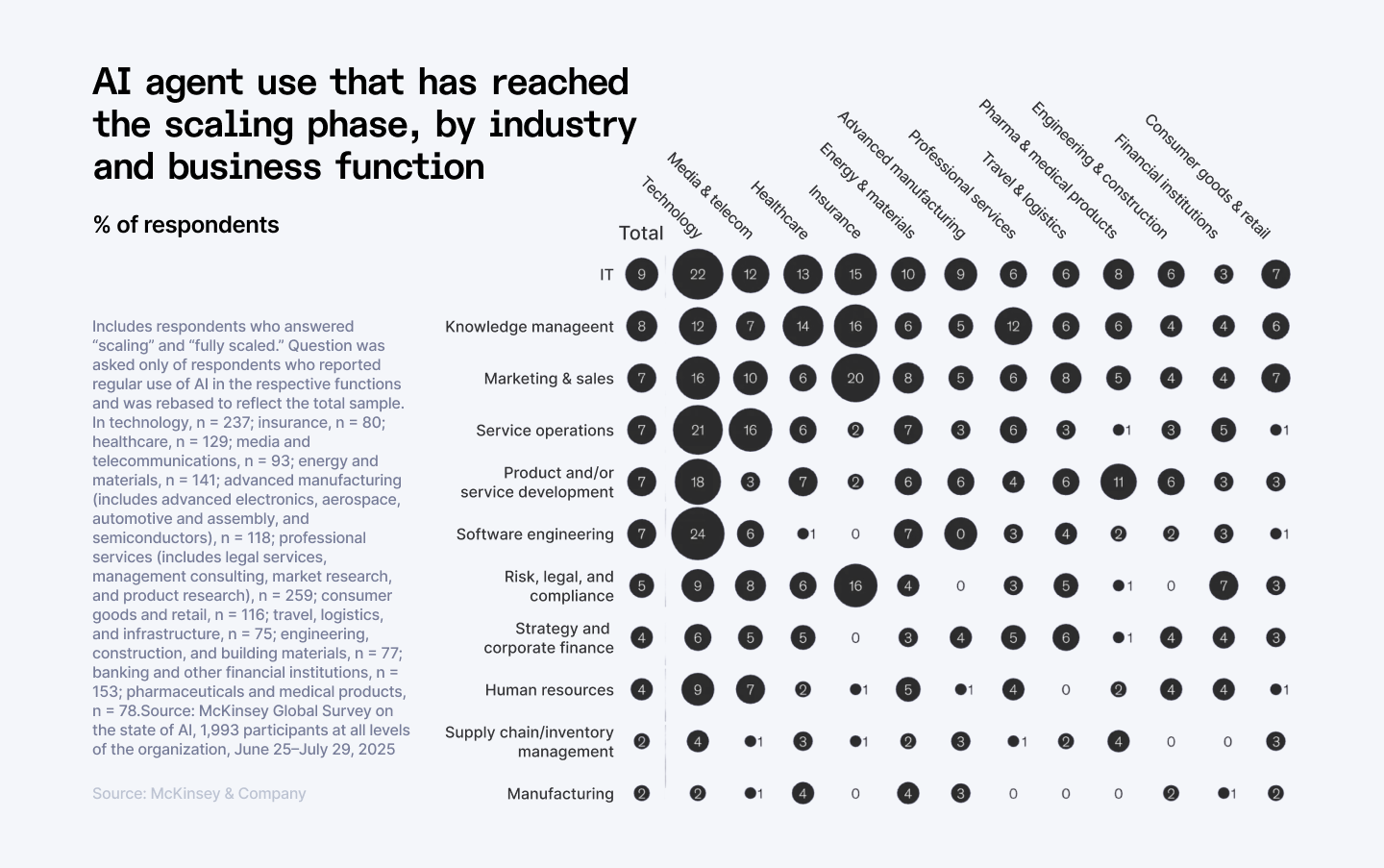
Source: AI Agent Use | McKinsey & Company
Practical Implications
For company leaders, the question is no longer whether to invest in AI, but rather where and how to invest for meaningful returns. Successful firms focus strategic use cases, integrate AI investments with business results, and strike a balance between innovation and governance, ensuring that AI spending in 2026 produces long-term competitive advantage rather than one-time technical gains.
See how quickly enterprises around the world are moving from AI pilots to full adoption.
Key Drivers and Sector Breakdowns
Demand Drivers
Several structural variables are propelling AI spending patterns worldwide. Among these is the push for automation and productivity benefits, as businesses utilize AI to cut costs, increase efficiency, and supplement human decision-making. Simultaneously, AI has emerged as a competitive differentiator, allowing for speedier innovation, tailored user experiences, and real-time analytics at scale.
Rising regulatory and risk-management requirements are also significant factors. Organizations are rapidly investing in AI for fraud detection, cybersecurity, compliance monitoring, and risk analytics, especially in regulated industries. This has transformed AI from a growth enabler to a defensive investment in line with governance and resilience initiatives.
Sector Insights
Financial services, healthcare, retail, and manufacturing are the industries with the highest levels of AI usage. Financial firms excel at AI-powered fraud protection, credit scoring, and algorithmic trading, while healthcare organizations use AI for diagnostics, drug discovery, and operational efficiency. Retailers are increasingly relying on AI for demand forecasting, pricing, and personalization, while manufacturers utilize it to manage supply chains and do predictive maintenance.
At the same time, emergent industries such as edge computing, autonomous systems, robots, and intelligent infrastructure are rapidly adopting AI, pushing the entire AI market size prediction for 2025-2030 beyond traditional enterprise software.
Geographical Dynamics
From a regional standpoint, North America continues to lead AI investment because of its significant Big Tech presence and enterprise adoption. Asia Pacific is the fastest-growing area, driven by large-scale digital transformation programs, whereas Europe prioritizes enterprise AI deployment in accordance with regulatory and ethical standards.
Challenges and Risks
Despite rapid momentum, different challenges hamper AI market size estimates and investment decisions. One of the most persistent concerns is the disparity in predicting approaches. Analyst forecasts might vary greatly since some models just contain AI software, whereas others include infrastructure, cloud services, semiconductors, and AI-enabled applications. This lack of consistency makes it difficult for businesses to measure genuine market growth or validate long-term plans.
“More than 50% of companies are failing to see any tangible returns from their AI investments.”
— Mohamed Kande, Global Chairman, PwC
Another significant barrier is infrastructure cost and energy intensity. Training and deploying large-scale AI models necessitates enormous computation, storage, and power resources, raising questions about sustainability, operational costs, and data center capacity. These expenditures have a direct impact on the tech budget allocation to AI in 2026, particularly for mid-sized firms.
Enterprises also confront skills gaps and governance difficulties, such as a shortage of AI engineers, data scientists, and risk specialists, as well as rising regulatory demands for transparency, security, and ethical AI use.
Finally, ROI uncertainty and budgetary restrictions remain significant issues. While AI promises long-term value, many firms fail to translate experimentation into quantitative outcomes, emphasizing the importance of disciplined investment guided by clear business objectives.
AI spending is rising fast—but do you know where the biggest risks are hiding? Learn more.
Conclusion
Artificial intelligence is no longer a gamble or an optional innovation line item. The AI market size prediction for 2025-2030 indicates that AI is becoming a fundamental layer of the global economy, transforming how software is developed, choices are made, and value is created. At the same time, growing disparities between high- and low-performing AI adopters highlight a crucial truth: expenditure alone does not ensure impact.
Organizations that view AI as an operational competence rather than a collection of experiments are more likely to succeed in 2026 and beyond. This includes investing in scalable data foundations, connecting AI programs to measurable business benefits, and assembling teams capable of consistently moving models from prototype to production. As AI budgets grow, focused execution, not ambition, will determine whether AI is a long-term gain or an expensive distraction.
⭢ Looking to leverage your AI investment into meaningful business impact? Index.dev enables you to hire validated AI specialists and engineers who can quickly and confidently design, launch, and scale production-ready AI solutions. Contact Index.dev to strengthen your AI team in 2026 and beyond.
➡︎ Want to go deeper into where AI is really headed? Explore more Index.dev insights on AI literacy and what it means in 2026, how AI is reshaping application and cloud development, and which industries are closest to a real AI tipping point. You can also dig into practical perspectives on why forward-deployed engineers matter, plus hands-on model comparisons that break down DeepSeek versus ChatGPT, how it stacks up against Claude, and which open-source Chinese LLMs are gaining serious traction.