You need an accelerator. Not because they're trendy. Because in reality, 60% of startups fail because founders can't execute. Accelerators solve that. With credibility, capital, and networks.
Y Combinator now backs 1,398 AI startups. Techstars increased funding from $120k to $220k—a $100k jump in one year. Google expanded its equity-free programs to India, Canada, MENA, and beyond.
Some programs take zero equity. Some hand you $600k plus cloud compute. Deadlines span six months. The fit varies wildly by stage, geography, and what you're building.
This guide breaks down the top 10 programs accepting applications right now. You'll know which one matches your startup before you finish reading.
87% of accelerated startups fail not from bad ideas, but bad hiring. Index.dev solves this—3 pre-screened developers in 48 hours.
Why 2026 Is Different for AI Accelerators
Two shifts happened simultaneously.
First, the market flooded. Venture capital chasing AI startups hit 33% of global VC allocation in 2024. That number keeps climbing.
Here's the weird part: seed-stage AI companies get valued 42% higher than non-AI startups. Series A? Up to $51.9M average. That's 30% more than traditional software. Accelerators know this. So they're fighting for access to your cap table. You've got leverage you didn't even know you had.
Second, the founders got smart. No more picking accelerators for resume padding. Founders now ask: Do you provide compute? Do you offer sales training? Can I stay equity-light? And do you have Generative AI strategy and tools? The menu matters now, and accelerators know it.
Both forces mean your leverage is higher than it's ever been.
⭢ Explore how Big Tech is rolling out its most impactful AI features across products you already use.
Which Accelerator Fits Your Startup?
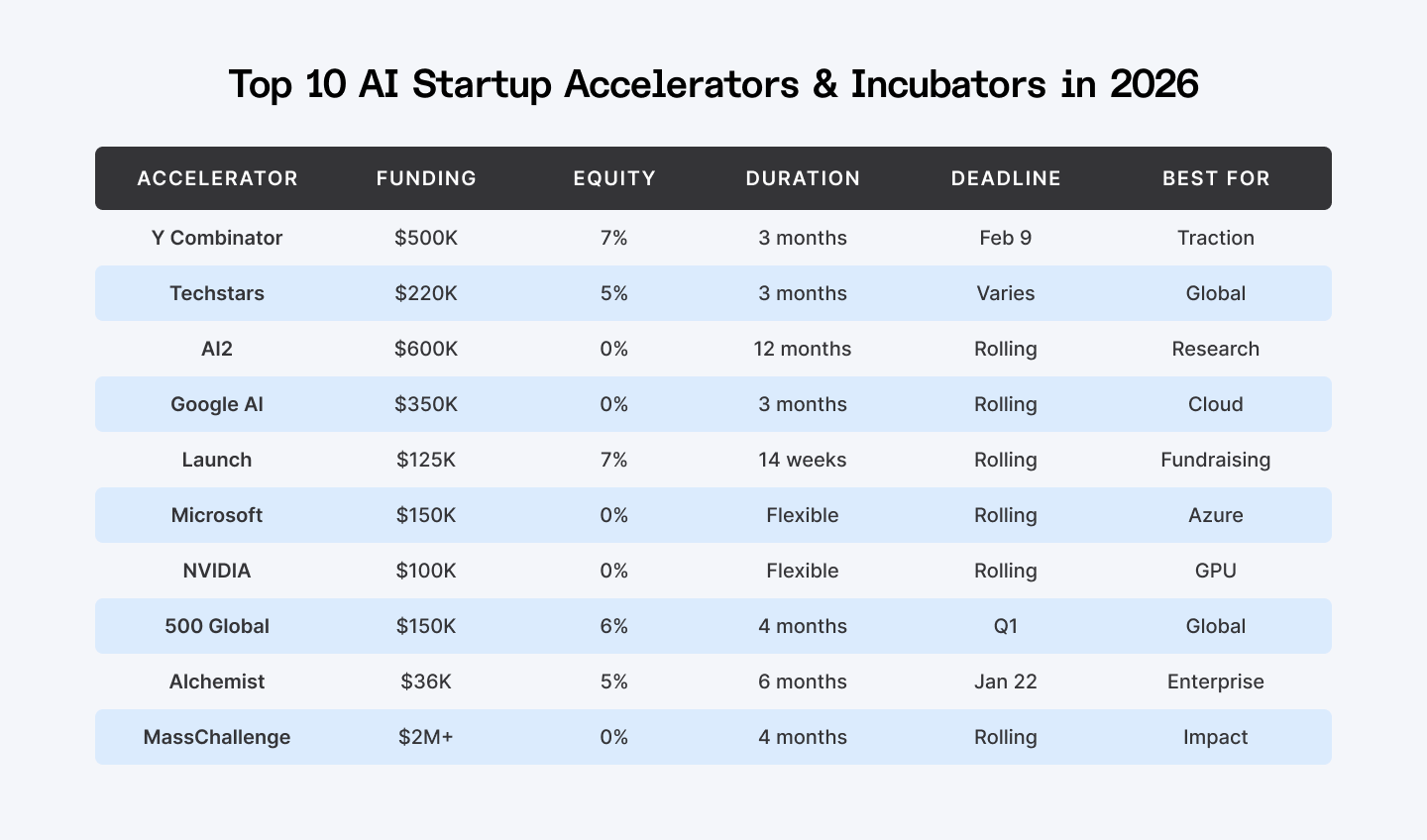
Where the capital actually comes from. $36k to $600k+. Zero to 7% dilution. Your constraint determines the winner.
1. Y Combinator (Spring 2026 Batch)

The deal:
- Funding: $125k for 7% + $375k uncapped SAFE (Total: $500k)
- Location: San Francisco (in-person, mandatory)
- Duration: 3 months
- Application Deadline: February 9, 2026
Why it still dominates: YC isn't the gold standard because of the half-million dollars. It's the gold standard because YC alumni represent 4,000+ founders who've exited successfully, and they'll take your calls.
That network creates asymmetric advantages. You get a dedicated partner—not a part-time mentor—who's scaled companies. Weekly meetings. Direct Slack access. When you're stuck on hiring, your partner knows five YC founders who've solved the exact problem you're facing.
The SAFE structure is intelligent. The uncapped SAFE with MFN (Most Favored Nation) means when your Series A prices at $20M post-money, your $375k converts at the best discount any investor negotiated. That's pure leverage.
Catch: SF relocation required. Cohorts are intense—everyone competes for mentor time. If you thrive on pressure, apply. If not, move on.
Best for: Founders with product + users who can handle competition.
2. Techstars (Spring 2026 - Global)

The deal:
- Funding: $220k total ($20k for 5% equity + $200k uncapped SAFE)
- Locations: 50+ global programs (Berlin, London, Toronto, Singapore, Bangkok, Dubai, Mumbai)
- Duration: 3 months
- Equity: 5%
Why Techstars just became more competitive: Techstars just raised their checks to $220k. That $100k jump? They're basically saying: "We're competing for your attention now, not settling for scraps."
The structure is cleaner. $20k upfront for 5% equity (you know cap table immediately) plus $200k uncapped SAFE. That 5% is lower than YC's 7%, which matters on the back end. Over a $50M Series A, the extra 2% you retain is real money.
The real advantage: Geographic diversity. YC has San Francisco. Techstars has 50 programs across emerging markets. If your customers are in India, Southeast Asia, Latin America, or Africa, Techstars' local networks beat Silicon Valley prestige.
Techstars maintains 3,700+ alumni companies that stay connected post-graduation. Your cohort becomes your referral partners for years.
Your move if: You’re a founder targeting emerging markets, or want lower dilution than YC. This is for founders who thrive in community-driven environments.
3. AI2 Incubator (Seattle)

The deal:
- Funding: Up to $600k pre-seed + up to $1M cloud compute credits
- Location: Seattle
- Duration: 12 months (longest runway in the space)
- New Fund: Raised $80M in October 2025 from Khosla Ventures, Point72, Madrona
Why AI2 plays a different game: 12 months means you're building, not pitching. Most accelerators force fundraising at week 12. AI2 gives you time to ship.
Technical mentorship comes from Allen Institute researchers—people publishing NeurIPS papers and shipping production ML systems. If you're wrapping OpenAI APIs, they'll see through you immediately. If you're building novel healthcare diagnostics or supply chain optimization, they'll get excited.
Seattle's AI House (launched March 2025) gives you co-working + events with 15k+ visitors already. The $80M fresh fund means they're writing bigger checks to deeper technical teams.
Brutal truth: AI2 wants domain experts + ML expertise. Consumer AI chatbots need not apply.
Who should apply: Research-heavy teams. Vertical AI builders (healthcare, manufacturing, logistics). Founders who need 12 months, not 12 weeks.
4. Google for Startups Accelerator: AI First

The deal:
- Funding: Up to $350k in Google Cloud credits (no cash equity)
- Equity: 0% (completely equity-free)
- Locations: India, Canada, MENA (Middle East, North Africa & Turkey)
- Duration: 3 months
- Program Focus: Seed to Series A, AI-first products
Zero equity, $350k compute, pick one: That's the pitch. No cap table hit. Credits cover Vertex AI, Gemini models, BigQuery—everything you need to train and deploy without burning cash. Mentors? Google Cloud architects + AI/ML product leads. Access to pre-release Gemini features.
The non-obvious perk: Google's partner network opens enterprise pilot doors. Credits + credibility = real revenue before Series A.
Who should apply: Cloud-native AI teams. India/Canada/MENA founders. Anyone prioritizing clean cap tables over cash checks.
5. LAUNCH Accelerator (San Francisco / Hybrid)

The Deal:
- Funding: $125k for 7% equity (clean, transparent)
- Follow-On Option: Up to $250k in next two funding rounds
- Location: Hybrid (select in-person, mostly virtual)
- Program: 14 weeks
- Cohort Size: 7 startups per batch (extremely selective)
Why LAUNCH wins on founder focus: LAUNCH doesn't try to be everything. It’s obsessed with one thing: getting you to Series A at higher valuation. You get a dedicated fundraising coach—someone who's actually closed other LAUNCH founders' rounds.
Fourteen weeks beats twelve weeks everywhere. That extra two weeks is Demo Day prep time. It's the difference between a polished pitch and a panicked one.
Seven-company cohorts mean scarcity creates attention. You're not competing against 150 startups for mentor bandwidth. Your partner is actually available.
Follow-on rights matter too. LAUNCH holds the option to invest $250k in your Series A, which means alignment. They're betting you'll succeed, not just exit cleanly.
The hybrid setup matters: you're not living in SF for three months. Couple in-person sessions for pitch prep and Demo Day. Rest is remote. That's why NYC, Austin, Denver founders actually apply.
Best for: Founders with traction who need to fundraise in 14 weeks.
6. Microsoft for Startups: Founders Hub

The deal:
- Funding: Basic tier: $5k Azure credits. Investor tier: $150k Azure credits
- Equity: 0% (completely equity-free)
- Locations: Global (all Azure-supported regions including India)
- Eligibility: Software-based startups, pre-Series C, privately held
Why bootstrapped founders should apply immediately: Microsoft's program isn't competitive in the traditional sense. There's no equity negotiation. You apply, verify your business, credits get added. The barrier is remarkably low.
If you're building on Azure (AI services, databases, machine learning), this removes your infrastructure cost problem. $150k in credits covers significant compute—enough to train models, run experiments, scale to early users without spending capital.
Investor network path: You're in Microsoft's Investor Network? They'll unlock the full $150k. Otherwise, you get $5k to start.
Pick this if: You're bootstrapped and Azure is your stack. Building with Azure OpenAI. Pre-seed and need infrastructure instead of capital.
7. NVIDIA Inception for Startups

The deal:
- Funding: No cash, but GPU credits (up to $100k cloud compute), custom server access, DLI training credits
- Equity: 0% (completely equity-free)
- Locations: Global
- Application: Rolling (no fixed deadlines)
- Eligibility: <$5M raised, AI/deep learning focus
Why NVIDIA matters for infrastructure founders:
If you're training models, NVIDIA is essential. Their GPUs power most LLM training globally. The Inception program gives you preferential GPU pricing, free technical training, and cloud credits.
The program isn't famous for mentorship—it's famous for access.
You get priority when GPUs are bottlenecked. Technical support from NVIDIA engineers. Invitations to NVIDIA events where you meet other AI founders and potential customers.
The prestige angle: Compute is expensive. Training a mid-sized model costs $50k–$200k in cloud credits. NVIDIA credits offset that directly.
More importantly, NVIDIA backing signals technical credibility when fundraising. Investors trust founders who matter to NVIDIA.
Best for: Founders building core AI/ML technology, startups training custom models, teams needing GPU access without structured program commitment.
8. 500 Global (Flagship Accelerator - Batch 37)

The deal:
- Funding: $150k for 6% equity (minus $37.5k program fee = net $112.5k)
- Follow-On Rights: Up to $500k investment option in Series A
- Location: Palo Alto
- Program: 4 months
- Batch 37: Q1 2026
Why 500 Global maintains real edge: 500 Global has invested in 2,400+ companies globally with notable exits: Canva, Twilio, Grab, and others returning 10x+ multiples. The network isn't just US-based—they have teams in San Francisco, Mexico City, Singapore, Dubai, Istanbul.
500 Global doesn't try to be specialized. Mentorship covers product, GTM, hiring, fundraising. Four months gives you breathing room that three-month programs don't.
Real advantage? The alumni. Founders actually stay connected. They hire from newer cohorts, invest in each other's Series A, pass referrals around.
By year five, your cohort IS your network.
Best for: Early-stage founders. Global expansion plays. Anyone willing to trade 6% for real follow-on support.
9. Alchemist Accelerator (San Francisco)

The deal:
- Funding: $25k–$36k for approximately 5% equity
- Duration: 6 months (longer than most programs)
- Location: San Francisco (hybrid participation available)
- Focus: Enterprise SaaS, B2B AI, automation
- Next Cohort: January 22, 2026
Why Alchemist wins on enterprise: Alchemist solves a specific problem: most accelerators teach consumer marketing. Alchemist teaches enterprise sales. The program includes intensive training on sales cycles, procurement, technical evaluation, and customer success in enterprise deals.
If you're selling AI to enterprises, this matters. Their curriculum covers the full enterprise sales cycle: RFPs, security reviews, procurement, pilots, renewals. Founders practice these motions during the program with mock customers.
The check size gets flak—$25k-36k feels light next to YC's half-million. But here's the math: 6 months of runway + enterprise sales training often leads to $250k+ pilots before Demo Day. Founders routinely pair Alchemist equity with angel checks to hit $75k total seed capital.
Reality check: Selling to enterprises? Skip everyone else. Alchemist teaches you how enterprises actually buy—RFPs, technical due diligence, procurement timelines. You practice with mock customers during the program.
Best for: B2B AI founders. Teams building automation for corporate use. Anyone who gets that enterprise sales is a different game.
10. MassChallenge (Boston / Austin / Rhode Island)

The Deal:
- Funding: Over $2M in annual cash prizes (no equity)
- Equity: Zero. Clean cap table.
- Duration: 4 months
- Locations: Boston, Austin, Switzerland
- Format: Merit-based (any industry, strong support for AI/sustainability/healthtech)
Why nobody talks about MassChallenge (but should): Non-profit model. No equity extraction. $2M+ in prizes awarded annually to top performers. Second place doesn't get a participation trophy—they get actual capital.
The corporate partner network is the hidden weapon. 200+ companies (think IBM, FedEx, Philips) participate as mentors and customers. AI startups routinely land pilot contracts during the program. That's not theoretical—it's in their stats.
Focus areas lean impact-heavy: climate tech, healthcare diagnostics, education platforms, workforce tools. If your AI solves a tangible problem (CO2 tracking, patient triage, skill matching), their mentors speak your language.
The catch: Pure merit. No guaranteed check. Top 10% win big. Bottom 50% get networking + credibility.
Who should apply: Founders who hate dilution. Impact-driven teams. Boston/Austin founders wanting corporate pilot access without VC strings.
The Funding Landscape Explained
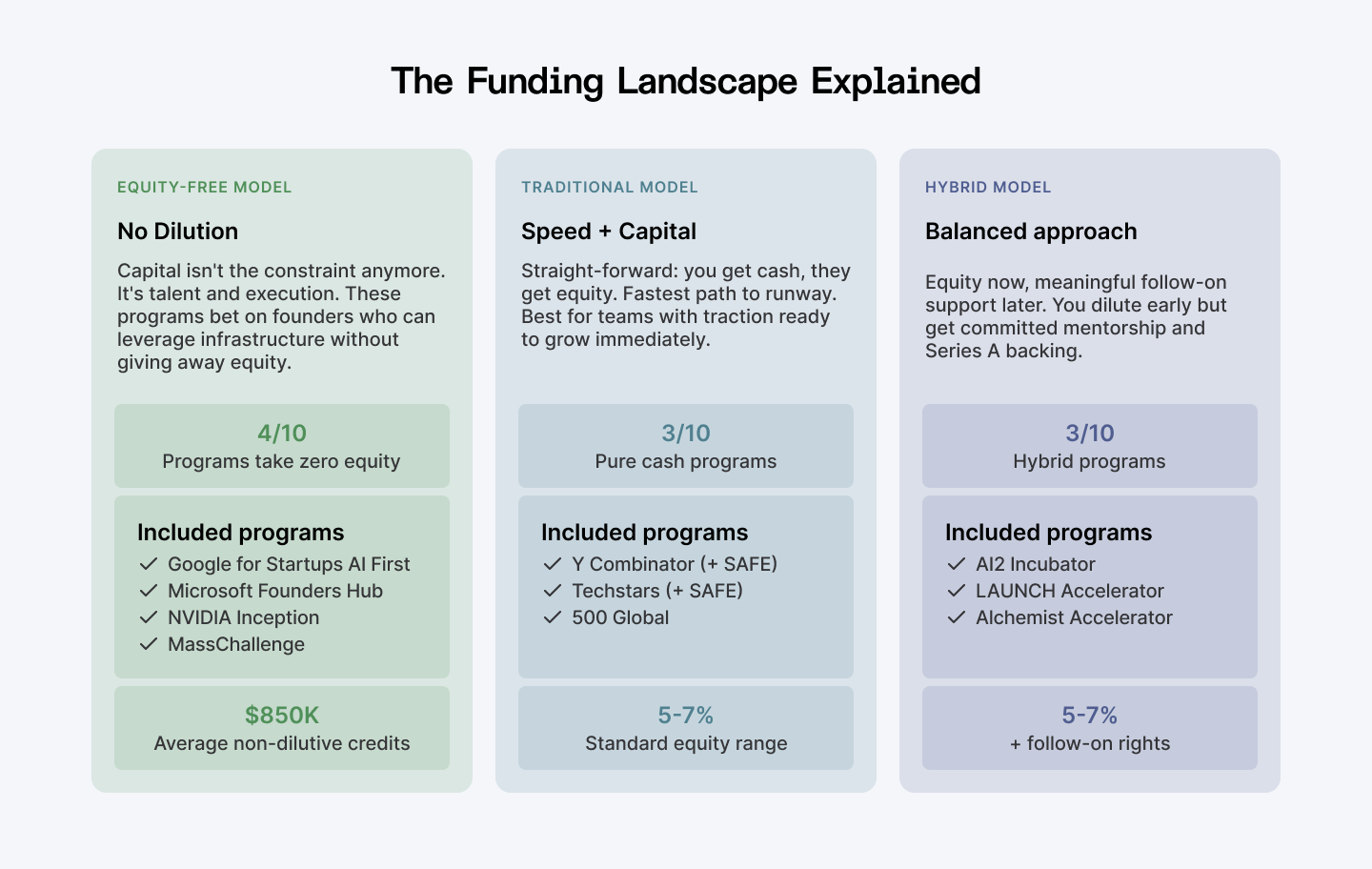
Here's the thing about the 2026 accelerator landscape—it's actually pretty simple once you stop overthinking it.
Some programs take zero equity. Google, Microsoft, NVIDIA, MassChallenge. They realized capital isn't the bottleneck anymore. Talent is. Execution is. So they give you $350k in compute credits or prize money and let you keep your cap table. That's it.
Then you've got programs that just write checks. Y Combinator, Techstars, 500 Global. You want their capital? You trade 5-7% equity. Simple math. You get runway, they get ownership. That's the deal. You both know what you're trading.
Then you've got the hybrid play. AI2, LAUNCH, Alchemist. They take equity, but they're actually backing you hard—Series A follow-ons with terms that protect you. You dilute now, but you get a real co-founder, not just a check.
Everything else is noise. Pick based on what you actually need to survive the next 18 months.
Tactical insight: Apply to rolling-admission programs immediately. Admission gets competitive as the year progresses. For fixed-deadline programs, have a polished pitch deck, 2-minute demo video, and founder bios finalized two weeks before.
Pro move: Don't apply to one accelerator. Apply to 5–7 simultaneously. Successful founders diversify, then pick the best fit. The negotiation leverage only increases.
⭢ See how major AI acquisitions in 2026 are reshaping the market and redefining competitive advantage.
The Developer Shortage is the Real Problem
Here's your real problem: hiring. Accelerators write checks. They don't hire engineers for you.
In 2026: 2 million dev jobs open. AI skills went from 5% to 9% of job postings in one year. Senior developers cost $235k+ now.
The supply simply doesn't exist. Demand is insane.
Accelerators give you credibility to recruit. They give you capital to pay competitive salaries. But you still need developers who can architect AI systems, validate model outputs, and deploy to production. This is where intentional recruitment becomes non-negotiable.
The execution reality: Startups don't scale on ideas. They scale on execution. If you graduate from an accelerator with $500k but no technical team, you've solved nothing.
➡︎ Build faster with the right team: An accelerator gives you capital and connections. It doesn't give you developers who've shipped at scale. Index.dev connects founders with senior AI engineers vetted across 20,000+ profiles. Post your role, get three pre-screened candidates in 48 hours. No months-long recruiting. Just builders who ship.
➡︎ Want to go deeper into where AI is really headed? Explore more Index.dev insights on AI literacy and what it means in 2026, how AI is reshaping application and cloud development, and which industries are closest to a real AI tipping point. You can also dig into practical perspectives on why forward-deployed engineers matter, plus hands-on model comparisons that break down DeepSeek versus ChatGPT, how it stacks up against Claude, and which open-source Chinese LLMs are gaining serious traction.