You don’t have time to interview 50 mediocre developers. You need to ship AI features. Yesterday.
In 2025, the "AI Gold Rush" is over. We are in the Efficiency Era. You don't need a prompt engineer; you need a builder who can fine-tune Llama-3, optimize RAG pipelines, and deploy to Kubernetes without crashing production.
But hiring them in the U.S. is broken. Salaries for Senior AI Engineers have hit $200k+. We tested the market. Here is the definitive shortlist of where to hire vetted AI talent in 2025, ranked by ROI, speed, and retention.
Looking to hire AI developers? Index.dev delivers pre-vetted, production-ready talent in 48 hours with risk-free trials.
The Shortlist (For the Busy CTO)
1. Index.dev: The "Production-Ready" Choice

Best For: CTOs who need to scale engineering capacity now but refuse to babysit freelancers.
Most platforms are revolving doors. You hire a freelancer, they ghost you in three months. Index.dev fixes the Retention Problem.
We specialize in sourcing Senior AI Engineers from LATAM and Central/Eastern Europe who are looking for long-term roles, not gigs.
The 2025 Edge
- The "Time Zone Tax" is Zero: Index.dev specializes in Latin America (LATAM) and Central/Eastern Europe (CEE). This means your developer is online when you are.
- The Vetting is Brutal: The platform doesn't just test for LeetCode style algorithms (which everyone cheats on with AI now anyway). We test for system design and production readiness. Only the top 5% pass.
- Sticky Talent: Platform’s retention rate hovers around 95%. In the gig economy, that is statistically absurd. It means you aren't re-hiring for the same role in 3 months.
The Cost
A Senior AI Engineer in San Francisco costs $220k/year. A Senior AI Engineer on Index.dev costs $60–$100/hour (~$120k/year). You get the same output for 50% of the cost.
Need local expertise? Index.hub connects you with vetted US-based developers who understand your market, compliance needs, and onsite requirements.
2. Toptal: The "Top-Tier" Option

Best For: Enterprise R&D units with deep pockets and very specific academic requirements.
Toptal built its brand on the "Top 3%" promise. They haven't changed.
If you need a developer with a PhD in Computer Vision to write a white paper on Neural Radiance Fields (NeRFs), go here.
The Pros:
- Extremely high talent floor
- White-glove service
The Catch:
- Price. You pay for the brand. Rates for senior AI talent often hit $150–$250/hour.
- Speed. Their rigorous internal process means matching can sometimes take longer than the automated platforms, though it's still faster than traditional recruiting.
- Extravagant. Often overkill for standard implementation work (e.g., integrating an API).
If budget is no object and you need to solve a math problem that hasn't been solved before, call Toptal. For everything else, it might be disproportionate.
3. Turing: The Automated Engine

Best For: Companies who need speed above all else, or who are building LLM training datasets.
Turing has pivoted. While they still do staffing, they are now a major player in "Coding for AI". They supply the massive volume of human-written code needed to train models like GPT-5 and Claude. Even OpenAI’s Sam Altman has credited partners like Turing for improving model reasoning.
The 2025 Reality:
Their "Intelligent Talent Cloud" matches developers in minutes. But because their new focus is fueling LLMs, their pool of 3 million+ devs is heavily optimized for gig-style task completion (RLHF, data labeling) rather than long-term product architecture.
They have pivoted significantly toward being a "Coding for AI" provider, supplying the massive amounts of human-written code needed to train models like GPT-5 and Claude.
The Experience:
It’s highly automated. You might not talk to a human recruiter until late in the process. For some, this is a feature. For others, it feels impersonal.
Pros:
- Speed: You can get matches in minutes.
- Platform: Their workspace management tools are slick.
Cons:
- Variable Quality: The automated vetting is fast, but sometimes lacks the nuance of a human technical screener.
- Churn: Higher turnover than boutique firms.
Use Turing if you need 50 developers by Monday to clean a dataset or run unit tests.
Next up: See what AI gets right—and wrong—when hiring developers.
4. Gun.io: The Boutique Choice

Best For: Non-technical founders who need a partner, not a mercenary.
Gun.io is the anti-platform. They don’t boast about having "millions" of developers. They have a small, tight-knit community of senior engineers. Their differentiator in 2025 is soft skills vetting.
Gun.io vets heavily for English proficiency and "founder mindset."
Why it matters:
In the age of AI, you don't just need a coder. Communication is the premium asset. That’s because ambiguity is high in AI development.
Gun.io excels at finding developers who can explain why your RAG (Retrieval-Augmented Generation) pipeline is hallucinating, rather than just throwing more compute at it.
5. Arc.dev: The Remote Bridge

Best For: Startups looking to make their first full-time remote hire.
Arc (formerly Codementor) has leaned hard into the "Permanent Remote" model.
2025 Feature:
Their HireAI tool helps draft JDs and screen candidates quickly. They focus heavily on the "Silicon Valley caliber" branding.
If you are trying to build a global core team that will be with you for 4 years (and you are willing to navigate local compliance/EOR yourself), Arc is a strong contender.
6. Braintrust: The Crypto-Native's Favorite

Best For: Web3 projects and "User-Owned" enthusiasts.
Braintrust is unique: it’s a user-owned talent network. The talent keeps 100% of their rate (no platform rake from their side).
This economic model attracts a very specific type of senior engineer: independent, highly skilled who are tired of giving Upwork 10-20%.
The 2025 Angle:
Because they attract crypto-adjacent talent, they have a surprisingly strong pool of engineers skilled in the intersection of AI and Blockchain (a growing niche in 2025).
Since there is a massive overlap between Cryptography and AI in 2025 (think Zero-Knowledge ML), this is a hidden gem for finding niche experts.
7. Upwork: The "Bazaar"

Best For: Data labeling, scraping scripts, and one-off isolated tasks.
You know Upwork. Everyone knows Upwork. It is the largest marketplace on earth.
In 2025, it’s flooded with "AI Experts" who took a prompt engineering course last week.
The Risk:
For every 1 great developer, there are 50 bots applying to your job. Vetting is 100% on you. In short—high noise, hidden gems.
The Use Case:
Never hire your Core AI Architect here. But if you need someone to scrape 10,000 PDFs or label a dataset for $20/hour, Upwork is still king. Just be prepared to spend 10 hours filtering spam proposals to find the one diamond.
Next up: Explore top 5 countries for the best ROI on AI developer salaries in 2026.
Why US Companies are Nearshoring in 2026
You can’t ignore economics. The average salary for a Senior AI Engineer in the US has hit $200k+. Meanwhile, the "AI Premium" means you are competing with OpenAI and Anthropic for talent.
Nearshoring to LATAM (via platforms like Index.dev) leverages Geographic Arbitrage.
2025 Cost Comparison (Senior AI Engineer)
| Region | Est. Annual Cost | Time Zone Overlap |
| USA (Tier 1 City) | $220,000+ | 100% |
| LATAM (Index.dev) | $80,000 - $110,000 | 80-100% |
| Asia (Offshore) | $50,000 - $80,000 | < 10% |
Data Source: Index.dev 2025 Hiring Trends Report
Platform Comparison
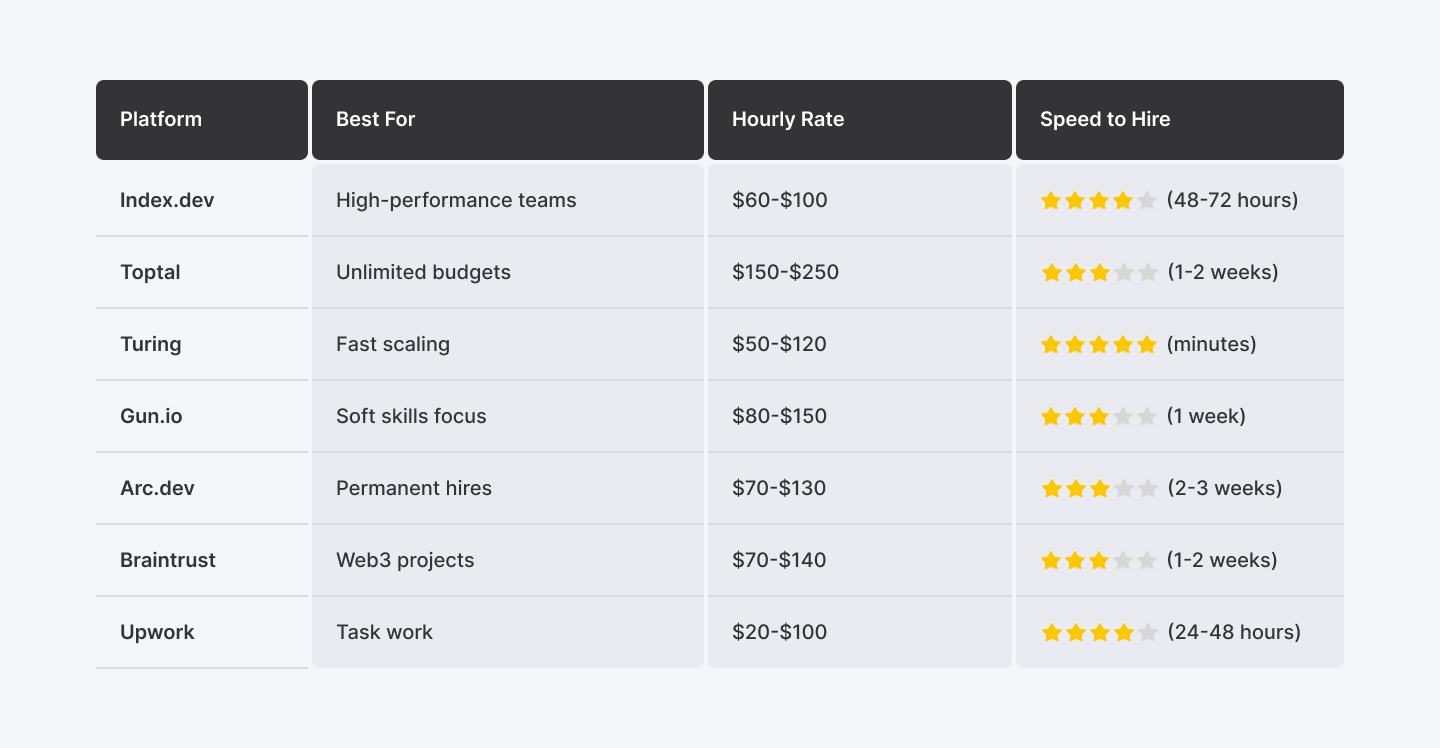
The "Time Zone Tax"
Hiring in Asia is cheaper, but the "Time Zone Tax" kills velocity. If your AI lead is asleep when you find a critical bug, you lose a day.
LATAM engineers work when you work. Real-time collaboration is non-negotiable in Agile AI development.
The "Generalist" Shift
According to the SignalFire 2025 State of Talent Report, the era of the hyper-specialist is fading. The winner of 2025 is the AI-Enabled Generalist—someone who doesn't just know Python, but knows how to leverage Cursor, Replit, and Copilot to do the work of three people.
You aren't looking for a coder anymore. You are looking for an editor of high-velocity code.
How to Vet AI Developers (The 2025 Playbook)
Most hiring managers are vetting for 2021. Stop asking them to invert a binary tree on a whiteboard.
Here is how you vet for the Agentic AI Era:
The "Blank Editor" Test:
Give them a vague problem ("Build a sentiment analysis tool for Twitter"). Watch how they use AI.
Do they copy-paste blindly? Or do they use the AI to scaffold the boilerplate, then manually refine the logic? You want the pilot, not the passenger.
System Design over Syntax:
Syntax is free now. Architecture is expensive. Ask: “How would you design a RAG pipeline that handles 1M documents without blowing up our vector database costs?”
The Ethics Check:
Ask about bias. "How do we ensure our loan-approval bot doesn't discriminate?" A junior dev will stare at you blankly. A senior dev will talk about training data distribution and explainability metrics.
Want to hire real AI/ML experts? This guide shows you exactly what to look for.
Wrapping Up
The goal isn't to "fill a seat." The goal is to ship products before your competitor does.
- If you have infinite money: Toptal.
- If you need pros for data tasks: Turing or Upwork.
- If you want to build a high-performance team that sticks around: Index.dev.
The talent is out there. But they aren't on job boards applying to your "Easy Apply" link. They are already working or waiting to be shortlisted. You just need a partner who knows where to find them.
➡︎ Need AI engineers who can ship? Index.dev connects you with production-ready AI specialists from LATAM and CEE in 48 hours—senior talent at half the Silicon Valley cost, with 95% retention and zero time zone headaches.
➡︎ Want to dive deeper into developer hiring and talent strategies? Explore our guides on how to effectively vet software developers to avoid costly mis-hires, proven strategies to retain your best tech talent, the top platforms to hire backend developers in the USA, our comprehensive developer onboarding process, and 5 common reasons developers fail job vetting.