A job title doesn’t make you senior. You could have “Senior Developer” on LinkedIn and still leave your team in chaos. I once heard a Tech Lead say,
“I don’t care if you’ve been coding for ten years. If every year you did the same thing, that’s one year, not ten.”
When I started, I thought being a senior was all about code. Clean pull requests. Fast bug fixes. Deep framework knowledge. Those things matter. They’re the shiny, visible part. But real seniority is what happens when the code doesn't work. When the deadline moves up. When the product team changes direction three days before launch. When a junior developer is stuck and too afraid to ask for help. True seniority is how you make decisions, how you handle trade-offs, how you communicate, and how you leave your ego at the door.
So what really makes a developer senior? Let’s dig into it.
Want to level up your career? Join Index.dev to work remotely with top UK and US companies.
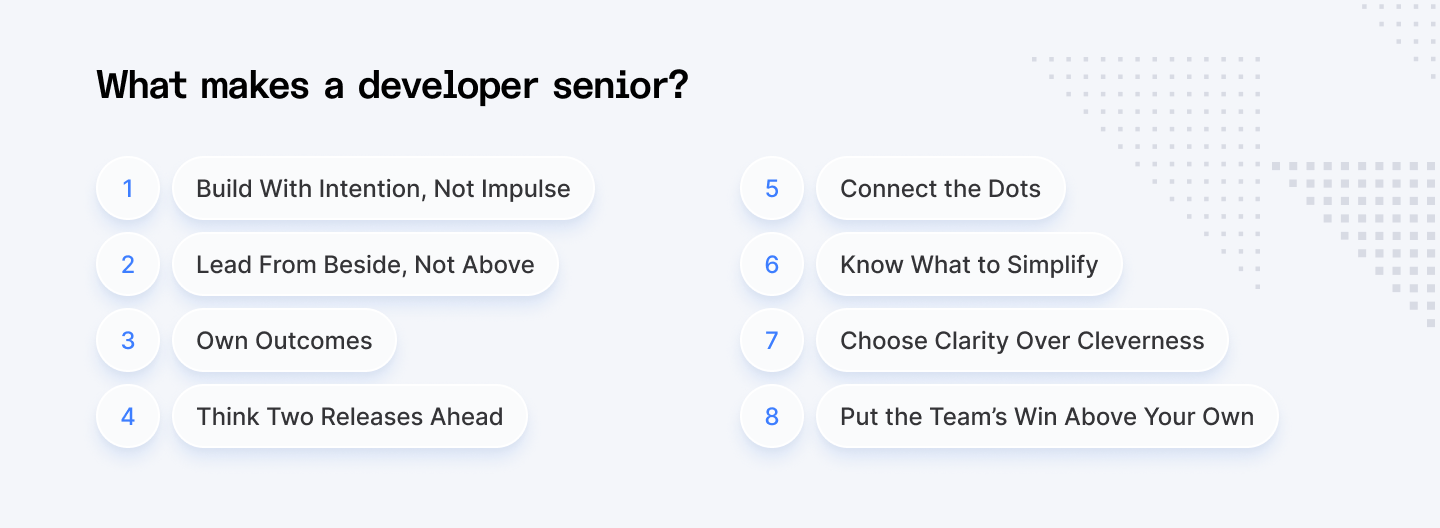
1. Build With Intention, Not Impulse
Boring first, flexible later
Being senior is less about writing the fanciest code and more about making smart choices before you even touch a keyboard. Great engineers work in context. Business context. Team context. Time context. Before they open their editor, they ask: what problem are we solving, and what cost are we willing to pay?
A common scenario
Your team needs to add search to an app. It's basic stuff: users want to find records by keyword across a few fields. You've got a solid PostgreSQL database already running. Do you add a full text search engine like Elasticsearch? A junior developer gets excited about the new technology. They read the docs, watch some conference talks, and start drafting the architecture.
A senior developer pauses. They know Elasticsearch is powerful, but they also know it means another system to learn, deploy, monitor, and keep in sync. They ask: what are we searching for? A few thousand records? A million? Do we need fuzzy matching, relevance scoring, or real-time updates? Or do we just need "find me the customer named Smith"? Most of the time, Postgres with proper indexes handles it fine.
Senior developers think in trade-offs, never absolutes:
- Speed versus longevity.
- Sometimes you need a quick win. Sometimes you need the foundation. The trick is knowing which game you're playing.
- Sometimes you need a quick win. Sometimes you need the foundation. The trick is knowing which game you're playing.
- Operability versus performance.
- A system that's 10% slower but your team can debug beats a performance monster that only one person understands.
- A system that's 10% slower but your team can debug beats a performance monster that only one person understands.
- Familiarity versus capability.
- Your team knows React. The new framework promises better performance. But what's the real cost of that learning curve? How long until you're productive again?
- Your team knows React. The new framework promises better performance. But what's the real cost of that learning curve? How long until you're productive again?
- Complexity today versus flexibility tomorrow.
- Abstractions buy you flexibility, but they cost you simplicity. Make the wrong call and you're maintaining a framework nobody needs.
- Abstractions buy you flexibility, but they cost you simplicity. Make the wrong call and you're maintaining a framework nobody needs.
- Obvious costs versus hidden costs.
- That new tool looks free until you factor in training, integration time, monitoring, and the on-call burden.
- That new tool looks free until you factor in training, integration time, monitoring, and the on-call burden.
Then they ask the quiet, seemingly simple questions that save months of work:
- What are we optimizing for here? Not in theory. In practice. Is it time to market? Developer happiness? Cost? Reliability? You can't optimize for everything.
- What breaks first when we're wrong? Every decision has failure modes. Good judgment means knowing which failures you can handle and which ones sink you.
- Who's going to own this in production? It's easy to add complexity. It's hard to maintain it. If the person who built it leaves, can someone else pick it up?
- What's our rollback plan? Things go wrong. Can you undo this decision in a day, a week, or are you locked in for years?
- What data would tell us to change course? Set the criteria upfront. If performance drops below X, if deployment time exceeds Y, if the team can't onboard new members in Z weeks, then we revisit.
Often, the answer is: choose the boring solution that fails in familiar ways. Not always. Sometimes you need to invest in something new, but only with a clear migration path and explicit exit ramps. Either way, senior thinking looks past the immediate win to see the system effects. They're buying the team options and keeping risk contained.
How to build this skill
Start keeping a decision log. Write down the technical choices you make and why. Six months later, review them. What went right? What went wrong? What would you do differently? This is how you build your pattern library.
Before you reach for a new tool or pattern, write down three boring alternatives. Force yourself to articulate why the boring solution isn't enough. If you can't, stick with boring.
When you make a trade-off, make it explicit. Don't let it hide in your head. Tell your team: "We're choosing speed over flexibility here because we need to ship by the end of quarter. If this feature takes off, we'll need to rebuild it in Q2." That clarity prevents revisionist history later.
2. Lead From Beside, Not Above
Humility over heroics
True seniors don’t play heroes. They don’t show up to “rescue” the code or the project just to be admired. They make the people around them better. That shift, that move from “me” to “we”, is the real sign of seniority. Early on, you optimize for your own output. Later, you optimize for the team. You share context, quietly unblock blockers, and set patterns others can follow. Influence grows because people trust you, not because a title demands it.
Day to day, it looks like this
- Code reviews become coaching sessions.
- You highlight trade-offs, explain risks, suggest simpler paths, and show why. You're not just pointing out the problem. You're teaching the pattern.
- You highlight trade-offs, explain risks, suggest simpler paths, and show why. You're not just pointing out the problem. You're teaching the pattern.
- You pair with intention.
- Ten minutes on a video call walking through a debugging technique beats two hours of back-and-forth in comments. Last month a junior dev was stuck in a race condition. I could have fixed it in five minutes and moved on. Instead, I asked, "Want to pair on this?" We spent twenty minutes there. I showed how I use logging to track execution order, how to reproduce it reliably, how to verify the fix.
- Ten minutes on a video call walking through a debugging technique beats two hours of back-and-forth in comments. Last month a junior dev was stuck in a race condition. I could have fixed it in five minutes and moved on. Instead, I asked, "Want to pair on this?" We spent twenty minutes there. I showed how I use logging to track execution order, how to reproduce it reliably, how to verify the fix.
- You write things down.
- Crisp PR descriptions that explain the "why" behind the change. One-page docs that lay out the gotchas in a system. Not because you have to. Because you've been the person six months later trying to figure out why the code works this way. Every time you write something down, you're preventing someone from having to ask you directly. You're scaling yourself.
- Crisp PR descriptions that explain the "why" behind the change. One-page docs that lay out the gotchas in a system. Not because you have to. Because you've been the person six months later trying to figure out why the code works this way. Every time you write something down, you're preventing someone from having to ask you directly. You're scaling yourself.
- You surface good work that others might miss.
- In standups, in Slack, in retrospectives, you point out when a junior developer wrote a particularly clean fix. When a designer created a flow that avoided a technical nightmare. When QA caught something critical. Credit costs you nothing and buys you everything.
- In standups, in Slack, in retrospectives, you point out when a junior developer wrote a particularly clean fix. When a designer created a flow that avoided a technical nightmare. When QA caught something critical. Credit costs you nothing and buys you everything.
- You keep the room healthy.
- You notice when someone's been quiet in meetings and ask what they think. You translate harsh feedback into something constructive. When someone makes a mistake, you focus on the system that allowed it, not the person.
- You notice when someone's been quiet in meetings and ask what they think. You translate harsh feedback into something constructive. When someone makes a mistake, you focus on the system that allowed it, not the person.
- When things get tense, you stay calm.
- During a production incident, panic spreads fast. The senior developer who can say "Okay, you check the database logs, you verify the cache is responding, I'll check if the API gateway is throttling us. Let's sync in five minutes" just cut the response time in half.
- During a production incident, panic spreads fast. The senior developer who can say "Okay, you check the database logs, you verify the cache is responding, I'll check if the API gateway is throttling us. Let's sync in five minutes" just cut the response time in half.
None of this requires a manager title. Leadership here is practice, not position. You model how to disagree without getting personal. You admit when you don't know something and ask for help early. You say no when scope creep would torpedo the release. You say yes to the unglamorous fixes that prevent future pain.
How to build this skill
Start by reviewing your last five code review comments. Are you explaining or just correcting? Are you teaching the principle or just fixing the instance? Rewrite one of them the way you wish you'd written it originally.
Pick one junior or mid-level developer on your team. Once a week, ask them if they're stuck on anything. Not in a formal mentorship way. Just a casual "Hey, working on anything tricky?" Most people won't volunteer that they're struggling. But they'll tell you if you ask directly.
Document one thing this week that only exists in your head. A debugging trick. An architectural decision. Put it where your team can find it. Then watch how often it gets used.
Looking to make your mark in open source? Discover 20 open-source GitHub projects that will challenge you.
3. Own Outcomes
End-to-end or it isn’t done
For seniors, the work doesn’t end at merge. It starts in production. They think in outcomes, not tickets. A feature isn’t “done” the moment the code lands. It’s done when it solves a real problem, performs under load, and is easy to operate. That mindset changes everything you do.
A common scenario
Let's say your team just shipped a new checkout flow. You rewrote the payment processing, cleaned up the validation, deployed it. Most developers call that done and move on to the next ticket.
A senior developer asks different questions.
- Are conversion rates steady or better?
- What's happening to page load times under real traffic?
- Are API response times reasonable at peak?
- What errors are showing up and where?
- Are customers completing purchases or dropping off at some unexpected step?
Before you even deploy, you've already thought through this. You added a few key metrics to a dashboard. Nothing fancy. Just conversion rate, average checkout time, payment success rate. You set up two alerts that actually matter: if error rate spikes above 2%, if checkout completion drops below baseline. You documented the rollback procedure in the PR description. You wrote down three quick health checks anyone on-call can run.
After release, you don't just walk away. You watch those numbers for the first few hours. You skim the support tickets that come in. You look for patterns. And when you see that three users hit the same validation error, you don't wait for someone to file a bug. You fix it that afternoon while the context is fresh.
This isn't perfectionism. It's pragmatism.
Here’s a simple way to think about “definition of done” for seniors:
- Monitoring that matters is in place.
- Not monitoring for monitoring's sake. Specific metrics that tell you if this feature is working.
- Not monitoring for monitoring's sake. Specific metrics that tell you if this feature is working.
- Documentation that helps the next person.
- A PR description with rollback steps. A runbook update with health checks. A quick note about why you made this architectural choice.
- A PR description with rollback steps. A runbook update with health checks. A quick note about why you made this architectural choice.
- A way to measure if you delivered value.
- This can be simple. Did the error rate go down? Did the feature get used? Did customers stop complaining about that flow? If you can't measure it, you can't know if you succeeded.
- This can be simple. Did the error rate go down? Did the feature get used? Did customers stop complaining about that flow? If you can't measure it, you can't know if you succeeded.
- The system is easier to operate than before.
- This is the part most people miss. Did you add complexity or remove it? Did you make the next deployment riskier or safer? Did you create more on-call burden or less?
- This is the part most people miss. Did you add complexity or remove it? Did you make the next deployment riskier or safer? Did you create more on-call burden or less?
Ownership also shows up in smart choices. If a small library solves the problem cleanly, they use it. If pairing today gives a better result, they block the time. If scope threatens reliability, they cut it and document why. Ego never drives the plan. Outcomes do.
How to build this skill
Before your next feature goes to production, write down three specific metrics you expect to change and by how much. Then check them a day after release, a week after release. Were you right? If not, why not? This habit trains you to think in outcomes instead of outputs.
Set a calendar reminder for one week after your next deployment. Spend thirty minutes reviewing what actually happened. Look at metrics, support tickets, error logs. What surprised you? What would you do differently? Write it down.
Next time something breaks in production, volunteer to write the post-mortem. Not to blame anyone. To practice thinking systemically about failure. What allowed this to happen? What would prevent an entire class of similar failures? That's the skill.
4. Think Two Releases Ahead
See the map while everyone sees the mile
Junior developers solve the problem in front of them. Senior developers ask if it's the right problem to solve.
Systems break, priorities shift, and requirements mutate. What separates a senior from a junior or mid-level developer is not just skill, but the ability to stay focused, calm, and effective when everything moves under your feet.
A common scenario
Your product manager comes to you with a feature request: users want to export their data to Excel. The junior developer starts researching Excel libraries, thinking about file formats, planning the implementation.
The senior developer asks questions first.
- How often will people use this?
- Who's asking for it?
- What are they trying to accomplish with the export?
Turns out it's three power users who want to do custom analysis. They're exporting the data, then importing it into their own tools. The real problem isn't "we need Excel export." The real problem is "we need better filtering and aggregation in the product."
You could spend two weeks building Excel export that three people use once a month. Or you could spend two weeks improving the filtering that everyone uses every day, which also solves the power users' problem.
Strategic thinking shows up in how you frame problems. When you bring an issue to stakeholders, you don't just present the technical constraint. You translate it into business impact and options.
- Senior developers think in terms of leverage.
- They ask: what's the highest-value thing we could be working on right now? Sometimes that means saying no to feature requests. Sometimes it means questioning the roadmap. Sometimes it means pointing out that the bug everyone's ignoring is going to become a crisis in three months.
- They ask: what's the highest-value thing we could be working on right now? Sometimes that means saying no to feature requests. Sometimes it means questioning the roadmap. Sometimes it means pointing out that the bug everyone's ignoring is going to become a crisis in three months.
- They think in systems, not features.
- When you propose adding a new capability, a senior thinks about the entire lifecycle. How will this be monitored? What happens when it breaks? How will users discover it? What does support need to know? How will we deprecate it when we build the better version? Who will maintain it when the original developer moves to another team? These aren't blockers. They're inputs to the decision.
- When you propose adding a new capability, a senior thinks about the entire lifecycle. How will this be monitored? What happens when it breaks? How will users discover it? What does support need to know? How will we deprecate it when we build the better version? Who will maintain it when the original developer moves to another team? These aren't blockers. They're inputs to the decision.
- They also think in time horizons.
- What solves today's problem might create tomorrow's crisis. What looks expensive now might be cheap compared to the alternative. Your database is getting slow. You could add caching and buy another six months. Or you could invest two months in proper indexing and query optimization that solves it for years. Which path you choose depends on your constraints, your goals, your team capacity.
- What solves today's problem might create tomorrow's crisis. What looks expensive now might be cheap compared to the alternative. Your database is getting slow. You could add caching and buy another six months. Or you could invest two months in proper indexing and query optimization that solves it for years. Which path you choose depends on your constraints, your goals, your team capacity.
How to build this
Before you start any new task this week, ask yourself: what problem is this actually solving? Who benefits and how much? What happens if we don't do this at all? Write down your answers. You might be surprised by what you discover.
Next time you're in a planning meeting, count how often people discuss impact versus effort. If a task is proposed, ask: "What does success look like? How will we know this worked?" Make measuring outcomes a habit.
Pick one feature or system your team built in the last year. Now research: how much is it used? What's the adoption rate? What's the impact? Compare that to the effort invested. What does that tell you about how you prioritize work? Use that data to inform future decisions.
5. Connect the Dots
Build bridges, not silos
Being senior isn’t just about knowing your framework inside out. It’s about connecting the dots between people, ideas, and systems. A senior developer doesn’t just write code, they make sure everyone else can understand it, build on it, and act on it.
Translation is the skill that matters most.
A common scenario
Seniors are the bridges that keep teams moving. They connect code to context, ideas to outcomes, and people to results.
Here's what bad communication looks like:
- "We can't ship this feature because the cyclomatic complexity is through the roof and we need to refactor the service layer before we add more conditional logic or we'll be dealing with an unmaintainable mess." Technically accurate. Completely useless to anyone who needs to make a business decision.
Here's the same thing translated:
- "This part of the code has gotten messy. If we spend a week cleaning it up now, new features will ship faster and break less often. Without that cleanup, each new feature takes longer and introduces more bugs. Your call on timing, but the cost only goes up the longer we wait."
Same information. Different frame. Now someone can make a decision.
The difference is that you've pointed at outcomes people care about: speed, reliability, cost. You've given them options instead of a wall.
Translation works in both directions. When a product manager says "users are frustrated with the checkout flow," a junior developer might shrug and say "works fine for me." A senior digs in. What specifically is frustrating? Where are they dropping off? What do the analytics show? What did support hear?
During incidents, seniors are calm narrators. Imagine the API gateway is down. The junior devs are panicking. A senior steps in and says, “Here’s what we know, here’s what we’re trying next, and here’s when I’ll update you again.” Everyone stays focused instead of guessing or blaming.
Seniors also deliver hard news early and clearly. When you realize the current approach won't scale, you don't wait until it's too late to fix. You raise it now, with alternatives and honest cost estimates.
- "This approach will handle our current traffic fine, but when we hit the growth targets for next quarter, response times will degrade. We can either refactor now for two weeks, or we can ship this and plan a bigger rewrite in Q2. Here are the trade-offs for each path."
When you're behind schedule, you don't hide it and hope you can make it up. You surface it early with options.
- "We're tracking a week behind because the third-party API isn't documented correctly and we've been troubleshooting integration issues. We can still hit the deadline if we cut the admin dashboard and ship it in the next sprint. Or we keep everything and push the date. What matters more?"
The goal is alignment. You're not complaining. You're giving stakeholders the information they need to make good decisions.
How to build this
Next time you write a technical update, read it from the perspective of someone who doesn't write code. Can they understand what you're saying? Can they make a decision based on it? If not, rewrite it focusing on outcomes and options, not implementation details.
In your next meeting with non-technical stakeholders, count how many times you use jargon. Pick your top three most-used technical terms and practice explaining them in plain language. "Caching" becomes "storing a copy so we don't have to fetch it again." "Refactoring" becomes "cleaning up the code so it's easier to change."
Once this week, ask someone from a different team about their biggest frustration with your team's work. Really listen. Don't defend. Don't explain. Just understand their perspective. Then figure out what small change in your communication could prevent that friction.
Want to level up your Python? Test yourself with these essential concepts and see how you measure up as a senior developer.
6. Know What to Simplify
Simplicity that scales
Messy systems are inevitable. A senior doesn’t romanticize the mess or show off by wrestling with it. They respect it, map it, and then work to reduce friction for the team.
A common scenario
I've seen this play out dozens of times. A team starts with a simple feature. Then someone decides it needs to be "extensible." So they add a plugin system. Then a config file to control the plugins. Then a factory to instantiate the plugins based on the config. Then an abstract base class because "what if we need different types of plugins later?"
Six months later, you've got five layers of abstraction between the HTTP request and the actual business logic. Adding a new feature takes three days because you have to thread it through all these layers. Bugs hide in the seams between components. The person who built it left, and now nobody really understands how it all fits together.
That's complexity theater. The senior move is almost always to delete. Replace all those layers with explicit code paths and clear tests. Keep one small interface where extension happens. Delete everything else.
What happens? Requests get faster because there are fewer hops. Changes take hours instead of days because you can see the whole path. New people can understand it because there's less magic.
I worked on a codebase that had a "universal data transformer" framework. Beautiful abstraction. Configurable pipelines. Completely over-engineered. We spent two weeks ripping it out and replacing it with five simple functions that did exactly what we needed. Performance improved by 40%. Bugs dropped because there were fewer places for things to hide.
When complexity is truly required, treat it like hazardous material. Handle it with care:
- Isolate it behind a clear boundary.
- Put the complexity in one place with a small, simple API. Everything outside that boundary should be straightforward. The messy coordination logic lives in the scheduler. The rest of the system just calls schedule(task, when) and doesn't think about it.
- Put the complexity in one place with a small, simple API. Everything outside that boundary should be straightforward. The messy coordination logic lives in the scheduler. The rest of the system just calls schedule(task, when) and doesn't think about it.
- Draw the diagram before you write the code.
- If you can't sketch how the pieces fit together on a whiteboard in two minutes, you don't understand it well enough to build it. And if you can't explain it simply, the next person definitely won't understand it.
- If you can't sketch how the pieces fit together on a whiteboard in two minutes, you don't understand it well enough to build it. And if you can't explain it simply, the next person definitely won't understand it.
- Add observability where things can go wrong.
- Log the decision points. Add a metric for the happy path and the failure cases. When it breaks at 2am, you want data, not guesswork.
- Log the decision points. Add a metric for the happy path and the failure cases. When it breaks at 2am, you want data, not guesswork.
- Write down the why.
- Not in code comments explaining syntax. In a short doc that captures why this complexity exists, what alternatives you considered, and what would need to be true to simplify it.
- Not in code comments explaining syntax. In a short doc that captures why this complexity exists, what alternatives you considered, and what would need to be true to simplify it.
The default should always be: prefer fewer moving pieces. Push complexity to the edges where it's easier to contain. Question every abstraction. If you can't articulate the concrete benefit, you don't need it.
7. Choose Clarity Over Cleverness
Write code humans can read
Early in your career, clever tricks feel like mastery. You write nested ternaries, recursive one-liners, or chain obscure language features. It works. It tests green. But six months later, even you struggle to understand it. Senior developers write for readers first. They choose clarity over cleverness every time.
A common scenario
Look at these two approaches to the same problem:
// clever
const groups = arr.reduce((a, x) => ((a[x.k] ??= []).push(x), a), {});

// clear
const groups = {};
for (const item of arr) {
  const key = item.k;
  if (!groups[key]) {
    groups[key] = [];
  }
  groups[key].push(item);
}
The first one is technically impressive. It uses reduce, nullish coalescing, comma operators. It's one line. If you understand JavaScript deeply, you can parse it.
The second one is longer. It's explicit. A junior developer can read it and understand what's happening. Someone coming from another language can follow it. Both pass the tests. Only one is kind to tired brains.
Clarity shows up in a thousand small choices:
- Names say what things are, not how they work.
- expiresAt is better than t. customerEmail is better than e. hasPermission is better than check. You're not saving anything meaningful by being terse. But you're costing everyone else cognitive load.
- expiresAt is better than t. customerEmail is better than e. hasPermission is better than check. You're not saving anything meaningful by being terse. But you're costing everyone else cognitive load.
- Functions do one thing.
- When a function scrolls off the screen, it's doing too much. When a function has three different levels of abstraction, it's too complicated. Break it up. Give each piece a name that describes what it does.
- When a function scrolls off the screen, it's doing too much. When a function has three different levels of abstraction, it's too complicated. Break it up. Give each piece a name that describes what it does.
- Comments explain why, not what.
- // Loop through items is useless. The code already says that. // Skip expired subscriptions because billing already processed them is useful. It explains business logic the code can't express.
- // Loop through items is useless. The code already says that. // Skip expired subscriptions because billing already processed them is useful. It explains business logic the code can't express.
- Edge cases are handled in the open.
- Don't hide error handling in clever control flow. Don't bury special cases in nested ternaries. Make them explicit. if (user.isAdmin) { return allData; } at the top of a function is clear. Weaving that logic through three layers of conditionals is not.
- Don't hide error handling in clever control flow. Don't bury special cases in nested ternaries. Make them explicit. if (user.isAdmin) { return allData; } at the top of a function is clear. Weaving that logic through three layers of conditionals is not.
- Consistency matters more than personal preference.
- Seniors help a team settle on conventions and stick to them. Not because one way is objectively better, but because switching mental modes is expensive. When the codebase feels like it was written by one person, everything gets easier. You stop thinking about style and start thinking about logic.
- Seniors help a team settle on conventions and stick to them. Not because one way is objectively better, but because switching mental modes is expensive. When the codebase feels like it was written by one person, everything gets easier. You stop thinking about style and start thinking about logic.
I used to think consistency was about ego or aesthetics. Now I realize it's about efficiency. Every time someone reads code and has to decipher a different style, that's cognitive overhead that could have gone toward understanding the actual problem. Clarity isn't dumbing things down. It's showing respect for the people who come after you. It's recognizing that code is a liability, not an asset.
The less mental effort it takes to understand, the more mental effort goes toward building the right thing.
How to build this
Go back to something you wrote six months ago. Can you understand it immediately? Does it make sense, or do you have to reverse-engineer your own thinking? If it's hard for you to understand your own code, it's definitely hard for everyone else. Rewrite the confusing parts.
Next time you're about to write something clever, stop. Ask yourself: am I doing this because it's better, or because it makes me feel smart? Write the boring version instead.
Establish one team convention this month. It doesn't matter what it is. How you name functions. Where error handling goes. How you structure test files. Pick one thing, document it in three sentences, and stick to it. Consistency is a force multiplier.
8. Put the Team’s Win Above Your Own
Less proving, more contributing
Early in my career, I tied my identity to my code. A critical code review felt like a personal attack. Winning a technical argument mattered more than finding the right solution. If someone questioned my approach, I got defensive.
That's natural when you're a junior. You're still proving yourself. You need validation. Your code is how you demonstrate value, so criticism of your code feels like criticism of you.
But that fades. Or at least, it should. The shift from junior to senior isn't just technical. It's emotional. The work stops being about proving yourself and starts being about serving the team and the product.
A common scenario
I remember writing a long comment on a PR defending my architectural choice. I had reasons. Good reasons. I spent twenty minutes typing them out. Then a teammate posted two test cases that completely broke my approach. I stared at it for a minute. Then I wrote: "You're right. I missed that. Let's go with your solution." And I merged their code.
That moment did more for my reputation than any argument I ever won. People remembered that I could change my mind. That I cared about being right more than looking right. After that, they trusted my technical judgment more, not less, because they knew it wasn't driven by ego.
- Your sense of purpose widens as you mature.
- Cool technology is still interesting. Solving hard problems is still satisfying. But they're not the point anymore. The point is solving a real problem for real users. That shift gives you a steadier hand. When deadlines move, you don't panic. When plans change, you adapt. When someone proposes a completely different approach halfway through, you can evaluate it fairly.
- Cool technology is still interesting. Solving hard problems is still satisfying. But they're not the point anymore. The point is solving a real problem for real users. That shift gives you a steadier hand. When deadlines move, you don't panic. When plans change, you adapt. When someone proposes a completely different approach halfway through, you can evaluate it fairly.
- You stop treating your code like your child.
- It's not precious. It's functional. If it needs to be replaced, you replace it. If someone else's approach is better, you use theirs. The goal is shipping good software, not protecting your contribution.
- It's not precious. It's functional. If it needs to be replaced, you replace it. If someone else's approach is better, you use theirs. The goal is shipping good software, not protecting your contribution.
- This matters most when things get stressful.
- When production is down. When the launch date gets moved up. When the requirements change three days before deployment. A senior developer sets the tone. They stay calm. They break the problem down into clear steps. They give short, regular updates so nobody spirals into panic. They use plain language. They don't assign blame.
- When production is down. When the launch date gets moved up. When the requirements change three days before deployment. A senior developer sets the tone. They stay calm. They break the problem down into clear steps. They give short, regular updates so nobody spirals into panic. They use plain language. They don't assign blame.
Senior developers make heroics unnecessary. They build systems that don't break. They document things so anyone can fix them. They share knowledge so they're not a single point of failure. They'd rather be boring and effective than dramatic and essential.
The best senior developers I know still call themselves learners. They read. They experiment. They try new tools and approaches. They admit when they don't know something. Their confidence sits alongside humility. They know what they're good at. They also know what they don't know. And they're comfortable with both.
How to build this
Next time you get critical feedback on your work, notice your first reaction. Is it defensive? Do you want to explain why the critic is wrong? Just notice it. You don't have to act on it. Awareness is the first step to changing the pattern.
Pick one technical opinion you hold strongly. Now try to argue the opposite position. What would someone who disagrees with you say? What's their strongest point? This exercise weakens your ego's grip on your technical thinking.
After your next project ships, write down three things that went wrong or could have been better. Not as blame. As for learning. Share it with your team.
How Do You Even Measure Seniority?
Talking about junior, mid-level, and senior developers makes it sound like there’s a single measuring stick. There isn’t.
The skills that define a senior developer shift depending on the company, the product, and the context. The skills that make you senior at a ten-person startup are different from what makes you senior at a 10,000-person enterprise.
A senior developer building embedded systems needs different strengths than a senior developer building web apps. Context matters more than credentials.
To get a handle on it, I like to think in four broad skill areas:
- Your ability as an individual contributor.
- Can you solve hard technical problems? Can you write solid code? Can you debug gnarly issues? This is the baseline. You can't be senior if you can't ship working software.
- Can you solve hard technical problems? Can you write solid code? Can you debug gnarly issues? This is the baseline. You can't be senior if you can't ship working software.
- Your ability to grow other developers.
- Can you make the people around you better? Can you explain things clearly? Can you review code in a way that teaches? Can you unblock someone who's stuck?
- Can you make the people around you better? Can you explain things clearly? Can you review code in a way that teaches? Can you unblock someone who's stuck?
- Your ability to navigate organizational dynamics.
- Can you work across teams? Can you build consensus? Can you communicate technical trade-offs to non-technical stakeholders? Can you get things done in a complex environment?
- Can you work across teams? Can you build consensus? Can you communicate technical trade-offs to non-technical stakeholders? Can you get things done in a complex environment?
- Your ability to connect technical choices to business outcomes.
- Do you understand why you're building what you're building? Can you prioritize based on impact? Can you say no when something doesn't serve the business?
- Do you understand why you're building what you're building? Can you prioritize based on impact? Can you say no when something doesn't serve the business?
The mix matters more than the absolute levels. At a small startup, your coding chops and your ability to mentor might be everything. At a large enterprise, your ability to navigate organizational complexity might be more important than your raw technical ability. You're not writing as much code. You're aligning teams, defending architectural decisions to committees, and translating between business and engineering.
Ready to guide experienced developers? Learn strategies to inspire, align, and lead your senior development team without burning out.
My Technical Hierarchy
Here’s how I think about skill growth from junior to senior:
Junior developers know one way to solve a problem
Usually the way they learned in a tutorial or bootcamp. Usually involving whatever framework is trendy right now. They don't yet have the pattern library to see alternatives. When they hit a problem, they reach for the tool they know. If they learned React, everything becomes a React problem. If they learned microservices, everything needs to be decomposed. They're not wrong. They just don't have enough reps to know when the tool doesn't fit.
Mid-level developers understand that problems live in systems
They start caring about maintainability, code quality, testing, documentation. They see beyond their own immediate task to how their work affects the team. But they can still get lost in the process, arguing over whether a sprint is structured “correctly” or debating frameworks. "Are we doing agile correctly?" "Should this be a class or a function?" "Is this RESTful enough?" They're learning to think systematically, but they're still looking for the "right" answer in books and best practices.
Senior developers understand that everything has trade-offs
There are no perfect solutions. Every choice has downsides, risks, and costs. Their decisions aren't about what's cool or what's "correct" according to some authority. They're about holistic risk management across the entire system and team.
They don't care what's trendy. They care what's maintainable, teachable, and debuggable. They care what their team can actually operate. They care what will still make sense in a year when half the team has turned over.
Wrapping Up
Seniority is a way of thinking, not a badge. Being a senior developer isn’t about a title or a count of years in code. It’s about how you approach the work, the team, and the problem.
It’s in the small, deliberate choices you make every day: thinking before typing, questioning assumptions, teaching instead of showing off, and taking responsibility for the outcome, not just the output.
The real marker of seniority is impact. Not the code you wrote, but the way your presence shifts the team, the way your decisions make systems safer, your teammates stronger, and your product more reliable. It’s measured in fewer fires, more predictable releases, and a team that grows faster because you are in the room.
Humility is at the heart of it. A senior knows they don’t have all the answers. They embrace curiosity, experiment, ask questions, and listen. That eagerness to learn, even when others expect you to already “know it all,” is what accelerates growth, your own and everyone else’s.
So if you want to level up, stop chasing the label. Own your code, your failures, your learning. Elevate the team, keep your ego in check, and always ask, “How can this be better tomorrow than it is today?” Do that, and you won’t need anyone to call you senior. Your work will make it obvious.
➡︎ Ready to level up your career? Join Index.dev's network of elite remote developers. We match you with companies that value real skills over titles, strategic thinking over buzzwords, and impact over credentials. Start your application →
➡︎ Looking to hire senior developers who actually deliver? Index.dev connects you with battle-tested remote developers who think in trade-offs, own outcomes, and elevate entire teams. Skip the resume screening. Get developers who work like seniors from day one.
➡︎ Want to level up your development skills and career? Explore our complete collection of practical guides on developer productivity, AI tools, and technical evaluation. Discover how AI coding assistants are transforming workflows, compare leading AI models in Claude vs ChatGPT, and see which AI tools boost efficiency. Learn how AI is reshaping frontend development, test drive cutting-edge builders in v0 vs Bolt, and explore specialized tools like Google Stitch and Kombai. For backend optimization, check out 5 best AI tools for SQL database optimization, and see real performance data in Mistral AI review. Browse our complete library of software development insights from Index.dev experts.