
Hiring DevOps talent in 2025 is like trying to buy plane tickets during a flash sale. Everything moves fast, everyone wants the same thing, and if you hesitate for five seconds, the good stuff's gone.
The DevOps market hit $15.06 billion this year. Demand grew 38% year-over-year. And yet 19% of recruiters still can't find a qualified professional.
You need engineers who architect Kubernetes clusters like others order coffee. People who treat Infrastructure as Code as scripture. DevOps specialists shipping production deploys before your standup meeting even starts.
Traditional hiring takes three months. Every week you delay, your competitors ship features while you're still screening resumes.
In this guide we identified eight platforms delivering real DevOps engineers to US companies. Tested their vetting rigor. Benchmarked their speed. Analyzed real hiring outcomes.
Looking to hire DevOps engineers in the USA? Index.dev connects you with pre-vetted engineers in 48 hours, risk-free, fully integrated with contracts and compliance.
The 2025 DevOps Labor Crisis
The numbers don't lie. The global DevOps market reached $15.06 billion in 2025, projected to hit $38.11 billion by 2029. But supply hasn't kept pace. The average DevOps engineer salary sits at $133,740, with San Francisco roles hitting $173,816—a 68% premium reflecting acute scarcity.
The Eight Platforms That Deliver
1. Index.dev: Speed Meets Senior Talent

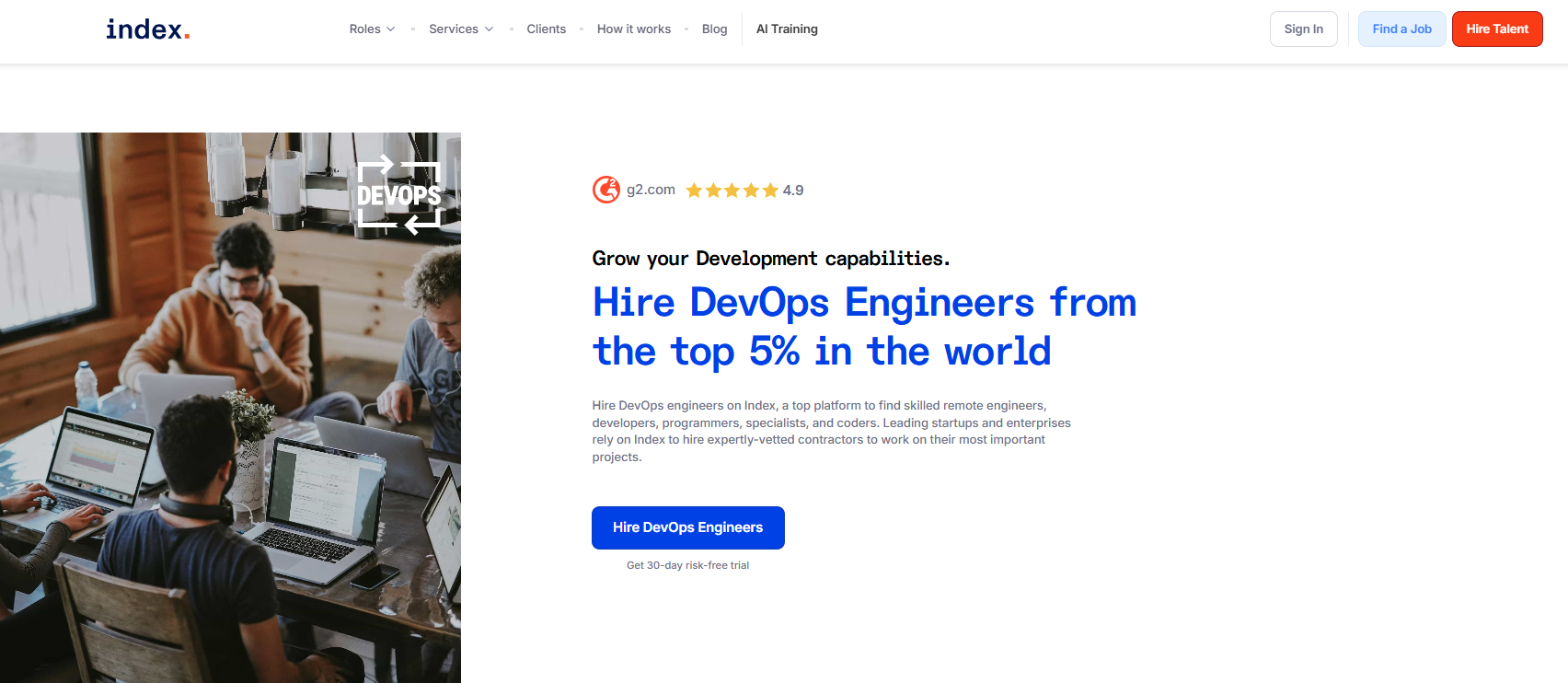
Index.dev treats DevOps hiring like a filter. Post a role. Get three pre-vetted, interview-ready engineers in 48 hours. No recruiter theater. No endless screening loops. No day-one surprises.
The vetting is surgical. Only 5% of 15,000+ monthly applicants pass the filter. Background verification, technical assessments, live coding sessions, soft skills evaluation, English proficiency testing, and culture fit analysis eliminate noise at source. The result? 97% match quality and 97% trial-to-hire conversion rates.
Rates run $50-$80 per hour—40-50% cheaper than US hiring without sacrificing seniority. Engineers arrive production-ready with AWS, Azure, GCP, Kubernetes, Docker, Jenkins, Terraform, and CI/CD pipeline design experience. Our US hub explicitly focuses on American companies needing time zone compatibility.
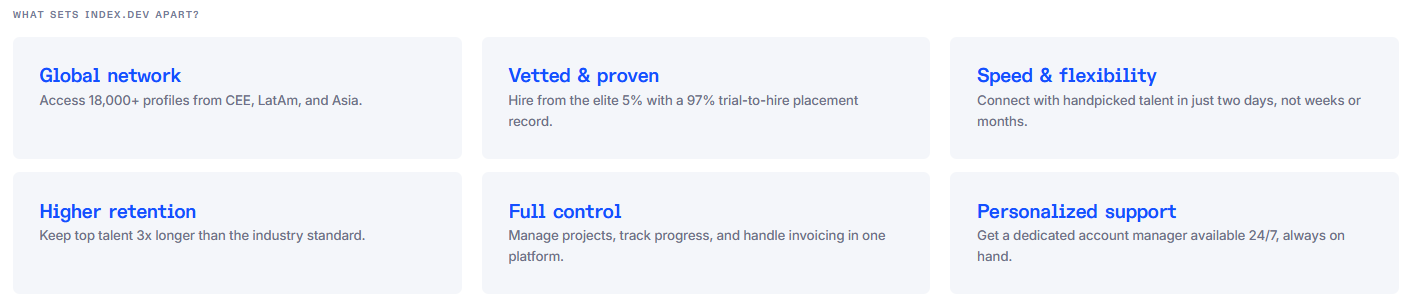
The 30-day risk-free trial lets you evaluate real performance before charges apply. Replacement at no cost if culture misfires or expectations diverge. Index.dev handles contracts, payroll, NDA compliance, and international employment complexity across 160+ countries.
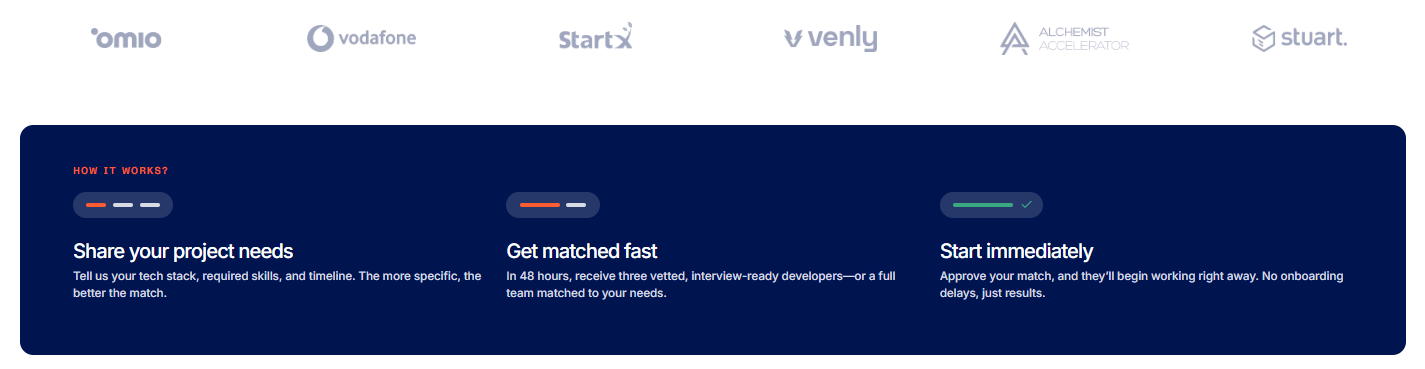
Omio, Vodafone, and Venly use Index.dev for critical infrastructure work. Real companies. Real stakes. Real results.
Best for: Startups and scale-ups needing senior talent fast with transparent pricing and no hidden fees. We value long-term retention over churn, and trust AI-vetted talent matched by experts.
2. Toptal: The Premium League for Architects

Toptal brands itself as the "top 3%" network. That's not marketing—that's policy. Less than 3% of applicants pass their five-stage screening. You get architects, not implementers.
These are engineers who've designed multi-region failover systems for enterprises. Who implements DevSecOps from scratch. Who think in distributed systems, not individual scripts.
The tradeoff? Expect $100-$200+ per hour depending on seniority and expertise. Enterprise budgets absorb this. Startups grimace.
Speed trades for quality. Matching takes 7-14 days. The upfront deposit requirement feels friction-heavy when timelines compress. But Toptal's talent pool runs deep—Fortune 500 experience, proven track records, battle-tested judgment.
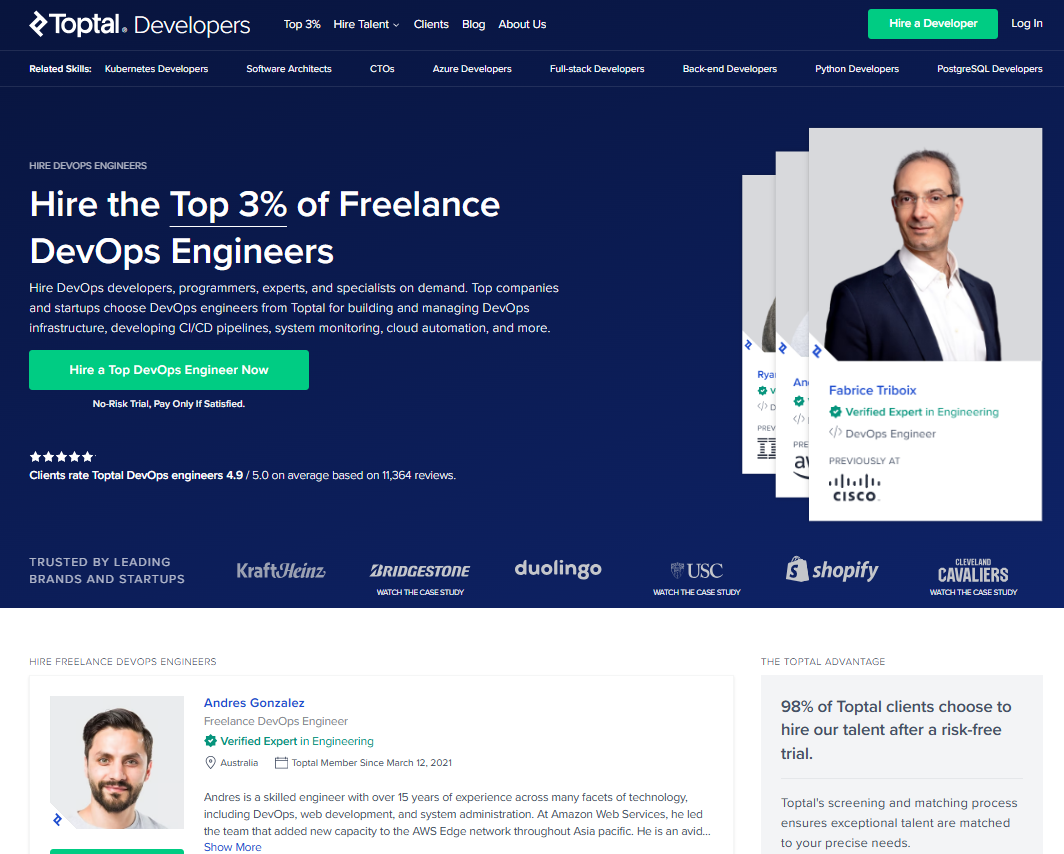
Use Toptal when: Budget isn't the conversation, you're migrating mission-critical infrastructure, you need proven architects who've handled production chaos at scale, and you value the Toptal brand as insurance.
3. LatHire: Nearshore Speed with 80% Cost Savings

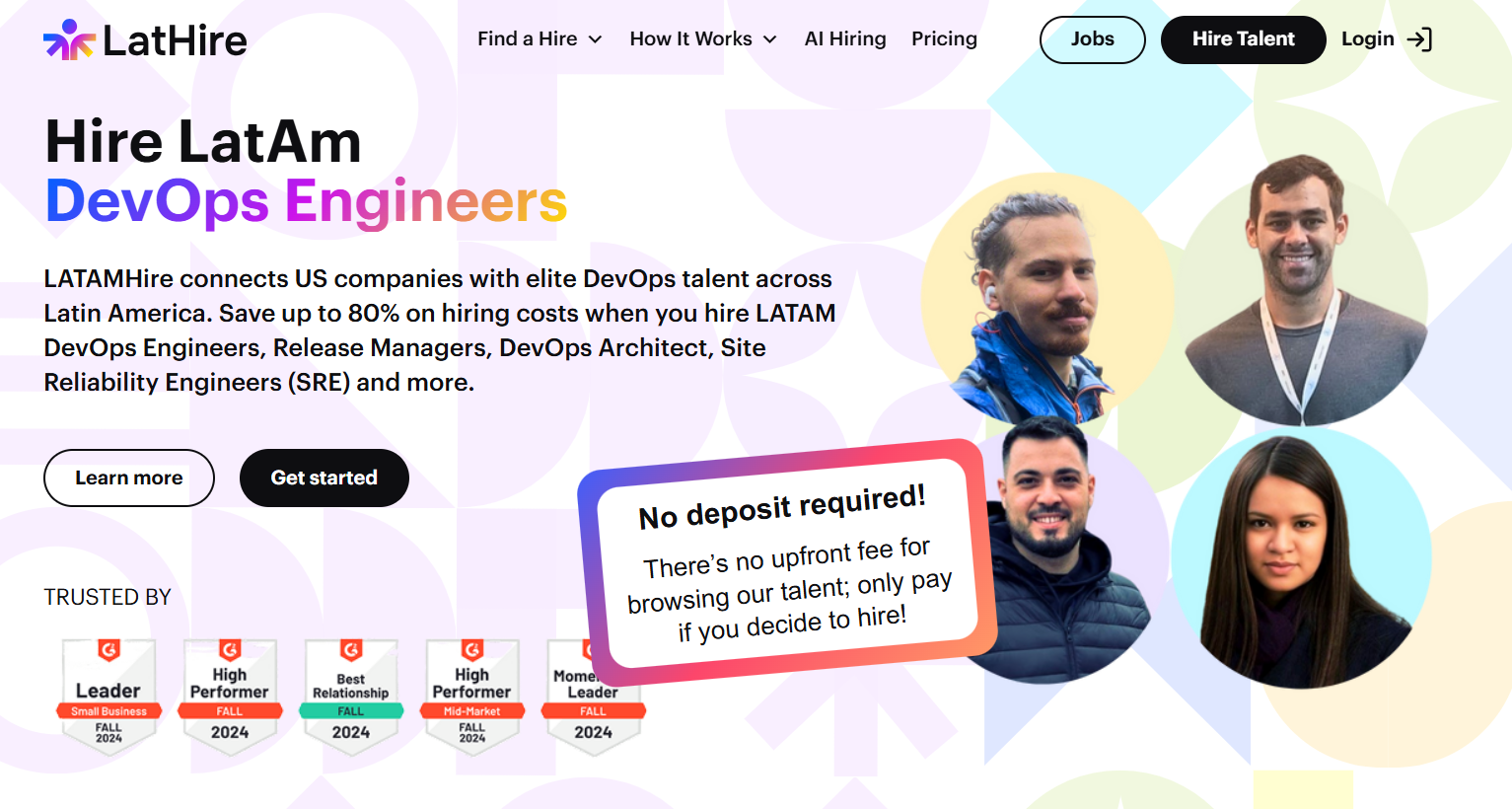
LatHire does something different. They connect you with 800,000+ vetted Latin American developers in 24 hours—not global, not US-only, but strategically positioned in your time zone with a punch below the belt on pricing.
They help you save up to 80% versus US hiring. Seriously.
A mid-level DevOps engineer costing $120k annually in New York costs $14,388 annually in Latin America. Same infrastructure knowledge. Same cloud expertise. Same Kubernetes chops. Different continent. Better budget math.
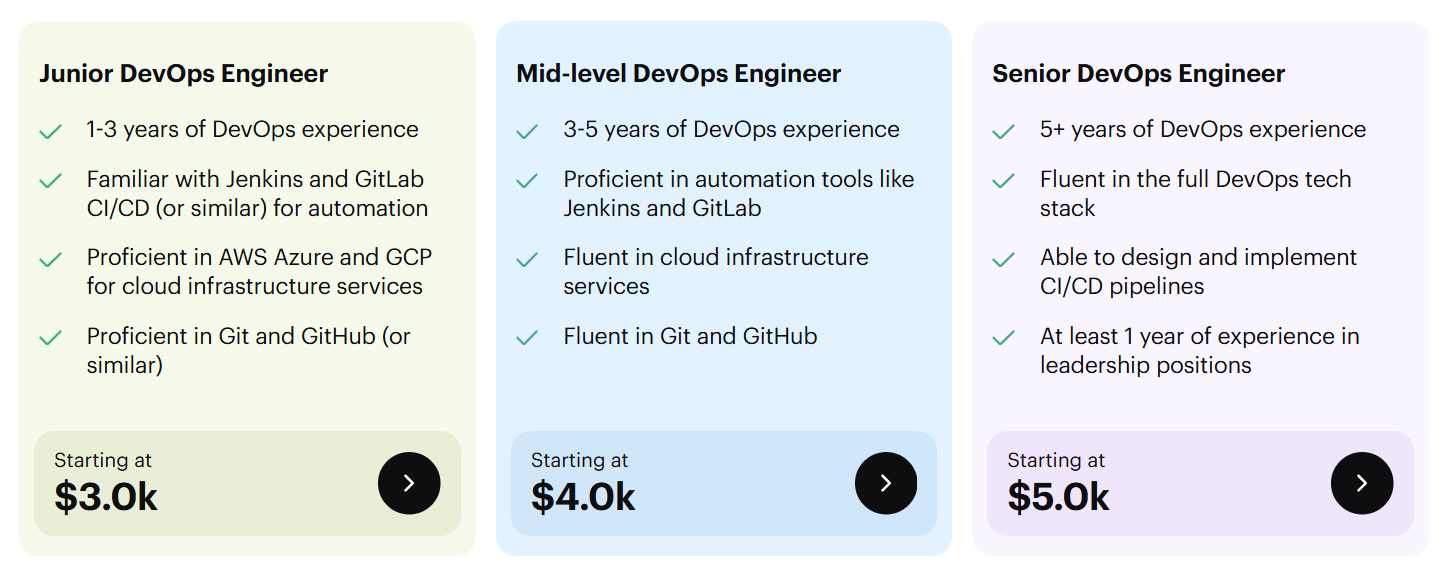
LatHire's AI-powered matching finds DevOps engineers fast. They handle payroll, compliance, taxes, health insurance, and all the HR bureaucracy you'd otherwise hemorrhage money on. No placement fees. No deposits.
You still need to interview carefully—AI handles logistics, not intuition.
You pay a monthly salary—dirt cheap compared to US equivalents. The talent pool speaks fluent English, runs parallel time zones (0-3 hours difference), and culturally aligns with North American work styles better than distant outsourcing alternatives.
The real limitation? You're hiring from Latin America, not recruiting US-based engineers. But if cost matters (and when does it not?), this tilts the math hard in your favor.
LatHire recently merged with CloudDevs, combining two of the largest LATAM platforms into a nearshore powerhouse. Translation: better bench depth, better pricing.
Best for: Budget-conscious teams, startups needing to stretch engineering dollars, long-term hires where time zone overlap beats geographic location.
Up next: Discover the top 6 platforms to hire Java developers in the USA.
4. Andela: Full Teams, Not Just Individual Talent

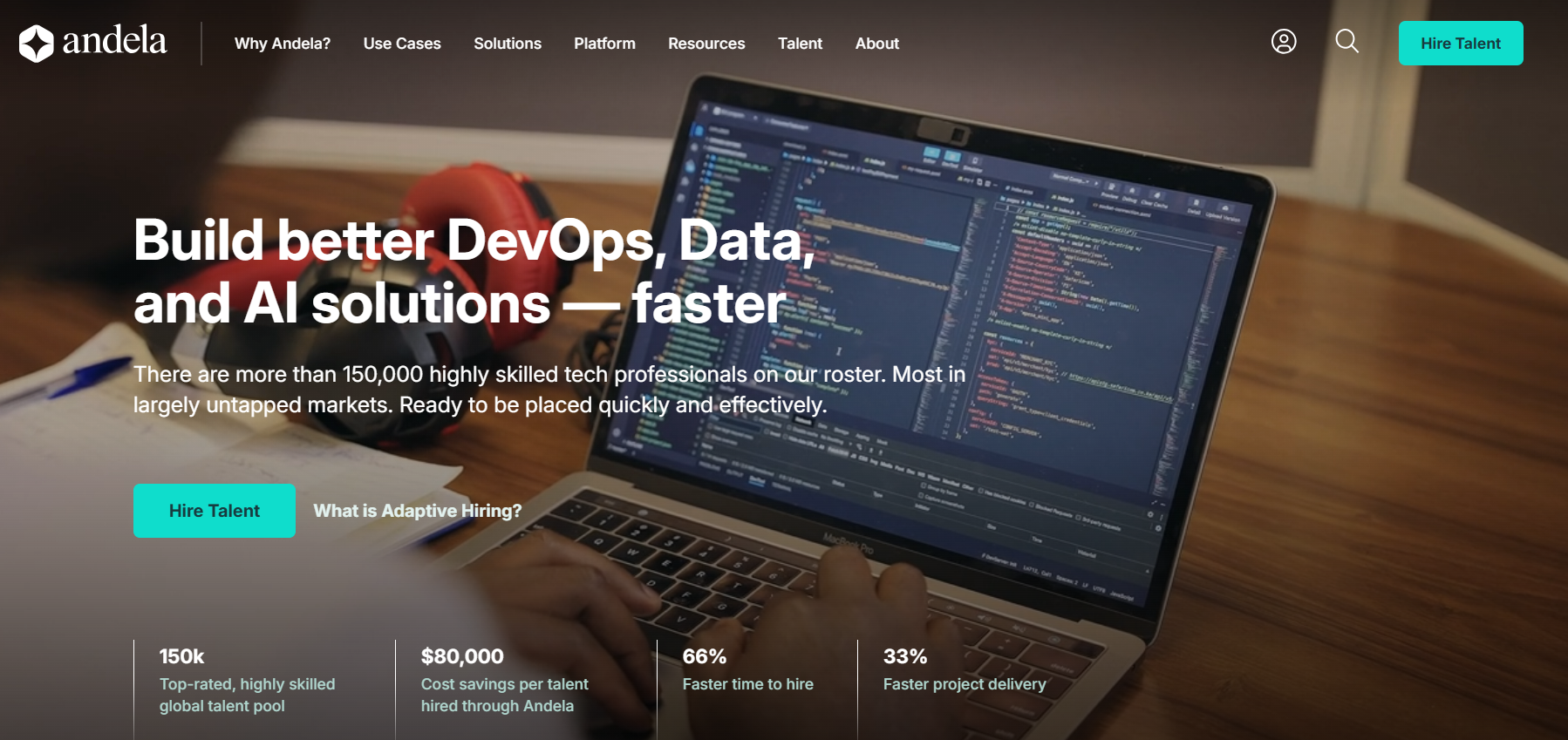
Andela operates the largest private marketplace for technical talent at scale.
They specialize in Cloud & DevOps—everything from cloud migration to Site Reliability Engineering. Recent clients include GitHub, Resy, and Circana. They don't hire individuals. They build squads.
They recently launched the Andela AI Academy training 3,000 technologists in AI-powered DevOps skills—future-proofed talent.
Hire within 48 hours. Scale from solo engineers to full managed squads. Pricing? Custom quotes based on engagement scope. No transparency, but comprehensive support compensates. Andela handles recruitment, vetting, onboarding, and ongoing management.
Use Andela when: You're an enterprise needing entire DevOps pods, value ongoing management support, want AI-native talent trained on emerging tools, and can negotiate custom pricing.
5. X-Team: Retention Beats Churn Every Time

X-Team obsesses over long-term engagement.
97% retention rate means your engineers stick. They integrate into your CI/CD pipelines, adopt your culture, and push production deployments like internal staff.
X-Team engineers bring hands-on expertise with Kubernetes, Terraform, Jenkins, Docker, and cloud-native architectures. Contracts, NDAs, payroll, and IP protection are all handled globally. Rates aren't public but sit mid-to-upper tier for quality and stability.
OFX used X-Team during COVID-19 when traditional hiring collapsed—securing IT resources when supply vanished. Stress-tested. Proven.

Use X-Team when: Retention drives your roadmap, you're building long-term infrastructure that demands stability, and you want engineers embedded as full teammates with multi-quarter commitments.
6. Gun.io: Transparent US Talent Without Hidden Margins

Gun.io focuses on US-based developers. Developers keep 100% of their rate. You see exactly what you pay. No middleman markup disguised as "platform fees."
Senior DevOps engineers charge $70-$200+ per hour. Matches take 13 days on average—slower than AI platforms but more personal. Every candidate gets vetted by senior developers, not algorithms.
Free talent swaps if hire doesn't land. Support includes time tracking, invoicing, and dedicated account management. Ideal for companies wanting experienced engineers in similar time zones with no BS pricing.
Use Gun.io when: You prefer US-based talent, value radical transparency in billing, can wait 2+ weeks for expert-led matching, and want no surprise charges.
7. Lemon.io: Startup Speed Without Startup Sacrifices

Lemon.io targets startups drowning in hiring timelines.
Matches happen in 24-48 hours. Full-time or part-time. Month-to-month flexibility. No long contracts. No upfront fees.
Rates start $55-$95 per hour. 1,500+ vetted developers span Europe, LATAM, and the US.
No-risk trial up to 20 hours—test engineers on real tasks before committing. If performance slips or deadlines threaten, replacement at no extra cost.
Lemon.io shines when the runway is tight and hiring windows compress. Contracts, payouts, compliance handled. Startups love the speed-to-productivity ratio.
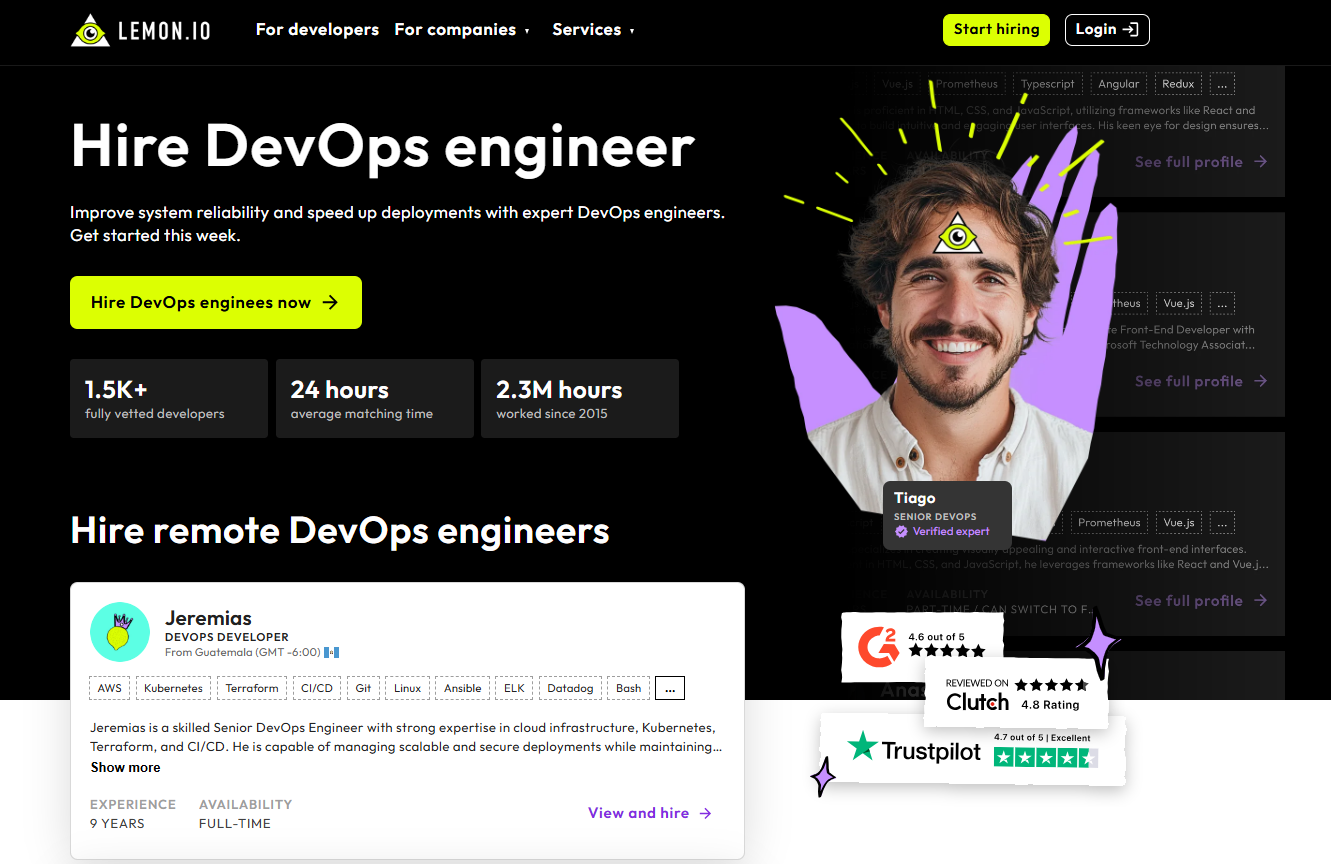
Use Lemon.io when: You're bootstrapped or lean, need onboarding measured in hours not weeks, want trial-based evaluation before commitment, and can handle remote global talent.
8. Flexiple: Dedicated Matching with Seamless Support

Flexiple wraps vetting in personalized support.
Six-step screening process evaluates freelance DevOps developers. Rates span
$30-$100 per hour depending on expertise.Each client gets a success manager defining requirements and handpicking matches.
One-week trial evaluates developers before long-term commitment. Scales from part-time to full-time. Engineers bring CI/CD, AWS, Kubernetes, infrastructure management, and monitoring expertise.
Flexiple serves Sequoia-funded startups and enterprises needing flexibility. Focuses on Indian and global freelancers offering cost-effective solutions without gutting technical depth.
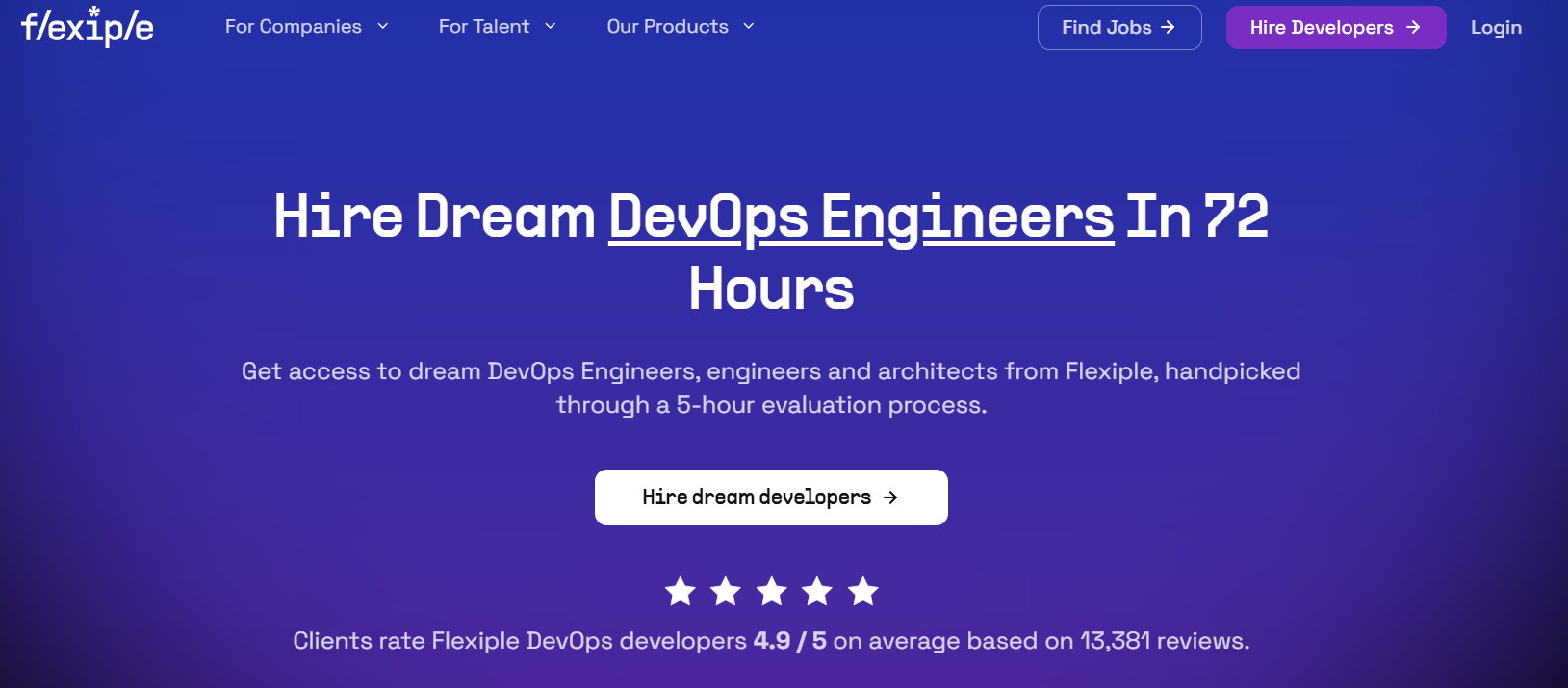
Use Flexiple when: You want dedicated success management, prefer trial periods before full commitment, value cost-effective talent with strong fundamentals, and need flexibility around engagement duration.
Next, explore the 6 best platforms to hire LLM developers in the USA.
The Reality Check: You're Hiring in a Seller's Market
Every recruiter is chasing the same 5% of DevOps talent. Every week you spend deliberating is a week competitors are shipping.
You have two paths forward.
- Path One:
- Keep posting on job boards, filtering resumes, interviewing for eight weeks, negotiating for two more, onboarding for six, and hoping the engineer doesn't leave in month four. That's four months minimum. Your competitors shipped v2 already.
- Keep posting on job boards, filtering resumes, interviewing for eight weeks, negotiating for two more, onboarding for six, and hoping the engineer doesn't leave in month four. That's four months minimum. Your competitors shipped v2 already.
- Path Two:
- Pick a platform, post your role, interview pre-vetted engineers within 48 hours, trial for 30 days risk-free, and have someone shipping code by week four. You're ahead.
- Pick a platform, post your role, interview pre-vetted engineers within 48 hours, trial for 30 days risk-free, and have someone shipping code by week four. You're ahead.
36.7% of DevOps hiring focuses on pure engineers. 37% of IT leaders have skill gaps. Scarcity is real. Time is finite. Competitors are moving.
Eight platforms exist because no single approach works for everyone. Budget, urgency, team size, geographic preference—these decisions matter. But indecision costs the most. The company that hired yesterday wins against the company still deliberating today. Pick your platform. Post your role. Hire engineers who actually ship infrastructure. Then scale.
➡︎ Can't afford to wait 3 months for DevOps engineers? Index.dev matches you with pre-vetted, production-ready DevOps specialists in 48 hours. Get Kubernetes, Terraform, and CI/CD experts with a 30-day risk-free trial. Only pay when they ship. Start hiring at DevOps speed.
➡︎ Want to dive deeper into developer hiring and talent strategies? Explore our guides on how to effectively vet software developers to avoid costly mis-hires, proven strategies to retain your best tech talent, the top platforms to hire backend developers in the USA, our comprehensive developer onboarding process, and 5 common reasons developers fail job vetting.
Frequently Asked Questions on DevOps Hiring
Q1: What's the actual difference between "vetted" and "pre-screened"?
Vetted means platforms test Kubernetes knowledge, AWS architecture design, troubleshooting ability, soft skills, and more. They run live coding assessments and verify past infrastructure projects.
Pre-screened means they filter resumes for keywords: "Terraform," "Kubernetes," "CI/CD," "Docker." No technical validation. No culture fit assessment. No depth verification.
Vetted takes weeks and catches impostors. Pre-screened takes hours and catches nothing. LinkedIn pre-screens. Job boards pre-screen. Specialists like Index.dev vet properly—live coding, architecture questions, the works.
Q2: Do these platforms handle taxes and compliance for remote DevOps developers?
Depends on contractor vs. employee structure and geographic location.
Index.dev, LatHire, Andela? Full payroll management—they own the headache. Toptal and Gun.io? They partner with services like Deel (you still manage the relationship). Flexiple? You manage everything.
International DevOps hiring creates tax mines. W-9s, 1099s, foreign tax withholding, social security agreements. Verify compliance handling upfront or discover $50k liability three months later. Not fun.
Q3: Is it cheaper to hire DevOps engineers from Latin America vs. Eastern Europe?
LATAM: $30-70/hour. Eastern Europe: $40-100/hour. Both handle US time zones. LATAM costs less.
Eastern Europe often has deeper infrastructure credentials from Soviet-era complexity. Cost doesn't equal quality. Pick based on project needs, not just hourly rate.
Infrastructure migration? Eastern Europe depth wins. Scaling infrastructure? LATAM speed and cost efficiency wins. CI/CD automation? Either works.
Q4: How do I know if I need a senior vs. mid-level DevOps engineer?
- Prototype or MVP:
- Mid-level works. They can set up basic CI/CD, manage cloud infrastructure, and handle standard deployments.
- Mid-level works. They can set up basic CI/CD, manage cloud infrastructure, and handle standard deployments.
- Production apps at scale:
- Senior needed. They architect multi-region failover, optimize for observability, implement DevSecOps, and handle incident response.
- Senior needed. They architect multi-region failover, optimize for observability, implement DevSecOps, and handle incident response.
- Complex architecture decisions (microservices migration, Kubernetes cluster design, multi-cloud strategies):
- Senior. They avoid expensive mistakes.
- Senior. They avoid expensive mistakes.
- Team expansion (building a DevOps function):
- Hire a mix of both. Seniors set direction; mid-level executes.
- Hire a mix of both. Seniors set direction; mid-level executes.
The interview process reveals gaps.
Senior DevOps prevents catastrophic mistakes. Hire overqualified rather than underqualified. Underskilled engineers cost more in broken deployments.
For more on interview questions, check out Index.dev’s Senior DevOps Interview Questions and Answers.
Q5: How do I structure compensation—hourly vs. salary?
Hourly works for contractors and short-term engagements (under 6 months). DevOps engineers billed hourly: $50-$200/hour depending on platform and experience.
Salary works for full-time, long-term hires (6+ months or indefinite). Annual salaries: $70k-$250k+ depending on seniority and geography. Hourly hires leave when better offers appear. Salary hires build infrastructure you'll use for years.


